

In the first of these two articles showing a selection of paintings of people sleeping through their siesta in the fields, I concentrated on classical stories; today I look mainly at those who have been working in those fields.
Among the most prominent in European painting are the shepherds out in the fields around Bethlehem at the time of the Nativity.

These appear in Jules Bastien-Lepage’s The Annunciation to the Shepherds of 1875. His shepherds have come from Millet’s social realism rather than Biblical Bethlehem, and behind the two who have been woken by the angel is a third who remains fast asleep.
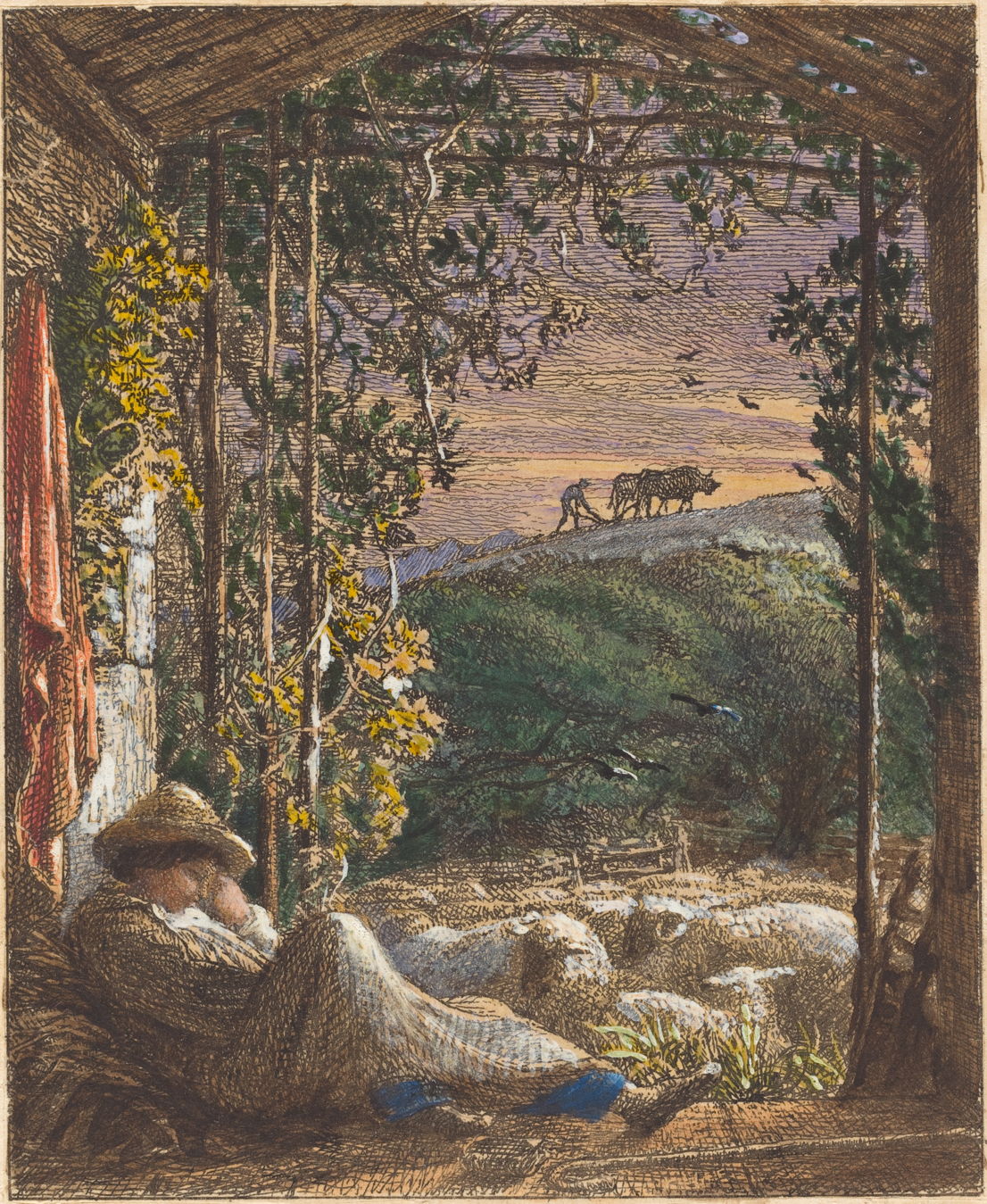
Samuel Palmer’s paintings of the British countryside provided glimpses of reality in the warmth of their light. In his The Sleeping Shepherd; Early Morning from 1857, a shepherd is asleep with his flock in the foreground, as a team is already at work ploughing in the distance.

Wilhelm Friedenberg’s undated The Goose Girl’s Lunch shows a younger girl, plainly dressed as a ‘peasant’ and barefoot, sat as she enjoys a short break with her lunch. Her younger brother is fast asleep at her side, worn out by all this tending of geese.
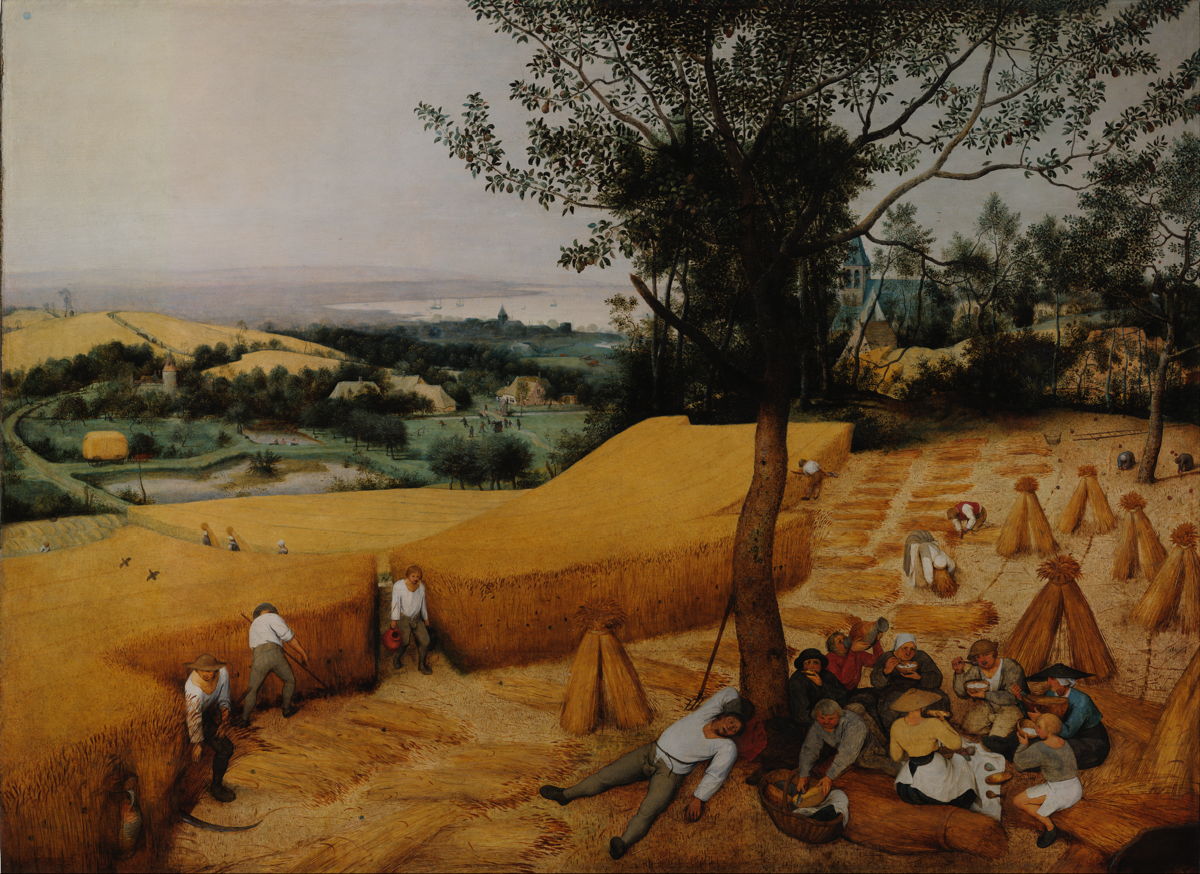
Pieter Bruegel the Elder’s visual encyclopaedia of Harvesters from 1565 shows one peasant in a white shirt in the centre foreground who has fallen asleep under the tree, during his lunch-break.

Évariste Carpentier’s undated Children Asleep is one of many sentimental paintings of the rural poor, featuring two young children asleep by a hedge as their parents are cutting hay in the field.
If there’s one artist who knew all about siestas in the open air it was John Singer Sargent, who repeatedly caught his friends just resting their eyes as they dozed off a good lunch.

Whether he sketched their repose in oils (above) or watercolour (below), Sargent was adept at capturing their siestas, here in the Alps in 1905.

Then there are a few paintings where there seems a bit more than just sleep.
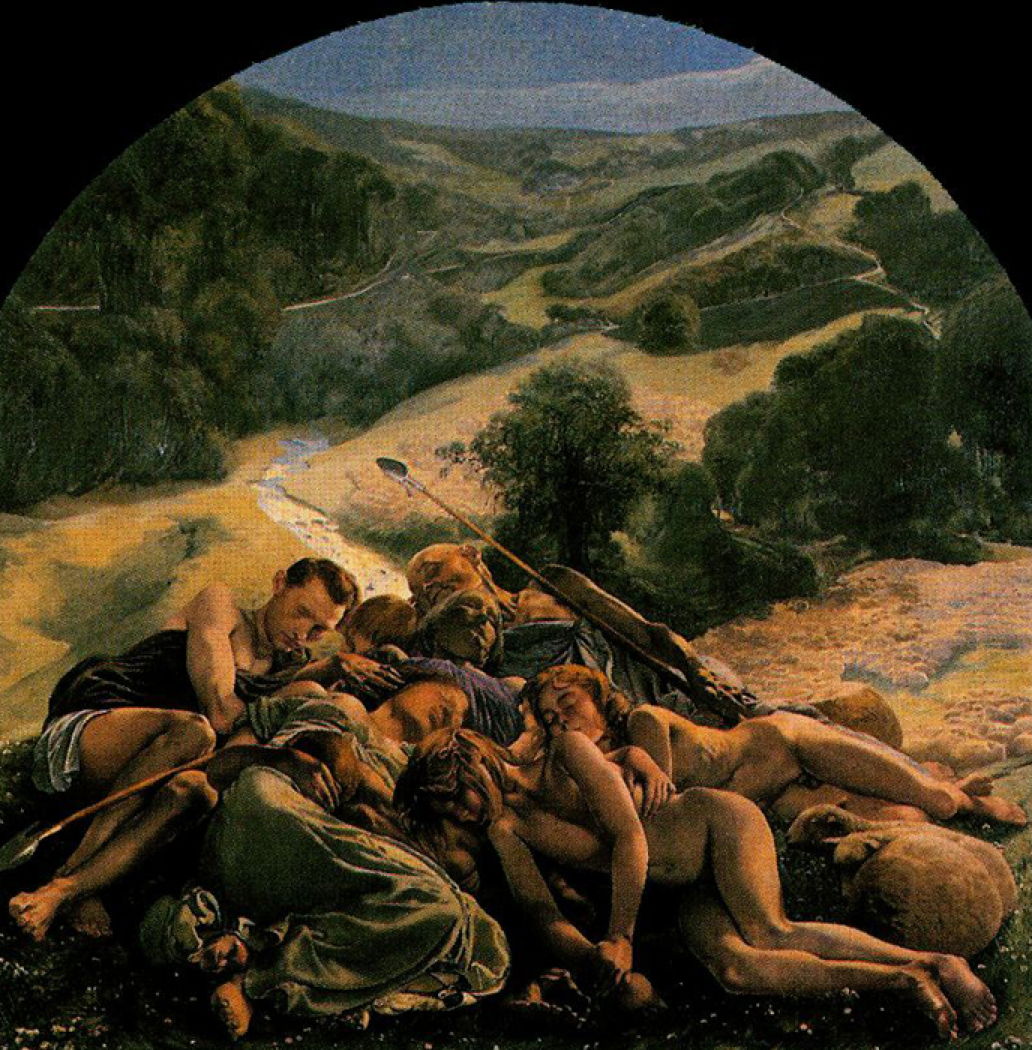
The centre panel of Léon Frédéric’s triptych The Golden Age from 1900 shows Night. A small group of sheep and people, some bearing spears, are asleep in a heap in the middle of a pastoral valley in the hills. Fields behind contain dense flocks of sheep, but there are no visible landmarks to orientate the viewer in space or historical period.

Pierre Puvis de Chavannes’ The Dream seems more symbolic. In a placid and contemplative Mediterranean coastal setting, a traveller (vagrant), with their meagre possessions tied up in a cloth, is asleep under a crescent moon. Three angelic but wingless figures from a dream are shown in mid-air, two scattering stars and one bearing a laurel wreath.

John Roddam Spencer Stanhope’s Robins of Modern Times (1860) is a highly original wide-angle composition, and one of the most visually-arresting paintings made at this time. It’s set in the rolling countryside of southern England during the summer.
The foreground is filled with a young woman, who is asleep on a grassy bank, her legs akimbo. She wears cheap, bright red beads strung on a necklace, and a floral crown fashioned from daisies is in her right hand. She wears a deep blue dress, with a black cape over it, and the white lace of her petticoat appears just above her left knee. On her feet are bright red socks and black working/walking boots. A couple of small birds are by her, one a red-breasted robin, and there are two rosy apples near her face.
In the middle distance, behind the woman’s head, white washing hangs to dry in a small copse. A farm labourer is working with horses in a field, and at the right is a distant farmhouse.
This painting remains an enigma.
 The Eclectic Light Company