
During the 1840s, Eugène Delacroix (1798–1863) was occupied with two major decorative painting tasks, in the libraries of the Chamber of Deputies of the Palais Bourbon, and of the Chambre des Pairs in the Palais du Luxembourg. Although useful images of his work there are hard to come by, I show here a selection of details that should do them justice.
Delacroix had made his proposals for the remainder of the Palais Bourbon once he had completed its Salon du Roi to great acclaim, but it was decided to divide the remaining work between four accomplished artists:
- Horace Vernet got the Salle des Pas-Perdus, which he used for an elaborate and contemporary allegory that hasn’t stood the test of time;
- Alexandre Abel de Pujol got the Salon des Distributions, which he painted coldly in dignified grisaille;
- François-Joseph Heim got the Salle des Conférences, where his embedded historical scenes worked well;
- Delacroix got the library, the largest and most challenging.
Delacroix and his team of assistants then set about painting the ceiling of the library, in a series of five cupolas and two half-domes. Each cupola has an overall theme – Science, History and Philosophy, Legislation and Eloquence, Theology, and Poetry – each containing four trapezoidal pendentives. The half-domes are at each end of those, and have their own historical painting.
The pendentives are painted in oil on canvas, and the half-domes using the same combination of oil paint and wax that had worked so well in the Salon du Roi. The work was commissioned on 31 August 1838, individual paintings mostly completed between 1843-45, and the whole was finished in 1848.
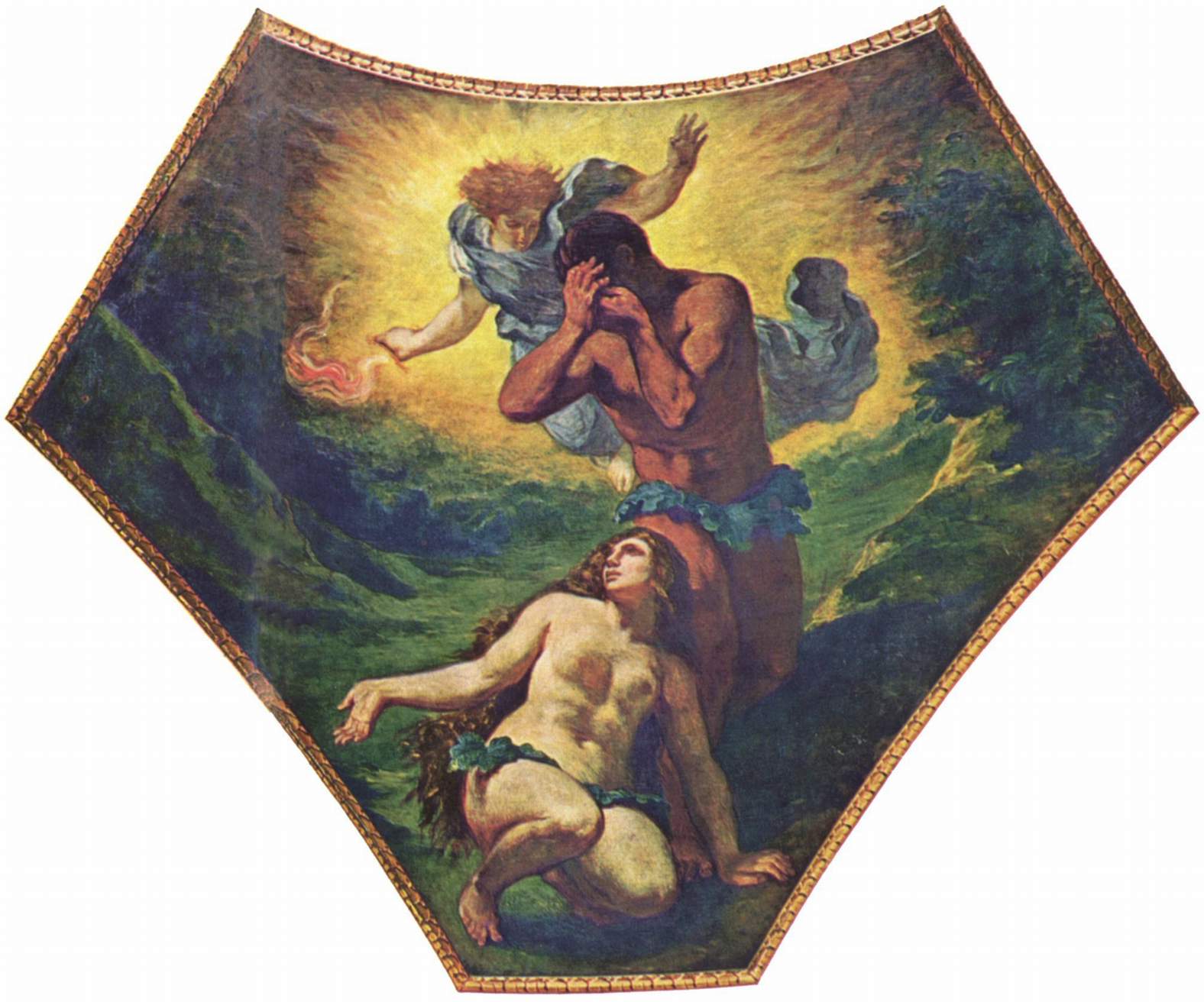
One of the four pendentives in the Theology cupola shows Adam and Eve in a classical composition.

Also in that cupola is The Babylonian Captivity.

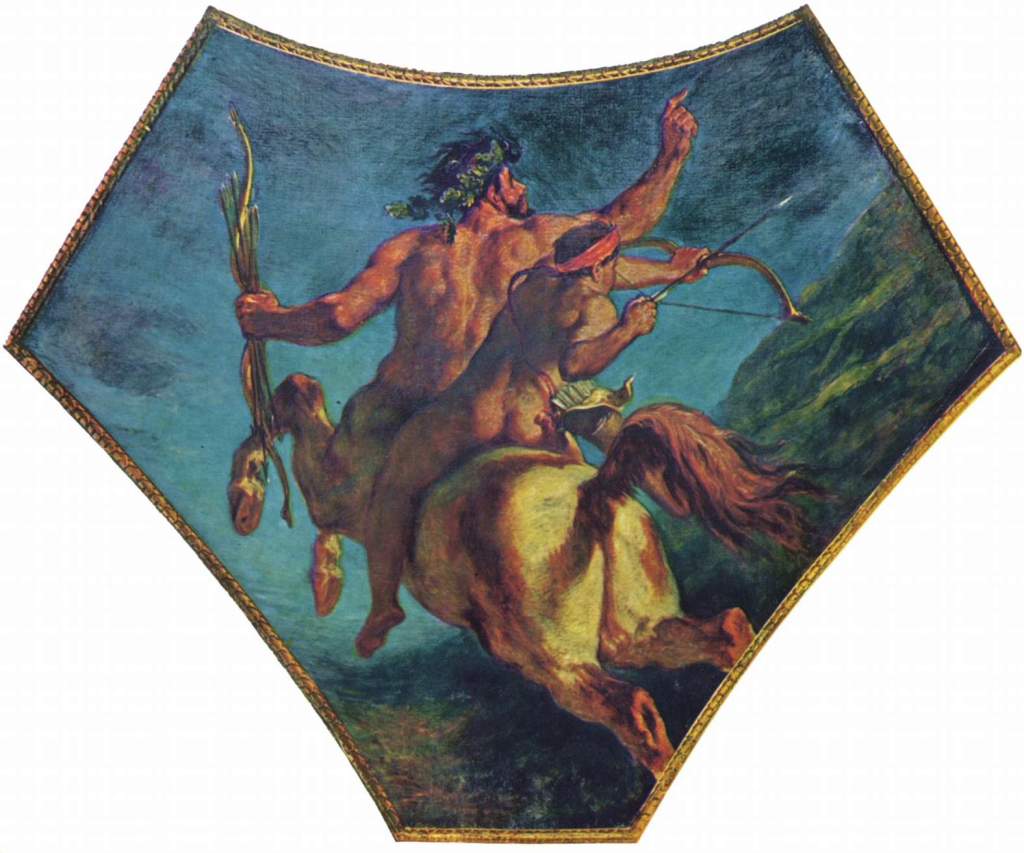
In the Poetry cupola is The Education of Achilles, showing the young Achilles with a bow and arrow, riding on the back of his tutor Chiron the Centaur, on the steep slopes of Mount Pelion. This became one of Delacroix’s favourite motifs.
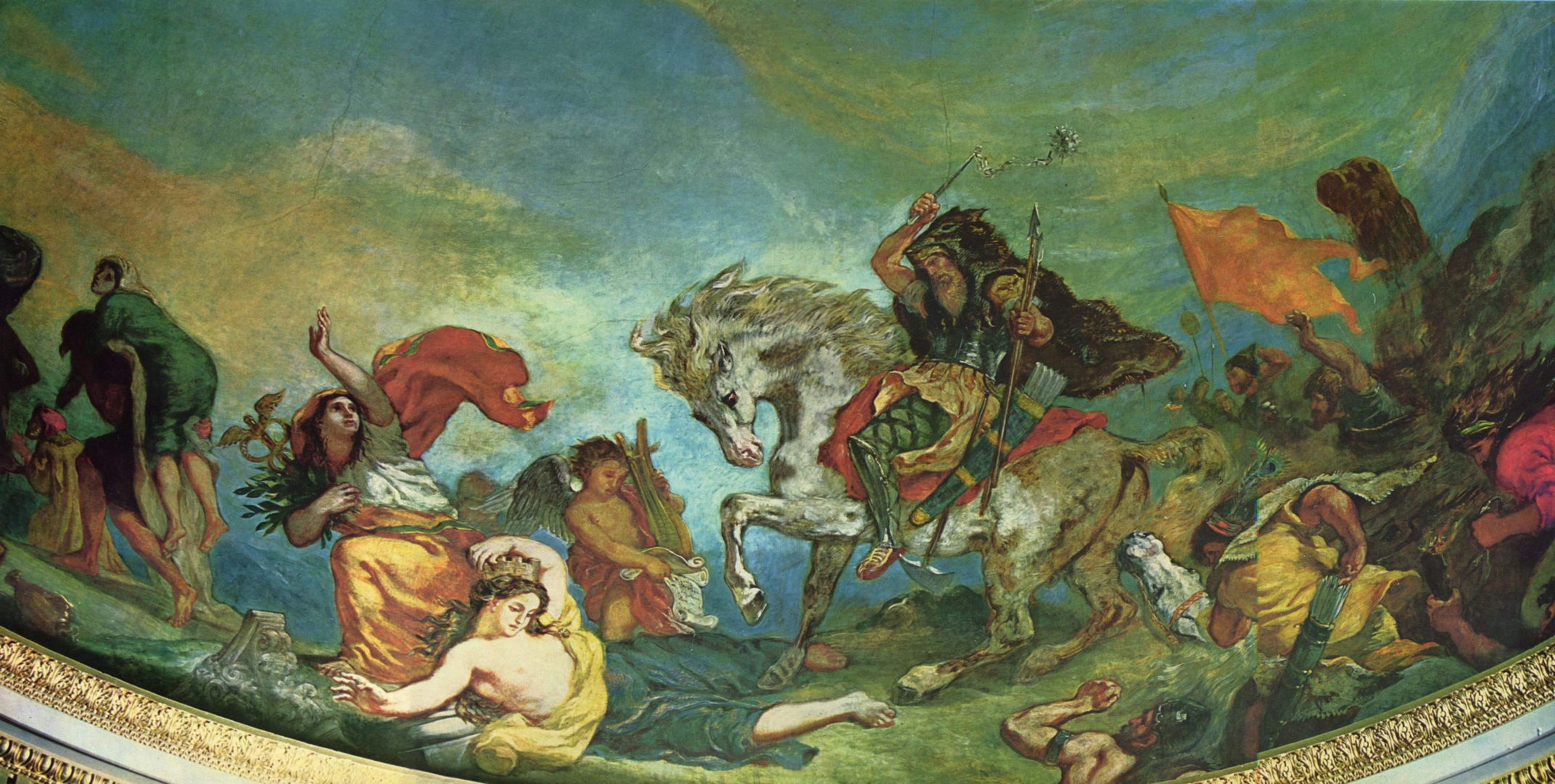
The northern half-dome shows Attila and his Hordes Overrun Italy and the Arts, from which this is a detail. The Arts are seen fleeing from before the king of the Huns, as he sweeps in with his horde to slaughter everyone.
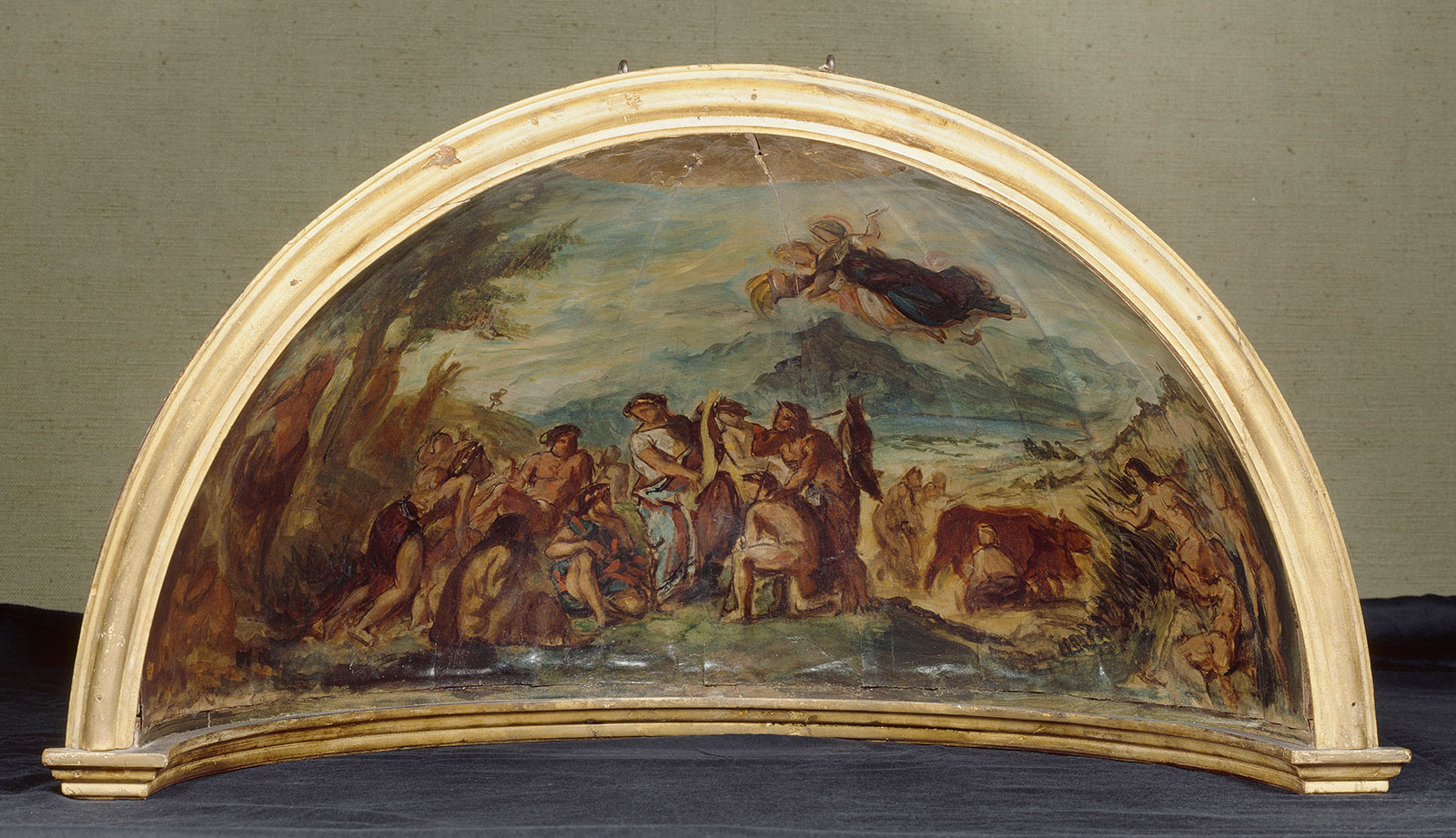
This study of Orpheus Civilises the Greeks was made for the southern half-dome. This shows Orpheus surrounded by simple men and women, with Naiads and the goddesses Ceres and Pallas descending from the heavens.
The half-domes represent the defining moments of Classical times, in the start of Greek civilisation and at the end of the Roman Empire with the invasion by Huns. Between them are five great programmes of learning and culture. In these twenty-two paintings, Delacroix provided a graphical summary of the great Mediterranean civilisations of the past.
Delacroix’s paintings for the other library, in the Palais du Luxembourg, started rather later and proved more of a technical challenge. The end result is no less breathtaking in his accomplishment. To have completed both in a little over ten years is astonishing.
References
Barthélémy Jobert (2018) Delacroix, new and expanded edn, Princeton UP. ISBN 978 0 691 18236 0.
Patrick Noon and Christopher Riopelle (2015) Delacroix and the Rise of Modern Art, National Gallery and Yale UP. ISBN 978 1 857 09575 3.
Lucy Norton (translator) (1995) The Journal of Eugène Delacroix, 3rd edn, Phaedon. ISBN 978 0 7148 3359 0.
Arlette Sérullaz (2004) Delacroix, Louvre Drawing Gallery, 5 Continents. ISBN 978 8 874 39105 9.
Beth S Wright (editor) (2001) The Cambridge Companion to Delacroix, Cambridge UP. ISBN 978 0 521 65077 1.
 The Eclectic Light Company