

The last full epic in the Trojan cycle is that told most eloquently by Virgil in his Aeneid, the story of Aeneas the Trojan and his escape from the burning city of Troy. From there he had his own odyssey as he made his way to central Italy, where he founded a city from which Rome was developed.
Virgil was a brilliant and sophisticated storyteller, and uses complex and non-linear techniques in his epic poem. The start of Aeneas’ story isn’t told until he is with Dido in Carthage, and is recited by the hero himself. Throughout its twelve books, Virgil gives a parallel narrative of events with the gods who control the destiny of Aeneas. From the point of view of narrative painting, these literary subtleties can’t be approximated, and I will here unravel Virgil’s story into a more linear form.
The events told in the Aeneid start with the conception of Aeneas, like so many classical heroes the product of a union between a god and a mortal. This case is unusual, as it wasn’t Jupiter to blame, and Aeneas’ father was the mortal Anchises, and his mother the goddess Venus.
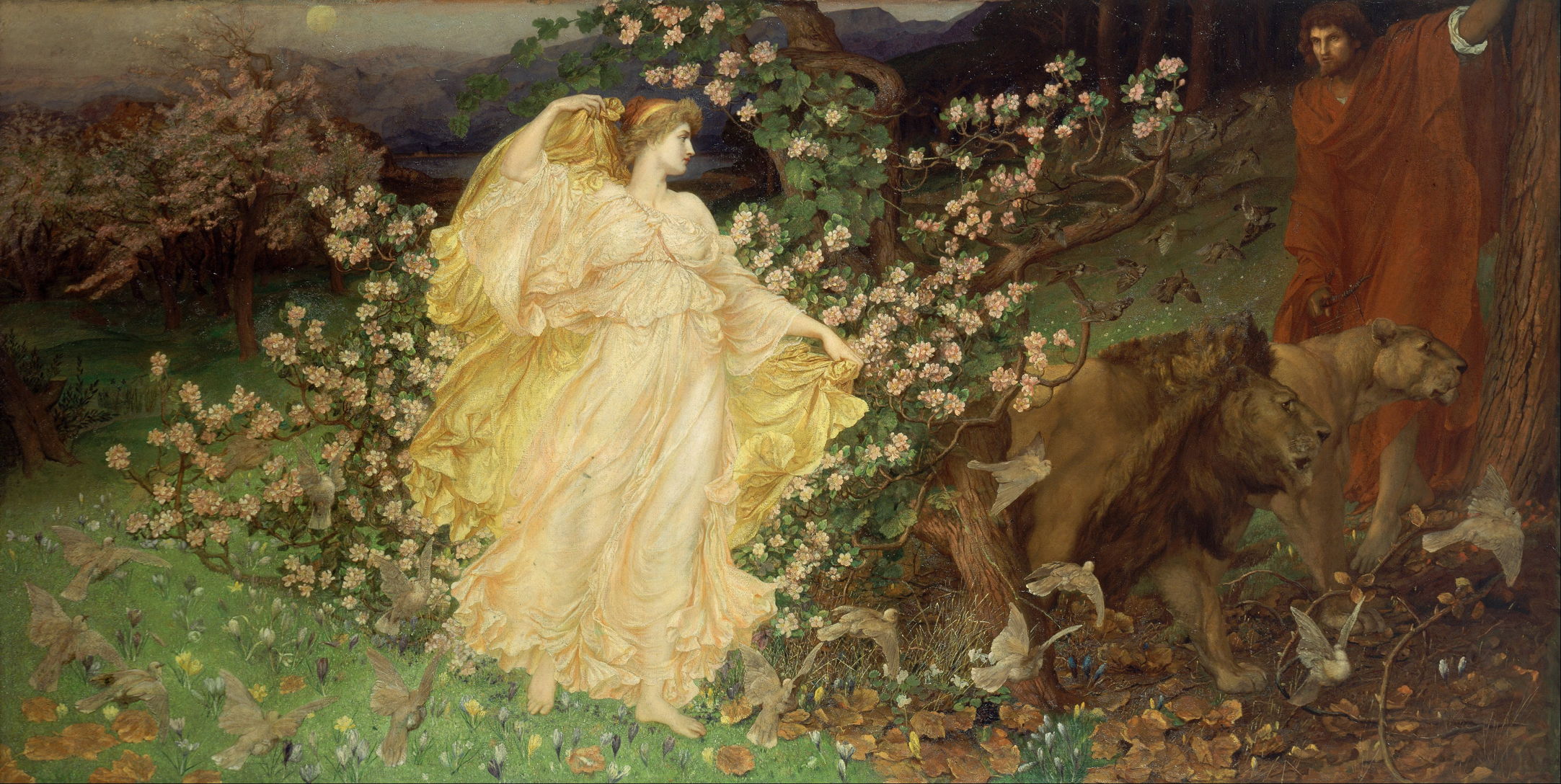
Venus and Anchises, painted by William Blake Richmond between 1889-90, shows this legend. Jupiter challenged Cupid to shoot an arrow at his mother, causing her to fall in love with Anchises when she met him herding his sheep on Mount Ida. Aeneas was the result of that union, and the legend the explanation for Venus watching over the safety of Aeneas during his prolonged journey from Troy.
Aeneas and his father, wife Creusa, and young son Ascanius were among those who abandoned the burning city of Troy after it fell to the Greeks, in his case thanks to the ghost of Hector telling him to get out quick.
There’s no shortage of paintings of Aeneas bearing his father Anchises on his back, as they flee the ruins of Troy.

Unusually, one of Adam Elsheimer’s paintings of Aeneas Saving Anchises from Burning Troy was made in gouache. Of all the depictions, this seems to be the only one based on a reconstruction with models, as the method of carrying is not only feasible, but practical. Note how Aeneas is grasping a robe acting as his father’s seat, and Anchises has interlocked his fingers on his son’s forehead.

Adam Elsheimer’s The Burning of Troy (c 1600-01) shows Aeneas carrying his father in the left foreground, with young Ascanius and his mother Creusa to the right. The backdrop of the burning city includes the Trojan Horse, to the left of the upper centre, and hints with subtlety at the vast tragedy taking place.

Simon Vouet’s Aeneas and his Father Fleeing Troy from about 1635 shows the family group in close-up. From the left are Creusa, Aeneas’ wife who died before she could leave the city, Aeneas, Anchises, and a very young Ascanius. This is the start of their flight, as Aeneas and Creusa are persuading Anchises to let Aeneas carry him to safety.

Pompeo Batoni’s Aeneas Fleeing from Troy (1753) shows the family as they leave the burning city behind them. Creusa is already starting to fall behind, and looks distressed. By the time the hero reaches the city gates with his father and son, his wife is nowhere to be seen. Aeneas re-enters the burning city to look for her, but her ghost tells him that his destiny is to reach Hesperia, where he will become a king and marry a princess.
Aeneas then organises survivors from the burning city to build themselves a fleet of ships and set sail to escape the remains. They reach a series of nearby ports, including Thrace and Delos.
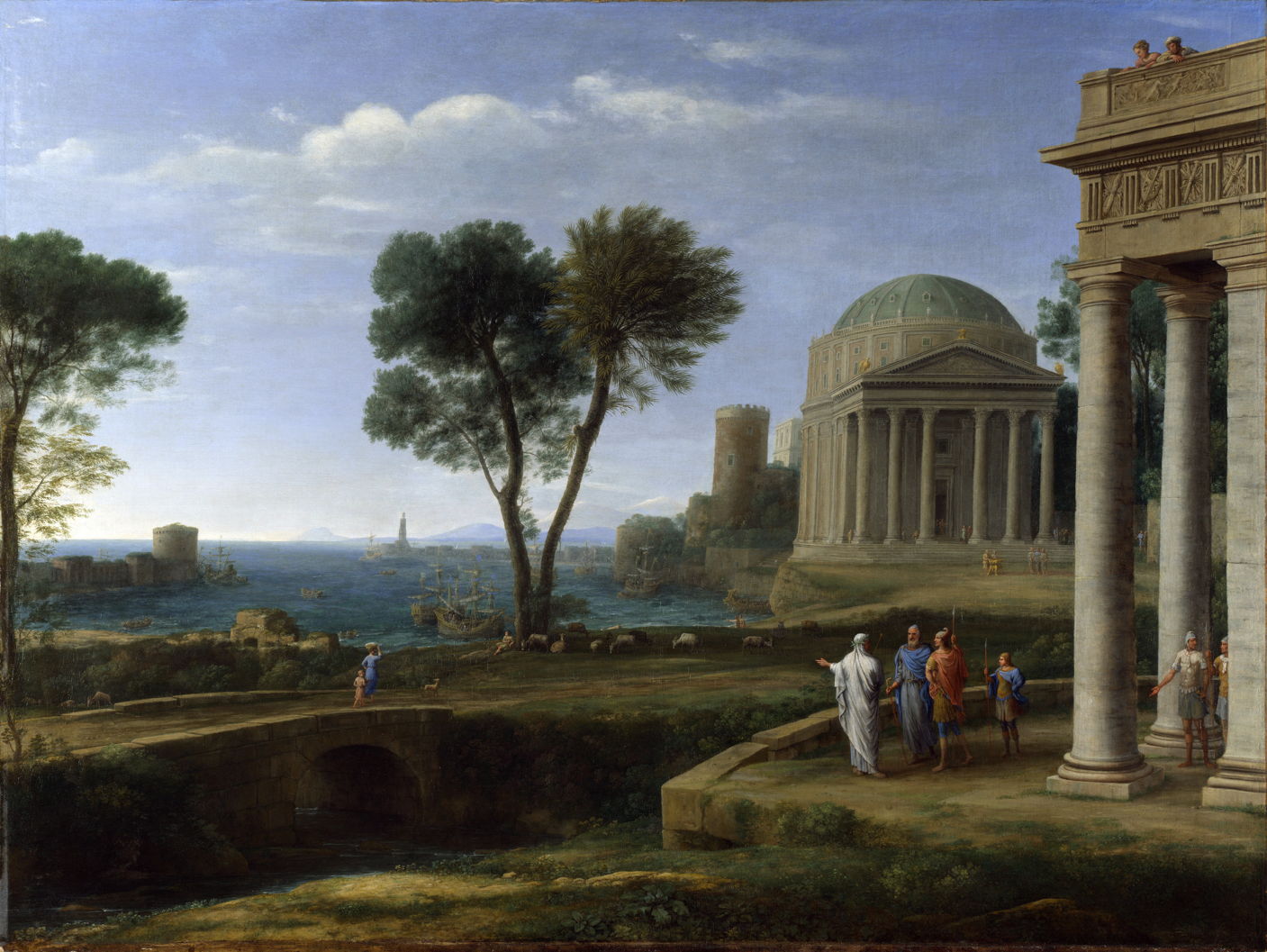
This landscape masterpiece, a singular painting in every respect, is Claude Lorrain’s Landscape with Aeneas at Delos (1672). This was the first of half a dozen works based primarily on the Aeneid painted in the final decade of Claude’s life. Its meticulous details are supported by a coastal landscape of great beauty.
The twin trees at its centre, an olive and palm according to myth, are those which the goddess Latona held when she gave birth to Apollo and Diana, and now provide shade for a shepherd and his flock of sheep.

The king and priest Anius is at the left of the group, wearing priestly white, and pointing out those twin trees to his guests. To his right is Anchises in blue, then Aeneas holding his spear, and his young son Ascanius, with a suitably shorter spear in his right hand.

The relief at the top of the temple, immediately below a couple of casual onlookers, tells the story of Latona’s twins killing the giant Tityus (Tityos), who had tried to rape their mother. Tityus is seen at the right of the relief, fallen down and wounded by the arrows of Diana (centre) and Apollo (left). Similarly to the Titan Prometheus, Tityus was sentenced to spend his time in the Underworld with two vultures feeding on his liver, which regenerated each night.
Apollo tells the Trojans to leave and seek the land of their ancestors. They next arrive in Crete, where they build the city of Pergamea, but they’re struck by a plague that convinces them to move on to the Strophades, where they meet the Harpy Celaeno.
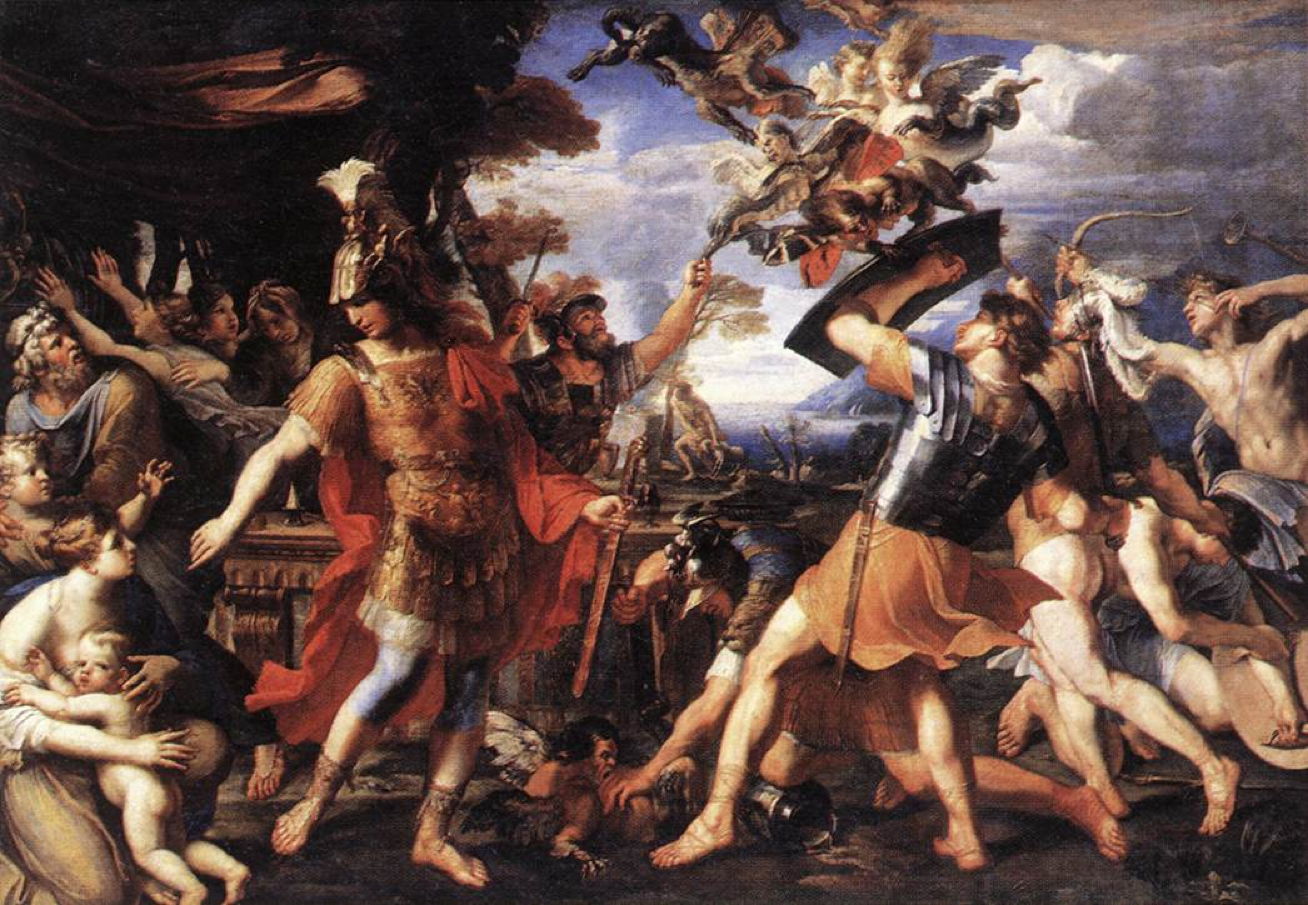
François Perrier’s Aeneas and his Companions Fighting the Harpies, for which I have no date, shows Aeneas to the left of centre, as his men battle with the flying Harpies. Celaeno directs them to leave her island and head for Italy, where she prophesies that they will become so hungry that they will eat their tables, before finding their destiny.
 The Eclectic Light Company