

During the 1840s, Eugène Delacroix (1798–1863) was occupied with two major decorative painting tasks, in the library of the Chamber of Deputies of the Palais Bourbon, and cupolas and half-dome in the library of the Chambre des Pairs in the Palais du Luxembourg. In this article I look at some of the easel paintings he managed to squeeze in during those two projects.
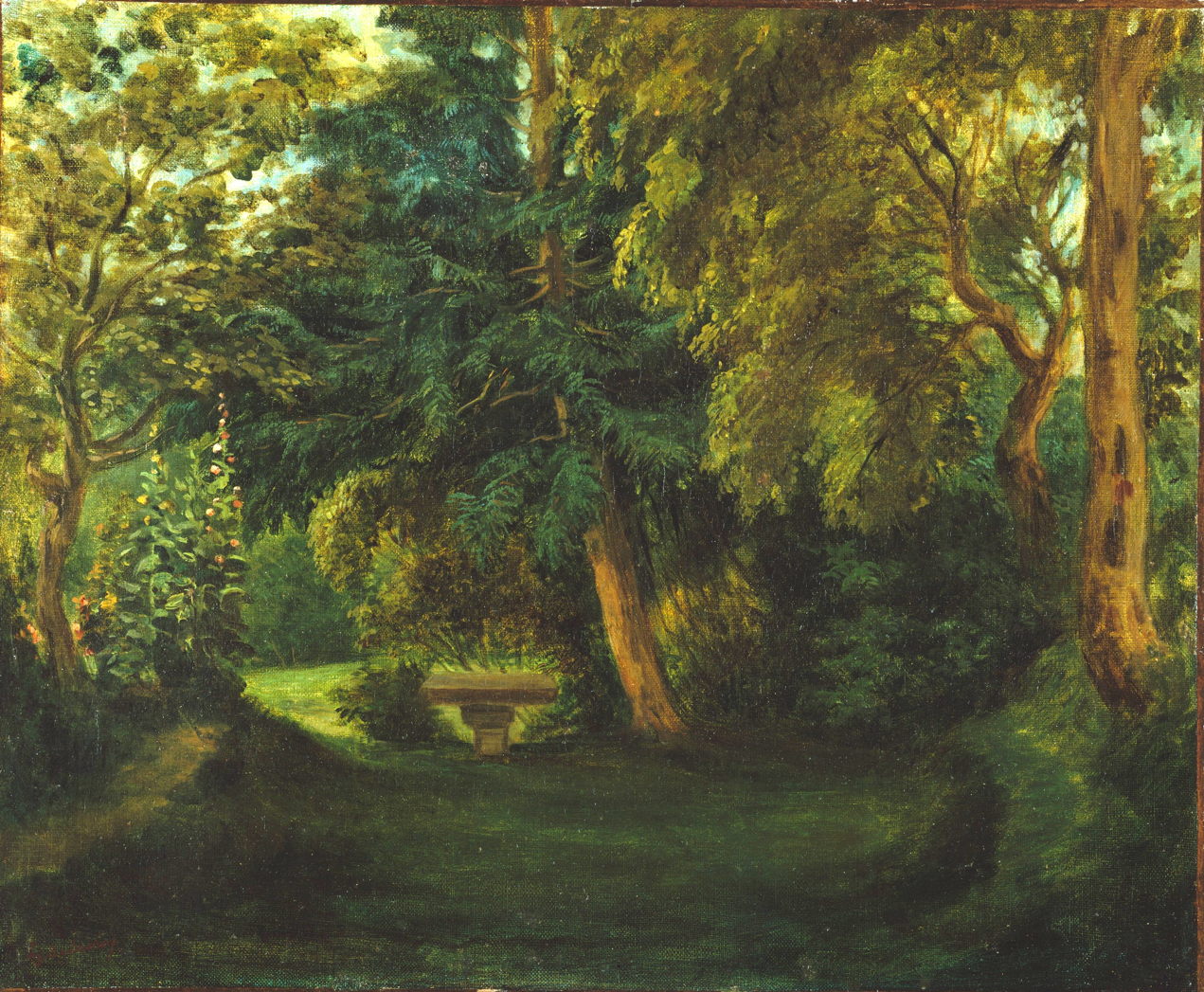
During the 1840s, Delacroix became a close friend of Aurore Dudevant, the French author known by her pseudonym of George Sand. He made three summer visits to her country home in Nohant, central France. During one of those, he painted one of his very few pure landscapes, George Sand’s Garden at Nohant (1842-43). This shows the land to the south of her house, with a basic stone table amid the luxuriant foliage of trees.

The Death of Marcus Aurelius (1843-44) was one of two substantial paintings he exhibited at the Salon of 1845. A fairly conventional deathbed scene from Roman history, it has been compared with the neoclassical works of David.

His other large painting shown at that Salon is one derived from his visit to Morocco a decade earlier. The Sultan of Morocco and His Entourage (1845) shows Moulay Abd-er-Rahman, Sultan of Morocco, leaving his palace in Meknes on 22 March 1832. This was based on a quick sketch in ink he made at the time, coupled with written notes, later developed through a series of studies. As with his other Orientalist paintings, it has rich and harmonious bursts of colour, and was justly acclaimed by the critics.

Delacroix’s Lycurgus Consulting the Pythia (1835-45) shows this celebrated leader of the Spartans, who lived sometime around 900-800 BCE, and laid down much of the law and institutions of the Spartan state, although he refused to be its king. Before he implemented these reforms, he visited the Oracle at Delphi, who told him that the state that observed his laws would become the most famous in the world. Pythia, the high priestess at Delphi, is here shown listening intently to Lycurgus, before she gives her prophesy.
Like his contemporary Léon Cogniet, Delacroix had enjoyed reading Sir Walter Scott’s romantic mediaeval novel Ivanhoe, first published in English in 1820, and in French translation soon afterwards. Ivanhoe is a swashbuckling story of one of the remaining Saxon noble families in the predominantly Norman court of 1194, after the failure of the Third Crusade. Sir Wilfred of Ivanhoe, the hero, is opposed by Sir Brian de Bois-Guilbert, one of the Norman Knights Templar. Isaac of York is a Jewish moneylender with a beautiful daughter, Rebecca.
At the siege of Torquilstone Castle by the Black Knight (King Richard), Robin of Locksley (Robin Hood), and their Saxon forces, Rebecca is abducted by Brian de Bois-Guilbert. Meanwhile Ulrica, an old Saxon woman, sets fire to the castle, and revels in her vengeance on top of its tower.

After watercolour studies, Cogniet painted a finished oil version, exhibited in the Salon in 1831, of The Abduction of Rebecca by a Knight Templar (c 1828), seen here in a reduced size copy. Set in daylight, it shows Brian de Bois-Guilbert, Rebecca, and Bois-Guilbert’s Saracen slave in the foreground. As their horses gallop away, the castle behind them is consumed by fire.
Around 1830 Delacroix made a series of lithographs illustrating the works of Scott, and in 1846 turned this same scene from Ivanhoe into one of his great narrative paintings.

Delacroix’s Abduction of Rebecca was shown at the Salon of 1846 under the extended title of Rebecca Abducted at the Order of the Templar Bois-Guilbert during the Sack of the Castle of Front-de-Boeuf, but only achieved a lukewarm reception. In 1858, Delacroix attempted an entirely different composition, which was shown in his final Salon the following year, and is now in the Louvre.

Delacroix’s religious paintings are less well-known, and several suffered undeserved fates. His Christ on the Cross from 1846 was shown at the Salon the following year, and despite praise and comparison with the crucifixions of Rubens, it was sent to a dark and damp chapel in Vance. The artist was understandably unhappy that it should be condemned to deteriorate in such conditions, and petitioned the Minister of State for it to be sent back to Paris for repair and care.

His pastel version of that work was painted slightly later, in 1847-50, probably for Haro, who supplied the artist with his materials, after the latter came to admire his oil original at the Salon.
Delacroix continued to draw on the writings of Lord Byron, whose poem The Bride of Abydos was the literary basis for four paintings in all. The young and beautiful Zuleika had been promised by her old father Giaffir to an old man, but fell in love with her young friend Selim. The couple eloped to a cavern by the sea, where he revealed that he was the leader of a group of pirates who were waiting to hear his pistol shot as a signal to them. When Giaffir and his men approached, Selim fired his pistol, but was killed by Giaffir, and Zuleika died of sorrow.

His Bride of Abydos from 1843-49 shows the moment of climax as Selim is preparing himself to defend against Giaffir’s attack.

At some time prior to the Salon of 1847, Delacroix revisited the shipwreck of the Don Juan in Castaways in a Ship’s Boat (c 1840-47). The number of survivors is gradually falling.
At last, his decorative work was completed, as I’ll show in the next article in this series.
References
Barthélémy Jobert (2018) Delacroix, new and expanded edn, Princeton UP. ISBN 978 0 691 18236 0.
Patrick Noon and Christopher Riopelle (2015) Delacroix and the Rise of Modern Art, National Gallery and Yale UP. ISBN 978 1 857 09575 3.
Lucy Norton (translator) (1995) The Journal of Eugène Delacroix, 3rd edn, Phaedon. ISBN 978 0 7148 3359 0.
Arlette Sérullaz (2004) Delacroix, Louvre Drawing Gallery, 5 Continents. ISBN 978 8 874 39105 9.
Beth S Wright (editor) (2001) The Cambridge Companion to Delacroix, Cambridge UP. ISBN 978 0 521 65077 1.
 The Eclectic Light Company