

As Eugène Delacroix (1798–1863) was busy decorating the Palais-Bourbon in Paris, he found time to complete a succession of easel paintings based largely on literary works. Among these were pioneering scenes from William Shakespeare’s Hamlet, and the first in what was to become a long series of small boats in rough seas.
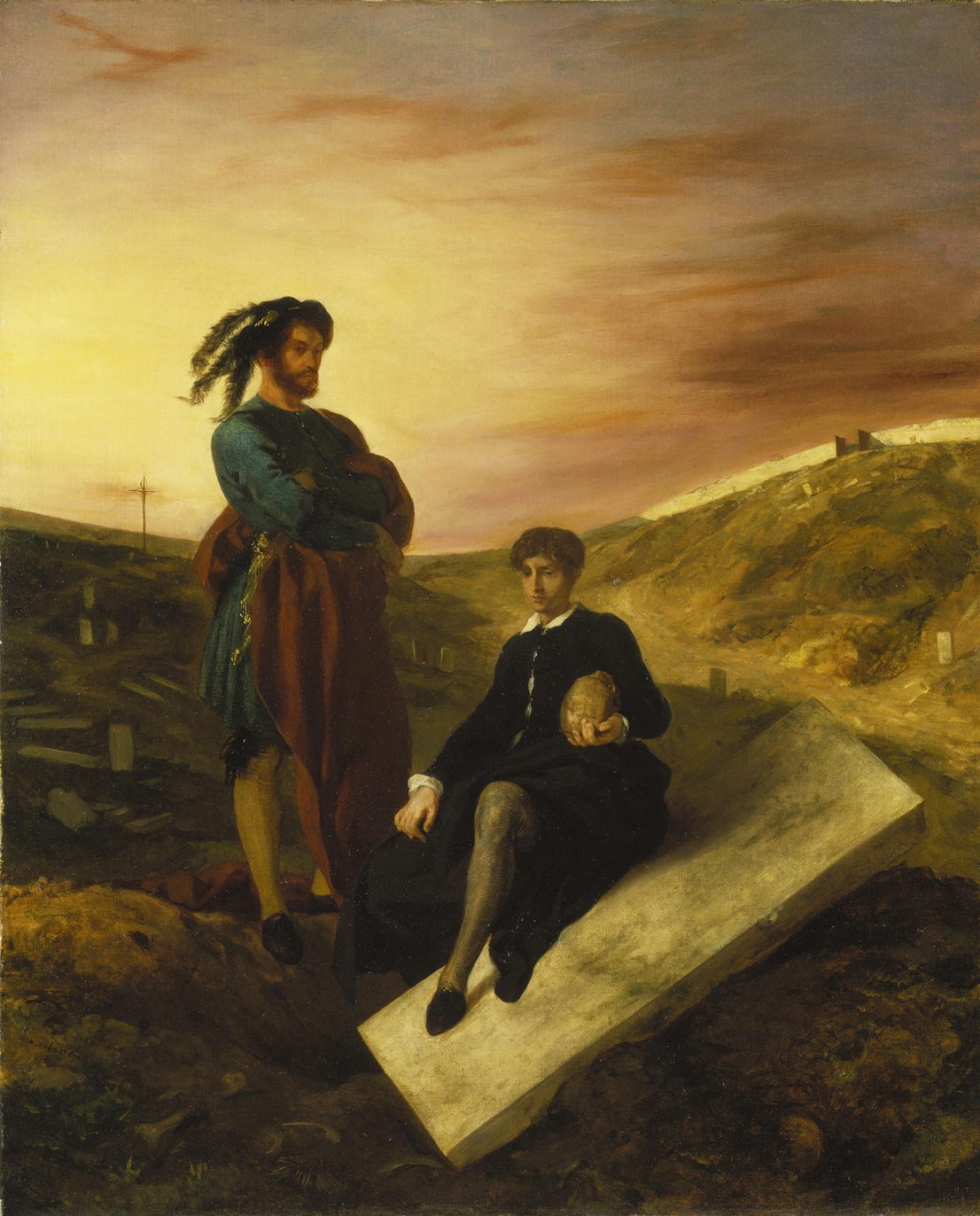
Delacroix first drew a lithograph in 1828 illustrating Shakespeare’s well-known scene in the graveyard, and in 1835 followed that with the stark Hamlet and Horatio in the Graveyard. This was rejected by the Salon the following year, which puzzled and angered his supporters. He returned with an inferior composition in 1839, which was accepted.

It was Delacroix who first seems to have realised the visual potential in Ophelia’s drowning. His first and almost monochrome painting of The Death of Ophelia in 1838 follows Queen Gertrude’s account of events in Act 4 Scene 7 of the play. In that, Ophelia climbed into a willow tree whose branch broke, dropping her into the stream below. Delacroix painted a more finished version of that in 1844, and another in 1853. By the last of those, John Everett Millais had painted his masterpiece of Ophelia, and others were to follow where Delacroix had led.
He also painted some unusual details from familiar stories. Among these is the method by which Cleopatra acquired an asp with which to end her life. In her final hours, Caesar’s men had to disarm the queen to prevent her from stabbing herself. After she had been warned further of her imminent death, she arranged for a peasant to bring her a basket containing asps hidden among figs.

Delacroix painted Cleopatra and the Peasant in 1838. One of the asps is seen midway between the peasant’s hands, among the figs in his basket. This was exhibited successfully at the Salon the following year.
At about the same time, Prince Demidoff commissioned a pair of paintings showing the life of Christopher Columbus, for his palazzo near Florence.
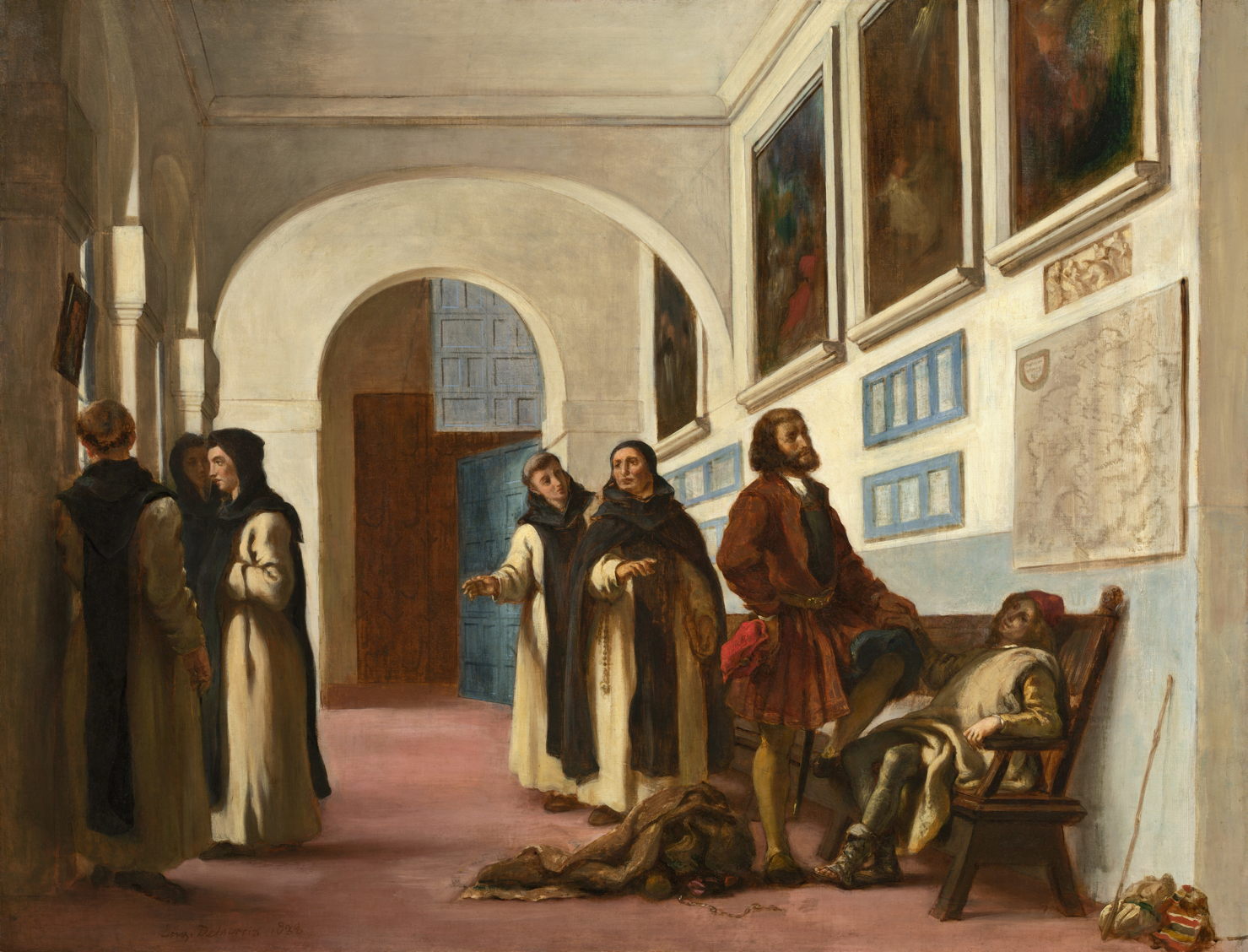
Christopher Columbus at the Monastery of La Rábida (1838) shows Columbus and his son seven years before the discovery of America, after they had walked to meet Don Juan de Marchena, the prior of that small monastery, who became Columbus’ loyal supporter. The pendant shows Columbus presenting Ferdinand and Isabella with the riches he had obtained during his expedition.
Another theme that Delacroix was to return to later is Medea’s murder of her own sons, from classical mythology.
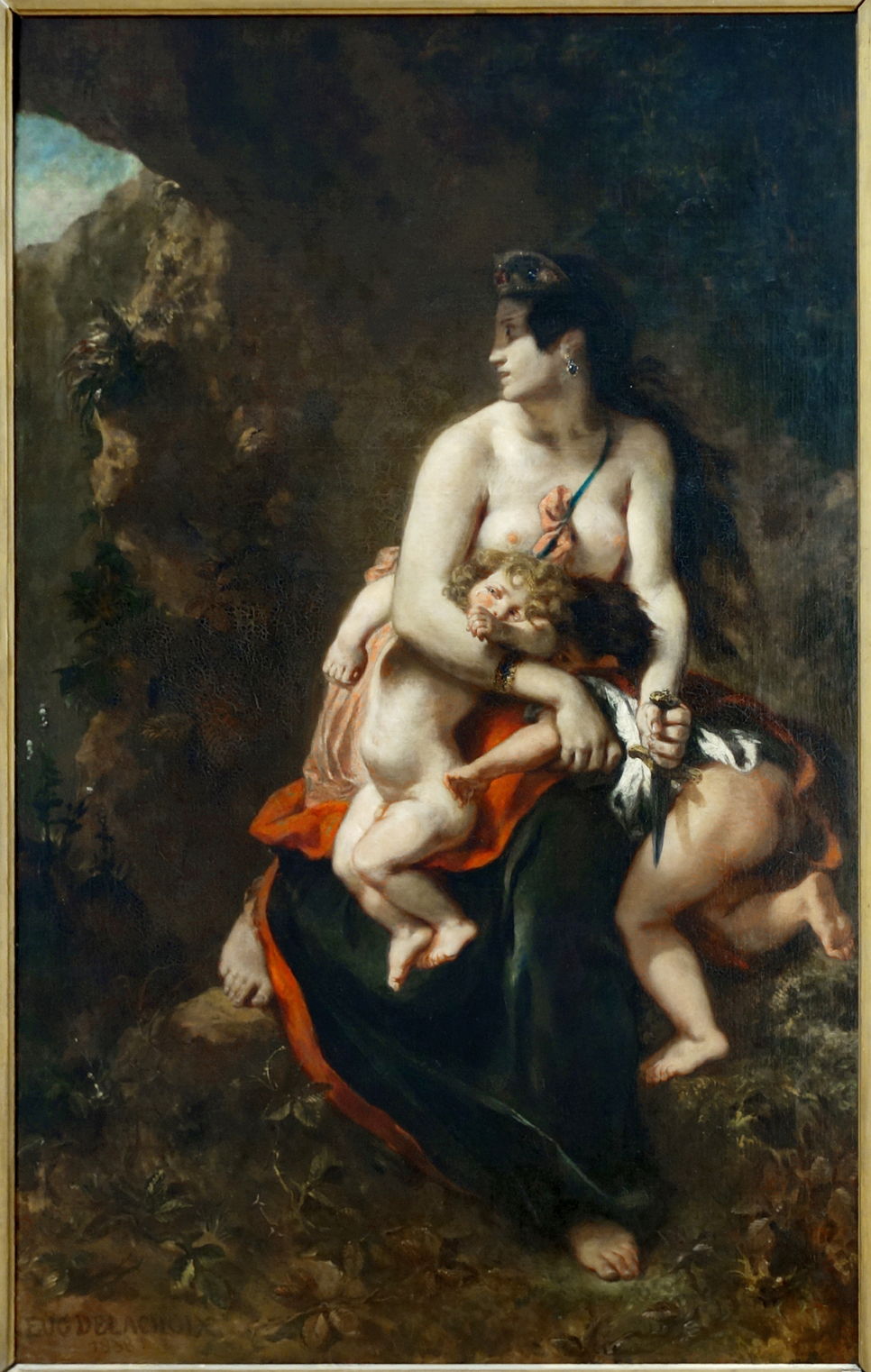
His first version, Medea about to Kill her Children from 1838, captures the scene well. The mother looks anxiously into the distance, to see if she’s being followed, or there are any witnesses about. The boys seem to know what is about to happen: one is crying as Medea’s arm is holding him by his neck, and the other is hiding under her skirts. This was exhibited at the Salon in 1838, where it caused quite a stir, although the artist was disappointed that the State purchased it for display not in Paris, but in Lille.
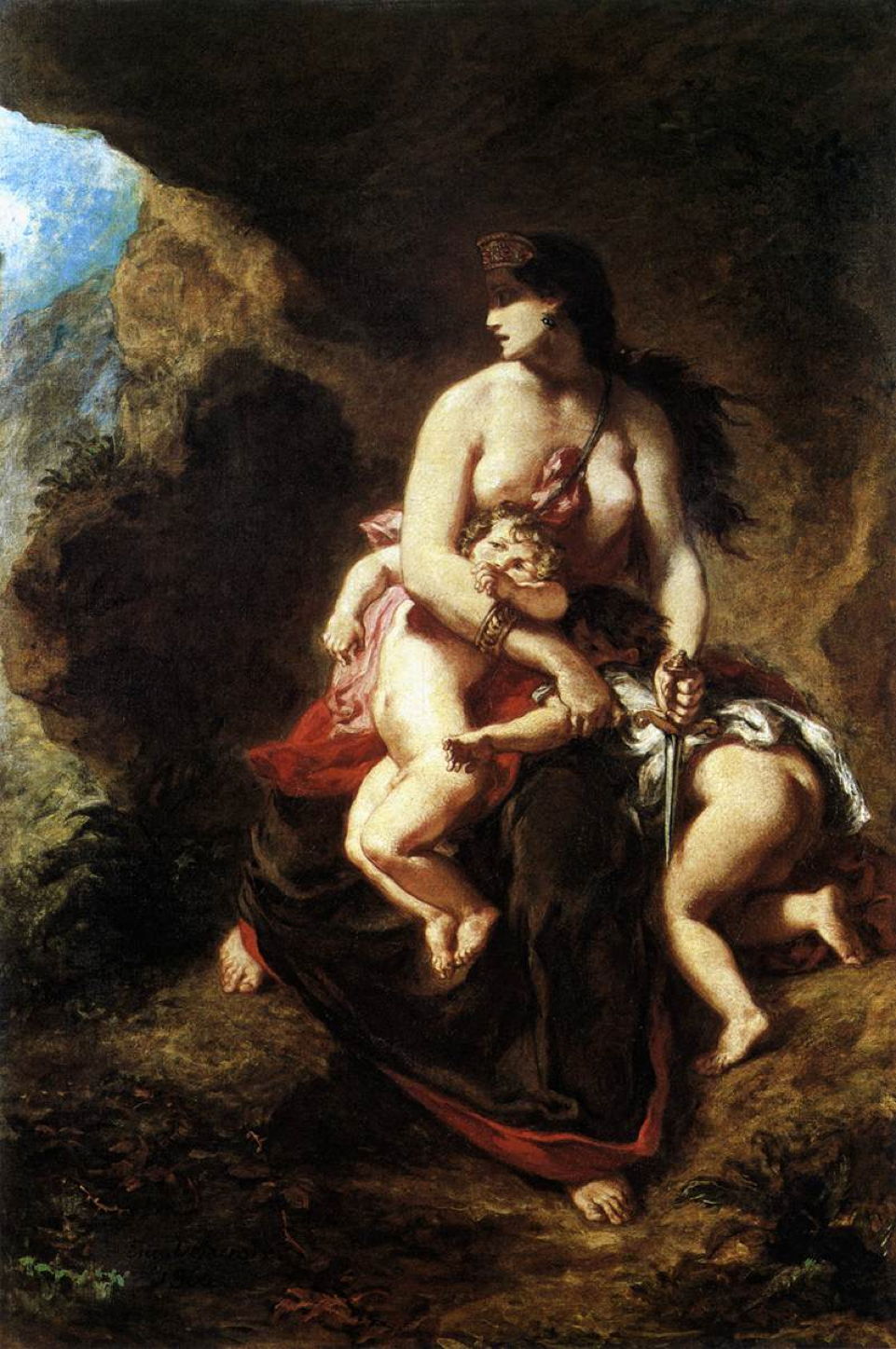
Delacroix made at least two later copies, including this half-size version of 1862, now in the Louvre.

His major entry for the Salon of 1841 was The Entry of the Crusaders into Constantinople (1840), destined for display in the Salle de Croisades in Versailles. This shows an episode from the fourth crusade in 1204, in which the crusaders took Constantinople. French forces were under the command of Baldwin, Count of Flanders, and had attacked from the land, while Venetians attacked the port from the sea. Its reception was as muted as its colours.
Around 1841, Delacroix started painting scenes of a small boat in rough seas. The first of these, exhibited at the Salon that year, was drawn from Byron, but the others became his famous works showing Christ on the Sea of Galilee. These must owe their origins to Géricault’s Raft of the Medusa, and his own Barque of Danté.

Shipwreck of Don Juan (1840) is taken from the second canto of Byron’s poem Don Juan. In this, Don Juan and his shipwrecked companions run out of food. They then draw lots to determine who will be sacrificed.
References
Barthélémy Jobert (2018) Delacroix, new and expanded edn, Princeton UP. ISBN 978 0 691 18236 0.
Patrick Noon and Christopher Riopelle (2015) Delacroix and the Rise of Modern Art, National Gallery and Yale UP. ISBN 978 1 857 09575 3.
Lucy Norton (translator) (1995) The Journal of Eugène Delacroix, 3rd edn, Phaedon. ISBN 978 0 7148 3359 0.
Arlette Sérullaz (2004) Delacroix, Louvre Drawing Gallery, 5 Continents. ISBN 978 8 874 39105 9.
Beth S Wright (editor) (2001) The Cambridge Companion to Delacroix, Cambridge UP. ISBN 978 0 521 65077 1.
 The Eclectic Light Company