
Chariots are two-wheeled carts intended for performance rather than load carriage. They traditionally come with three engine options: two-, three- and four-horsepower. For the average charioteer or deity, the two-horse version provided swift conveyance to satisfy most requirements from the battlefield to the heavens above. Four horses took considerably more skill to handle, and were normally reserved for professionals who needed to cover a lot of ground, such as when towing a heavenly body around the earth in only twenty-four hours.
The chariot’s two key technologies are domestication of the horse, which probably occurred somewhere around modern Ukraine in 3,000 BCE or earlier, and the spoked wheel, probably invented in the same area and period.

Franz von Matsch’s The Triumph of Achilles (1892) is at the top of the staircase of the Achilleion Palace, a celebration of the myths of Achilles, built on the island of Corfu for Empress Elisabeth of Austria. This shows Achilles in his two-horse chariot driving at speed around the walls of Troy, towing the naked body of Hector and followed by celebrating Greeks.
Some horses add distinction to the regular two-horse model.

Walter Crane’s account of the abduction of Persephone shows the pair of black horses harnessed by Hades to his chariot, symbolising the underworld, as he makes off with her into the dark cavern to the right.
For the chariot of the sun, only a four-horse model was capable of covering the ground fast enough.

Originally, there was clear separation between Apollo and Helios, the Titan god of the sun. In more recent times, they became conflated, into Phoebus Apollo, shown in Gustave Moreau’s Chariot of Apollo from about 1880.

In the heavens of Nicolas Poussin’s brilliant Dance to the Music of Time (c 1634-6), Aurora, goddess of the dawn, precedes Apollo’s sun chariot, on which the large ring represents the Zodiac, and may well be a reference to Aion. Following the chariot are the Hours.
Other deities and near-gods can sometimes be distinguished by the creatures towing their chariot.
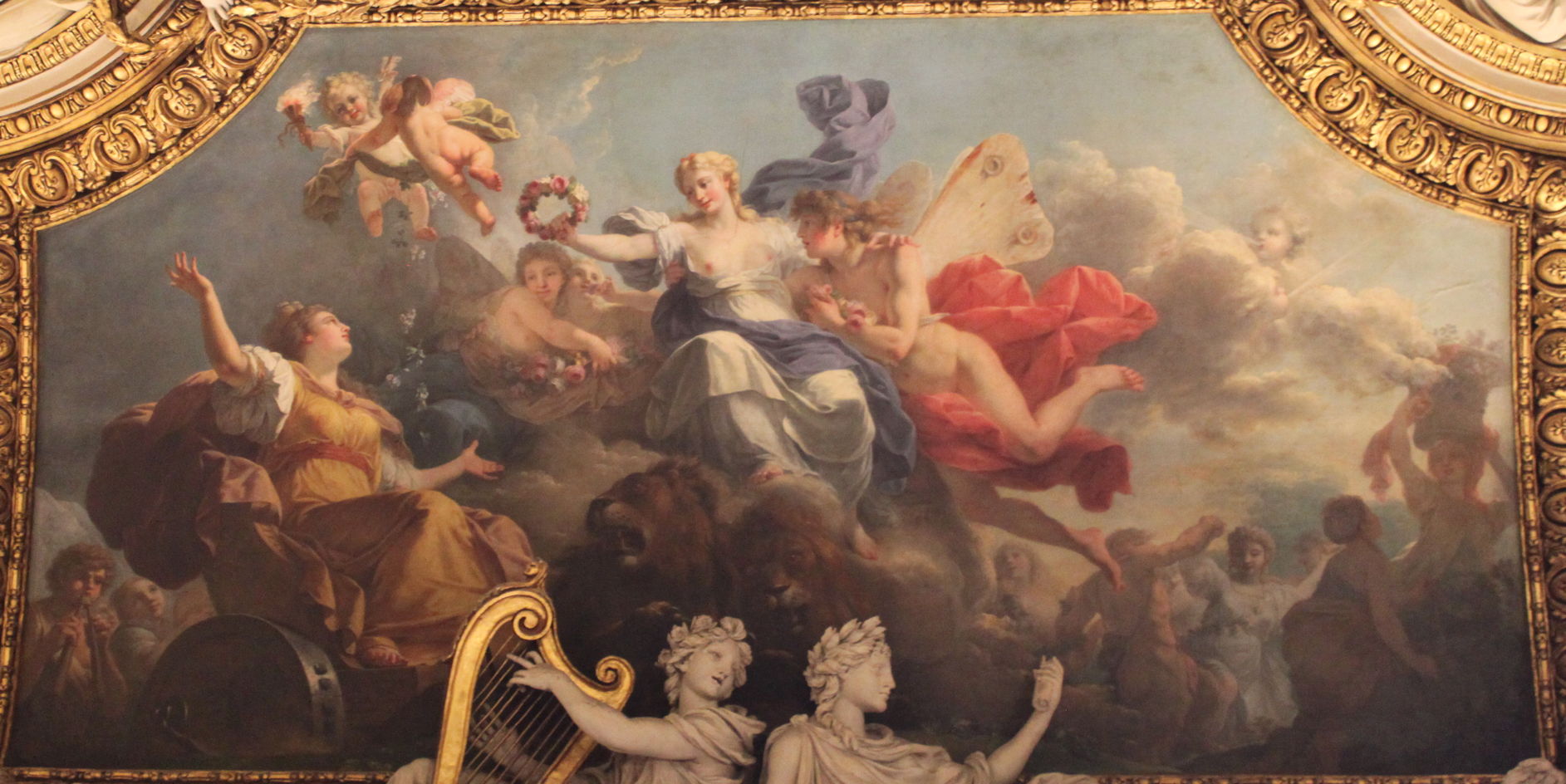
After the running race between Hippomenes and Atalanta, the couple were so impatient to marry that they made love in an old shrine. The deities on Olympus weren’t amused, and as punishment they were turned into a lion and lioness to tow Cybele’s chariot. Antoine-François Callet’s magnificent Spring, or Zephyr and Flora Crowning Cybele (1780-81), now adorning the ceiling of the Galerie d’Apollon in the Louvre, shows the couple at work.
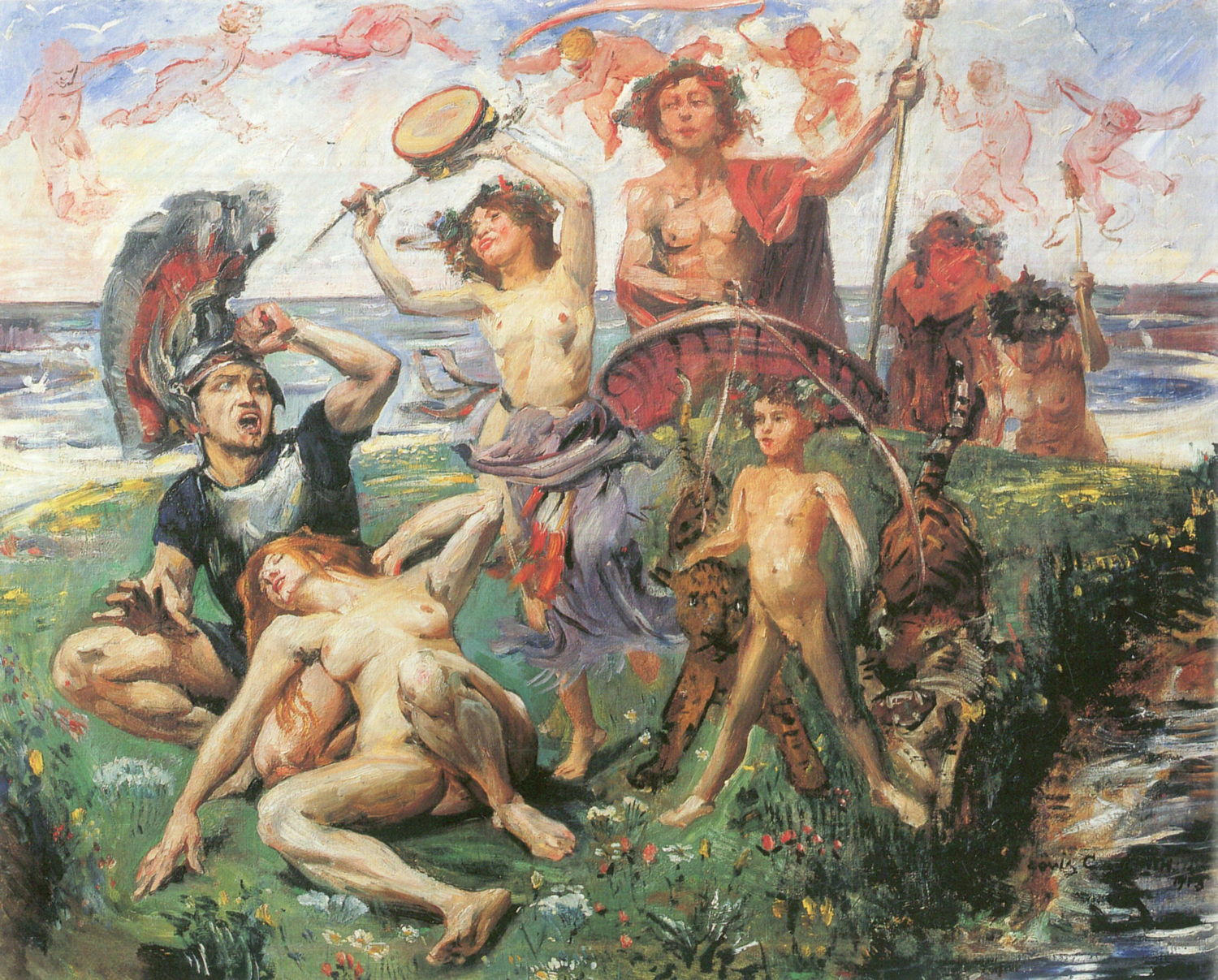
Dionysus or Bacchus is normally shown with other big cats towing his chariot. As he arrives at the right of Lovis Corinth’s Ariadne on Naxos (1913), those are depicted as tigers, but could instead be panthers or other related species.

Charles Le Brun’s painting of Alexander Entering Babylon from 1665 shows the Macedonian king riding in a large golden chariot hauled by a small elephant, as the spoils of war are exhibited around them. This could perhaps be the charioteering equivalent of the SUV.
Other choices have been more creative, and symbolic rather than functional.

Mårten Eskil Winge’s painting of Thor’s Fight with the Giants (1872) shows the two goats drawing the Norse god’s chariot. In any other circumstances those goats might have looked rather feeble, but Winge makes them appear as ferocious as Thor himself.
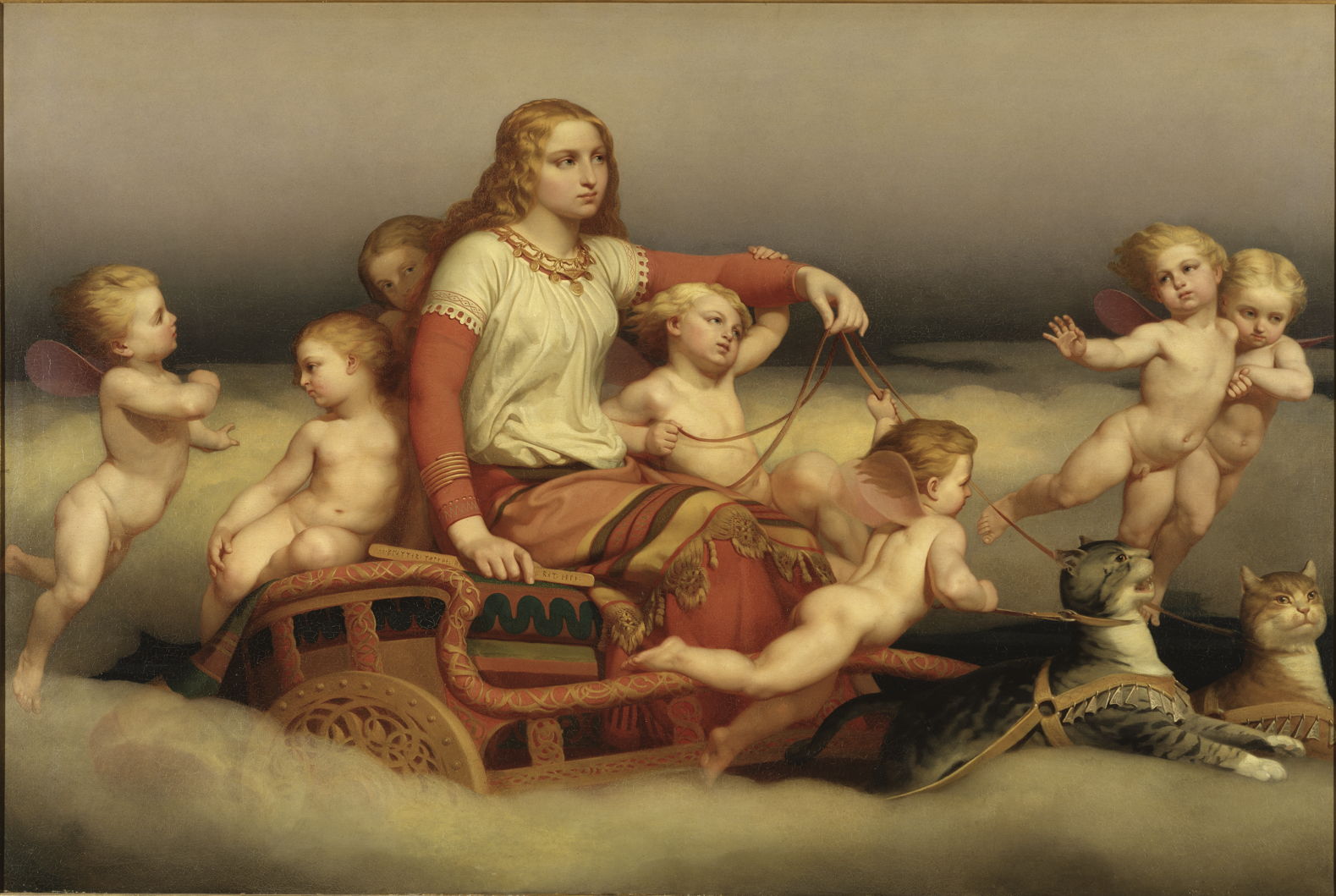
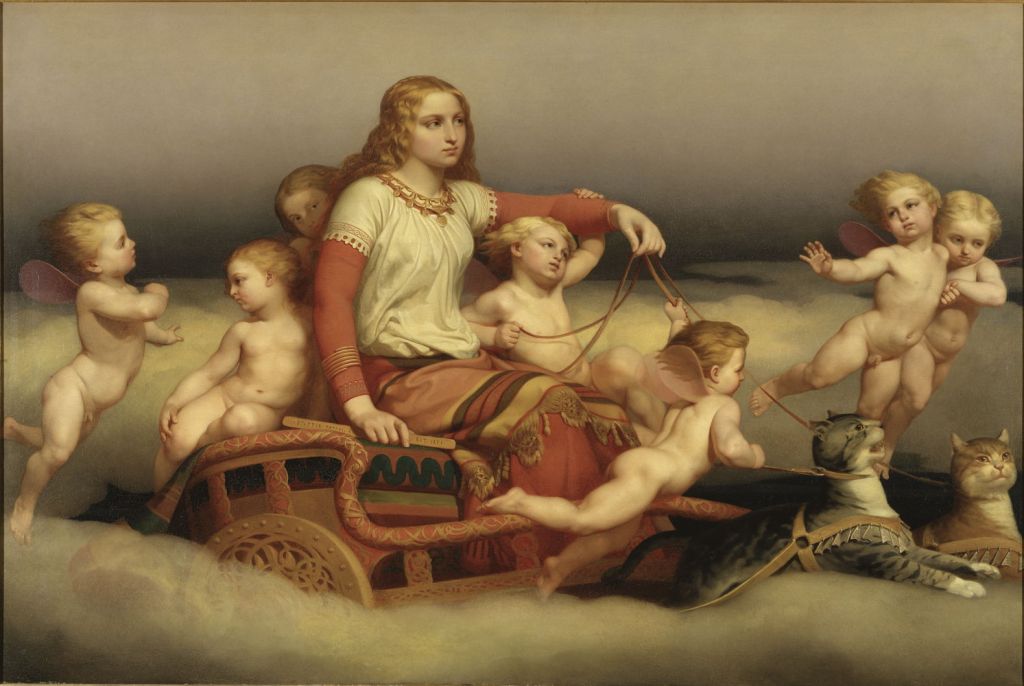
Nils Jakob Blommér’s undated painting of Freyja Seeking her Husband shows the goddess in her chariot drawn by domestic cats, as if they could ever agree on which direction to tow her.
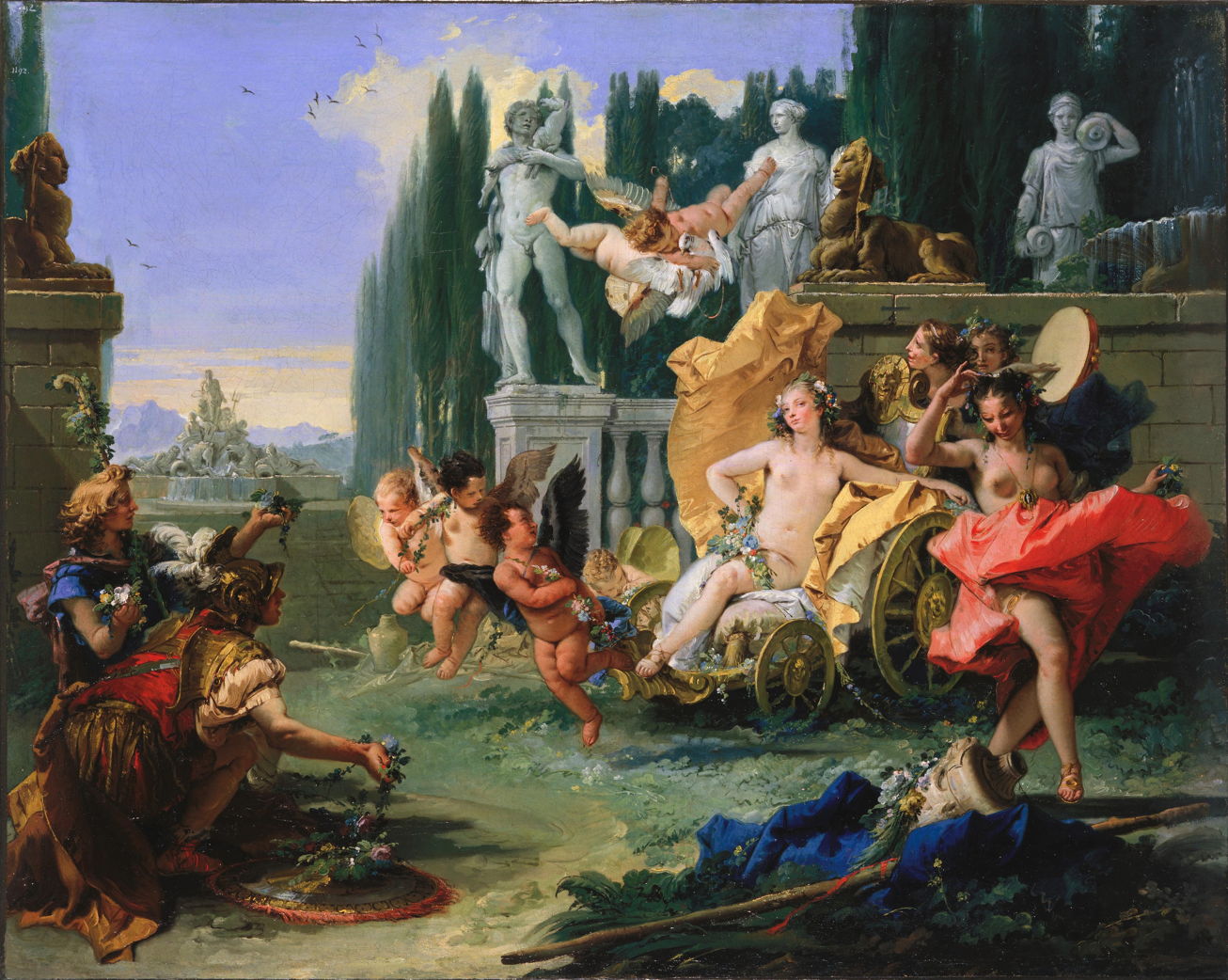
Giovanni Battista Tiepolo’s Empire of Flora from about 1743 shows her seated in an unusual four-wheeled chariot being drawn by winged cupids or winds.

Just a few years before his death, Rubens painted The Birth of the Milky Way (1636-37) showing Hera’s milk arcing out from her breast over the heavens, with two distressed peacocks trying to tow her chariot.

I suspect that Antonio Palomino’s Allegory of Air from about 1700 is a more probable account, with Hera’s peacocks standing and looking at one another rather than trying to tow her anywhere.

Another goddess apparently reliant on bird power is Venus/Aphrodite, shown in Charles Le Brun’s Deification of Aeneas from about 1642-44. This is a faithful depiction of Ovid’s account in his Metamorphoses, with the river god Numicus sat in the front, and Venus anointing Aeneas with ambrosia and nectar to make him immortal as the god Jupiter Indiges. At the right is Venus’ mischievous son Cupid, trying on Aeneas’s armour, and her chariot towed by white doves is ready to take the hero up to join the gods.
 The Eclectic Light Company