

The Phaeacians had spirited Odysseus back to a hidden harbour on the island of Ithaca while he was asleep. When he awoke, it took Athena to confirm that he wasn’t on yet another distant coast, but was home at last. She hid the treasure he had been given, and disguised him as a beggar, so that he could assess his kingdom before revealing himself as its long-lost king.
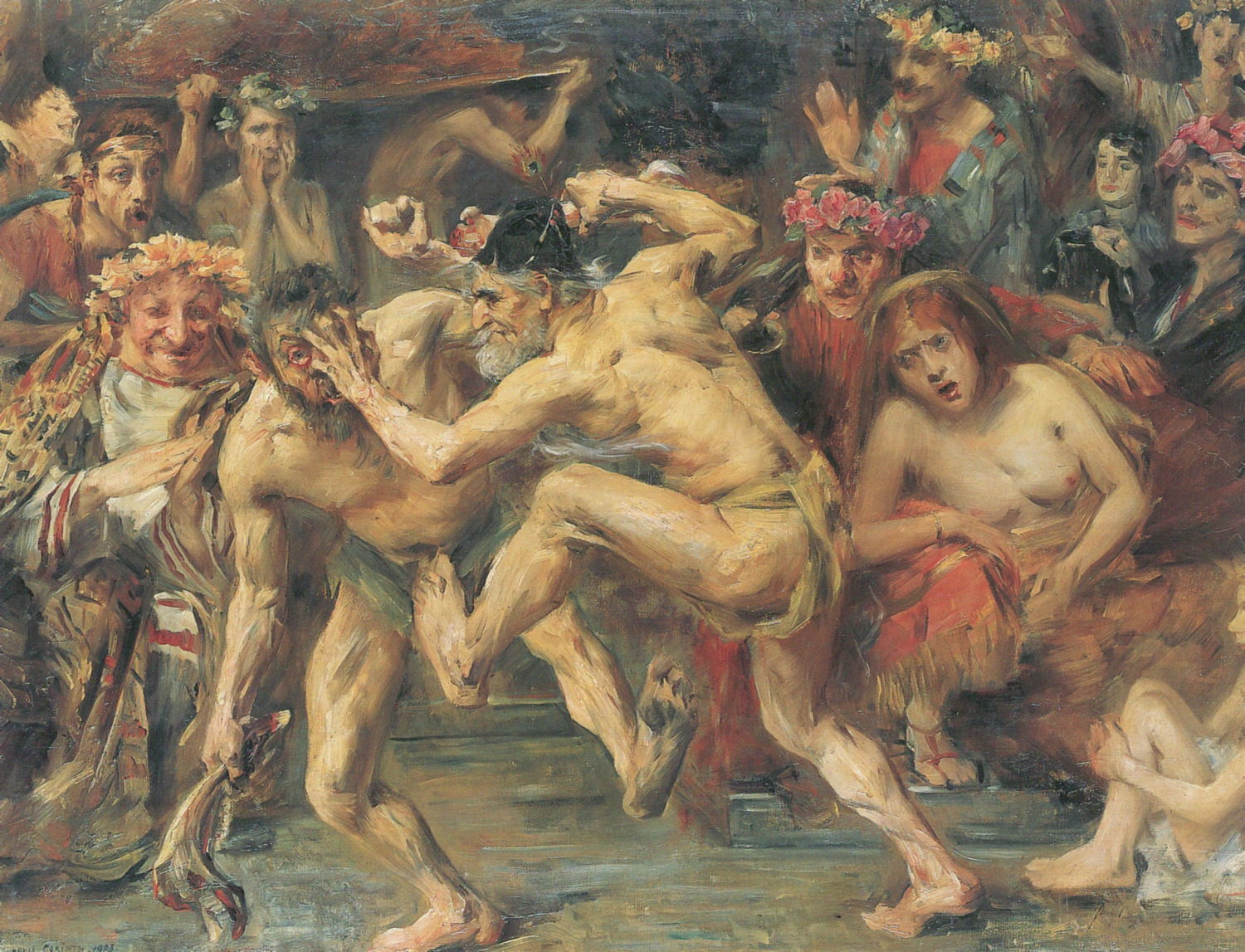
Lovis Corinth’s Ulysses Fighting the Beggar (1903) depicts the arrival of a real beggar named Arnaeus or Irus, who misguidedly picks a fight with Odysseus, who promptly floors the beggar and stops short of killing him. Corinth captures the fight as Odysseus (centre) is getting the better of Irus (left of centre), with various suitors and bystanders watching. Although painted loosely, each face has its own vivid expression, ranging from amusement to apprehension.
Odysseus’ son Telemachus, who had grown into a man during his father’s prolonged absence, sailed home from Sparta and met his father, who identified himself to his son. The pair then secretly plotted the best way to rid Penelope of the many suitors. The hero made his way to his palace, still disguised as a beggar, where he was ridiculed by the suitors before he tested his wife’s intentions.
While he was in the palace, Odysseus’ feet were washed by Eurycleia, his former wet-nurse now housekeeper. She recognised an old scar on him, and tried to tell Penelope who the beggar was, but Athena ensured that the queen couldn’t hear her, and Odysseus made her swear to keep the secret.

In 1849, this was set as the theme of the final of the Prix de Rome. Gustave Boulanger was the winner, with his Odysseus Recognised by Eurycleia (1849). Odysseus is putting his hand over Eurycleia’s mouth to prevent Penelope from hearing her revelation.
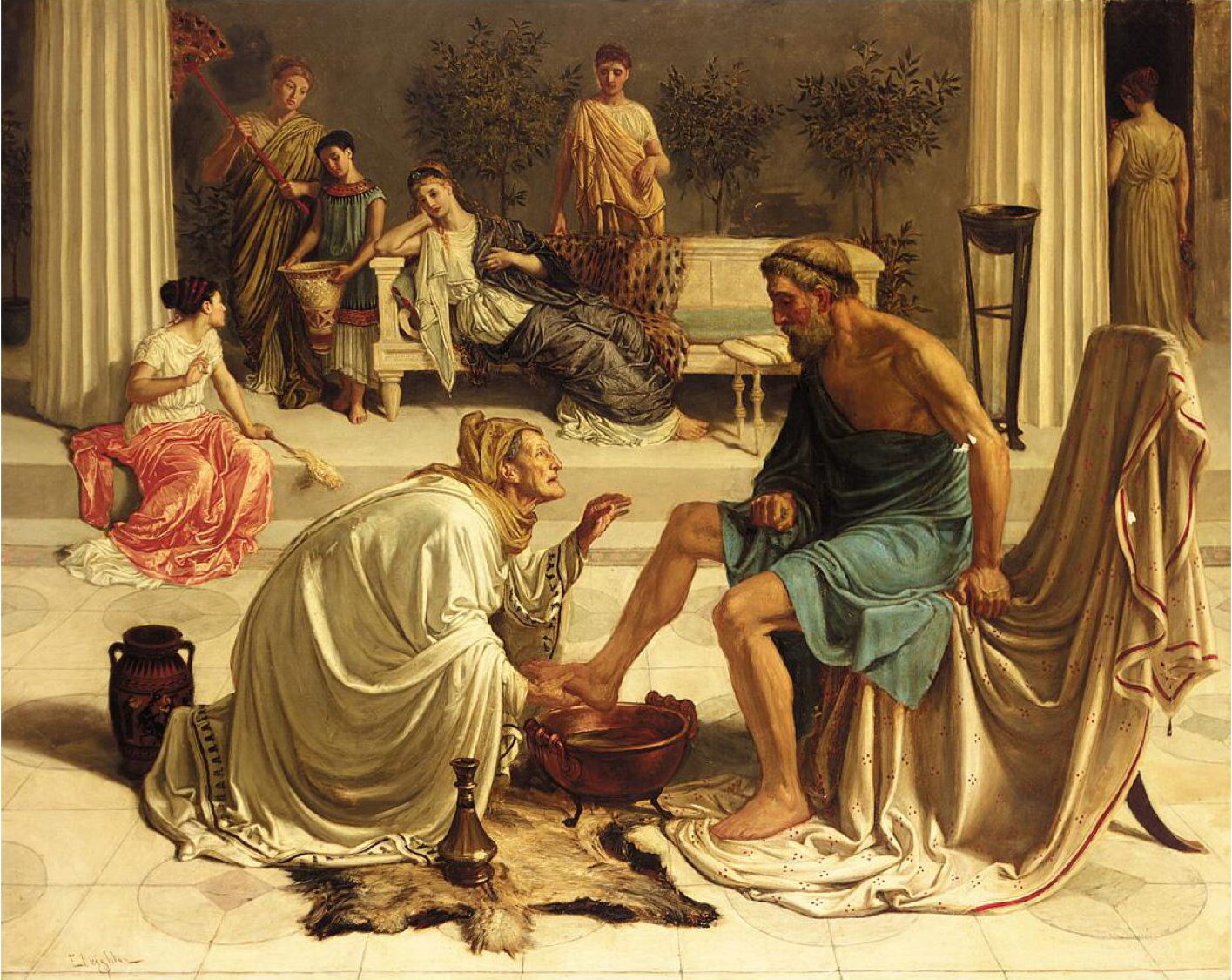
That’s clearly the same scene as depicted in this later work by a certain E Leighton, oddly titled The Mother of Ulysses Recognising her Son. At first sight, the artist might have been Edmund Blair Leighton, but he consistently signed himself in block capitals, and as E Blair Leighton, so I suspect this is a different late Victorian painter.
Once Odysseus had determined that all the suitors had to be killed, Athena prompted Penelope to get them to engage in an archery competition. Odysseus, still in disguise, won that, then killed Antinous, the most obnoxious of the suitors. He went on to kill the remainder of them, hanged a dozen of Penelope’s unfaithful maidservants, and finally revealed himself to Penelope.

Christoffer Wilhelm Eckersberg’s Ulysses’ Revenge on Penelope’s Suitors from 1814 shows Odysseus and Telemachus at the left as they attack a small group of the suitors. There are abundant pentimenti visible in the background, suggesting the artist changed his composition quite radically.

Lovis Corinth’s grand Odysseus in the Battle with the Suitors was painted in 1913 as a wall decoration for the Villa Katzenbogen, and shows Odysseus slaughtering the suitors.
It’s perhaps only appropriate that my last painting of the story of the Odyssey remains unfinished. There’s still controversy over when Gustave Moreau started work on it, but that was probably around 1852, although he doesn’t seem to have worked on it in earnest until nearer 1860. At that stage, it may have consisted of a smaller canvas, and he discontinued work on that by about 1864. He returned to it more seriously in the early 1880s, by which time the canvas had been enlarged considerably, and he finally abandoned it in around 1885.
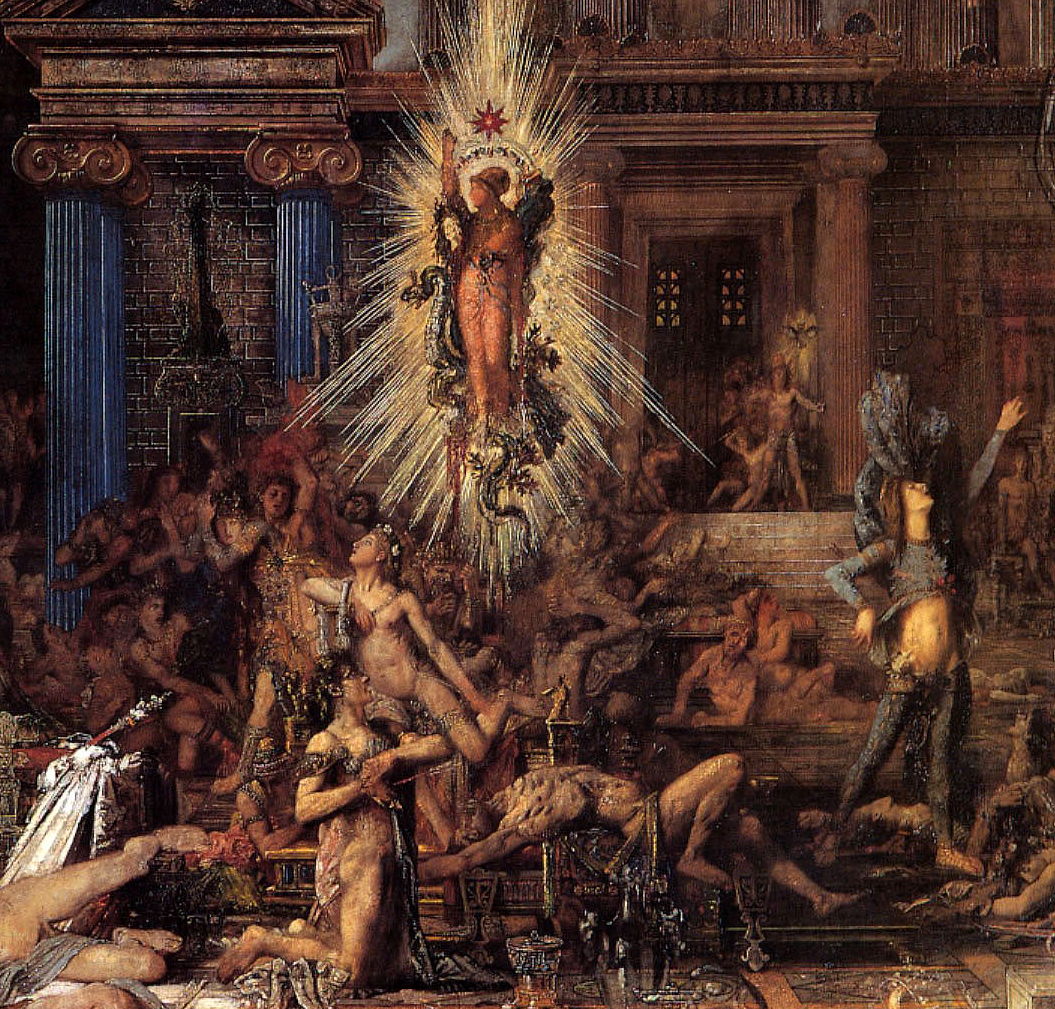
Using drawings made by Moreau in 1860, Cooke has argued that the original work was slightly larger than shown in the detail above, although even this area changed considerably during Moreau’s later re-working. Its final state when abandoned is shown below.

There are two prominent figures: Odysseus, who was originally holding a bow and standing proud at the top of steps on the right, and Athena, who is in mid-air in the middle of the painting, as Odysseus’ tutelary goddess. By the time Moreau had enlarged the canvas and repainted, Odysseus had become lost in the background, where he is now shown, still holding his bow, in the doorway at the back, with an owl over his head. Athena is pre-eminent.
Moreau justified this alteration, in a note written to his deaf mother, by typifying Odysseus as showing ‘material and brutal force’, but Athena represented ‘wisdom, moral force’. The suitors, now filling the canvas in their suffering and death, were ‘Last Judgement figures fleeing before the divine thunderbolt’ of Athena (quotations from Cooke).
With the suitors dead, Odysseus identified himself to Penelope, who finally recognised him when he told her that he had made their bed from an olive tree that was still rooted in the ground. With that, they embraced and slept.
The following day, Odysseus visited his father Laertes, where he was followed by a group led by Antinous’ father. When fighting broke out, it was brought to a halt by Athena and Zeus, and that closes Homer’s epic of the Odyssey, but isn’t the end of the Trojan cycle.
 The Eclectic Light Company