
The location in Europe with the longest and richest history as a subject for painting is Venice, and of all the sites in Venice, Piazza San Marco (Saint Mark’s Square) must be the most frequently painted. This weekend I show you my collection of views of the most famous piazza in the world, today for the first 340 years or so to the dawn of Impressionism, and tomorrow from then until just before the First World War.
There are a few important artists who did paint in Venice but for whom I have been unable to locate a usable image of any attempt to paint the Piazza. I have in those cases chosen paintings showing the closest motifs, to give an idea of their approach to similar motifs in Venice.
Piazza San Marco
If you have ever been to Venice, seen the city in films, or in photographs, you’ll be familiar with this, the city’s largest open area, surrounded by ancient buildings. There’s a good account of its geography and history on Wikipedia.
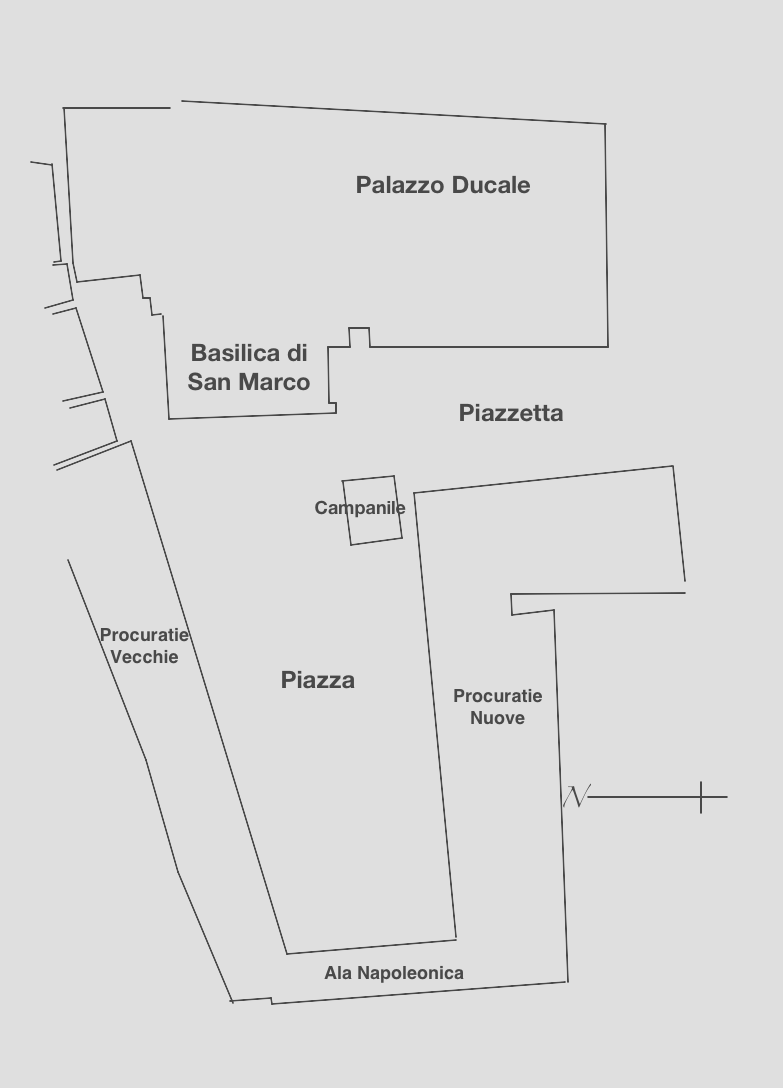
You may not be so aware that the Piazza isn’t rectangular, and not even strictly trapezoidal. Its eastern end, dominated by the distinctive Basilica and the high Campanile tower, is broader than the opposite end, with its lower buildings dating from Napoleon’s time. Neither are the other two sides, on the north and south, equal in length or height.
As a landscape or cityscape painting, it presents another major problem: its Campanile tower is high relative to the frontage of the Basilica. If you place your canvas in the portrait orientation to accommodate the height of the tower, then it lacks the breadth needed to show the north and south sides of the Piazza. If you choose instead the landscape orientation to encompass those sides, then the canvas will lack the height to show the Campanile.
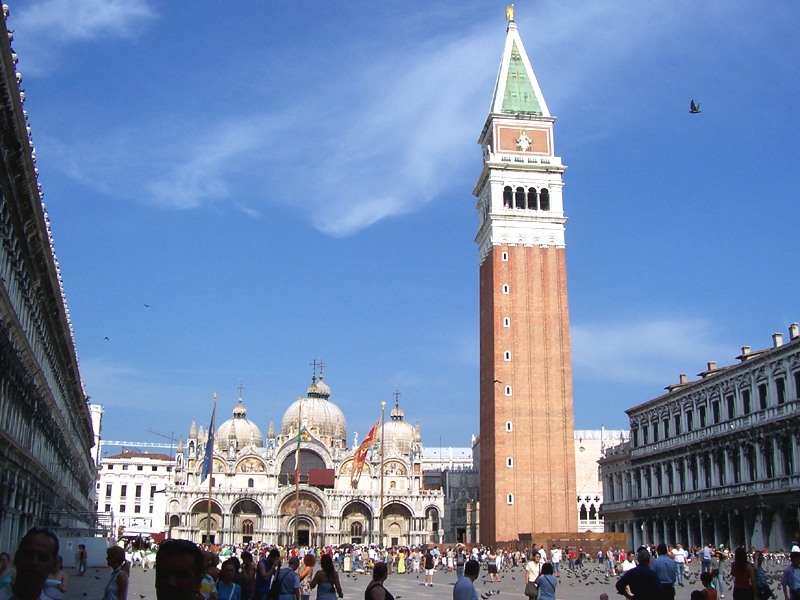
This photograph shows how difficult it is to accommodate three sides and the tower, and should remind you of the buildings that many of the paintings are intended to depict. Although this view has changed in detail since the erection of the first Campanile in 1499, its general layout has remained remarkably similar over the last 500 years.
Paintings 1496-1840
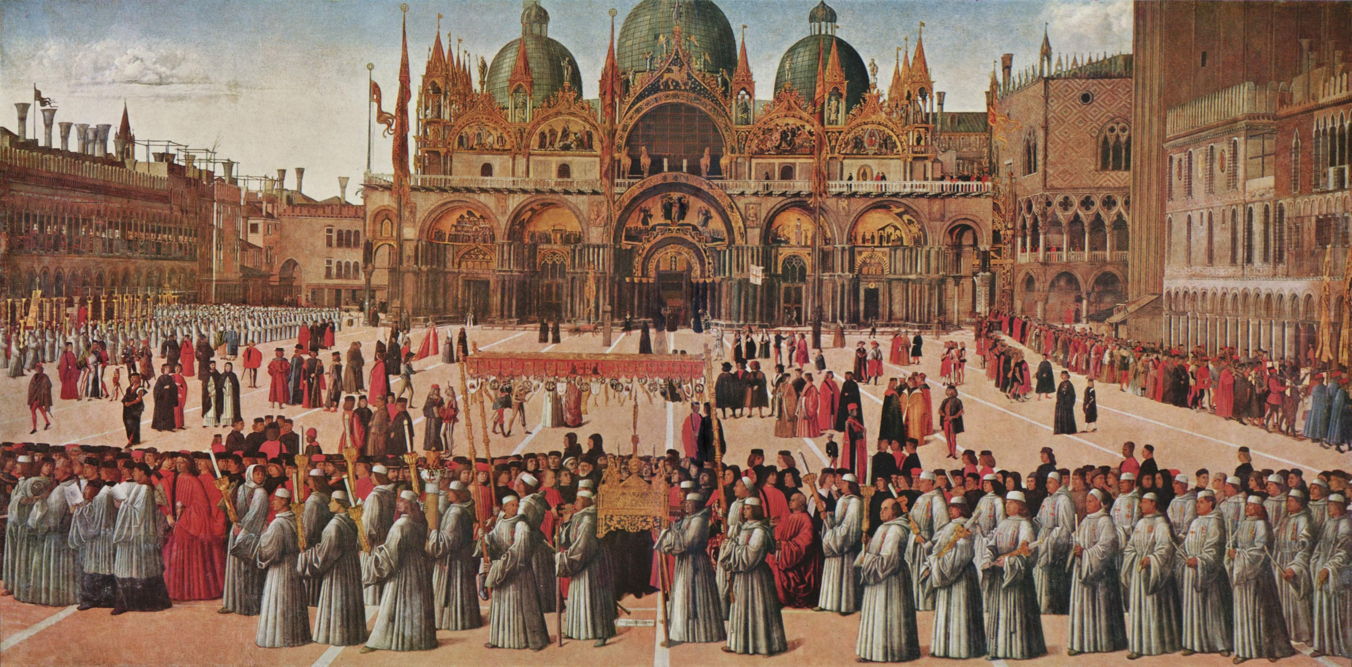
Gentile Bellini’s Procession of the True Cross in Saint Mark’s Square, Venice (1496) is the only painting believed to have been completed before the first Campanile, although there is a high building at its right that might represent the first tower during its construction. Its structural focus is the frontage of the Basilica, and its centre of attention and activity is the huge procession, in particular the True Cross sheltered under its canopy just to the left of the centre foreground.
As a Renaissance work, its main concerns are accurate projection and constructing the resemblance of reality. Although its figures are not the flat cut-outs typical of earlier paintings, they don’t give the impression of depth. The composition is also carefully aligned on the centre of the main entrance to the Basilica, to simplify the perspective projection. Using what would now be termed a panoramic format, it’s slightly too shallow to encompass the entire domes and superstructure of the Basilica. However, it’s a magnificently detailed depiction of this technically challenging motif.
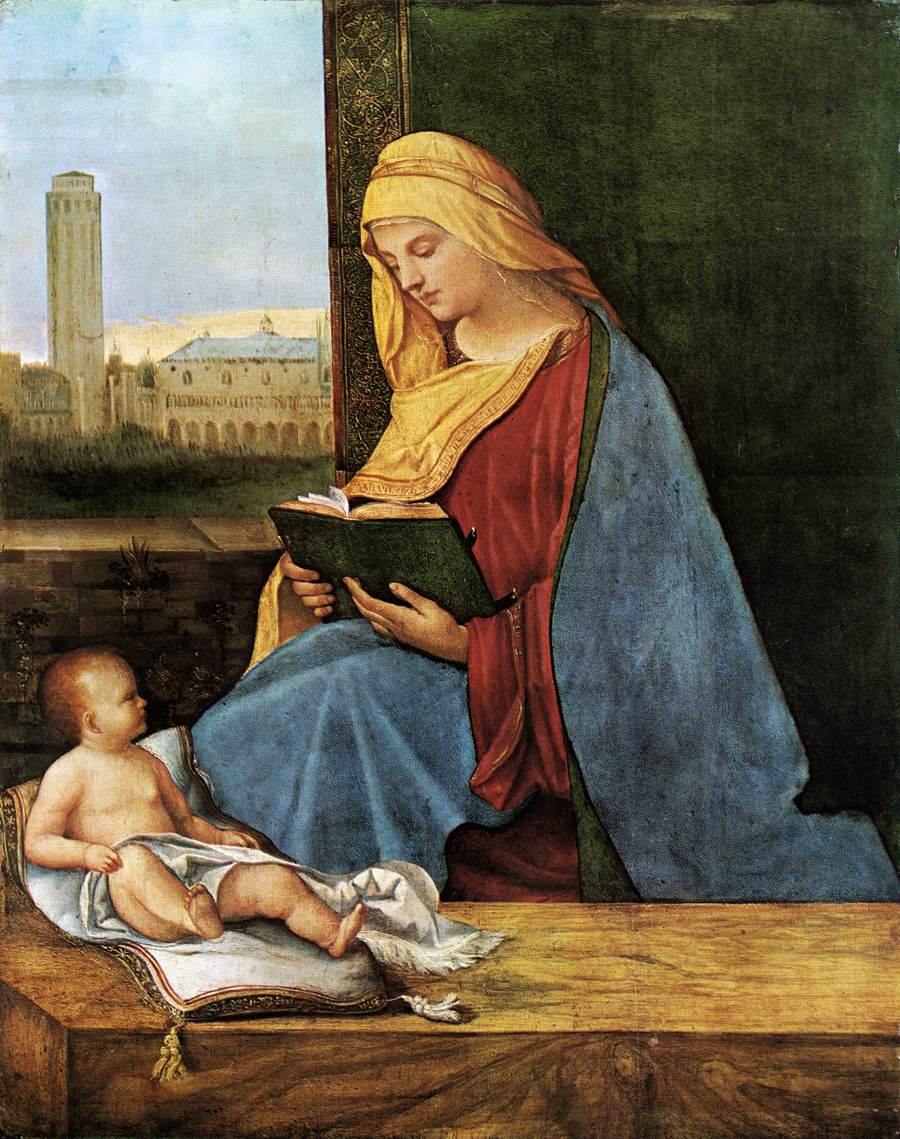
Attributed to Giorgione or his circle, The Virgin and Child with a View of Venice (The Tallard Madonna) (c 1500) is an excellent example of a landscape contained in cameo view, through the window.
The Virgin Mary and infant Jesus, who never of course came anywhere near Venice, are seen with a view through the window of the south-eastern corner of the Piazza, during completion of the first Campanile when it still had a flat roof between 1489-1511. Surprisingly the painter doesn’t take the opportunity to show the frontage of the Basilica. There’s also the odd contradiction that the Basilica and Piazza as a whole are dedicated to Saint Mark, who wasn’t martyred until about 68 AD in Alexandria. This cameo landscape is thus an artistic device to link the subjects of the painting with Venice, despite the impossibility of that link.
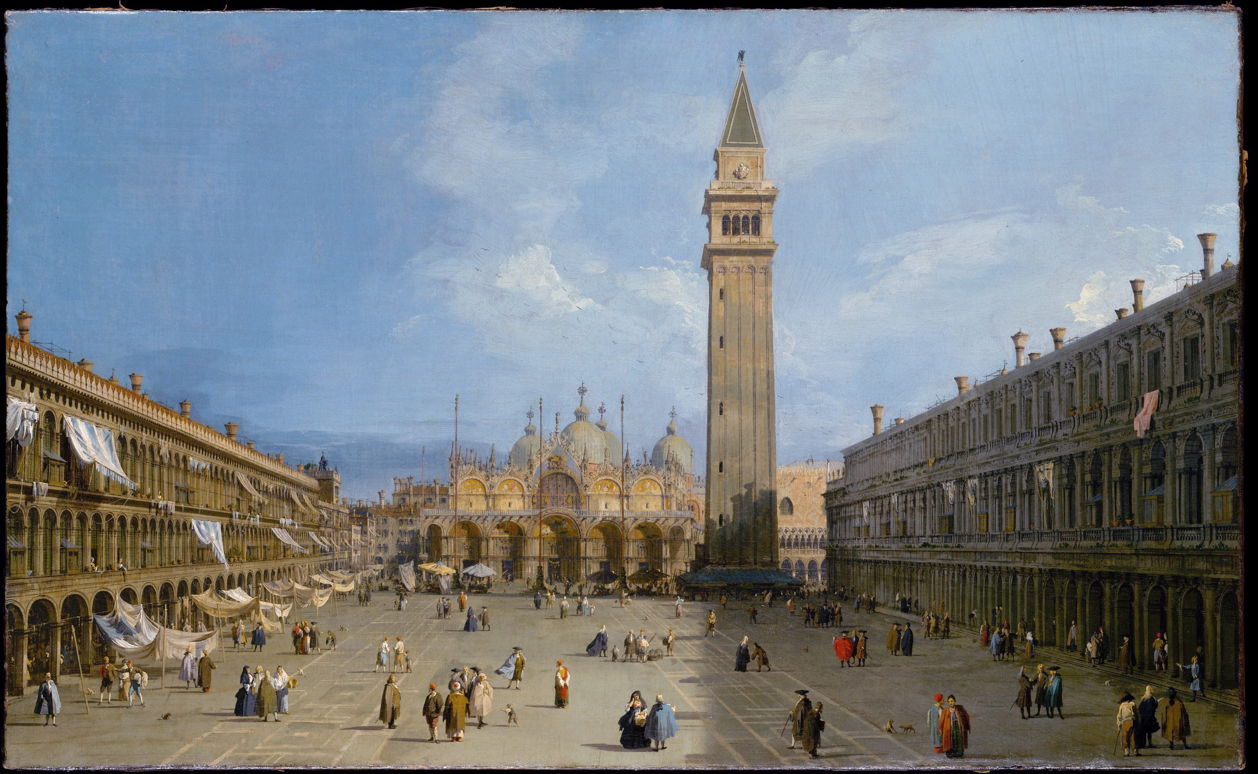
Canaletto was the first and most prolific specialist in Venetian scenes. I have chosen three of his many views of the Piazza as broadly representative. The first, Piazza San Marco (1720), presents the straight classical view of the Piazza, from the middle of the western end, looking straight at the Basilica. However, recognising the imbalance that would produce, Canaletto has angled the view slightly towards the Campanile, putting the centre of the Basilica to the left of the midline, and the Campanile slightly to the right.
This brings the higher buildings on the right (south) side to greater prominence, which is corrected for by placing the north side in full sunlight, as it would be with the sun to the south, and with a profusion of bright awnings along its length. Although Canaletto was never afraid to make adjustments in his paintings to enhance their aesthetics, the markings in the paving of the Piazza suggest that this view is faithful.

Painted about a decade later, Canaletto’s Piazza San Marco with the Basilica, Venice (c 1730) is almost identical, but with some interesting differences, other than the new buildings shown to the left of the Basilica. The sun is higher in the sky, shortening the shadows cast by the south side of the Piazza. The south and north sides appear less balanced, in the absence of awnings, and the north side (left) is at a more marked angle to the marks in the paving, making the east side (that of the Basilica) significantly longer. The Campanile also has an additional two slit windows up its height, and reaches to the very top of the canvas, so appears slightly higher.

Obscure relative to Canaletto, Michele Marieschi painted The Procession in St. Mark`s Square in Venice (c 1740) a decade after the later Canaletto, from a similar point and showing an almost identical view. Unfortunately the only digital image available is not of comparable quality.

Towards the end of his career, Canaletto painted a very different view, in his Piazza San Marco: Looking South-West from 1755-59. Here the viewer is at the opposite end of the Piazza, to the north-west of the end of the Basilica, and looks directly at the Campanile, and out into the Piazzetta behind and to the left of the tower.
With the irregularity in the shape of the Piazza, this gives the appearance of being projected using a wide-angle lens, and is remarkably early for such an effect in a painting. It has been suggested that Canaletto made extensive use of the camera obscura to construct his paintings, which could explain that, although given the inconsistencies between his paintings and the reality of Venice, that might appear unlikely.
Here the sun is in the north-west, with long cast shadows, implying that it was a summer’s evening. The Campanile is shown with the correct number of slit windows, but being much closer to the viewer in this case, it may well be shorter than it should have been, in order to squeeze it onto the canvas.
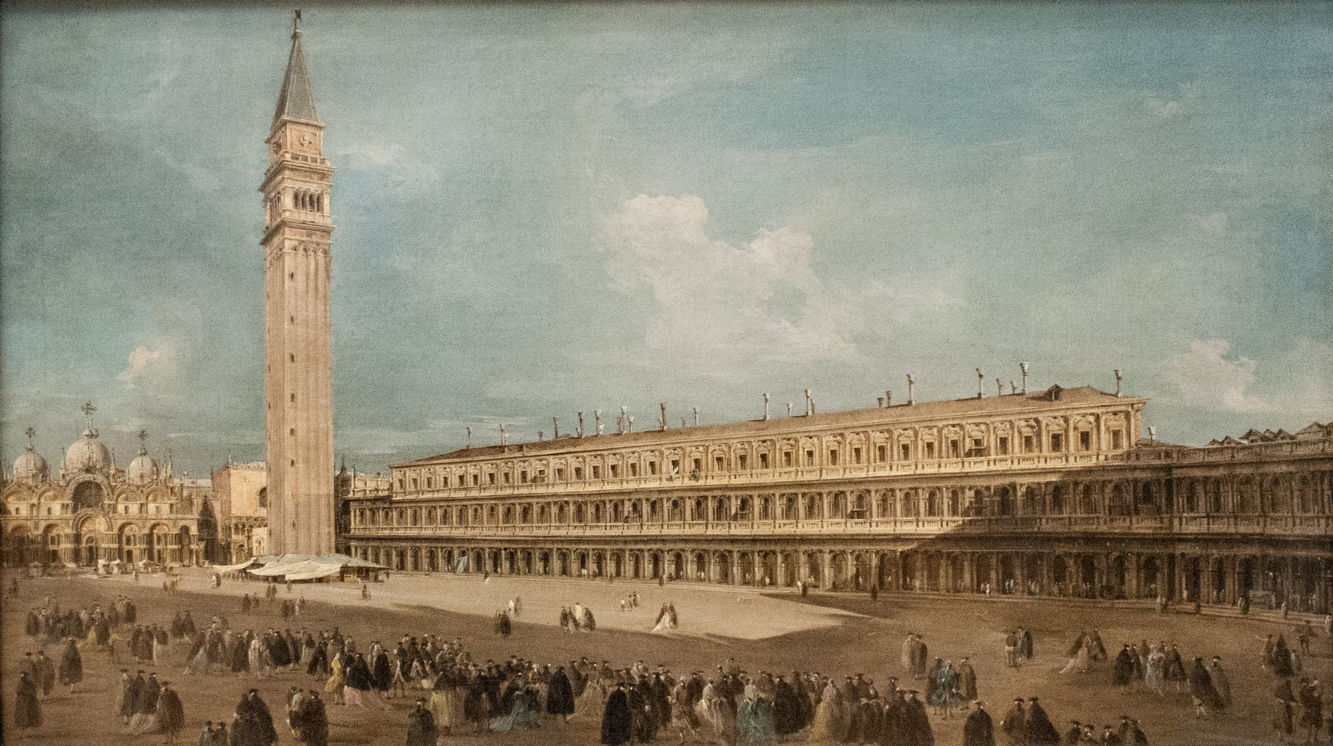
After Canaletto, the next most prolific painter of views of Venice was probably Francesco Guardi. In his Piazza San Marco in Venice from about 1770, he opts for a panoramic canvas, and places the viewer at the north-western corner of the Piazza, to show the Basilica, Campanile, and the whole of the southern side. With the sun low in the north-west, this too shows a summer evening, putting those buildings in sunlight.
This is dominated by the tower and the higher, newer block of buildings along the south side, giving it a formal linear air with deep perspective projection. The curved domes and arches of the front of the Basilica are distant and subjugated, and by placing the Campanile as deep as possible, he has accommodated its height within the relatively shallow canvas. Although as asymmetrical as possible, the composition balances the perpendicular of the tower against the advancing terrace of the Procuratie Nuove.
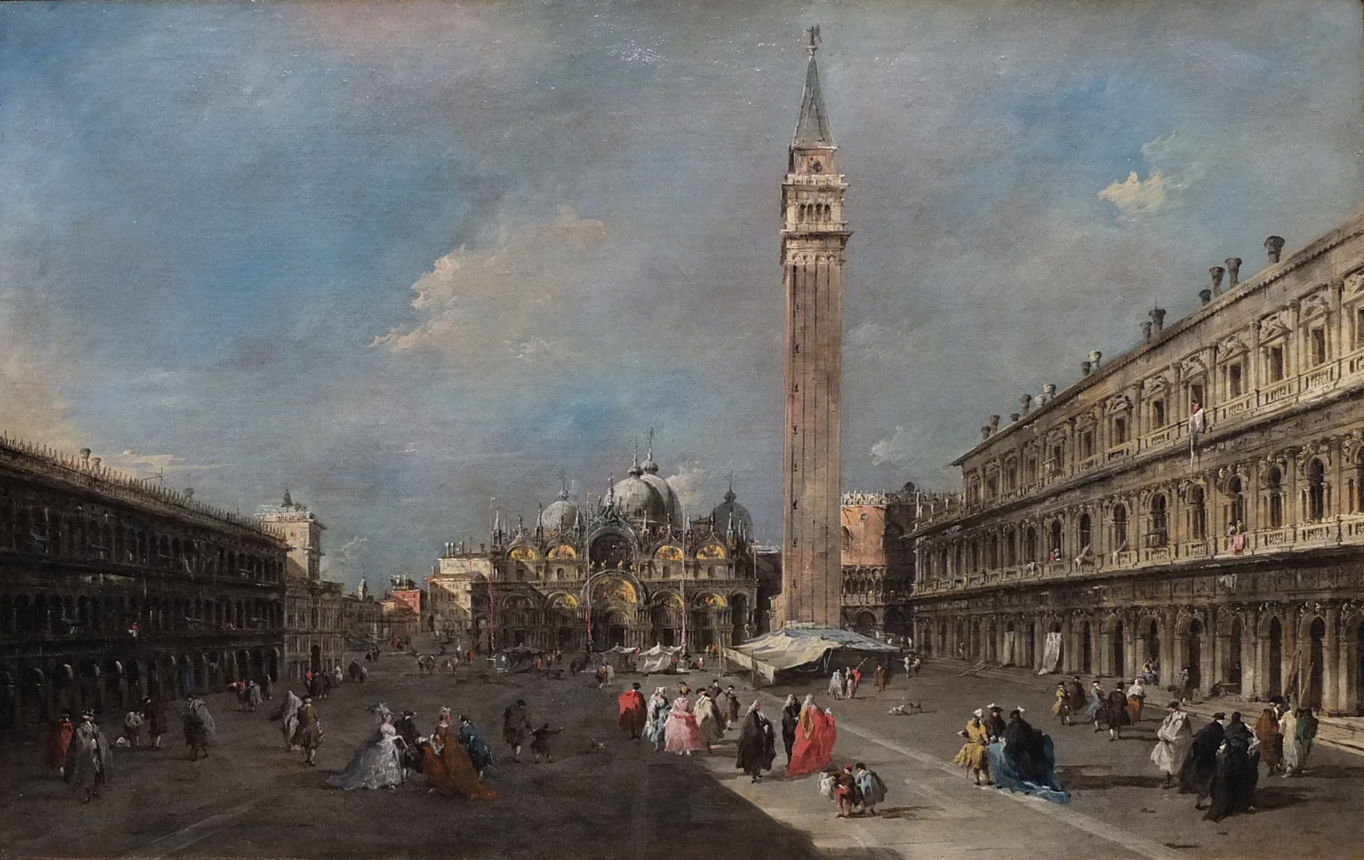
Just five years later, Guardi’s The Piazza San Marco, Venice (c 1775) marries the more conventional and classical view with a marked change in his painting style. The highly-finished precision of the previous paintings has been replaced by looser application of paint, allowing the marks made by the brush to be seen.
This is most obvious in the Basilica, which has lost its previous rigorous rectilinear appearance. The flagpoles in front of it appear less perfect, and its multitude of aerial spires and decorations has become an irregular jumble. Marks are most visible in the various fabrics, such as the clothing of the figures in the Piazza, awnings and other staffage, and in the clouds above. There is nothing to suggest that it was painted en plein air, and given the size of the canvas and the intricate detail shown, it was almost certainly the product of many days work in the studio.
Despite this radical departure in facture, the composition follows a traditional approach: the view is from the middle of the western end of the Piazza, with the centre of the Basilica and the Campanile straddling the centreline of the painting. The sun is again in the north-west, setting the time to a summer’s evening.
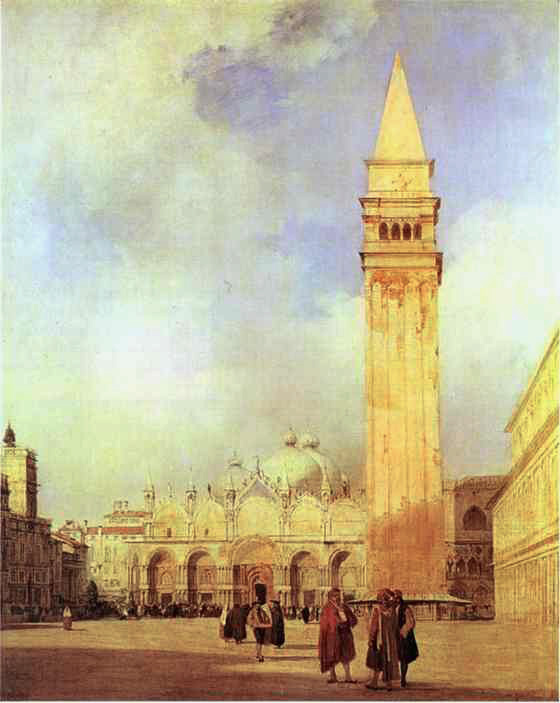
In his tragically brief life, Richard Parkes Bonington produced some remarkable paintings, and his unfinished Venice: The Piazza San Marco (1827-8) shows signs that it might have been among his best. At the time that he started this, Canaletto’s work was popular and able to command good prices from collectors, and he was perhaps aiming for the same market.
Bonington’s composition is one of the few since Giorgione’s to recognise the problem of incorporating the height of the Campanile, and attempts a resolution combining proportion with visual effect. The viewer is low down on the south side, gazing up into the sky. The tower, gently distorted by its projection, occupies the right, with the lower Basilica making a formal right angle at its foot. This spares us from the staffage needed to decorate large areas of pavement in the Piazza, which is relegated to the lowest eighth of the canvas. He painted an earlier watercolour to check that this would work.
The buildings have a golden glow from the setting sun, again low in the north-west, but those colours would undoubtedly have been enhanced by rich glazes, had Bonington lived long enough to complete it. It’s baffling that, when sold the year after his death, it fetched a mere £18.
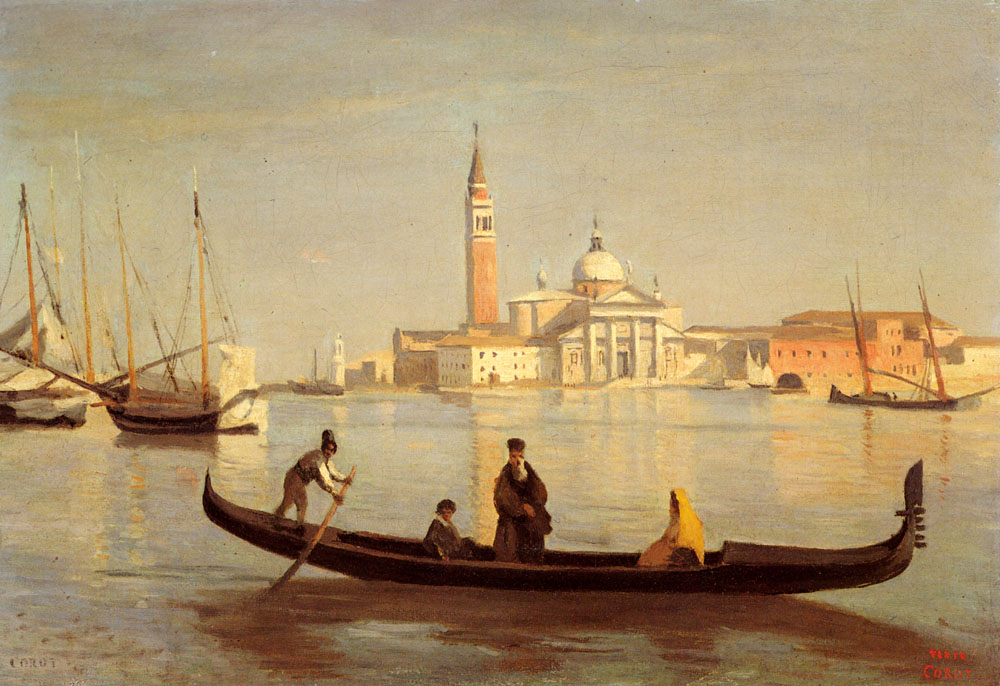
Better known for his extensive views of Rome and its campagna, Jean-Baptiste-Camille Corot painted some fine oil sketches, presumably en plein air, in Venice, including a distant view of the Church of San Giorgio Maggiore (pictured later by Monet), in Venice: Gondola on the Grand Canal (c 1835). Most obviously different is its limited level of detail, although this particular view contains many buildings and boats, and may have been the result of several sessions in front of the motif.
Seen in morning light, with the sun off to the right, in the south-east, Corot’s informal composition adds to the spontaneous appearance. However he has been careful to render the reflections softly but accurately; each of the edges shown in the water has been carefully aligned with its original.
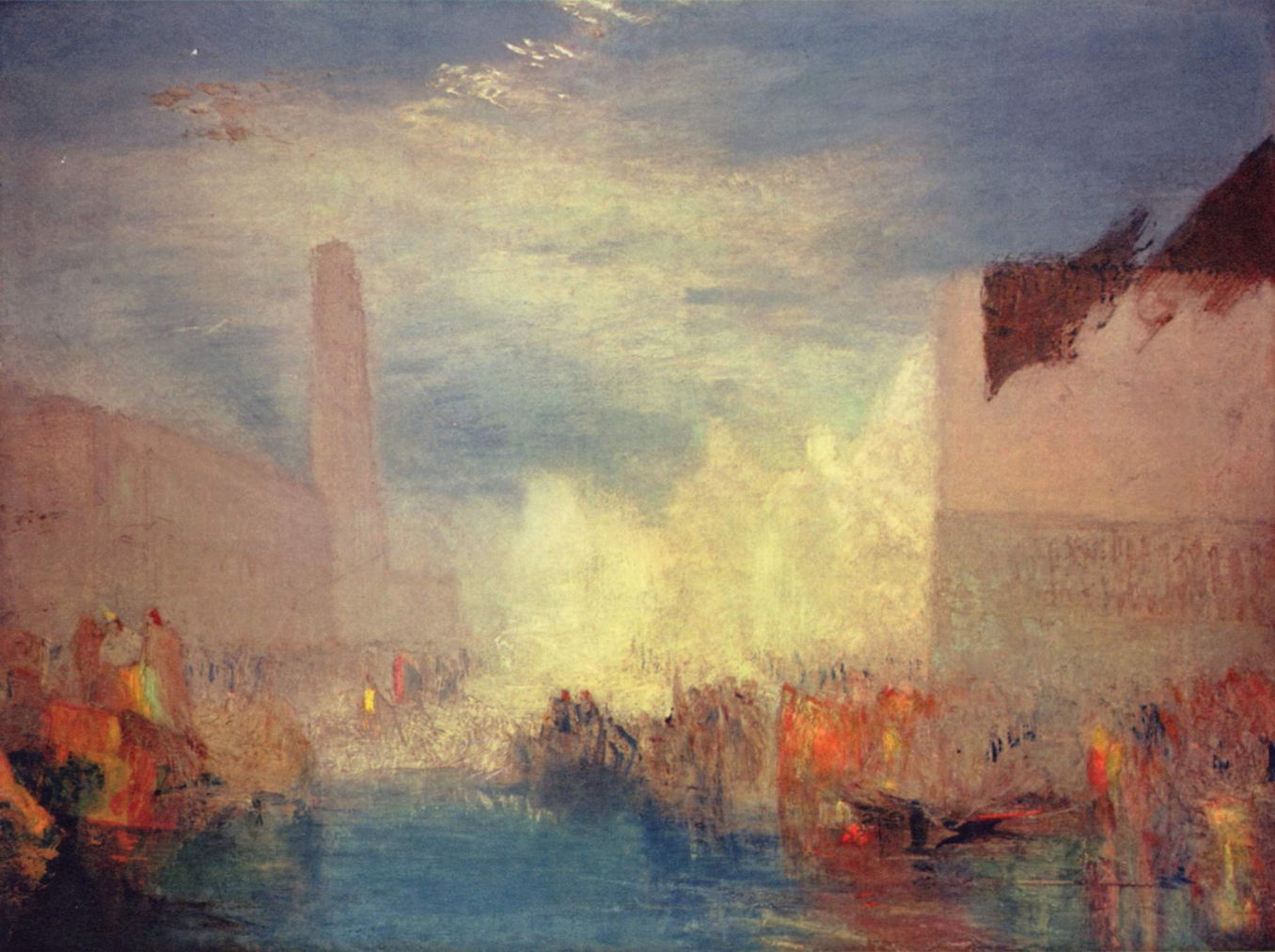
JMW Turner painted extensively in Venice, but I have been unable to find any accessible work showing any view of the Piazza. His Juliet and her Nurse (1836) showing a unique moonlit aerial view of the Piazza from the south-western corner, doesn’t appear to be freely available. Venice, the Piazzetta with the Ceremony of the Doge Marrying the Sea, (c 1835) shows the Piazzetta from the south, with the Campanile on the left, and the unmistakable domes of the Basilica in the centre.
Just as Turner’s view of the tower and Basilica is unusual, so his depiction is remarkable, particularly for its time. The buildings, figures, even boats in the foreground appear to have been formed in haste, and without detail. Even the most detailed figures on the boats in the foreground are made up of notional marks and patches of colour.

Turner’s Venice from the Giudecca (1840) is almost as radical in its approach. The viewer is again on the water, this time rather further from the Campanile, which dominates the skyline just to the left of centre. Instead of the rich colours of ceremony, this work is rendered entirely in earth colours, with blue for the sky. Minimal architectural details are given to provide cues to the forms and identities of the buildings.
The foreground is crisper and richer in detail, showing all the paraphernalia of trade and life in boats, and their reflections in the water. However it’s hard to discern exactly what is being shown; again we’re given an impression, here with ample detail, but insufficient to enable precise identification.

