

Many of those who showed their paintings in the First Impressionist Exhibition in 1874 were already prolific painters, and innovated during that early phase of the movement. Among the exceptions was Paul Cézanne (1839-1906), who had only started to learn to paint plein air Impressionist landscapes in the 1870s, and is now best-known for his later work.
Cézanne was born and brought up in a prosperous banking family in Aix-en-Provence. He was a close schoolfriend of Émile Zola, who went on to be a leading novellist, journalist and writer. In preparation for an intended career in the family bank, Cézanne studied law at the University of Aix from 1859, while taking evening classes at the Drawing School. He became determined to be a painter and left University prematurely, travelling to Paris in 1861.
In Paris he started to paint full-time, including copying at the Louvre, as was usual at that time, but was turned down by the École des Beaux-Arts. During the 1860s his paintings were generally very dark, and he experimented with painting using a palette knife. Subjects were also dark, and sometimes violent. He painted at the Académie Suisse, where he met Camille Pissarro, whose influence over him proved formative. He later met Claude Monet, Pierre-Auguste Renoir and Alfred Sisley.
Cézanne submitted paintings to the Salon each year between 1863-69. In the first of those years, his were shown in the Salon des Refusés, but after that they were simply rejected. In 1866, he enjoyed his sole success at the Salon, with a portrait of his father.

In 1867-69, when his other paintings were made coarsely with a knife, he painted this dark but effective Still Life with Kettle in oils. Using relatively coarse brushstrokes, he conveys surface texture and highlights effectively. He also shows his career-long disregard for conventional perspective projection, which was to come to dominate his later paintings.
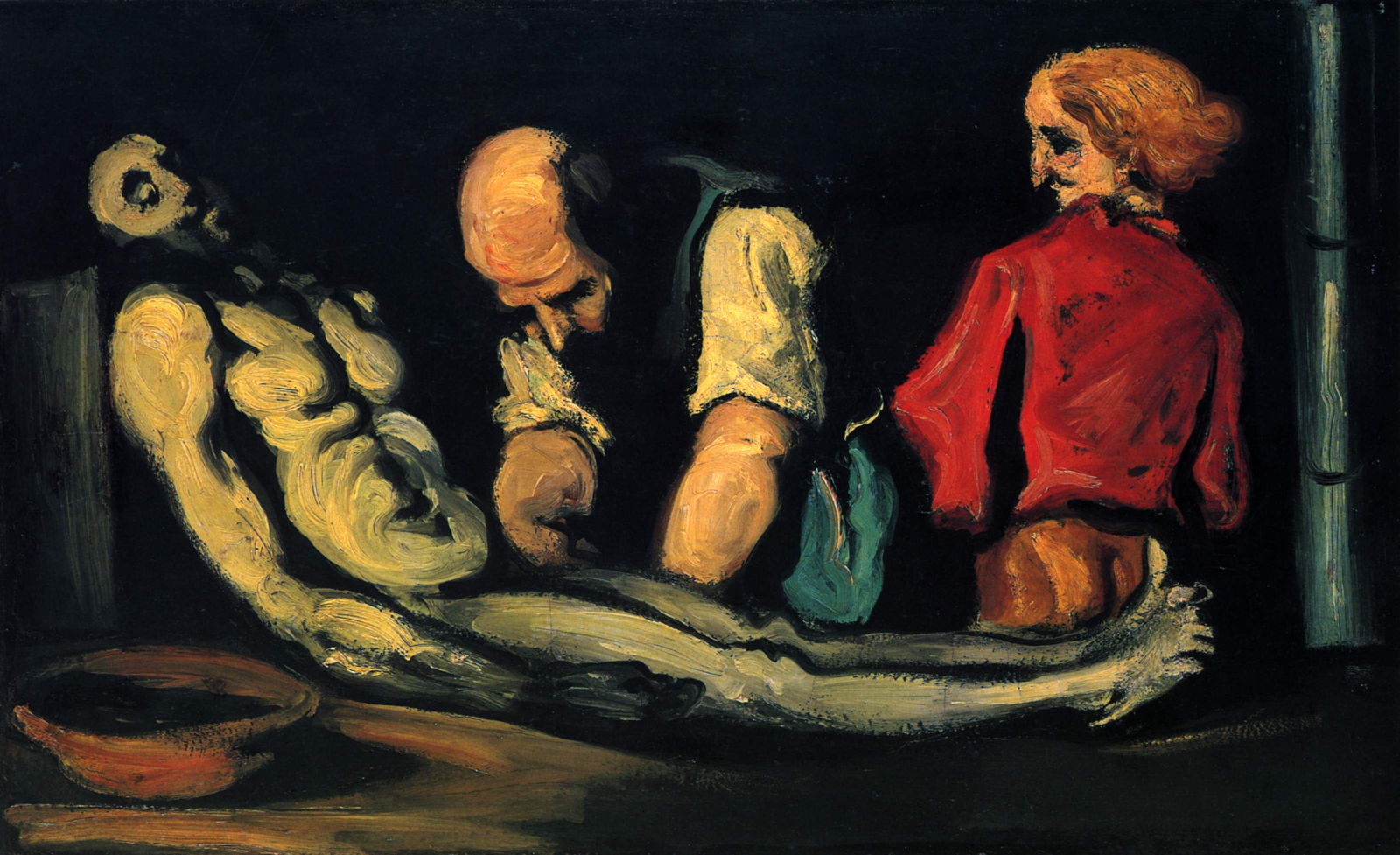
During this ‘dark’ period, Cézanne painted Preparation for the Funeral or Autopsy (1869), possibly intended for the hospital in his home town of Aix. This seems to have been the culmination in a sequence of works including The Rape and The Murder.
In early 1869, Cézanne met Hortense Fiquet, a part-time model, and they began living together. On the outbreak of the Franco-Prussian war in 1870, they fled to l’Estaque, close to both Marseille and Aix, where his paintings continued to become lighter. When they returned to Paris the following year, he started to paint in company with Pissarro, en plein air in villages along the River Seine not far from Paris, particularly in and around Pontoise. Over this period, he painted many landscapes in Impressionist style.

This painting of The Railway Cutting dates from about 1870, the start of his Impressionist period.

In this Small Delft Vase with Flowers (1873) he makes no attempt to capture the finer detail of the decoration on the vase, and the flowers are loose in form and brilliant in colour. Two fallen petals are seen next to the base of the vase.
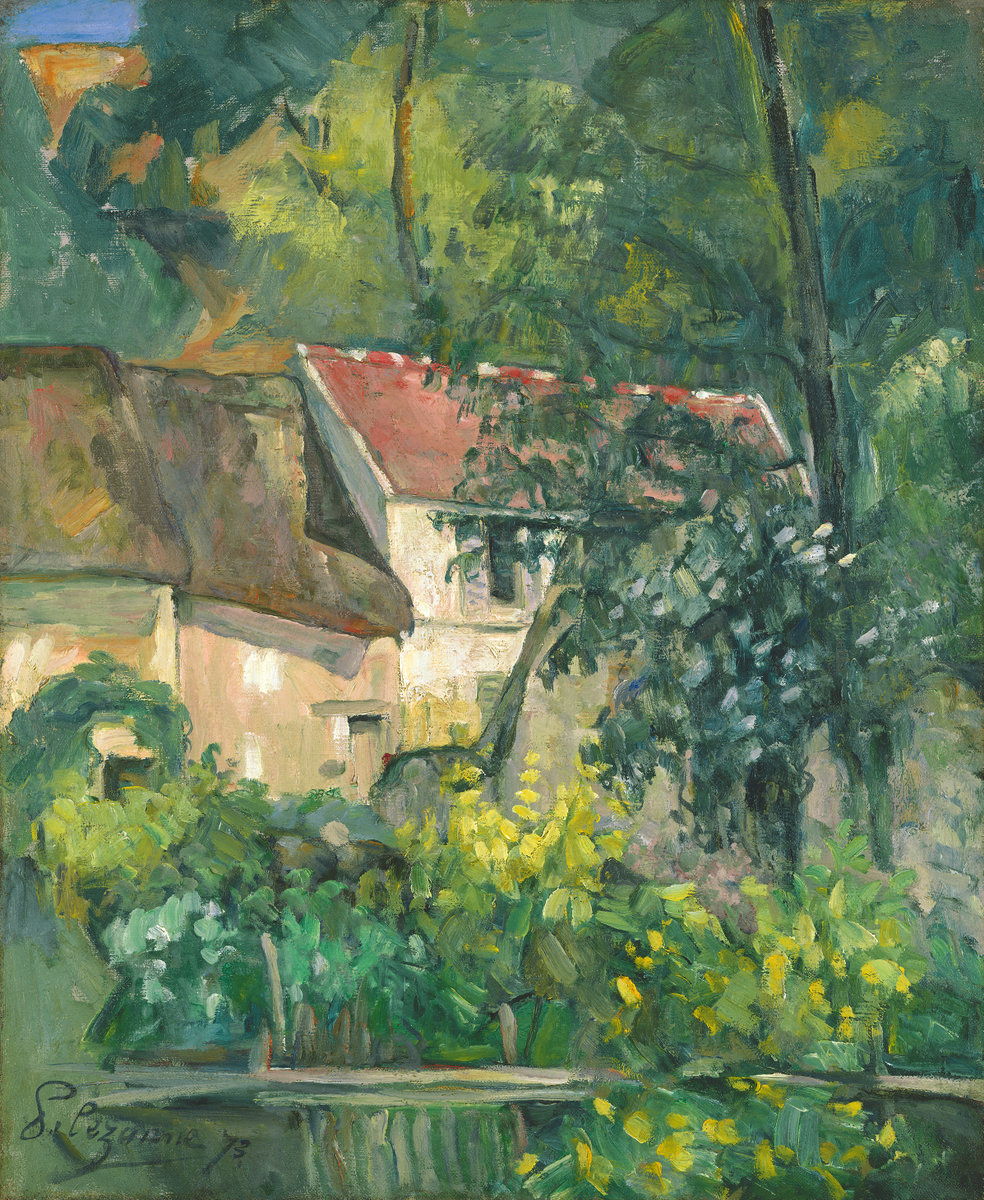
For Paul Cézanne learning to paint en plein air alongside Pissarro’s easel in 1873, cast shadows weren’t left until last, but painted as he completed each section of this view of the House of Père Lacroix, Auvers-sur-Oise. However, as with all beginners, he took a long time getting the painting to look right, so different sections of the roof were painted several hours apart, as reflected in the orientation of the shadows.
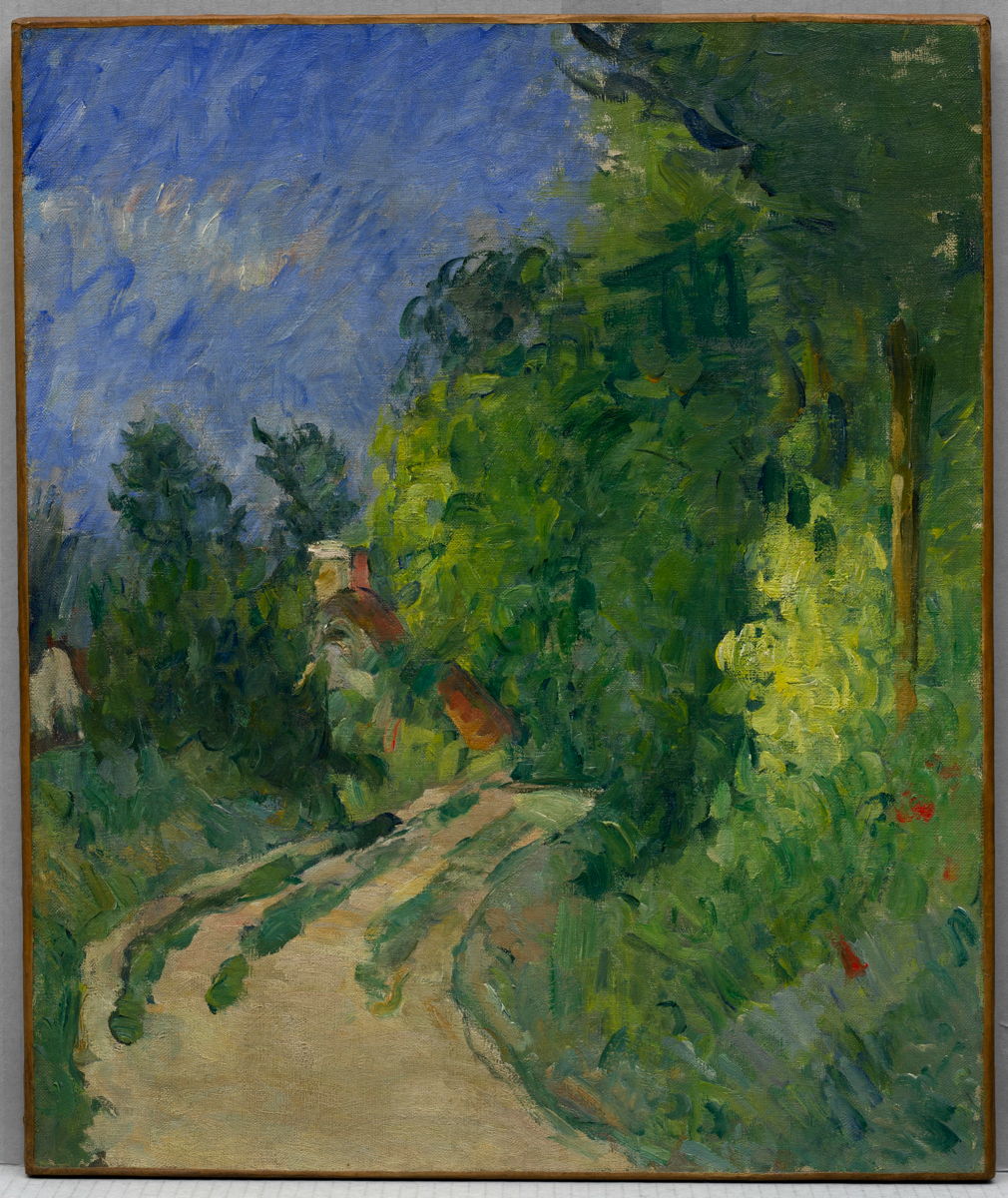
These early Impressionist paintings are light, high chroma, and worked briskly with broad brushstrokes. Accordingly his trees have quite solid canopies, with gesturally-marked trunks and branches, where the latter are visible. Although he used a range of colours across foliage, more subtle effects such as the textural differences between species aren’t apparent.

This view from Cézanne’s first campaign along the River Oise, painted in company with Pissarro, shows the northern bank near the hamlet of Valhermeil.

Painted in 1873-74, Cézanne’s A Modern Olympia is a return to his earlier figurative painting, but in a less dark style. Its quotation from Manet’s famous painting wasn’t appreciated as the tribute that he had perhaps intended.

Of all the paintings shown in Paris in 1874, Cézanne’s The Hanged Man’s House (1874) was among the most successful, as he sold it to the collector Count Doria for three hundred francs.
At the First Impressionist Exhibition, Paul Cézanne showed just three paintings, listed in the catalogue as:
- The House of the Hanged Man, Auvers-sur-Oise (above),
- A Modern Olympia (study) (above),
- Study: Landscape at Auvers.
During the 1880s Cézanne’s style became more distinctive and parted company from mainstream Impressionism. In the next decade it had become sufficiently different as to be termed Post-Impressionist, and a major influence for the next century’s art. Yet for much of the time until his death in 1906, Paul Cézanne painted in glorious isolation, and his work was largely ignored by other artists and critics. One of the few artists who maintained friendship, and sometimes painted in company with him, was Auguste Renoir.
References
Hans Weevers’ page with a thorough literature survey.
The First Impressionist Exhibition (in Italian), containing
the exhibition catalogue
Buck S et al. (2008) The Courtauld Cézannes, Paul Holberton Publishing. ISBN 978 1 903 47084 8.
Machotka P (2008) Cézanne, The Eye and the Mind, 2 vols, Editions Crès. ISBN 978 2 753 70047 5.
Machotka P (2014) Cézanne: Landscape into Art, Arbor Vitae. ISBN 978 80 7467 049 7.
Shiff R (1984) Cézanne and the End of Impressionism. A Study of the Theory, Technique, and Critical Evaluation of Modern Art, Chicago UP. ISBN 978 0 2267 5306 5.
Simms M (2008) Cézanne’s Watercolors, Between Drawing and Painting, Yale UP. ISBN 978 0 300 14066 8.
Smith P (1996) Interpreting Cézanne, Tate Publishing. ISBN 1 85437 171 1.
Solana G (2014) Cézanne, Site / Non-Site, Museo Thyssen-Bornemisza, Madrid. ISBN 978 8 4151 1350 8.
 The Eclectic Light Company