
During the late 1880s, the New English Art Club had become the venue for the group of British Impressionists. But it was mixed company, alongside Naturalists who had a different outlook on painting. So in 1889, Philip Wilson Steer and others broke away and formed the London Impressionists, centred on the Goupil Gallery in the city.

Now the leader of the breakaway London Impressionists, Philip Wilson Steer continued to paint the beaches of the Suffolk coast, here at Southwold in about 1889.

In about 1893, Jacques-Émile Blanche took another break from his studio to nip over to France and paint Dieppe Beach in August.
Walter Sickert had been born in Munich, Bavaria, to a Danish artist and his British wife, but his family moved to London when he was eight. He became assistant to, and a pupil of, Whistler, was advised by Edgar Degas when he visited Paris, and joined the New English Art Club in 1888. Although known better for his later paintings with muted colours, Sickert did sometimes adopt a more Impressionist style.

Fine sunny weather in about 1899 heightened the chroma in his View of the Hôtel Royal, Dieppe Beach.

This is another View of the Hotel Royal painted by Sickert in Dieppe, probably in the same year. He had another reason for visiting Dieppe so frequently at this time, as it was where his mistress lived.

Blanche continued to paint Dieppe Beach (1910) most summers while he was living and working in London.
Sir John Lavery was born in Belfast, now in Northern Ireland, but trained in Glasgow, Scotland, and painted from his studio in London for much of his career. Although the core of his paintings are portraits, he was a late adopter of Impressionist style in his seascapes.

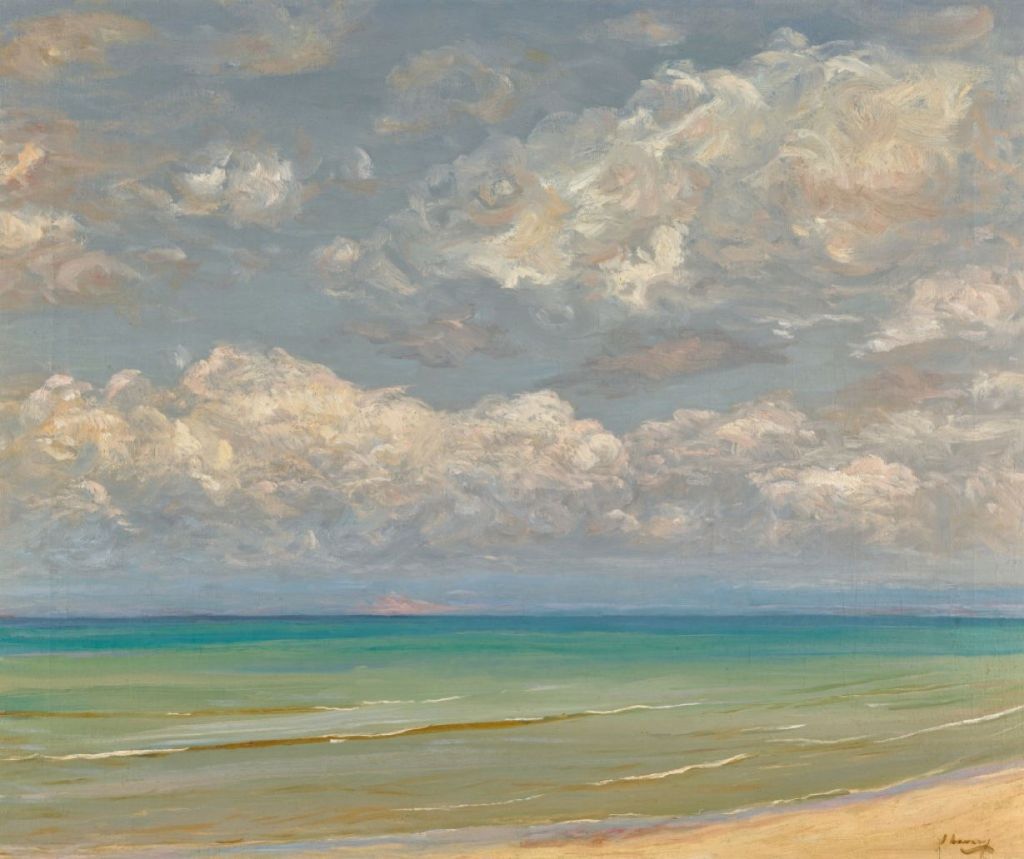
A Southern Sea (1910) may be a view across the Strait of Gibraltar, which could be the prominent peak on the horizon. Although other paintings of his from the early twentieth century had become much tighter, the clouds here are particularly painterly.
During the First World War, Lavery was an official war artist, but was injured fairly early, and mainly painted scenes of industry in the UK. For those he returned to realism and fine detail, and his loose brushwork didn’t return until after he had painted the formal surrender of the German High Seas Fleet in November 1918.

Tangier Bay, Sunshine (1920) is more obviously a view from Tangier Bay looking north across the Strait of Gibraltar, which is seen in the clear above the end of the small jetty at the left. This appears to have been sketched in oils in front of the motif.
The last of my British Impressionists is Alice Maud Fanner, who was one of the Impressionists in the New English Art Club, and retained the style until well into the twentieth century.

Fanner’s Burnham-on-Crouch – The Smack Race shows two racing boats heading into Burnham, Essex, a rival to Cowes for yachting, where boats on the moorings are fully dressed for the occasion of the regatta.
British Impressionists never matched those of the Nordic countries who assembled each summer at Skagen in Denmark, and have largely been forgotten today. But several went on to form other schools, including the Camden Town Group, led by Walter Sickert. As for those beaches, I suspect they’ve been fairly deserted this weekend, but they remain popular during each summer.

