

As the nights get longer, and the sun rises lower above the horizon, in these northern latitudes, this weekend we’re off to escape to Egypt, first for a little taste of its history, then on a tour in the company of some fine landscape artists.
With increasingly reliable means of travel in the early nineteenth century, it became more feasible for artists to travel to North Africa, including Egypt, which could also be coupled with a visit to the holy sites of Palestine. Quite inappropriately, this became dubbed Orientalism, although the great majority of works were painted in lands to the south rather than the east of Europe.
The land around the River Nile supported one of the oldest Mediterranean civilisations, going back to more than three millennia BCE. Some of the oldest paintings that can be reliably interpreted as being narrative are those of the ancient Egyptians. By about 1300 BCE there were many good examples of stories being told through paintings on various supports, most clearly the Books of the Dead to accompany royal burials.

The Weighing of the Heart from the Book of the Dead of Ani (c 1300 BCE), now in The British Museum, is one of the clearest examples. In the lower tier of images, the painting is read from the left. It first shows Ani and his wife Tutu entering the assembly of the gods. The centre section shows the god Anubis weighing Ani’s heart against the feather of Maat; should his heart be heavier, then he won’t be admitted to heaven.
This procedure is observed by the goddesses Renenutet and Meshkenet, the god Shay, and his own soul or ‘ba’ bird. The right section of the lower tier shows the monster Ammut, who is poised to devour Ani’s soul if his heart were to prove heavy, hence unworthy of heaven, and Thoth is there to record the outcome. The upper tier shows the other gods overseeing proceedings.
Skipping on to the first couple of centuries CE, Romans who lived in cities to the south of Cairo were buried with some of the earliest known funerary portraits painted using encaustic (wax) media.

This portrait of a woman known now as The European is among the most hauntingly beautiful of these, and was made between 80-200 CE using encaustic paint on a cedar panel. Rendered in fine, close-packed strokes of encaustic wax to model the form, the eyelashes have been formed by scraping away wax to reveal the underlying black ground. Small squares of gold leaf were applied around her neck, and the board cut down to size to fit the facial area of the woman’s mummy for interment.
The painter is believed to have been one of many professionals who made funerary portraits for the Romans who lived in the Egyptian city of Antinoöpolis, on the bank of the River Nile. Hundreds of others have been extracted from the underground burial sites of the Roman settlements along the Nile Valley. Among the most famous sites are Fayum, to the south of Cairo, Antinoöpolis further to the south, and Thebes, towards the southern limit of these Pharaonic Settlements.
These artistic treasures of Egypt prompted artists in northern Europe to paint how they imagined the civilisation might have looked, usually linking to biblical accounts.

Israel in Egypt (1867) is one of Edward Poynter’s first grand spectacles, a highly detailed panorama intended to show the Israelites during their time in bondage in Egypt. Although the popular press appreciated his archaeological basis, archaeologists of the day pointed out how he had conflated elements from the temples of Thebes, Edfu, and Philae, together with the Great Pyramid at Giza, and the limestone cliffs of Thebes.

In José María Avrial’s Pharaoh’s Daughter Rescuing Moses from the Nile from 1862, the story of Moses’ infancy is told in the tiny group of figures overwhelmed by its massive buildings. The artist provides a literal account, with Moses’ sister Miriam watching from the lower left corner as her baby brother is presented to Pharaoh’s daughter.
Others were fortunate enough to visit in person. In December 1842 and January 1843, before he became mentally ill, the young British artist Richard Dadd accompanied his patron on an extended cruise on the River Nile, enabling Dadd to paint several archaeological sites.

Tombs of the Khalifs, Cairo (c 1842-43) is a conventional watercolour ‘drawing’ which must have been just the sort of illustration his patron would have wanted for the book he was writing about these travels.
A decade later, the young Pre-Raphaelite landscape artist Thomas Seddon travelled to Palestine and Egypt to paint.

Seddon’s watercolour View on the Nile near Cairo is dated 1855, but I suspect it was painted prior to his journey to Jerusalem in May 1854; if not then, in the autumn of 1856 at the start of his second visit to Cairo.

Seddon’s last painting, of The Pyramids at Gizeh, is believed to have been painted in the autumn of 1856, and there’s also a second version of this view with even richer colours of sunset. Shortly afterwards, Seddon contracted dysentery, and died of that in Cairo on 23 November 1856, aged only thirty-five. The following year his paintings were exhibited at a memorial exhibition, and even the critic John Ruskin praised his “perfect artistical skill” and “topographical accuracy”.
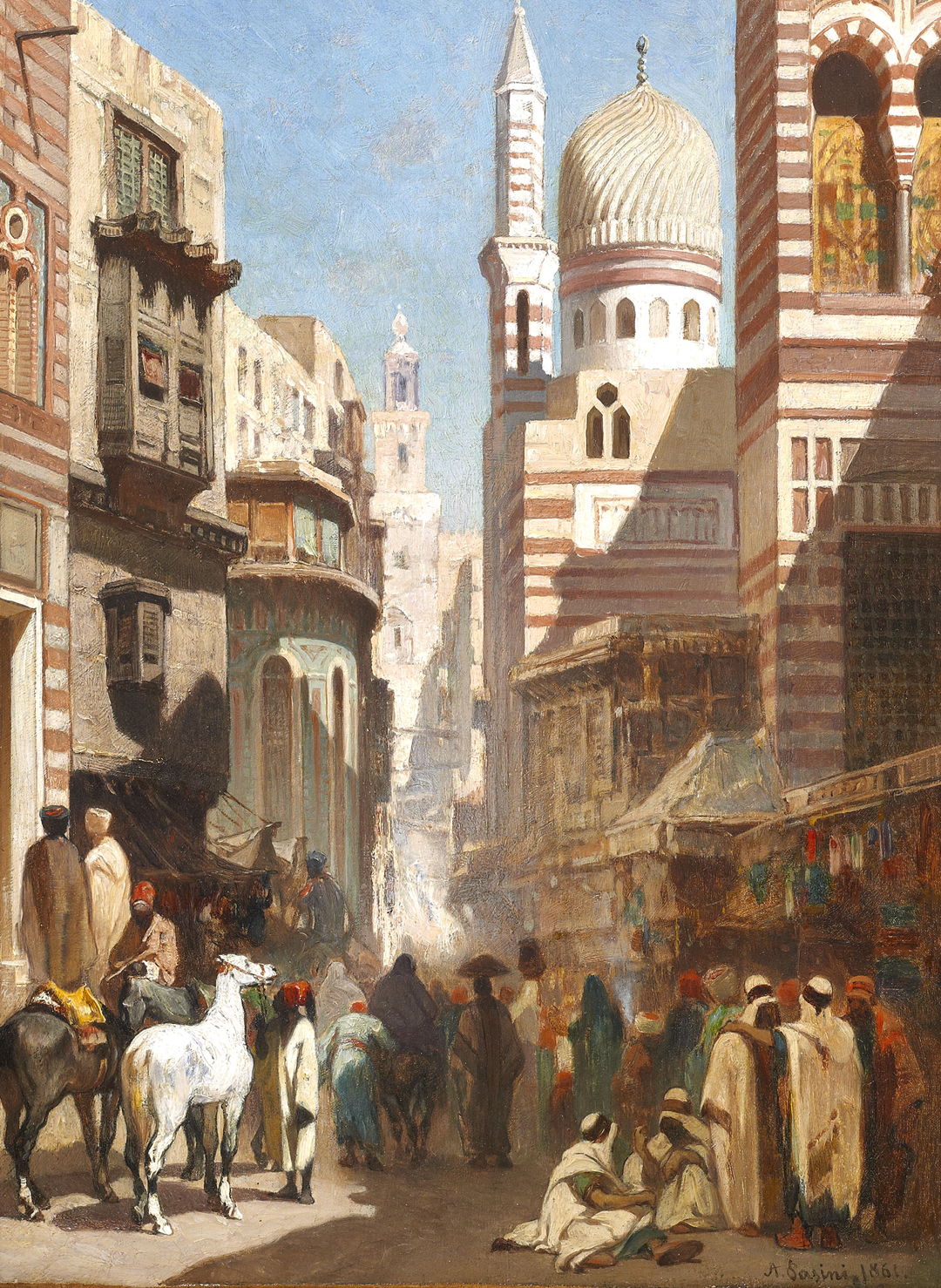
The Italian Orientalist artist Alberto Pasini visited Egypt a few years later, where he painted this marvellous view of Al-Khudayri Street, Cairo in 1861. Although it has been claimed to show the ancient Ibn Tulun mosque, its famous spiral minaret, and the Saladin fortress in the city, it looks more of a composite inspired by those buildings rather than a faithful depiction. The street below is bustling with those passing through, and the market stalls to the right. Pasini has been careful not to show the face of any of the figures.

