

In the Renaissance, many adults died before they were thirty, and we have no way of knowing how many aspiring Masters never achieved the greatness they deserved because they died before their talent became manifest. One painter who died tragically young but who had already transformed art was Tommaso di Ser Giovanni di Mone (Simone) Cassai, better known as Masaccio (1401–1428).
Born on 21 December 1401 in Tuscany, his father died when he was only five. He’s believed to have moved to Florence to start his apprenticeship in a painting workshop at the age of 12, but earliest reliable records are of his admission to the painters’ guild in Florence as an independent master in early 1422.

That year, his first as a master in his own right, he painted the Triptych of San Giovenale (1422), which was only discovered in 1961. Its central panel shows the Virgin Mary and infant Christ, with two winged angels in attendance. As is traditional, Mary is shown wearing a deep ultramarine blue cloak. The left panel shows Saints Bartholomew and Blaise, and the right panel Saints Juvenal (patron of the commissioning church) and Anthony Abbot.
This builds on the developments of Giotto in modelling faces, in particular, to impart a sense of depth. His attempt at perspective in the throne on which Mary sits is also unusually good for the time, although it clearly wasn’t formally projected to a single vanishing point and looks slightly out of kilter.
He seems to have travelled to Rome the following year with Masolino da Panicale (1383–1440), who was nearly twenty years older than him and much more experienced. In 1424 they were commissioned by Felice Brancacci, a wealthy and influential Florentine, to paint frescoes for his family chapel in the church of Santa Maria del Carmine in Florence. In 1425, Masolino left the remaining work there to Masaccio and went to Hungary. In 1426, Masaccio also left, possibly because of declining fortunes in the Brancacci family, but returned probably during 1427 and perhaps 1428 to paint further.
In the end, these frescoes were completed by Filippino Lippi in the 1480s. Unfortunately they were damaged by fire in 1771, and some areas were obscured by the later addition of marble slabs. All have now undergone modern cleaning and restoration so they can be seen in their full glory.

In St. Peter Healing the Sick with His Shadow (c 1425-8), the saint (foreground) is walking through a street in Jerusalem. In his shadow is a line of the sick: closest to the viewer, and only now in the saint’s shadow, a man is low down on the ground, crippled. Just behind him, and being healed as we watch, an older man is half-risen. The two men standing behind him have already been healed, and the nearer holds his hands together in praise at his miraculous recovery. The figure at the back of that line, wearing a red hat, has been identified as Masolino.
Masaccio here uses meticulously drawn one-point perspective to great effect, giving the wall and its accessory structures real depth, with the vanishing point situated off to the right.

In February 1426, Masaccio was commissioned to paint a large and complex polyptych altarpiece for a chapel in the church of Santa Maria del Carmine in Pisa, and he spent much of that year working on it. It appears to have been completed by the end of 1426, but in the 1700s it was dismantled and its individual paintings dispersed. Masaccio’s design was centred on The Virgin and Child with Four Angels, and this reconstruction shows how the eleven panels so far identified were probably placed. It’s thought to have originally consisted of a total of twenty panels.
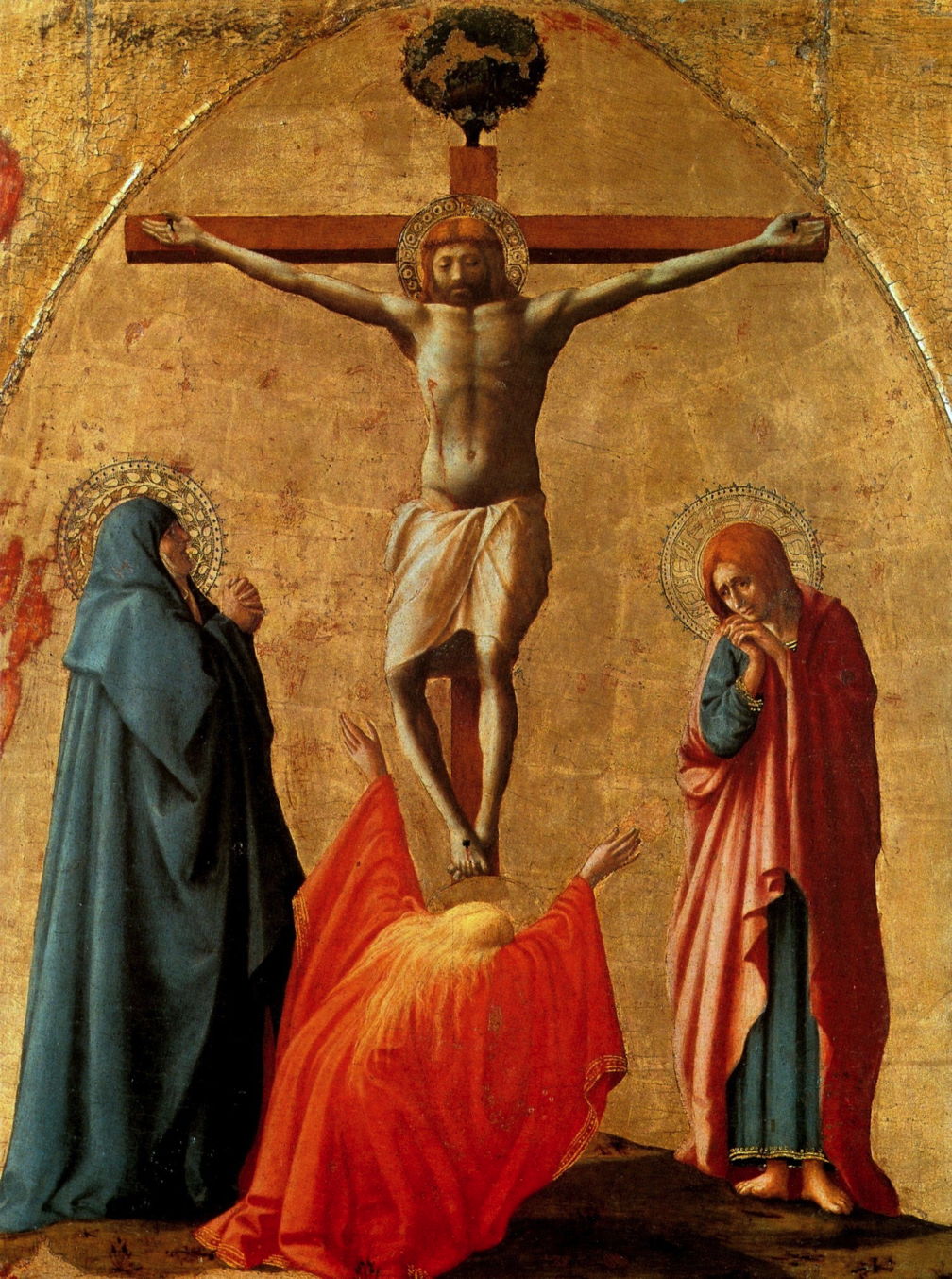
One panel of central importance is his Crucifixion (c 1426), composed to the standard formulae. In keeping with his efforts to depict 3D space more faithfully, Masaccio has painted this in recognition of the fact that, at the top of the altarpiece, it will always be viewed from below. Accordingly Christ’s head appears to be oddly flexed at the neck when the painting is seen from perpendicular to its picture plane. He has shaded and modelled Christ’s body, the faces, and clothes of the three Marys to give effective depth and volume.

Stories of St Julian and St Nicholas (1426) shows two of the stranger scenes from the lives of the Saints. On the left, Saint Julian the Hospitaller kills his parents while they are asleep in their bed, something he was tricked into doing by the devil. In the central alley, he is shown a second time, now covering his face in despair at what he has done. On the right, Saint Nicholas looks into the house of a poor man and his daughters, and gives them three golden balls to fund the girls’ marriages.
Masaccio experiments with perspective here, by projecting both scenes in common. In order to do so, the room at the right is rotated slightly. His cross-sectional views appear novel, and although the projection looks a little strange, I think it works.

Raising the Son of Theophilus and Saint Peter Enthroned (1425-8) is one of the more elaborate paintings in the Brancacci Chapel, and was one that Masaccio worked on in 1427. It combines the narrative of the miracle performed by Saint Peter after he was released from prison with some early church history.
He was taken to the tomb of the son of Theophilus, the Prefect of Antioch. The son had been dead for fourteen years, but the saint raised him from the dead. The boy is shown here amid bones from the tomb, his hands raised in amazement. Saint Peter is seen standing in front of the boy, and again in a painting hanging at the right. According to the story, this miracle so impressed the people of Antioch that they all converted to Christianity, and built a large church in the town. In the centre of that they provided Saint Peter with a large chair, so that he could sit throughout the long sermons, and that is shown in the painting.
Several of the figures are believed to show important Florentines of the day. The group at the far right is of particular interest: it’s claimed they represent (from the right) Brunelleschi, Alberti, Masaccio (self-portrait), and Masolino. However, Alberti and his family had been exiled from Florence to Genoa, and he was not allowed to return to the city until 1428; even then it seems most unlikely that he would have got to know Masaccio or Brunelleschi sufficiently well to appear in this way.
In addition to the extensive modelling of garments and faces, Masaccio here manages convincingly accurate two-point perspective projection.

The Tribute Money (1425-8) is probably the summit of Masaccio’s achievement in the chapel. Based on a story from the Gospel of Matthew in which Christ directs Peter to find a coin in the mouth of a fish so that he can pay the temple tax, Masaccio restages it and paints a composite in multiplex narrative. In the centre, the tax collector asks Christ for the temple tax. At the far left, as indicated by Christ and Peter’s arms, Peter (shown a second time) is taking the coin out of the mouth of a fish. At the right, Peter (a third time) pays the tax collector (shown a second time) his due.

He painted this Madonna and Child, known as the Madonna Casini, in about 1426-7 as a private commission, probably for Antonio Casini, a cardinal from Siena. The Virgin Mary, wearing her dark ultramarine robe, is swaddling the infant Christ in her left arm. With her right hand, she raises two fingers to bless him, but these appear to be tickling his neck; this accounts for the painting sometimes being known at the tickling Madonna. Christ also wears an unusual coral necklace, known as an apotropaic amulet, to bring good fortune. Another innovative feature is the three-quarter view of the Madonna.

In 1427, Masaccio was commissioned to produce a fresco on the Holy Trinity for the church of Santa Maria Novella in Florence. The painting’s patrons are thought to be the man shown to left of the Virgin, and his wife to the right of St John the Evangelist, from the Berti family.
This shows the traditional Christian Trinity of God the Father (top), God the Son or Christ (on the crucifix), and God the Holy Spirit (white dove flying from God the Father). At the foot of the crucifix are the Virgin Mary (left) and Saint John the Evangelist. The tomb at the bottom of the painting is that of Adam, the first man. The inscription on that tomb reads Io fui gia quel che voi siete e quel ch’io sono voi anco sarete: I once was what now you are and what I am, you shall yet be.
Masaccio required at least 28 days of fresco painting, judging from the areas covered in each session. For the first time in any painting, its perspective projection was realised by rigorous geometric means: Masaccio placed nails in the plaster, incised lines into its surface, and used ropes to project accurately to the vanishing point below the base of the cross.
This was not only the first major painting to use strict linear perspective projection, but was also a remarkably early trompe l’oeil painting, giving the optical effect of another chapel receding through the wall on which it is painted. This could only have been accomplished by meticulously accurate perspective projection, and careful choice of the vanishing point so that it looked right to the viewer.

Over the previous couple of years, in his fresco paintings in the Brancacci Chapel, Masaccio showed that he was capable of using not just one-point but even two-point perspective. However, as I explained in my earlier article, Brunelleschi had only recently discovered linear perspective, and Alberti had not yet written his book On Painting explaining how to use it.
It’s perfectly possible that by this time, Masaccio had learned the skills and techniques he needed to paint this extraordinary work. However it’s much more likely he was at the very least aided by, and probably worked throughout with, someone who understood the geometrical theory and intricacies of perspective.
The two main sources of information about perspective in Florence in the period 1425-1435 were Brunelleschi himself, and Alberti. However as I pointed out above, Alberti was in exile in Genoa, and wasn’t allowed back into Florence until 1428, by which time Masaccio had solved the problems and the painting was probably complete. Furthermore when Alberti did return to Florence, he needed time to learn from Brunelleschi before he would have known any more than Masaccio already did.
Donatello, the sculptor, was a close friend of Brunelleschi and might have been able to work with Masaccio on perspective. However, he was probably away most of the time working on commissions in Pisa and Siena. I therefore consider it most likely that Brunelleschi himself should be credited for his major contribution to this painting.
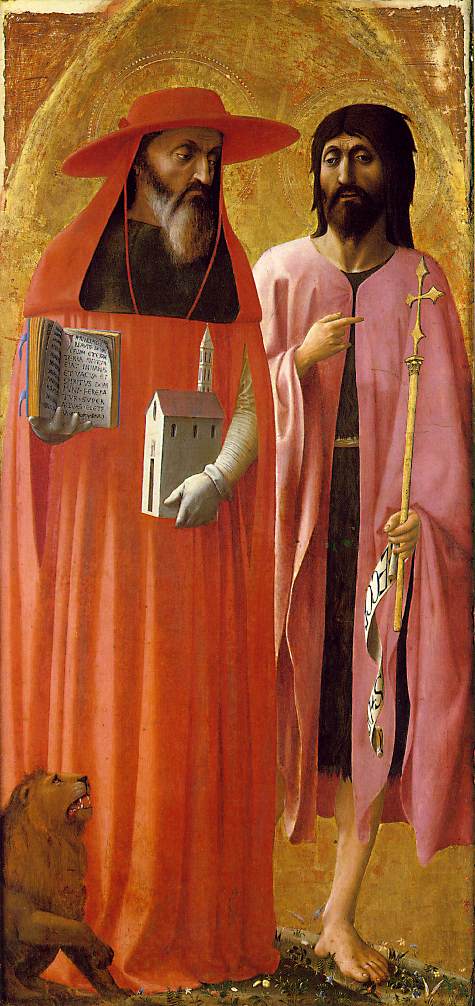
It is not clear whether The Holy Trinity or this painting was Masaccio’s last work. This was another made jointly with Masolino, who had been working on a polyptych for the altar of the Basilica of Santa Maria Maggiore in Rome. Masaccio’s panel shows Saint Jerome dressed in a cardinal’s scarlet robes and hat on the left, and Saint John the Baptist, looking rugged on the right.
Masaccio’s modelling of volume is superb, and the faces most lifelike and expressive. Small details, such as the lion at the lower left, and the flowers at their feet, are shown in excellent, realistic detail. Masaccio has brought painting from the flat icons of the Gothic into a new age of Renaissance realism.
In the spring or summer of 1428, Masaccio left for Rome, probably to meet Masolino who was then working on a fresco in the Basilica di San Clemente. Later, probably during the summer, he was reported to have died there, at the age of just 26. Although some have suggested he was poisoned, his untimely death was much more likely the result of infectious disease or an accident.
References
Article here on the early history of linear perspective.
Wikipedia
List of paintings on Wikipedia
Spike JT (1995) Masaccio, (French translation) Liana Levi. ISBN 978 2 8674 6133 0. (Also original English version and other translations.)

