
Before the development of photography during the nineteenth century, painting and drawing were the primary forms of visual art. Yet a substantial proportion of the population have some form of visual impairment. Colour vision is considered to be abnormal in as many as one in twenty males in most Western countries, and over half the adult population need to wear spectacles to restore their visual acuity. You might therefore expect some well-known and accomplished painters to fall into either or both of those groups.
If you search for a term like colour-blind artists, you’ll see several websites claiming that Vincent van Gogh, Edgar Degas, Claude Monet and others had deficiencies of vision, or abnormal colour vision. In this short series, I will consider what evidence in their art might support or refute such claims.
By the very nature of painting, the sense of sight and vision are at its heart. Explored in depth by many great artists, it finest visual expression is in Annie Swynnerton’s The Sense of Sight from 1895.

It was painted at a time when those influenced by Aestheticism were referring to other sensory modalities, including music, in their images. This could be seen as a reaction to such diversions, bringing the focus of visual art back in a visually arresting manner.
While there’s currently nothing that can be done to restore normal colour vision to the one in twenty men who are unable to see the full spectrum, corrective lenses in some form of spectacles have been available in Europe since the end of the thirteenth century, and they have been sold widely since the mid-fifteenth century.
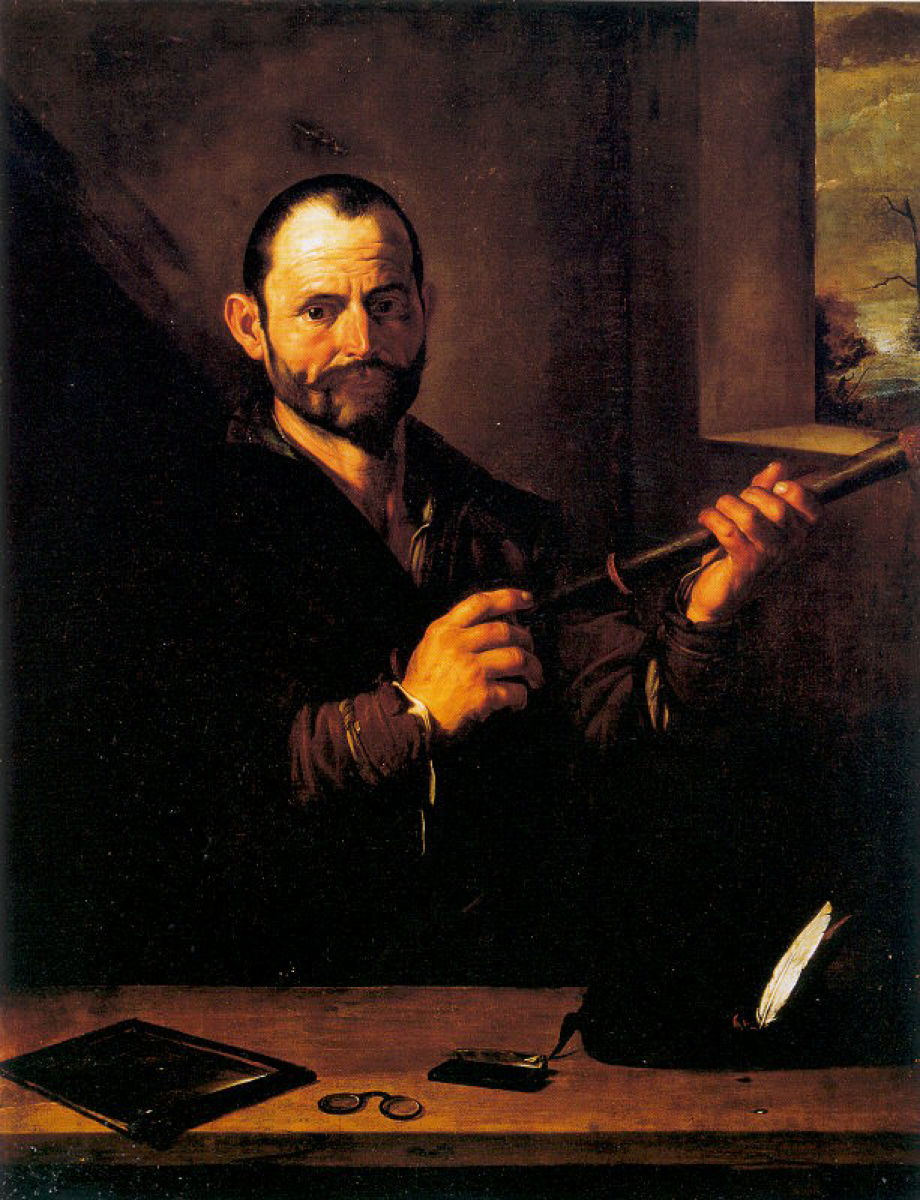
Jusepe de Ribera painted his Allegory of Sight (1615-16) just a few years after the appearance of the first working telescope in 1608. Ribera’s figure is surrounded by these wondrous new inventions, as well as a traditional flat mirror, next to which is a pair of spectacles. In his hands is an early telescope, possibly made in the Netherlands or Germany.
Yet remarkably few paintings show people wearing spectacles.

Four Figures on a Step (c 1655–60) is probably Murillo’s finest and most enigmatic secular work, showing four disparate characters from the street life of Seville. At the right is an older woman wearing prominent pince-nez spectacles that look out of place. She is plainly dressed, and sits with the head of a young boy on her lap. Her hands rest on his hair, as if checking it for nits and lice. It has also been suggested that her spectacles and scarf refer to the celestina figure of Spanish literature, making her a procuress, presumably for the young woman in the centre.
Training as a painter was normally by apprenticeship in the workshop of a master registered with the local guild of Saint Luke, and was hardly conducive to those with any form of visual impairment.

Johann Georg Platzer’s The Artist’s Studio (1740-59) shows an apprentice or assistant using a muller, at the far right, to prepare fresh oil paint for the painters at work in this workshop. With the advent of tubes of paint in the nineteenth century, those with difficulty perceiving colour could rely on labels, but prior to that normal colour vision was essential for many of the duties expected of an apprentice.
Replacement of apprenticeships by the academy system of training was even more competitive, and unlikely to admit pupils with visual problems.
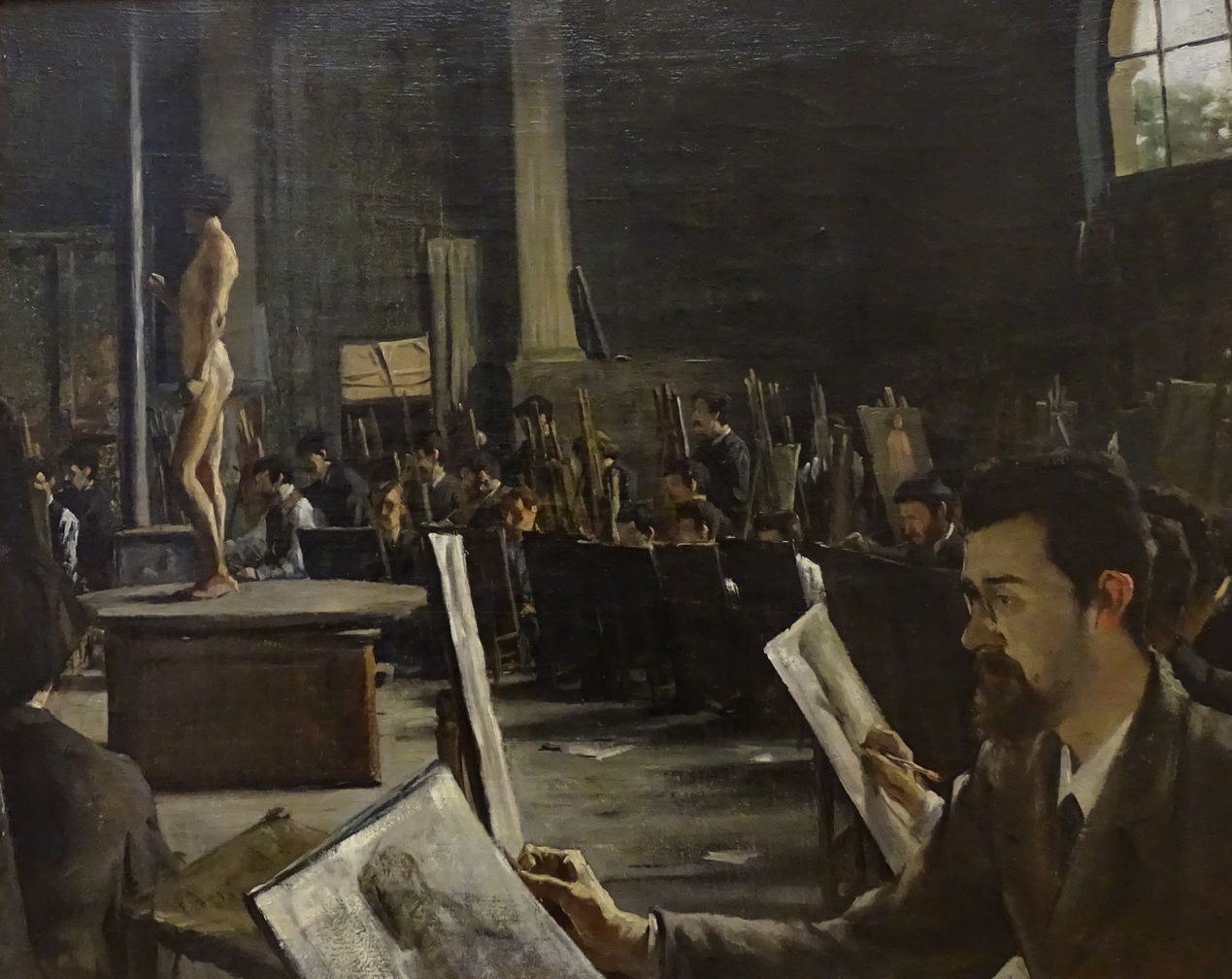
This painting by the otherwise forgotten Tancrède Baster, who was active around 1883-1890, shows Cabanel’s Studio at the École des Beaux-Arts in 1883, probably the most prestigious and demanding of the day.
Nevertheless some well-known painters have established records of visual problems, and there are claims those can be seen in their work.
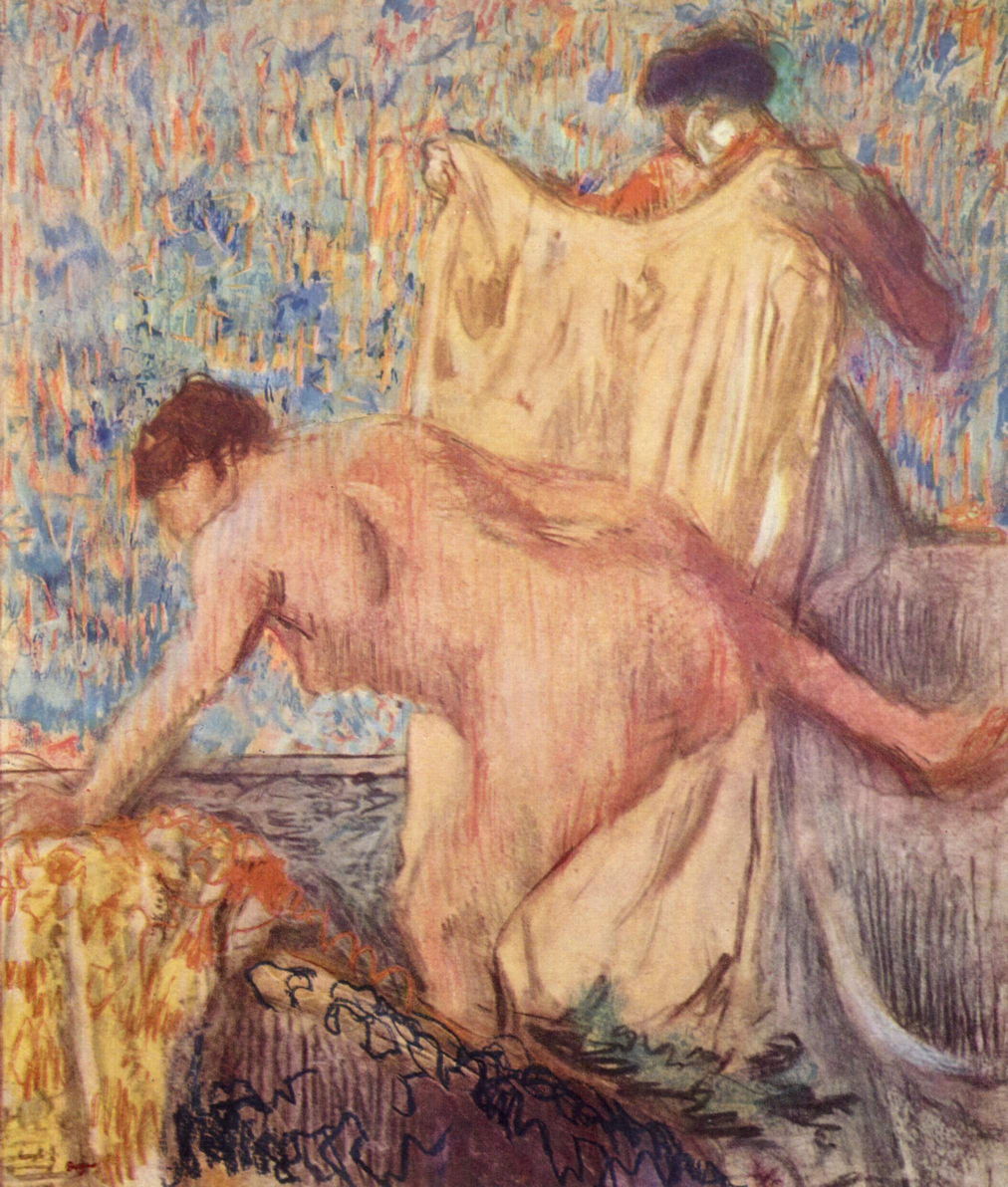
Edgar Degas is thought to have had problems from his early career, and is on record as complaining of them frequently, for example being unable to paint out of doors in sunlight. Some of his later paintings appear consistent with worsening eyesight as he grew older. His pastel painting of this woman Getting Out of the Bathtub from about 1889-90 shows his previously crisp and confident draughtsmanship starting to break up into more sketchy lines and vaguer forms.
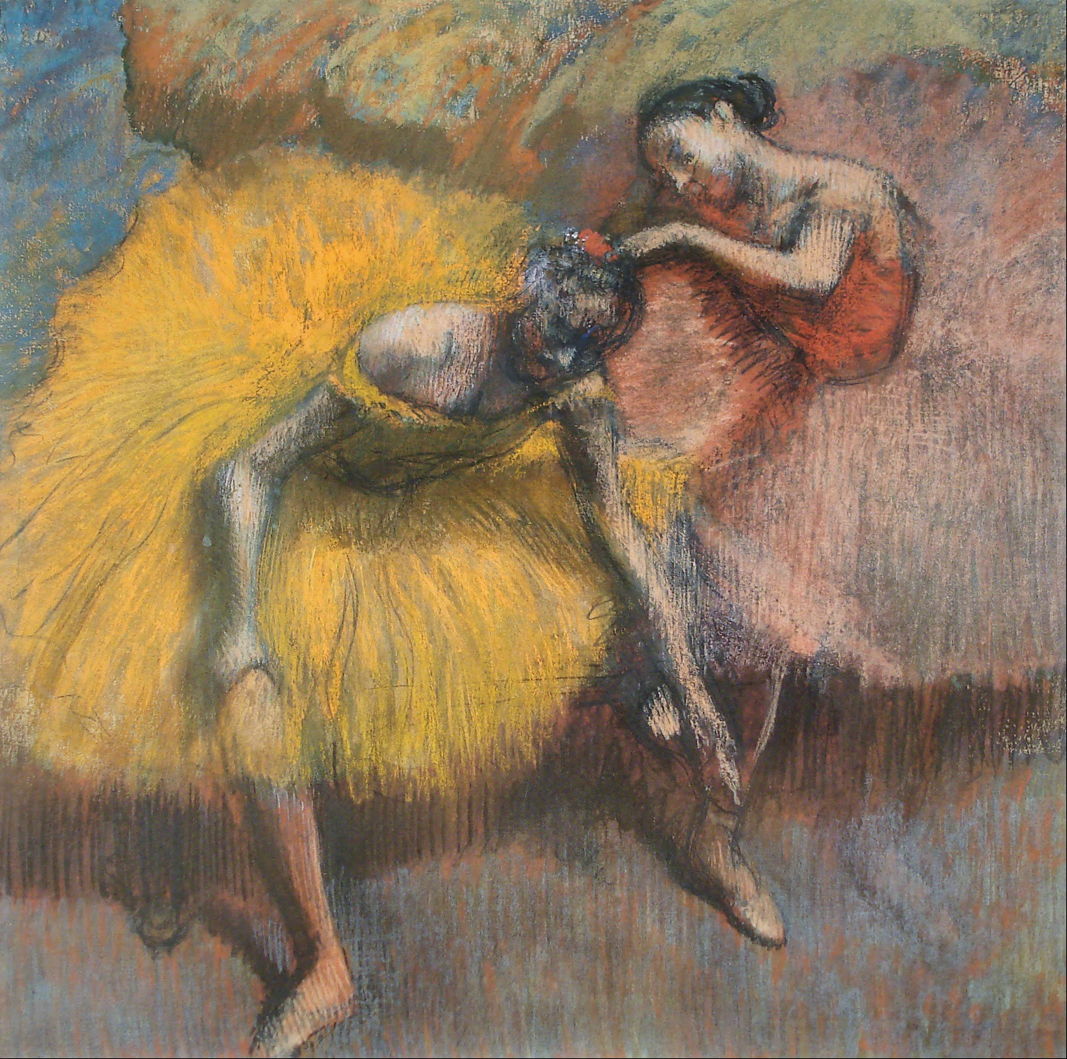
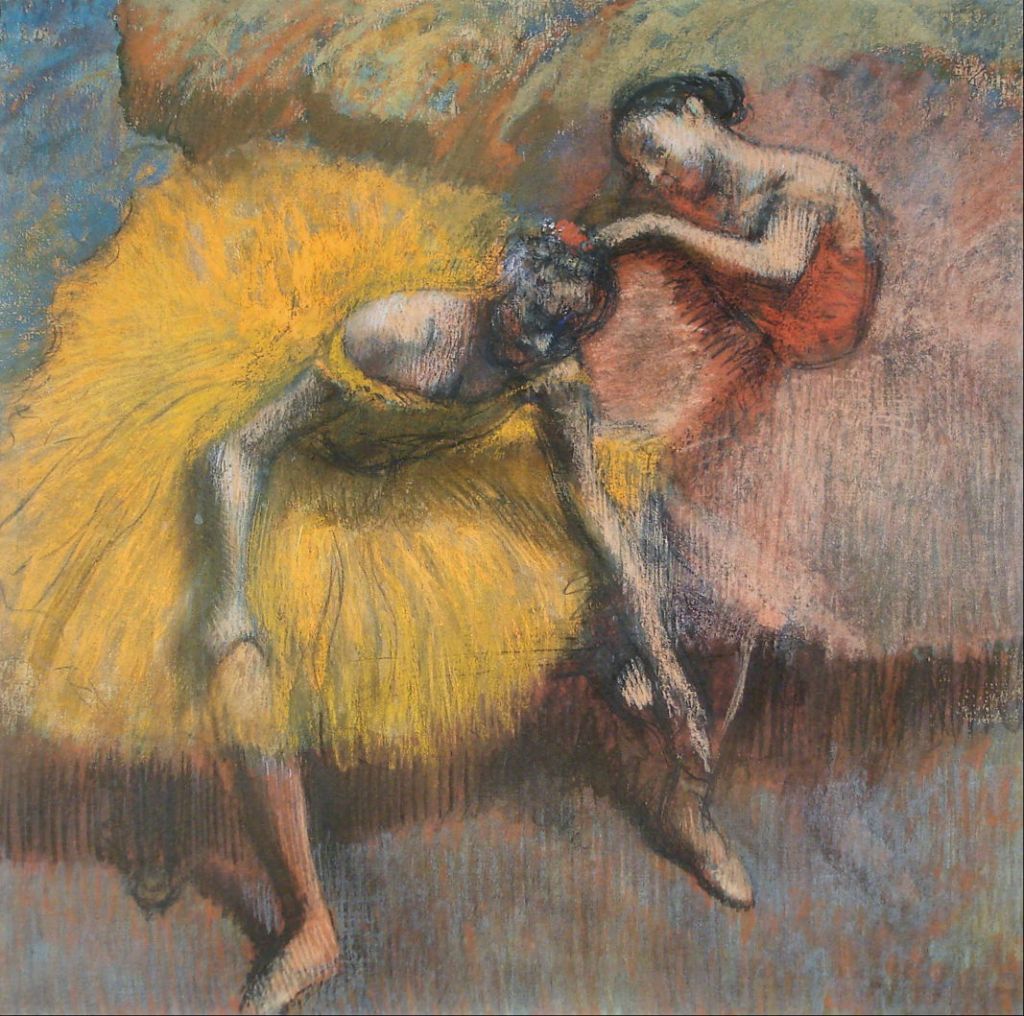
His Two Dancers in Yellow and Pink from about 1898 is highly textured with rich colours, but continues to lose form.
Another of the French Impressionists with documented evidence of eye problems is Camille Pissarro. By January 1896, when he returned to the city of Rouen for a second period painting there, he felt constrained to paint from inside the Hôtel de Paris rather than outdoors.

Pissarro’s Pont Boieldieu in Rouen, Rainy Weather (1896) is one of the finest examples of the view from his icy hotel room, looking out over the intense activity on and around this iron bridge which had only been completed in 1888.
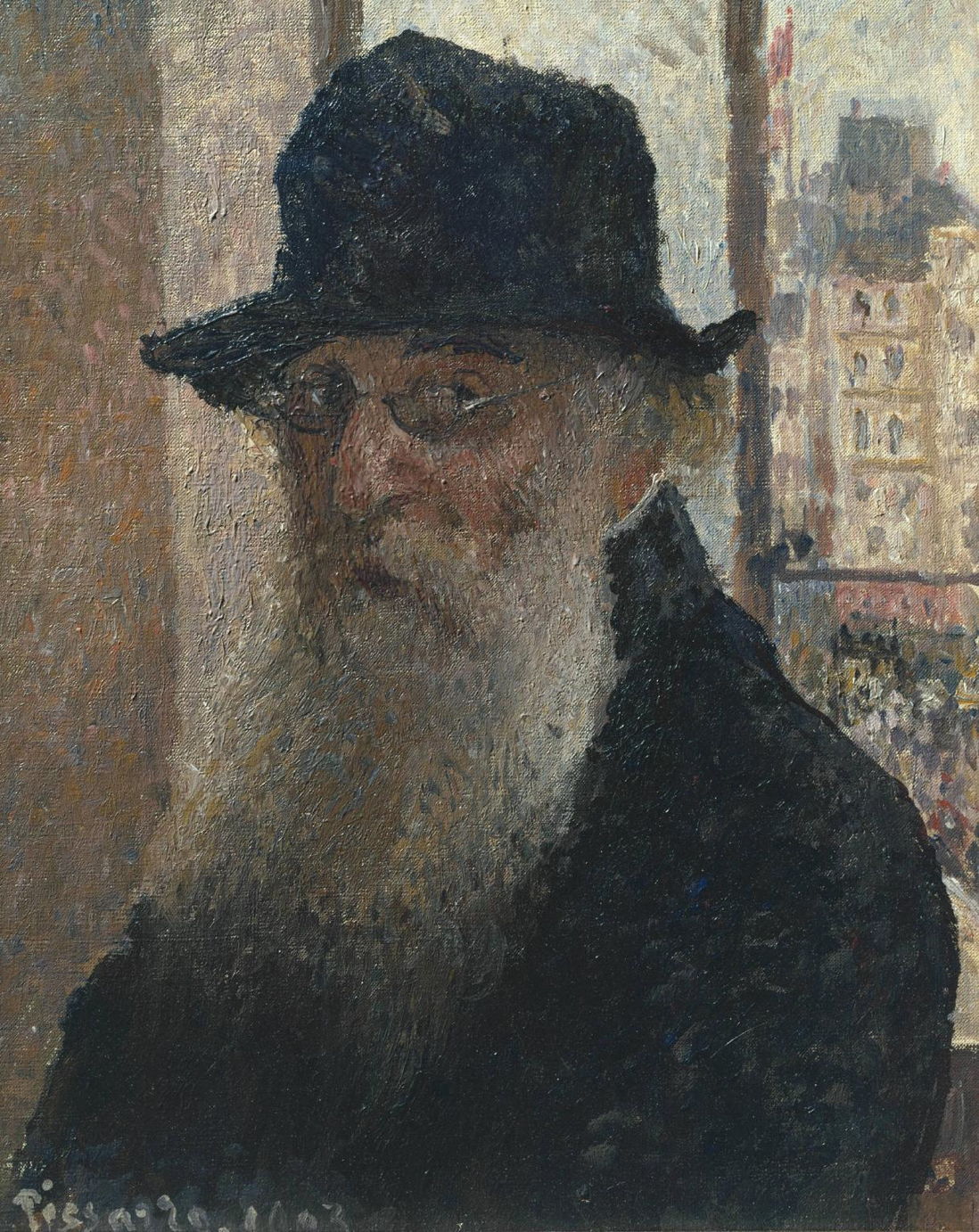
He is also one of the few major artists who was brave enough to paint himself wearing spectacles, in his swan-song Self-Portrait with Hat shortly before he died in 1903.
Most adults aged over fifty have evidence of developing cataracts in their eyes, and painters are no exception. Perhaps the most famous to battle through the blunted sight of cataracts is Claude Monet. By the end of the First World War, when he was in his late seventies, Monet had almost lost his sight, but continued painting series of water lilies in his garden at Giverny, and of weeping willows, as seen in the painting below, from 1918.

I hope you will join me as we follow in the footsteps of the great Patrick Trevor-Roper (1916-2004), an ophthalmologist who pioneered this field in his book The World Through Blunted Sight (1970), and his successors Michael F Marmor and James G Ravin, whose book The Artist’s Eyes (2009) is its worthy successor.

