

Venice was ideally situated for outbreaks of infectious disease during the Renaissance. A major seaport trading with most of the known world, it was densely populated, and in the summer the warm waters in the lagoon and canals, and its high population of rats, were perfect reservoirs. Every so often, a fresh wave of plague would sweep through the city, and a substantial proportion of its inhabitants would be stolen away to die on one of its dedicated plague islands.
In the summer of 1510, one victim who was taken to the island of Lazzareto Nuovo, and died there shortly afterwards, was Giorgio Barbarelli da Castelfranco, a young painter better known as Giorgione. His life and works are still the subject of mystery and speculation, but in his thirty-two or thirty-three years of life, he had become one of the most accomplished and celebrated artists in history.
Giorgione was born inland from Venice, in the small town of Castelfranco Veneto, in 1477 or 1478. One reason for uncertainty in many of these dates is that the Venetian year started on 1 March, so knowing only his year of birth following Venetian date conventions could put it anywhere between 1 March 1477 and 28 February 1478.
He was known to have been commissioned to paint portraits in 1500, and for an altarpiece in the cathedral of his home town in 1504. In 1507-8 there are records of him being involved in the painting of frescoes for the exterior of a building in Venice. Vasari’s account of his life claims that Giorgione met Leonardo da Vinci when the latter visited Venice in 1500 (or 1499). We also know that Giorgione was dead by October 1510.
Beyond those few dates, we know almost nothing factual about his life.
Ridolfi, a later biographer, states that both Giorgione and Titian were pupils of Giovanni Bellini (c 1430-1516), while Vasari states that Titian was in turn a pupil of Giorgione. All three appear to have known one another well, although whether there were simple master-pupil relationships is far less clear.
Giorgione’s only signed and dated painting is the portrait of ‘Laura’ from 1506. A small core of his surviving works match those described in the notes, between 1525 and 1543, of the Venetian collector Marcantonio Michiel. Vasari’s attributions are confusing, and change across different editions of his book. Over the years, art historians and connoisseurs have attributed more than a hundred paintings to Giorgione, but current experts are only generally agreed over some forty, of which I show a small selection.

Portrait of a Young Man (‘Giustiniani Portrait’) (c 1497-9) is one of the few unanimously agreed portraits painted by Giorgione, out of many that have been attributed. The identity of the sitter is unknown. It’s also agreed that this is an early portrait, and a remarkable achievement by a 20 to 22 year old. Unfortunately the letters V V were added in the 1800s, during a restoration.
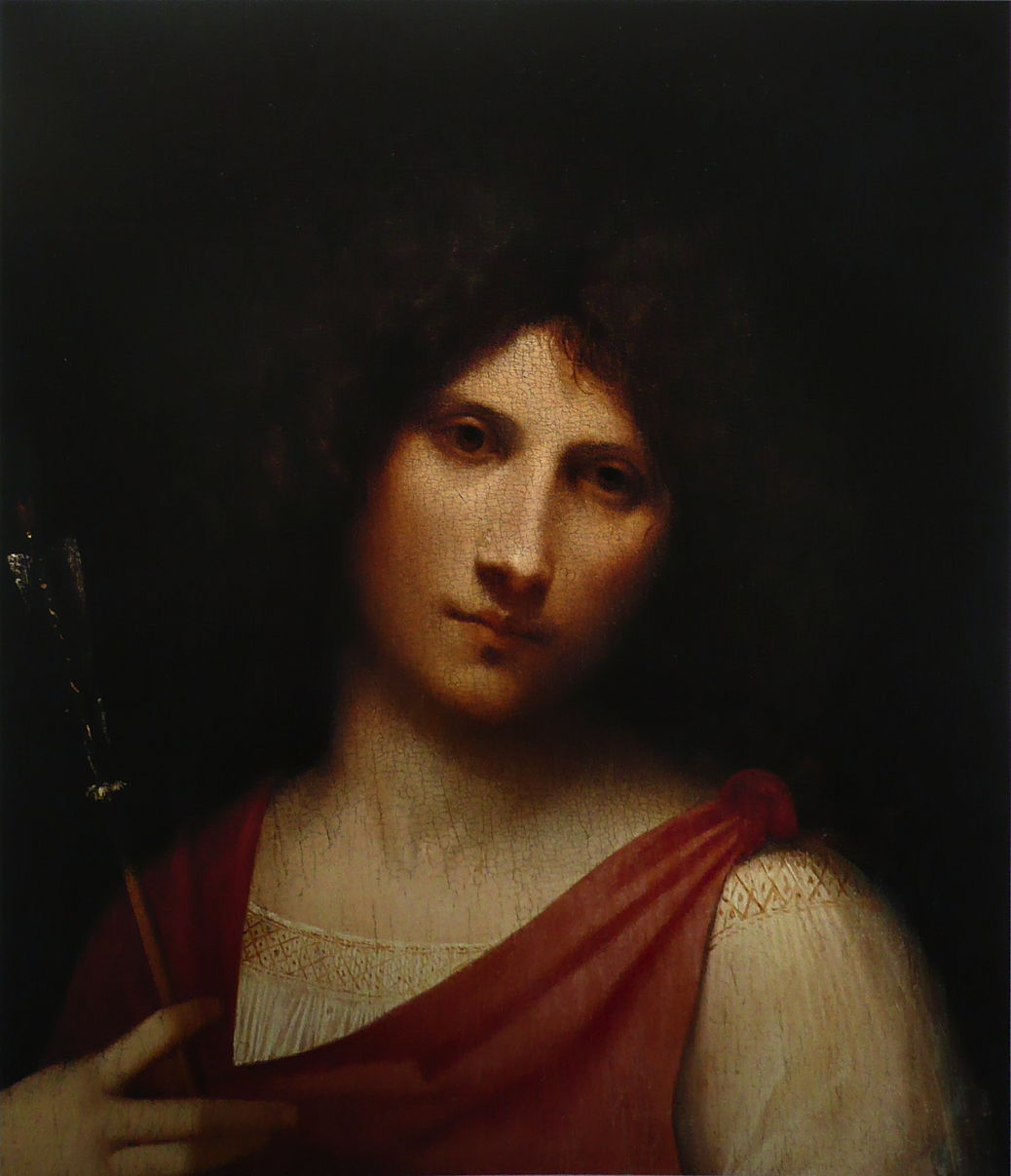
Boy with an Arrow (c 1500) is another brilliant portrait, which appears one of the more soundly attributed to Giorgione, according to Michiel’s account from 1531. His subtle modelling of this face may reflect what he learned from his meeting with Leonardo da Vinci in 1499 or 1500.

The Three Ages of Man (c 1500) is usually interpreted as an allegory, in which the young boy’s musical training by the older men is seen as an attempt towards a more universal harmony. The attribution of this painting remains controversial, as does its date. The faces are lifelike and expressive, and it is clearly from the hand of a master.

Virgin and Child with Saint Nicasius and Saint Francis of Assisi (‘Castelfranco Altarpiece’) (c 1500) is not only one of the most reliable attributions, but its date is also fairly secure. It’s one of Giorgione’s most brilliant paintings, combining a fine depiction of the Virgin and Christ child with two wonderful saintly figures – Nicasius’ armour is spectacular – and an innovative realist landscape. The buildings at the upper left are meticulously painted, and there is excellent aerial perspective at the upper right. At this time, the artist was still only 23.

Judith (c 1504) seems to have become one of the more secure attributions, and likely to date between 1500 and 1504. It’s an unusual and brilliantly painted full-length portrait of the Biblical Judith, with her left foot resting on the severed head of Holofernes.

The Tempest (c 1504-8) is one of the earliest ‘proper’ landscape paintings, and is well attested in Michiel’s notes from 1530. Its theme was to become familiar in the much later landscapes of Poussin and others, of an approaching storm. The sky is filled with inky dark clouds, and there is a bolt of lightning in the distance. The buildings of a small town back onto a little river, with a simple footbridge cutting the view in half.
The foreground is more enigmatic: on the right, a young infant is suckling from the breast of its almost naked mother, who sits on the bank of the river. She stares blankly at the viewer. On the left, a soldier stands bearing a staff against his right shoulder, looking across at the mother and child on the opposite bank. Trees frame the buildings and lightning in repoussoir, an extremely early and innovative use of this compositional device.
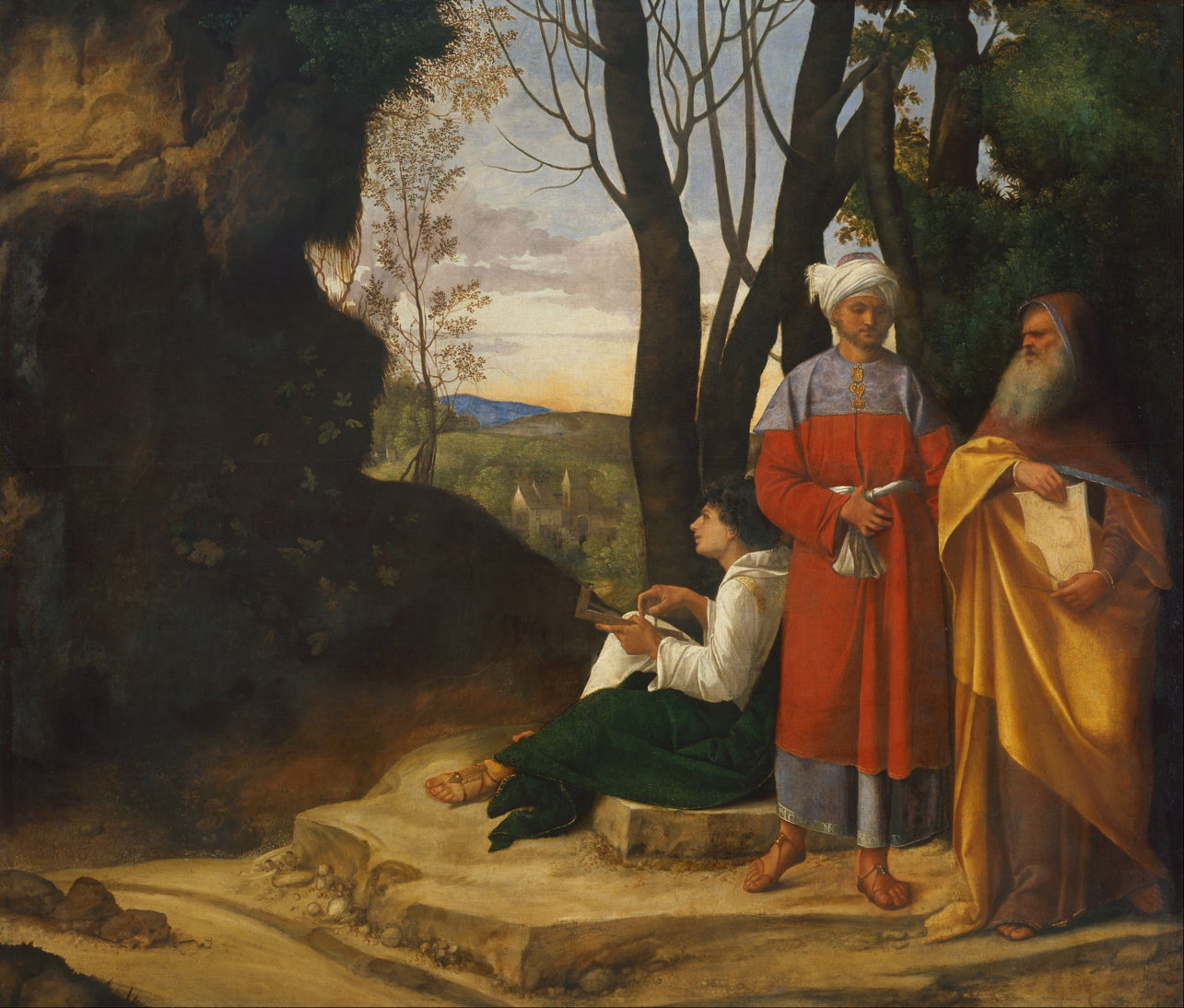
Three Philosophers (1504-8) is one of the earliest and most explicitly attested paintings in the notes of Michiel, from 1525, who stated that it had been completed by Sebastiano del Piombo (c 1485-1547), although recent convention is for Giorgione to be credited alone. He confirmed that the three figures are philosophers, which would include most of the sciences, and that the seated man is observing the sun’s rays. Michiel also considered that the rock was “so admirably faked”.

Portrait of a Young Woman (‘Laura’) (1506) is the only one of Giorgione’s paintings bearing an autographic inscription with a date:
On 1 June 1506 this was made by the hand of master Giorgio from Castelfranco, the colleague of master Vincenzo Catena, at the instigation of misser Giacomo.
Vincenzo Catena (or de Biagio) (c 1470-1531) is known largely from this inscription, and from a few paintings which have been attributed to him.
One of the finest portraits of the Italian Renaissance, this is believed to have been a bridal portrait intended to be seen in a domestic setting, hence the background of laurel foliage, and the right breast exposed from her fur jacket. It was also one of Giorgione’s earliest works to leave Italy, as it was bought and shipped to Britain to join the art collection of King Charles I in 1636.

The Adoration of the Shepherds (‘Allendale Nativity’) (1505-10) is an altogether more sophisticated and innovative painting, which should probably be attributed to Giorgione, according to current opinion. It shows two shepherds paying their respects to the newly born Christ and his parents, with superb modelling of those figures. Behind is an Italianate landscape with fine details and strong aerial perspective in the distant hills.
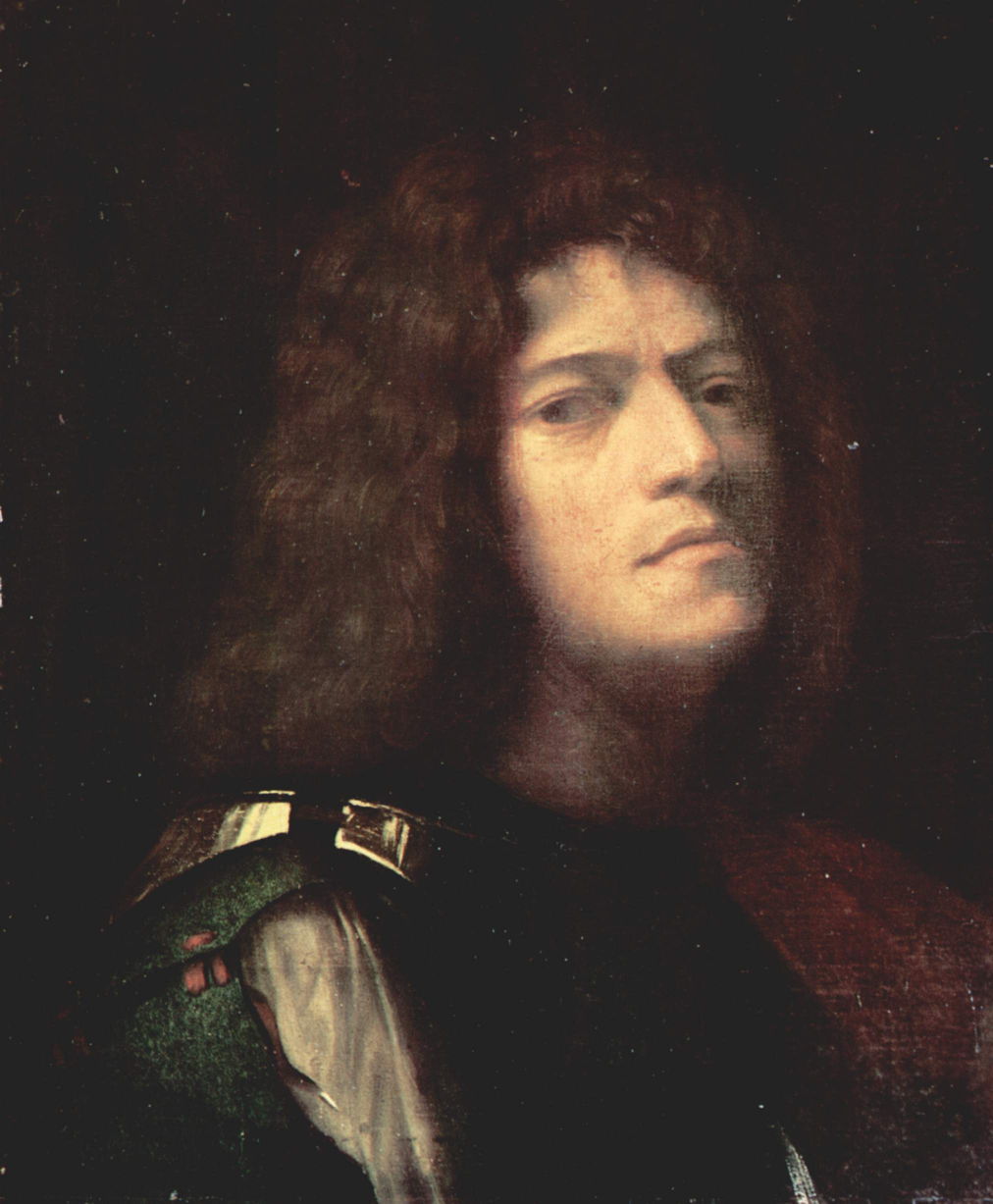
Self-portrait as David (c 1508) has been claimed to be Giorgione’s only self-portrait. It appears in a 1650 engraving by Wenceslaus Hollar, with the addition of a severed head, presumably Goliath’s, as a portrait of the artist.
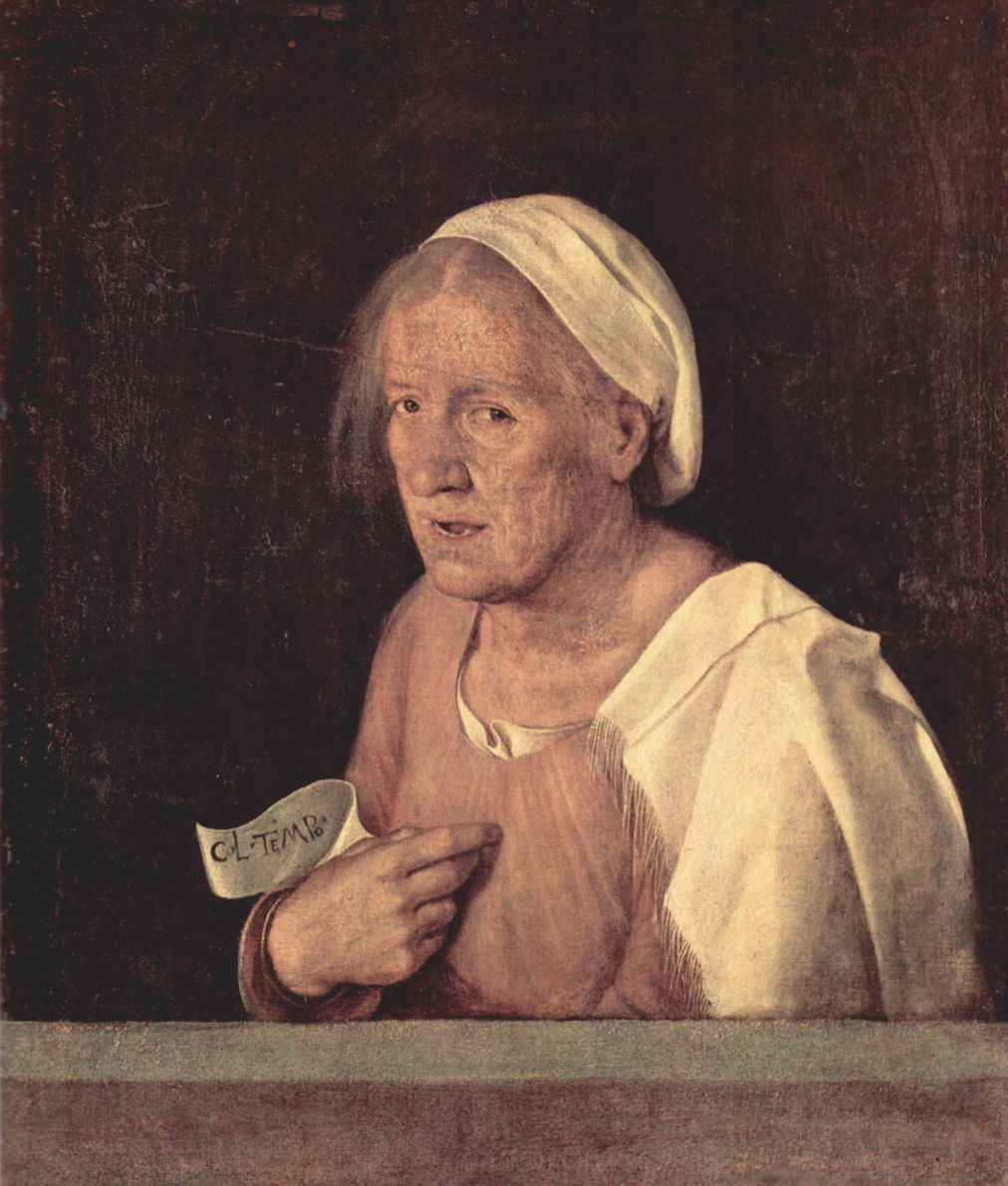
La Vecchia (The Old Woman) (c 1508-10) is a masterly portrait of an old woman who comes to life in its rich detail. The paper which she is holding bears the words Col Tempo – ‘with time’ – making it a reminder of ageing and the inexorable progress of time. This was first described in the late 1560s as depicting Giorgione’s mother, and has quite an extensive history following that, including spending a period with a cover portrait of a man, since lost.
Titian was in his early twenties when Giorgione died, so it isn’t possible to draw any firm conclusions on the influence that Giorgione may have had over his work. This is made the more complex by the difficulty in distinguishing their paintings: many which have in the past been attributed to Giorgione are now being considered to have been painted, or at least completed, by Titian.
If most of these attributions are correct, Giorgione appears to have been a key innovator and central figure in the development of the Venetian style. His portraits have a refinement that breathes life into their faces. Among his best are the paintings with the strongest evidence for being his: ‘Laura’, La Vecchia, and the full-length Judith.
References
Wikipedia
Facchinetti S & Galansino A (2016) In the Age of Giorgione, Royal Academy of Arts. ISBN 978 1 910350 26 3.

