

Most accounts of the history of narrative painting claim that it died during the nineteenth century. Although the stories told in visual art certainly changed, if anything there was more narrative painting during that century than at any time since the Renaissance. Here are some of the more prominent examples told using multi-image series.
Francisco Goya’s most remarkable paintings of the years before the Peninsular War were a series of six in which he told the story of the capture of a bandit known as El Maragato. This happened on 10 June 1806 near Oropesa to the south-west of Madrid, and it’s thought Goya based his account on a series of contemporary prints. These six paintings on panels, now in the Art Institute of Chicago, were apparently painted for his own interest.

In the fifth painting of the series, Friar Pedro Shoots El Maragato as His Horse Runs Off, orange and yellow flames are shown at the flintlock, and emerging from the gun barrel. El Maragato really has had a bad day: his horse has run off, he’s lost his gun, been overpowered by a friar, and shot in the buttocks.
You can see the complete series here.
Further north in Europe, successors to the tradition established by William Hogarth continued to moralise in sequences of paintings, among them Augustus Leopold Egg in Past and Present from 1858, on the perennially popular theme of the fallen woman.

The first shows an ordinary middle-class drawing room, in which there are mother, father, and two young daughters, each well-dressed. Most striking is the mother, who is lying prone across the green carpet. Her arms are stretched beyond her head, which is buried face down between her upper arms, and the hands are clasped together in tension.
The father is sat at a substantial circular table, facing the viewer. He is staring, brow furrowed, looking tense and worried. His left hand holds a small note; his right hand is clenched, and rests on the table. His left shoe presses a miniature painting into the carpet.
The daughters are playing together at the left, opposite their father, one kneeling, the other sat, on the carpet. They are building a house of cards, which is just about to fall. One stares, her mouth slightly open in anxious surprise, looking towards where her mother might have been standing before she fell to the floor. The other girl is still looking intently at the house of cards.
As with Hogarth’s narrative series, the room is full of cues, clues, and symbols to the narrative. Among the more visible are: the collapsing house of cards; an apple has been cut in two, one half left on the table, the other on the carpet by the mother; the reflection of an open door indicating the imminent departure of the mother.
Egg also uses Hogarth’s technique of paintings within the painting. On the wall at the left is the expulsion of Adam and Eve titled The Fall, below which is a miniature portrait of the mother; at the right is a shipwreck by Clarkson Stanfield titled Abandoned, below which is a miniature portrait of the father.

The two daughters are shown significantly older now. The senior is sat staring vacantly out of the open window at a three-quarter full moon, while her younger sister buries her face between the older’s knees, kneeling partly in prayer, and partly in grief. On the wall, separated by the window, are the miniature portraits of their parents. The sparsely furnished room, with bare floorboards, indicates their fall into poverty.

Meanwhile the mother is homeless, sat among the debris under the arches of one of London’s bridges. She stares wide-eyed and fearful at a star in the sky, cradling a young baby to her, under her thin cloak. Behind her, on the side of the arch, are old posters, one with the word VICTIMS prominent, another advertising excursions to Paris.
Egg’s three paintings have no individual titles, but when exhibited were accompanied by the text:
August the 4th. Have just heard that B______ has been dead more than a fortnight, so his poor children have now lost both parents. I hear she was seen on Friday last near the Strand, evidently without a place to lay her head. What a fall hers has been!
The clear implicit narrative is that the mother was in an adulterous relationship, which was revealed to the father in the moment of peripeteia shown in the first of the series. The other two paintings show the consequences.
The painter who came closest to creating an epic in his works must be Louis Janmot (1814–1892), whose series Le Poème de l’âme (Poem of the Soul) consists of no less than 34 images, of which the first eighteen are painted in oils, and the remaining sixteen are in charcoal. Miraculously, the complete series is still together, in the Musée des Beaux-Arts in Lyon, France. Although its caption doesn’t say so, each of the oil paintings is 130-145 cm in height, and 140-145 cm in width.

This is the third painting, titled The Angel and the Mother, set by the Lake of Moras, where the mother sits with the newborn soul on her lap. Its guardian angel is kneeling in prayer for the mother and the soul of her new child. This painting combines the images of the annunciation to the Virgin Mary, and the Virgin Mary with the infant Jesus.
You can see the whole of Janmot’s epic starting from here.
Completing substantial multi-image series proved even more difficult for others. In 1875 Edward Burne-Jones was commissioned to decorate the Music Room in Arthur Balfour’s central London house with his account of the myth of Perseus and Andromeda. Balfour was later to become Prime Minister of Britain. Burne-Jones worked on many sketches and preliminary designs, among which were gouache and gold layouts to show how his series of paintings would fit into their carved surrounds.
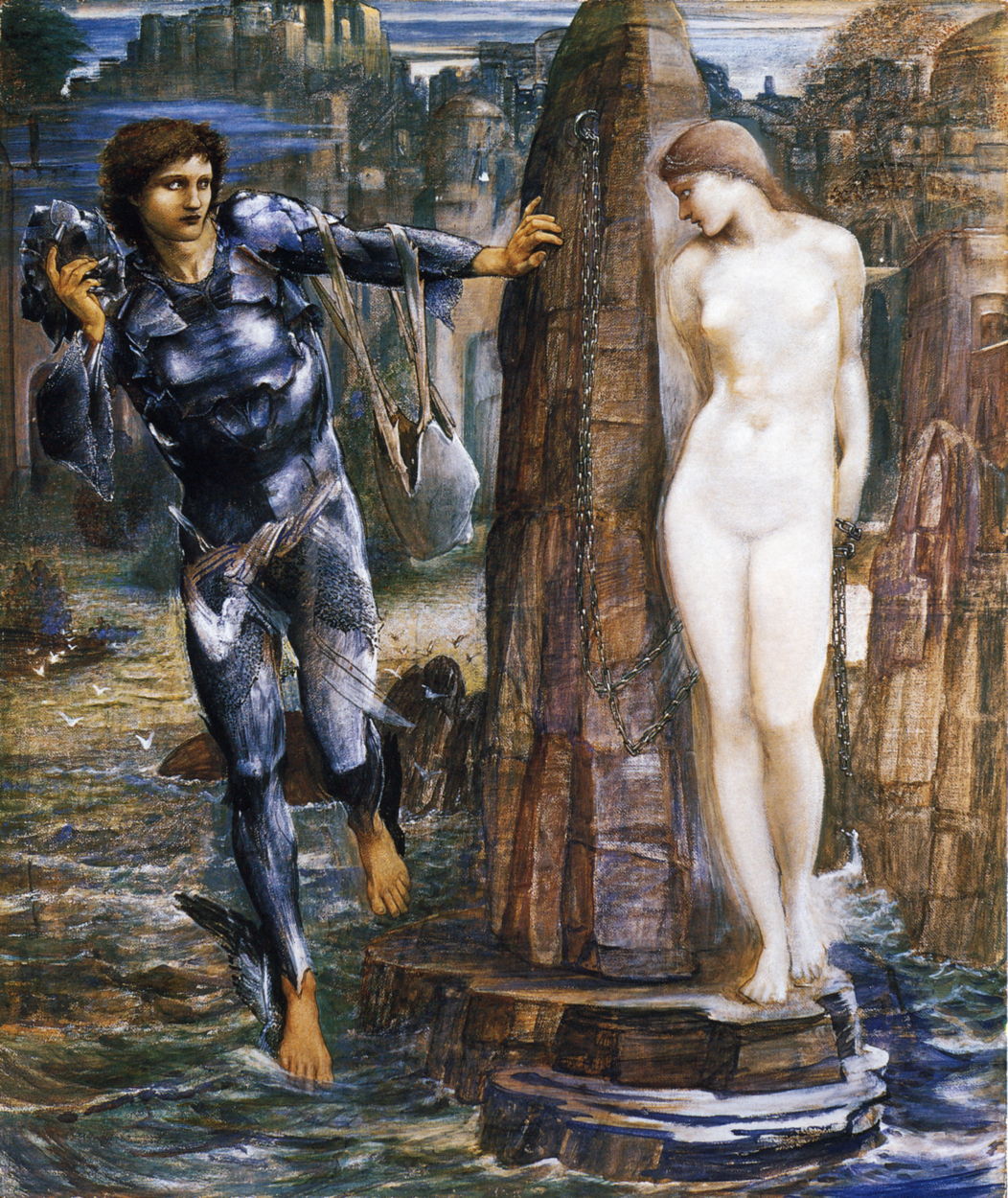
By the middle of the 1880s Burne-Jones was painting full-size studies in gouache. The eighth painting, The Rock of Doom (1884-5), takes Perseus on to his discovery of Andromeda, chained to the rock awaiting her fate in the maw of Cetus. His face looks hesitant and uncertain, and he has removed Hades’ helmet to make himself visible to Andromeda. Medusa’s head is safely stowed in the kibisis on his left arm, and Burne-Jones is faithful to the original Greek myth in having Perseus arrive on his winged sandals, not Pegasus.
For her part, Andromeda is naked, and looking coy and afraid, her face downcast. She is still chained to the rock, awaiting rescue. In the background, Burne-Jones shows what is presumably the capital of Aethiopia, or he may have accepted Strabo’s attribution to Jaffa. Burne-Jones completed a finished version of this bodycolour study in about 1885-88, shown below.
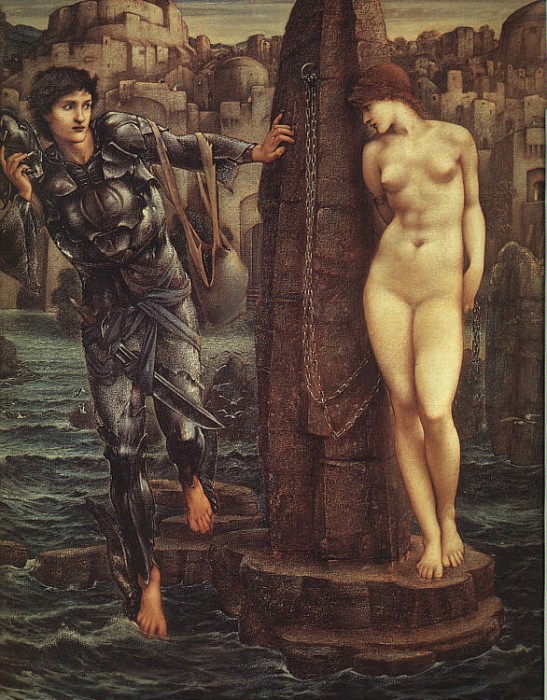
He continued to work on the Perseus series for Balfour, eventually completing only four finished versions in oils of the ten he intended, but progress slowed as the artist’s deteriorating health, other commitments and pressures took their toll. When Burne-Jones died on 17 June 1898, it remained incomplete and never graced the Music Room.
You can see the whole of Burne-Jones’ Perseus Series here.

