
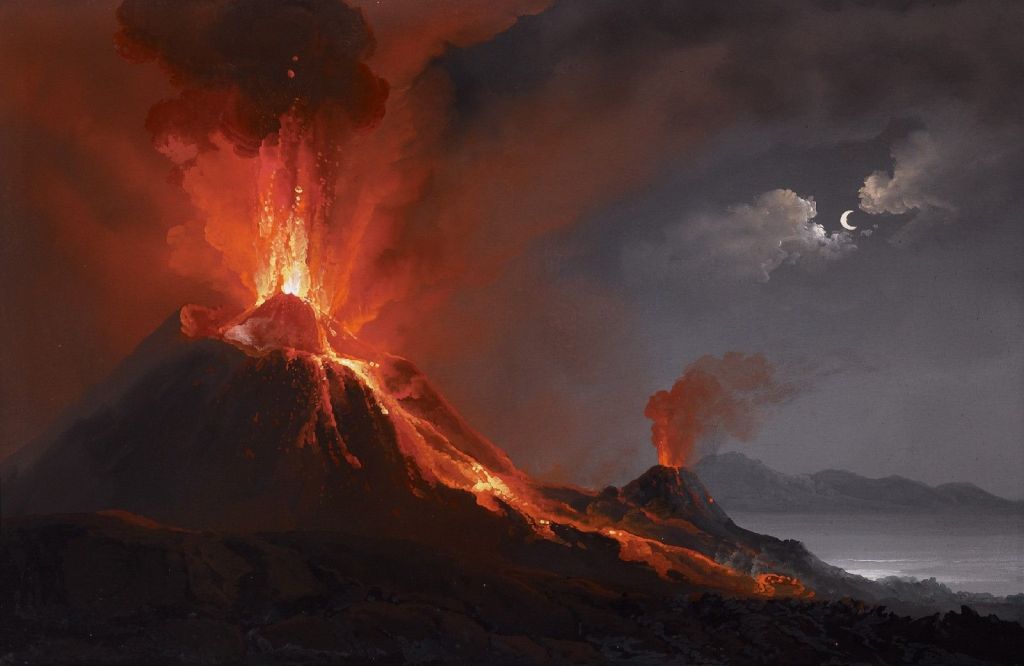
Although there are many worthy volcanoes on other coasts, particularly around the Pacific ‘rim of fire’, the volcano most favoured by European artists is Mount Vesuvius, which sits brooding over the city of Naples from the middle of the Bay of Naples, in the Mediterranean. Although it only reaches 1,281 metres (4,203 feet) elevation, it does so from sea level.
We know a great deal about its successive eruptions for the last two millennia of its 25,000 year history as an active volcano: in 79 CE, it overwhelmed several Roman towns including Pompeii, burying their inhabitants in tombs of ash and rock. Since then, Vesuvius has erupted dozens of times, and at present over half a million people live in the ‘red zone’ at greatest risk of flows of molten lava. The volcano has long been a tourist attraction, and since 1880 visitors have been able to travel up to its summit in a cable car.
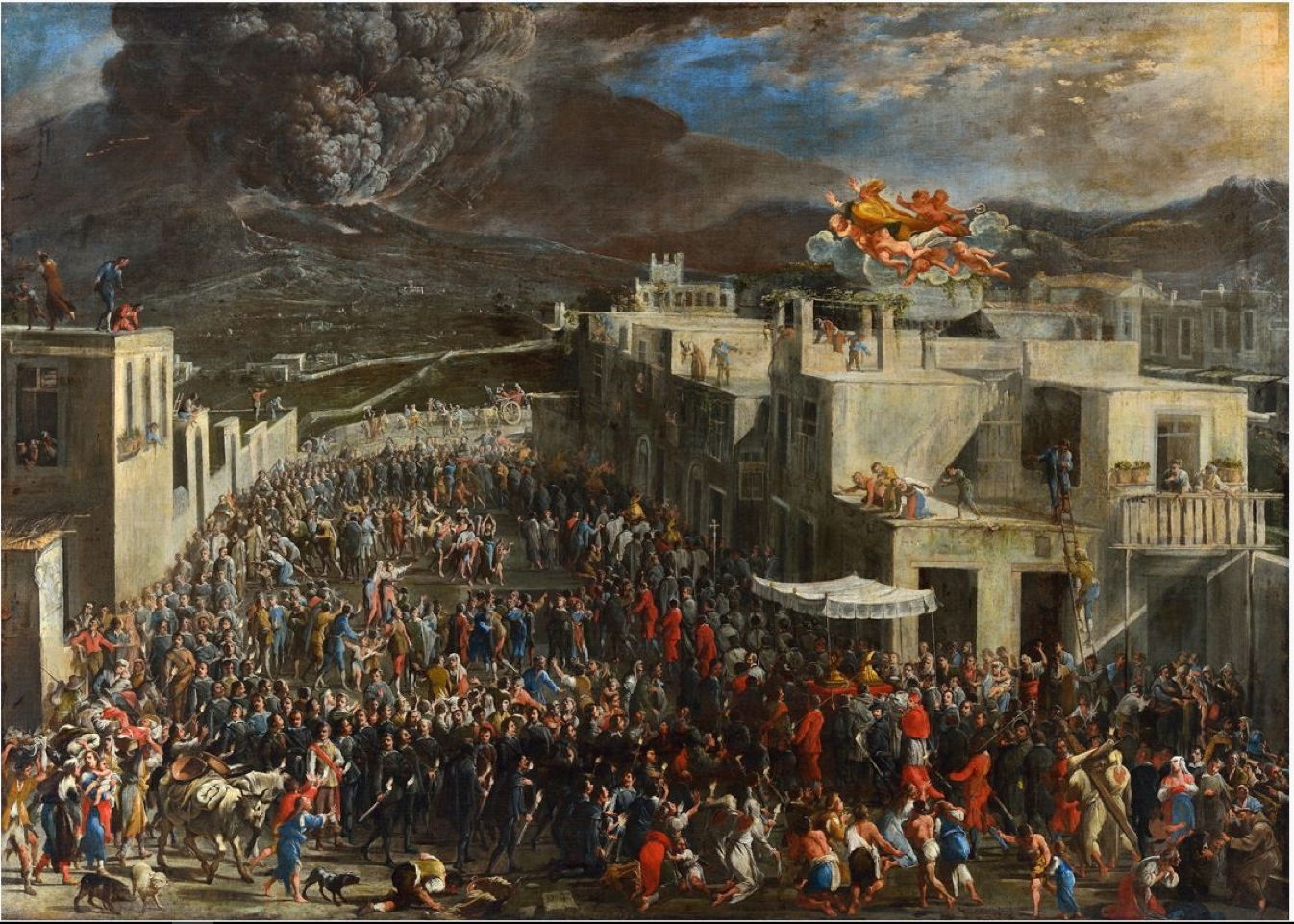
Domenico Gargiulo was a young artist when Vesuvius erupted a week before Christmas in 1631, and his painting of The Eruption of Vesuvius in 1631 is thought to have been made rather later, in 1656-60. This captures well the dense, toxic plume of smoke and gases emitted from the volcano, but is dominated by the human effects on one of the nearest towns.
The majority of the population seem engaged in a religious procession around the centre of the town, with a few taking to the rooftops to spectate. There’s even a small group of rather pagan-looking gods watching the scene from their cloud, probably a reference to the classical mythology of Vesuvius.

As the idea of travel for cultural exposure and improvement became more popular into the eighteenth century, so artists started to capitalise on wealthy visitors. Pietro Fabris is one of those who started making paintings, such as his Vesuvius in Eruption in 1767, from the Mole at Naples, which had probably been made in front of the motif in 1767, and was then turned into this coloured mezzotint nine years later.
This shows the eruption of Mount Vesuvius on 19 October 1767, and lasting just over a week. Fabris was one of the early artists to realise that the visual effects would be greatest at night, and to employ an ingenious view and composition which superimposes the silhouettes of boats against the fire and flames of the lava flows. He also made good use of the third element available at the coast, by showing the fire reflected on the surface of the Bay of Naples.

Pierre-Jacques Volaire was a French landscape artist, a pupil of Vernet, who moved to Rome in 1762, and on to Naples five years later. His painting of Eruption of Vesuvius on 14 May 1771 (c 1771) is one of a series he made covering eruptions from 1767 to 1782. He was also more innovative in his choice of view: here he has approached the lava flows and looks west across the Bay of Naples. This brings the moon into view, and provides contrasting colours.

Giovanni Battista Lusieri was another great landscape artist who was drawn to Naples. Born in Rome, he became a court painter, then documented the Acropolis in Athens for Lord Elgin. He was a superb watercolourist, and an innovative exponent of huge panoramic views, but many of his works were lost in a shipwreck after his death. Lusieri’s Eruption of Vesuvius, View from Naples is dated to 1792, which is also a puzzle, as the eruption on which it is based must have been that in 1774, unless the painting was made in 1794, in which case it would have shown the eruption of that later year.

JMW Turner travelled extensively in Europe, and made his first proper tour of Italy in 1819-20. When he visited Naples, he was fortunate enough to see Mount Vesuvius during an active period culminating in its eruption on 1 June. He painted his watercolour of Vesuvius in Eruption at about that time, following the apocalyptic approach popular in the previous century. He has populated the shore of the bay quite densely, and although there is a crescent moon at the left edge of the painting, he did not develop any significant area in more serene mood and colours. Instead, he has filled it with shock and awe.

Camillo De Vito seems to have caught an earlier phase during the eruptions of the same year. Most importantly, though, he has composed his Eruption of Vesuvius by Night, 21 February 1820 (c 1820) to great effect. The contrast between the violence of the eruption and its reds and yellows at the left, and the distant serenity of the moonlit coast at the right is stark, and makes this mature version one of the finest views of the volcano.
As new artistic movements and styles started to sweep Europe in the nineteenth century, painters avoided spectacular depictions of the eruptions of Vesuvius, but showed it as a more integrated feature within the coast of the Bay of Naples.
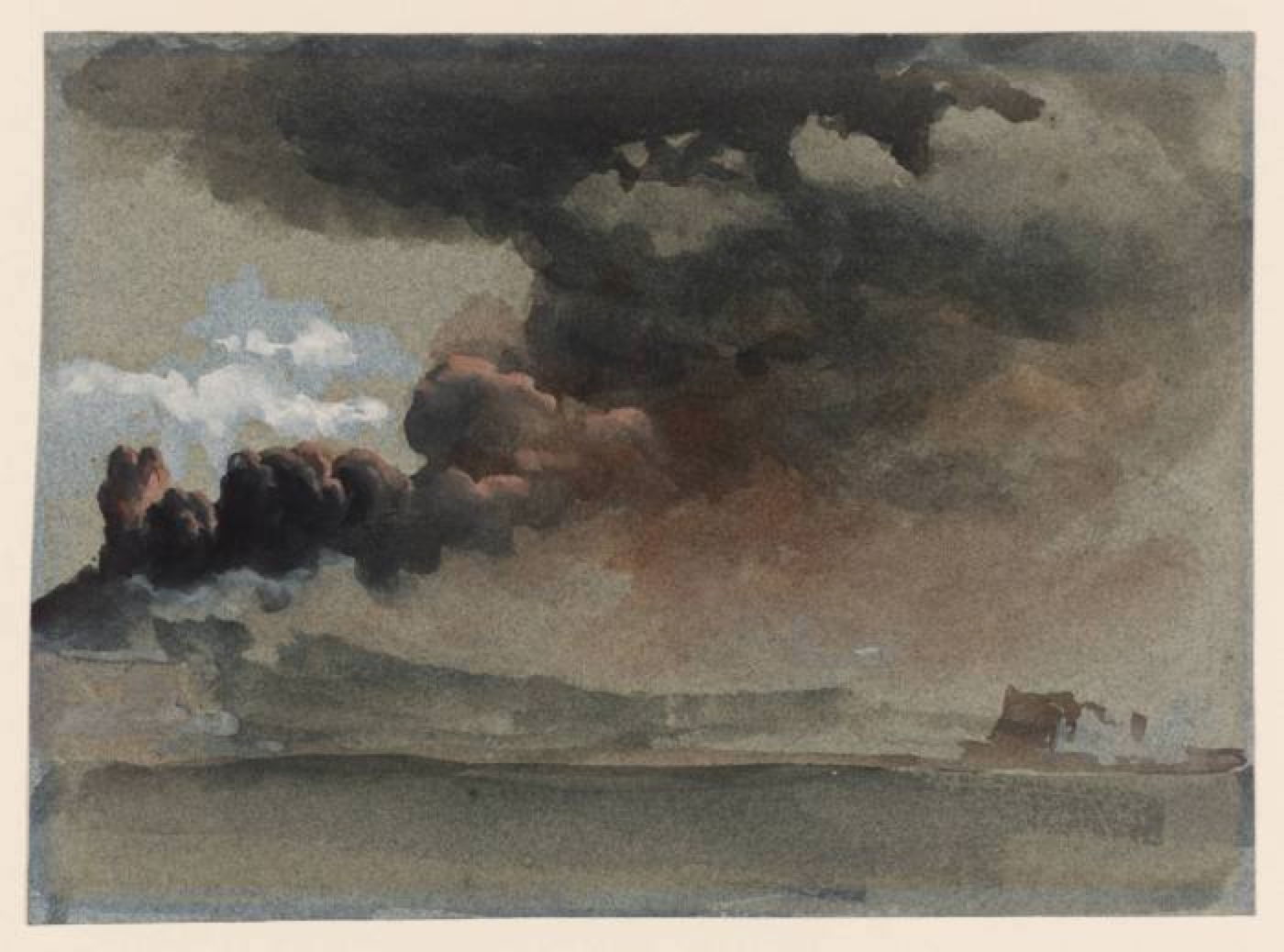
Among those was the British landscape and marine artist Clarkson Frederick Stanfield, whose watercolour sketch of An Eruption of Mount Vesuvius 1839 must have been painted in front of the motif in early January of that year, when Vesuvius was active again.
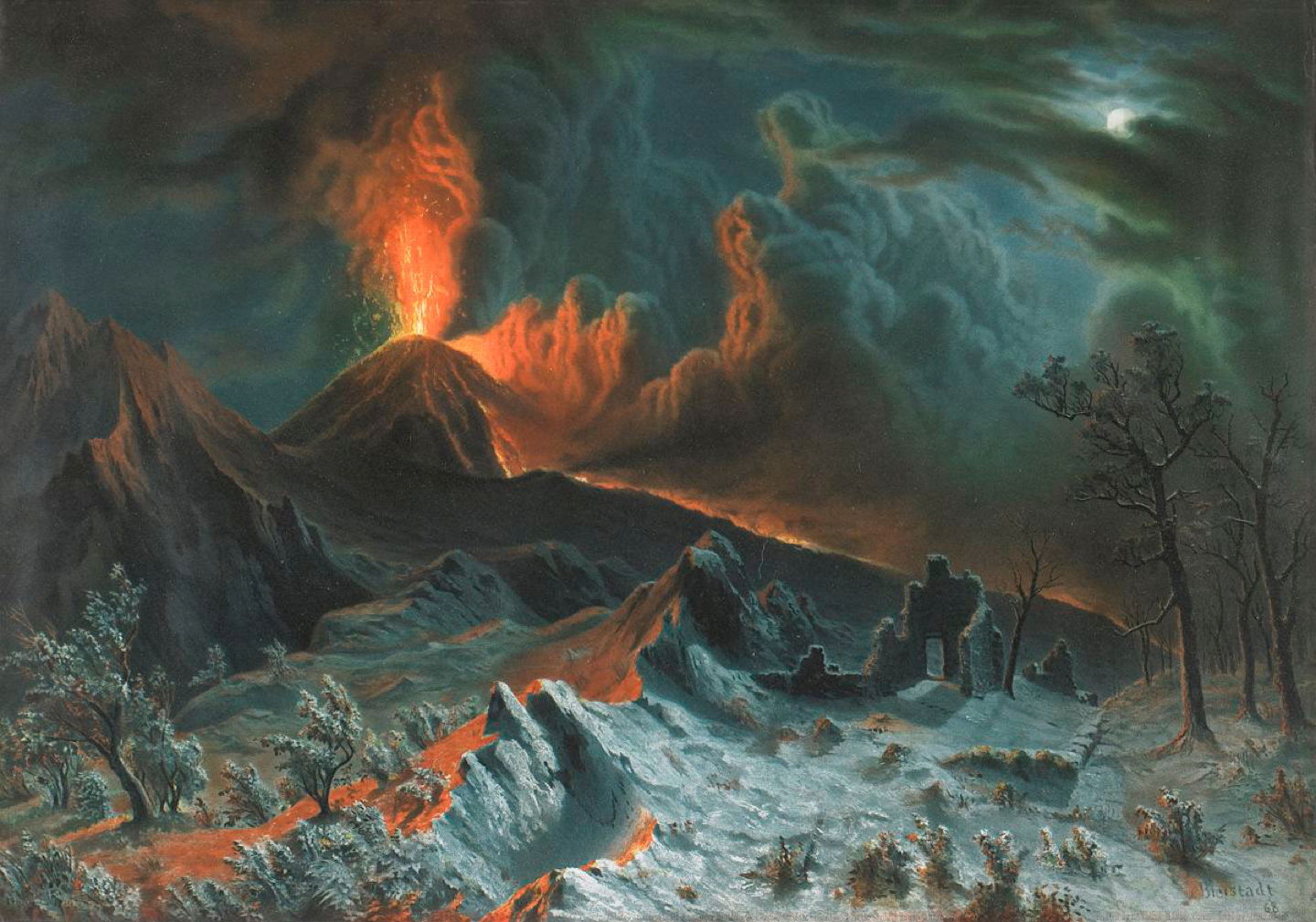
After Albert Bierstadt showed two of his landscape paintings in a private audience with Queen Victoria in 1867, he travelled in Europe for two years, reaching Naples in time to see an eruption, which he painted. Sadly his original has been lost since, but this chromolithograph of it survives, showing Mount Vesuvius at Midnight (1869).
Bierstadt opts for a more traditional and Romantic view, and uses the device of the moon, with the ghostly remains of buried trees and ruins in the foreground. It isn’t clear when Bierstadt saw this eruption, though: his work is claimed to show an eruption in January 1868, but the significant activity that year was in the second half of November.
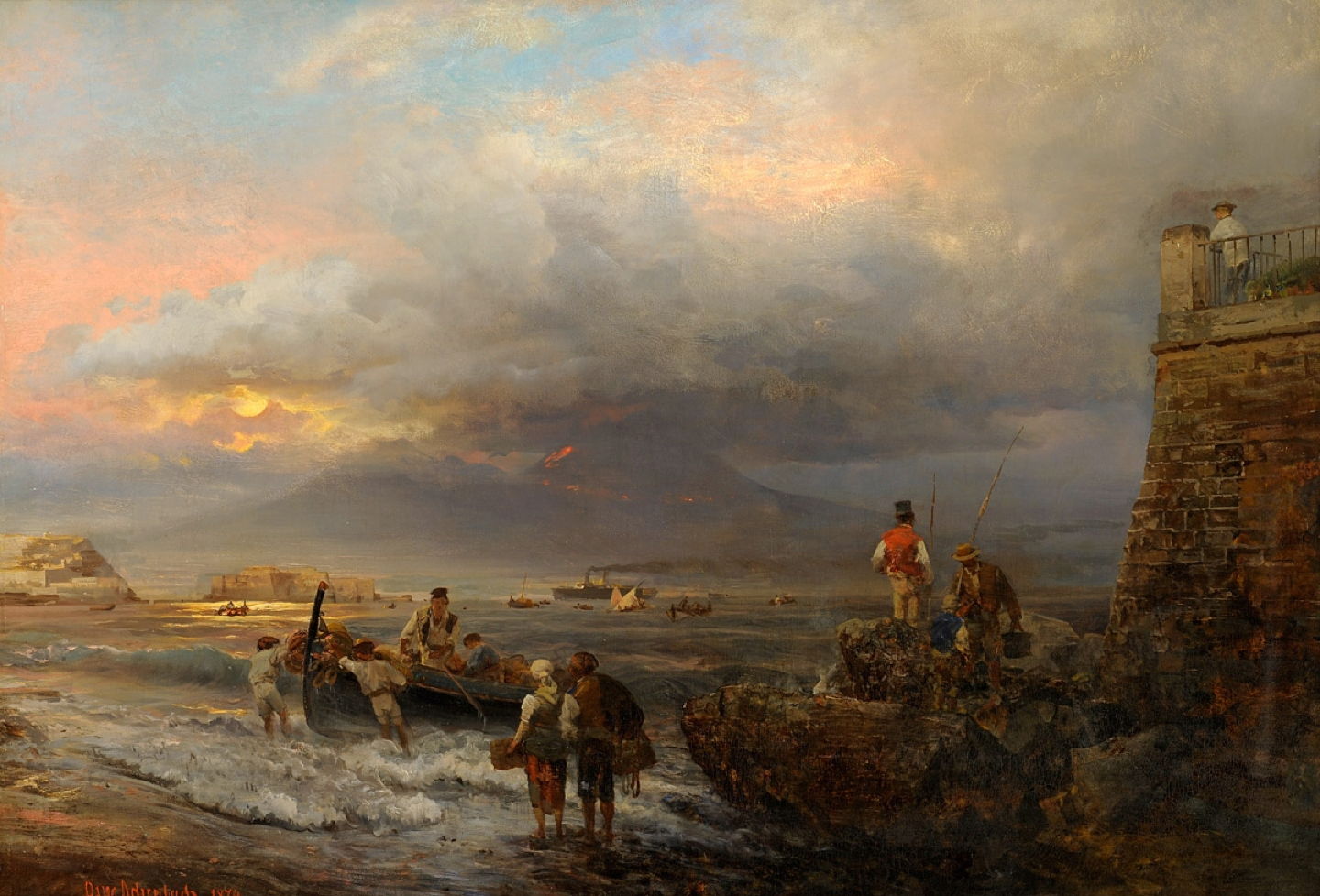
The great German landscape artist Oswald Achenbach had visited Italy on many occasions during his career, even painting on the island of Capri. After resigning from the post of Professor at the Kunstakademie Düsseldorf in 1872, he returned to Italy, and most probably painted The Bay of Naples with a View of Vesuvius during or after the eruption of late April. He adopted a popular viewpoint across the Bay of Naples, allowing him to make comparison between the volcano in the centre, and the early morning sun at the left. Vesuvius is now being better-integrated into its environment, and its effects on the atmosphere are more apparent.

He must also have made sketches for this view of Naples, Eruption of Vesuvius 1872 which he didn’t complete and date until 1890. This is one of the most complex and sophisticated paintings of Vesuvius, combining an apparently unexaggerated and realistic view of the volcano itself, and the local population reacting less wildly to its threat.

By the twentieth century, Vesuvius had faded from the forefront of landscape painting, its eruptions largely being captured in photographs. In his later years, the American landscape artist Charles Caryl Coleman lived in Rose O’Neil’s house, Villa Narcissus, on Capri. In 1906, at the start of Vesuvius’ eruption in April, he seems to have travelled to the mainland, where he painted A Shower of Ashes Upon Ottaviano (1906) in pastels.
This shows the dust- and smoke-laden air of the Naples suburb Ottaviano at ten o’clock in the morning. This brings us full circle to those Japanese views of Mount Fuji. Although Ottaviano was spared anything worse than dust and smoke in 1906, it was badly damaged during a major eruption in 1944.

Giuseppe Carelli was an Italian landscape painter from Naples, who lived between 1858–1921. Much of his work is now forgotten, but his undated Fishermen in the Gulf of Naples, Vesuvius in the background is perhaps the final artistic statement on the volcano, now that first movies then video have replaced spectacular paintings of natural phenomena.

