
Publius Horatius Cocles, lone defender of Rome’s Sublicius bridge, came from one of the great families that made up the original Romans: the Horatiuses, or in Latin Horatii. By far the most famous of the Horatii, in both Roman history and in European art, are the triplets who are claimed to have saved Rome in another battle, this time fought between just six men.
In legend, Rome was founded by Romulus, but had a long history before that, going right back to Aeneas and the other survivors of Troy who escaped with him. At the end of Virgil’s Aeneid, the epic account of their wanderings around the Mediterranean, Aeneas is in Italy near what was to become Rome, destined to bring about the founding of a great city. This is often interpreted as the founding by his son Ascanius of Alba Longa, rather than Rome itself, founded later by Aeneas’ descendants Romulus and Remus.
Later again, Rome’s legendary king Tullus Hostilius fought against Alba Longa, eventually resulting in the latter’s destruction. The battle of the Horatii is a legend within that legendary war.
Rather than set their armies against one another and lose many valuable citizens, Tullus and the king of Alba Longa made a gentlemen’s agreement to fight by proxy: each side would put up a set of triplets, who would fight one another to the death, and whoever survived would secure victory for their side.
The Albans fielded their renowned warrior triplets from the Curiatius family, the Curiatii; the Romans their Horatii, ancestors of Horatius Cocles.
The two sides then massed on a battlefield about five miles out of Rome on the Appian Way, and the six men fought in front of them. Given the high stakes, their fighting was fierce, and the Curiatii were seriously wounded at the cost of the lives of two of the Horatii. The remaining Roman, Publius Horatius, realised he was outnumbered, so to increase his chances he sought to separate the Curiatii brothers by running across the battlefield until they were well split up.
He then turned and killed the least wounded of the Curiatii, before taking on and killing the second. This left only the most badly wounded of the Curiatii, who was the easiest for him to kill. Publius Horatius was the victor, as was Rome, forcing Alba Longa to submit to Roman rule.

Fulchran-Jean Harriet’s Combat of the Horatii and the Curiatii was the winner of the prestigious Prix de Rome in 1798. It shows a late stage in the battle, as Publius Horatius is killing the Curiatii one by one, starting with the least-wounded of the three. One of his brothers doesn’t appear to be quite dead yet, either.
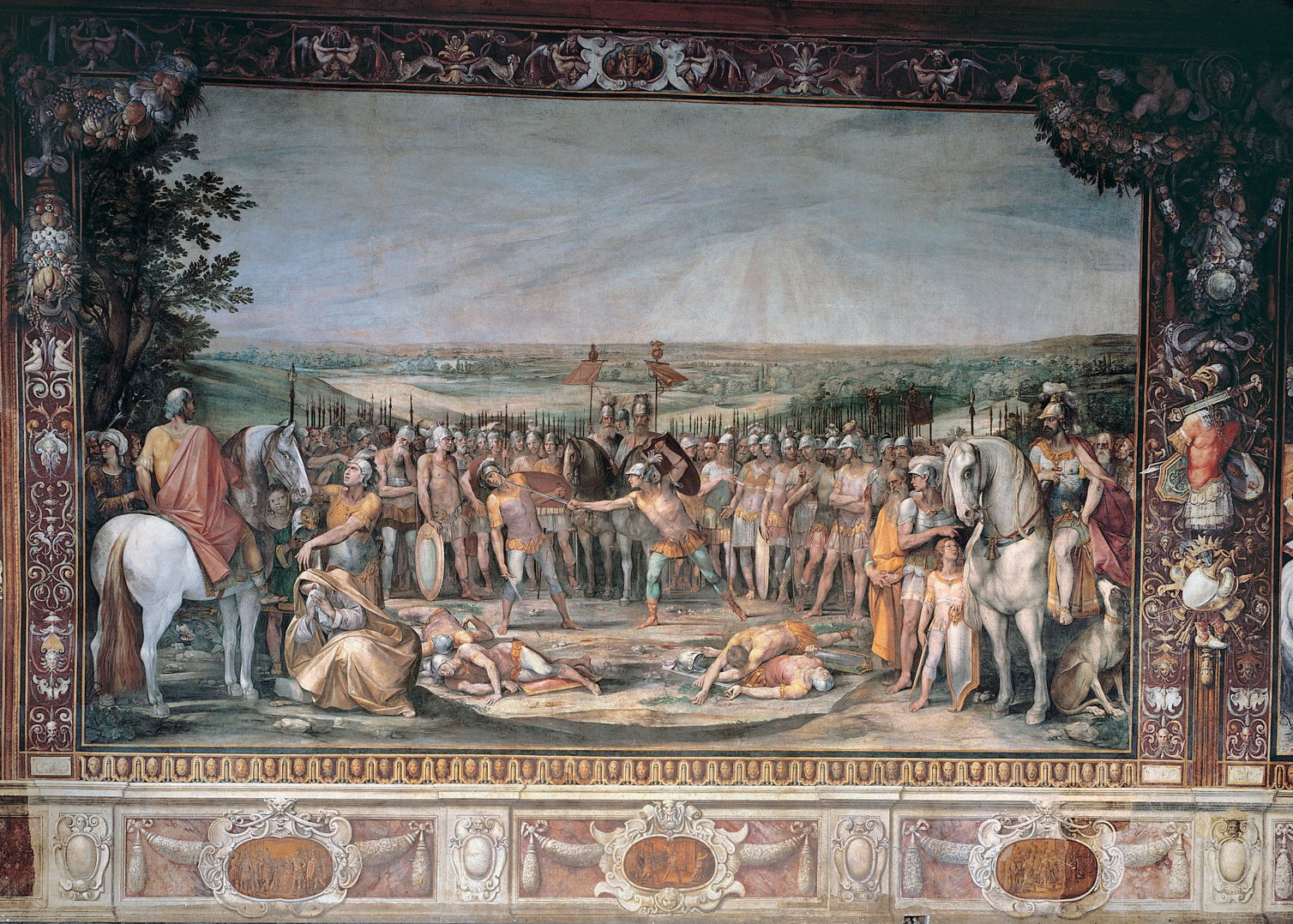
Giuseppe Cesari’s huge fresco Combat of the Horatii and the Curiatii (1612-13) shows the last Curiatius and Horatius (to the right) in the final phases of combat, as the Roman is about to deliver the coup de grace. Publius Horatius’ sister is shown at the left, by the bodies of the two dead Curiatii.
As was traditional, Publius Horatius then stripped the three corpses of their armour and weapons, and returned to Rome. He was greeted there by his sister Camilla, who had been engaged to one of the Curiatii, and immediately broke down and wept for the fate of her fiancé. Her surviving brother, declaring that no one should mourn the fallen enemies of Rome, killed her on the spot.
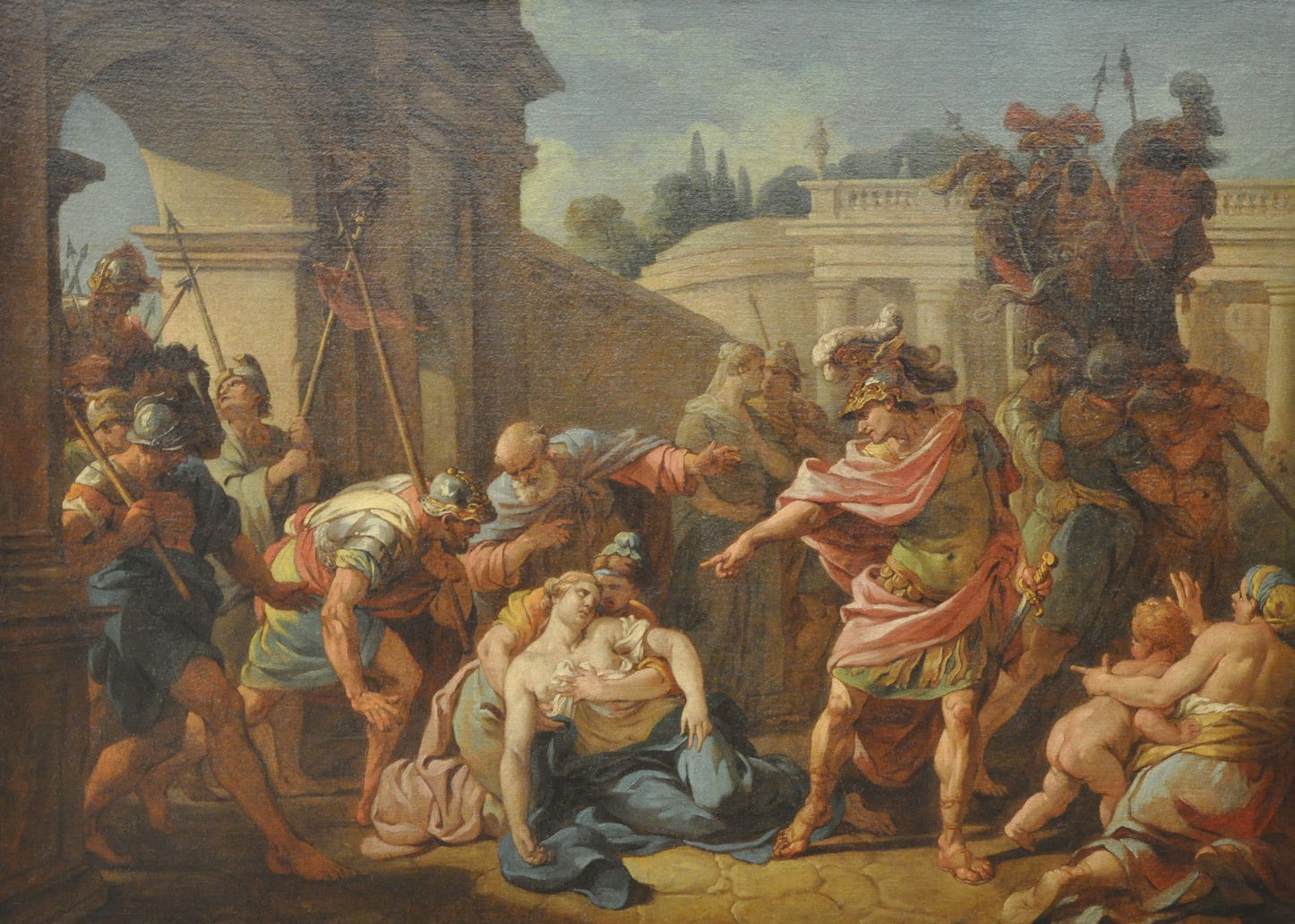
Louis-Jean-François Lagrenée’s Horatius Slays his Sister (1750-54) makes the brother appear thoroughly accusative, even though his sister is already dead. To the right of Horatius, the three bundles of clothes removed from the dead Curiatii are being paraded in public.

Francesco de Mura’s Horatius Slaying His Sister after the Defeat of the Curiatii (c 1760) shows the shock and fear generated by the murder, but omits the clothing said to have been the trigger of Camilla’s grief.

Victor Maximilien Potain’s Horatius Killing his Sister was the winner of the Prix de Rome in 1785. Publius Horatius is vociferously condemning his dead sister’s actions, and on the left is a display of the clothes he removed from the Curiatii.
Even in times of war, Camilla’s murder was of course a crime, and Publius Horatius was condemned to die as a consequence. However, he appealed to an assembly of the people, who promptly commuted his sentence, leaving his family to atone for the crime by making sacrifice to the gods, which became a tradition.
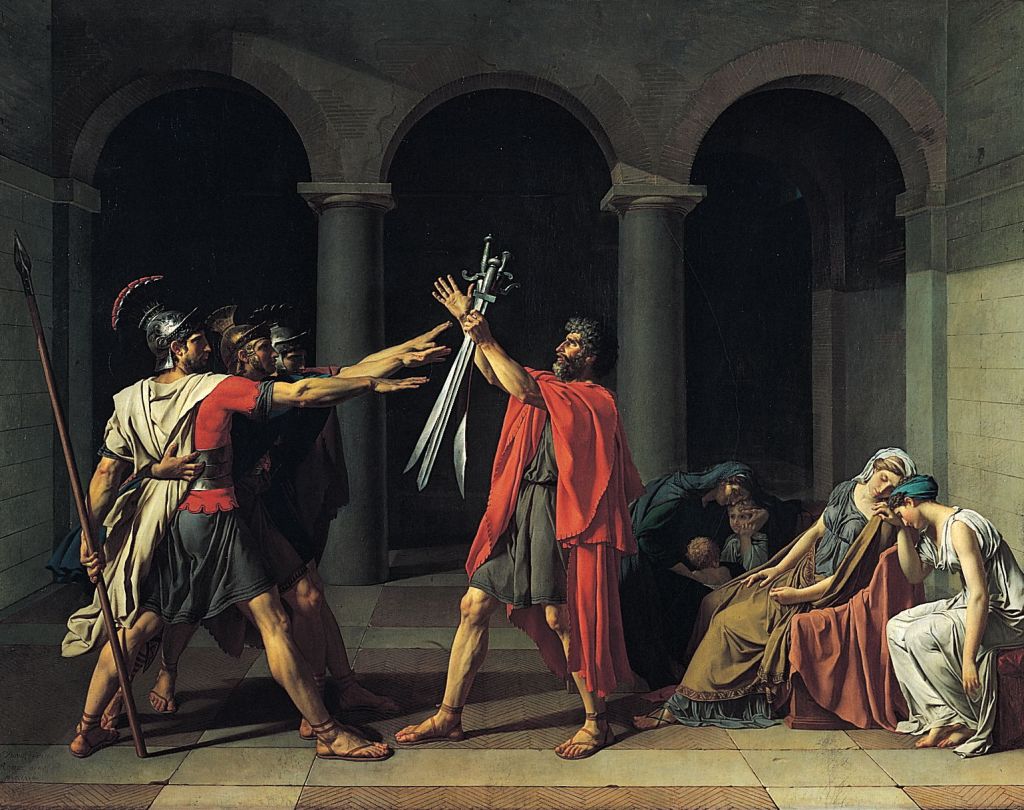
By far the most famous, and most important, painting of the Horatii is bloodless, and shows a scene that doesn’t appear in verbal accounts: Jacques-Louis David’s The Oath of the Horatii from 1784-85.

An image of the original, much larger painting made by David in 1784-85, now in the Louvre, is at the top of this article. Here I show a superior image of the smaller copy made by the artist in 1786, now in Toledo, OH.
The artist chooses to show the three Horatii saluting their father, and taking their swords immediately before combat. Behind the father are three women, of whom the young woman at the far right is Camilla, sister to the Horatii and betrothed to one of the Curiatii, who thus knows, no matter what the outcome, she will lose someone dear to her. David chose a decisive and dramatic instant, enhanced and empowered by his brilliant composition and use of body language.
This was commissioned for King Louis XVI, as an allegory about loyalty to the state and the monarch, interpreted by David as a message about the nobility of patriotic sacrifice. He cunningly left the viewer to decide where that loyal patriotism should be directed, and within five years, the French Revolution was at its height.
Did any of this actually happen though? Did two kings really make such a gentlemanly agreement? Once again, even the Roman accounts present them as little more than legends, and some doubt whether King Tullus Hostilius even existed. The whole story may have been invented to account for the destruction of Alba Longa and its absorption into the growing city of Rome.
As for David, his loyalty was soon to transfer from his patron to the revolutionaries, who executed the king in 1793.
Reference
Wiseman, TP (2004) The Myths of Rome, University of Exeter Press. ISBN 978 0 85989 704 4.

