
There were stranger sights that could greet those who fled the sweaty cities to go down to the beach.
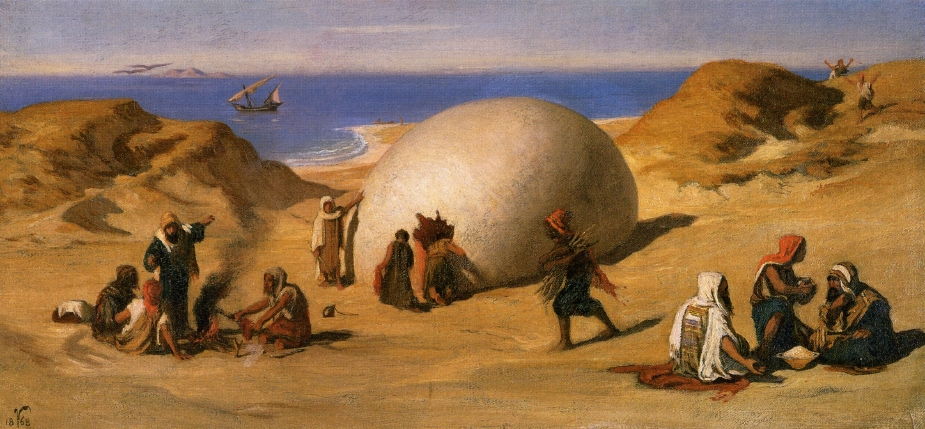
Elihu Vedder’s The Roc’s Egg (1868) is a scene from the legend of Sinbad the sailor, a story-cycle probably of Middle Eastern origin. These tales were a late addition to the compilation of the One Thousand and One Nights, but seemed to have existed independently before being incorporated there.
In the second voyage of Sinbad, he is accidentally abandoned on an island on which there are roc eggs. Rocs are legendary enormous birds that appear in a number of sources. Here the sailors remove the contents of one of the roc’s giant eggs, which they cook on an open fire. Later in that adventure Sinbad uses a roc to obtain diamonds, before returning home to Baghdad.
Beaches are also associated with fishing communities, who remain vulnerable to death by drowning. These have given rise to many local legends, several of which have become the basis of art, most notably in Benjamin Britten’s wonderful opera Peter Grimes (1945).

Thorvald Niss probably painted The Drowned Man’s Ghost Tries to Claim a New Victim for the Sea just before the end of the nineteenth century, and shows one popular version of these legends. The ghost of a fisherman who died by drowning appears to a living fisherman, and tries to drag him to the sea, so that he can join him by dying in the water.
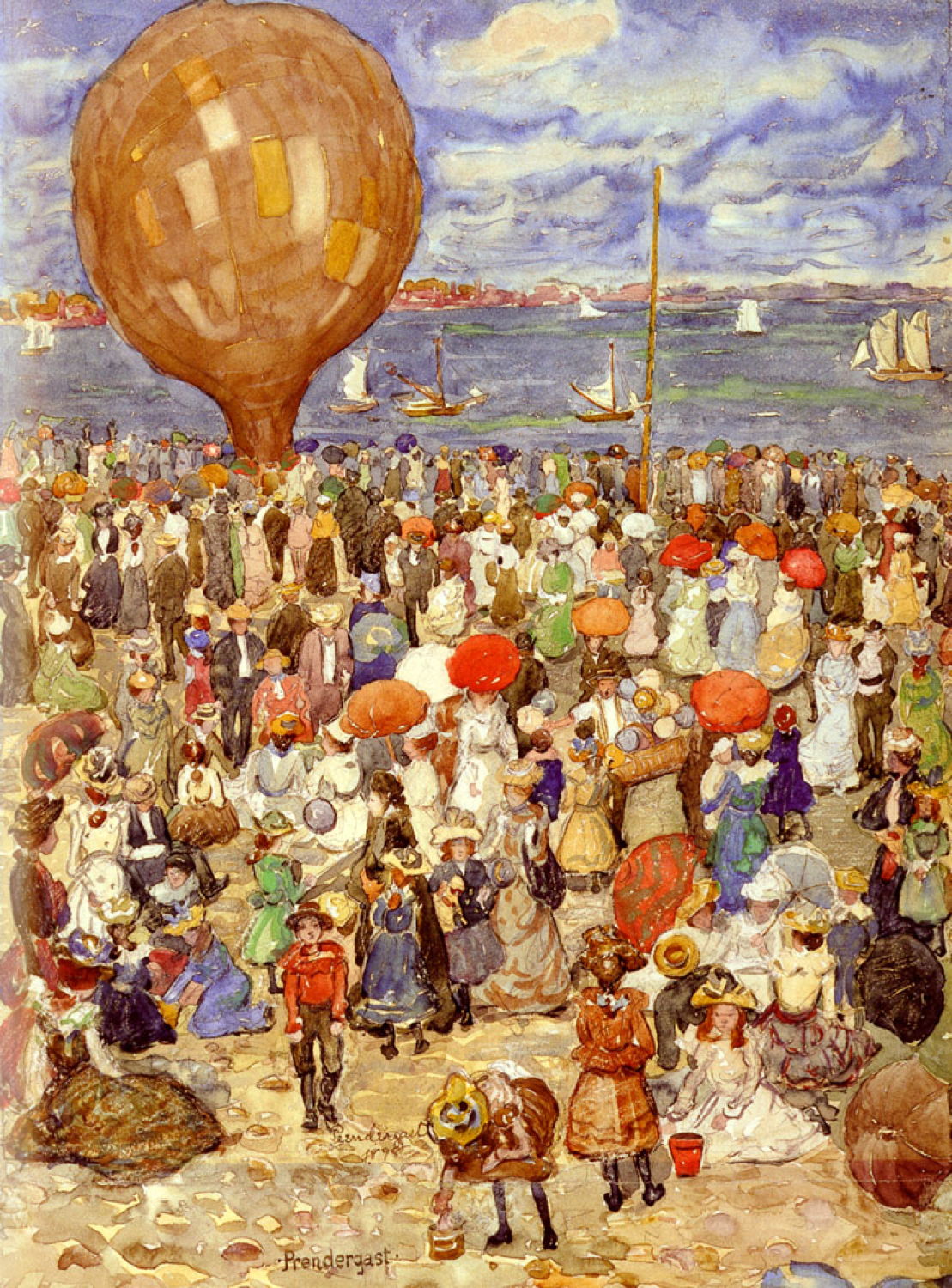
Maurice Prendergast found The Balloon on a beach in 1898. Although he may have painted this in Italy later that year, I suspect its location is on the East Coast of the USA, not far from his studio in Boston.
Beaches are also one of the sites in which some of our cultural heritage is preserved in performance arts going back to mediaeval roots, and living on in slapstick puppet theatre for children.
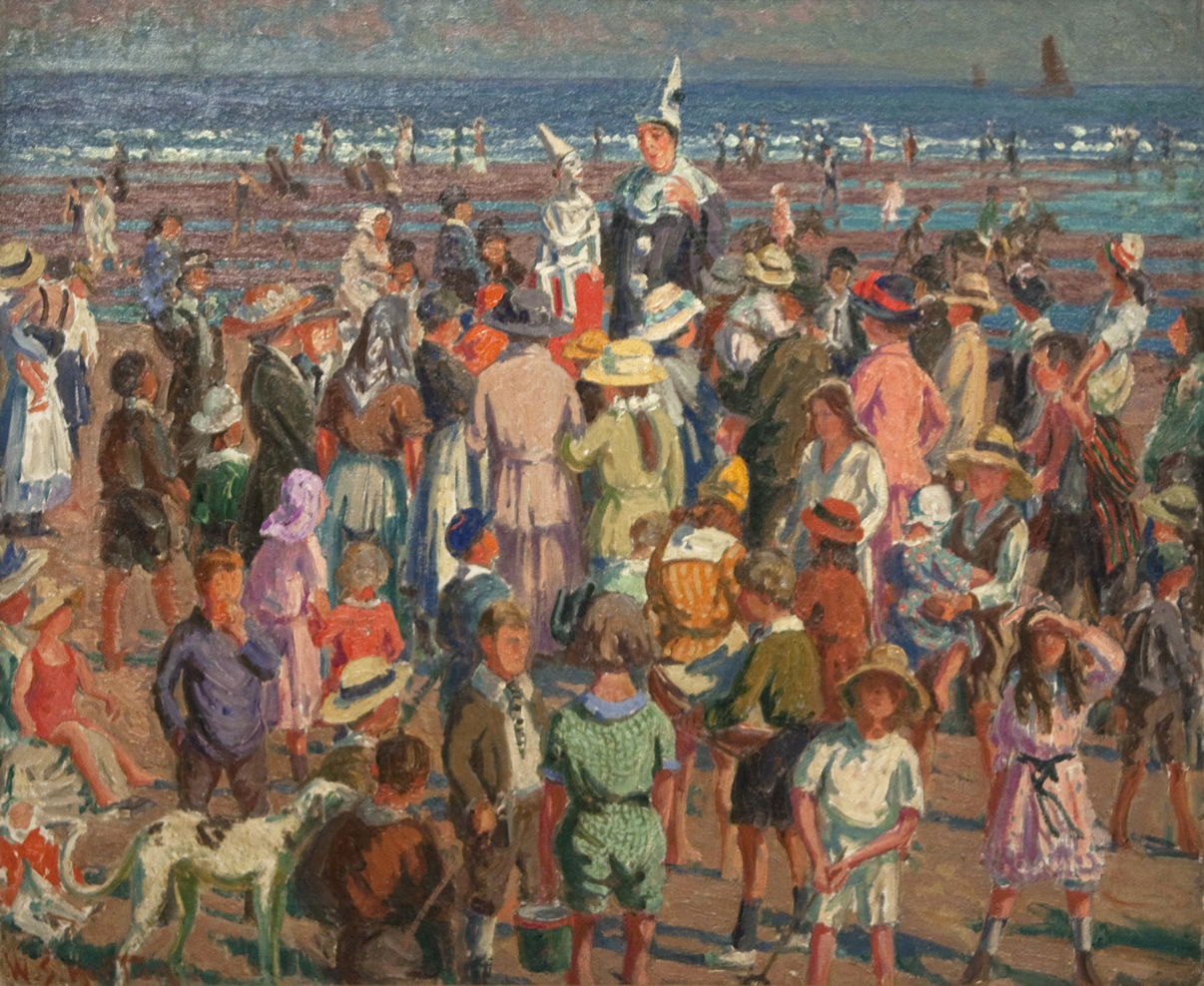
Visitors to the Hunter Museum of American Art, in Chattanooga, Tennessee, must find William S Horton’s painting of Punch on the Beach at Broadstairs, England (1920) quite cryptic. Horton was born in Grand Rapids, Michigan, and trained in Chicago, Paris, and New York, then painted almost entirely in Europe. In about 1917, he arrived in Britain, and in 1920 painted this Punch and Judy show taking place on the beach at Broadstairs, Kent – a traditional family beach resort at the extreme eastern tip of the south-east coast of England.
Punch and Judy shows have their origin in the sixteenth century Italian commedia dell’arte, with the lead male character, Mr Punch, based on Pulcinella, a trickster figure who batters his wife, Judy. The first recorded show in Britain was on 9 May 1662, using marionette puppets. For the last two hundred years or so, a stylised version performed using glove or other puppets has been popular with children visiting British resorts, and later beach resorts. In 1827, George Cruikshank made a series of sketches of a performance, which were turned into the first illustrated and printed script.

Stay late enough on some beaches on the right night and you could be treated to wild partying, as depicted by PS Krøyer in his Midsummer Night’s Bonfire on the Beach at Skagen from 1903.

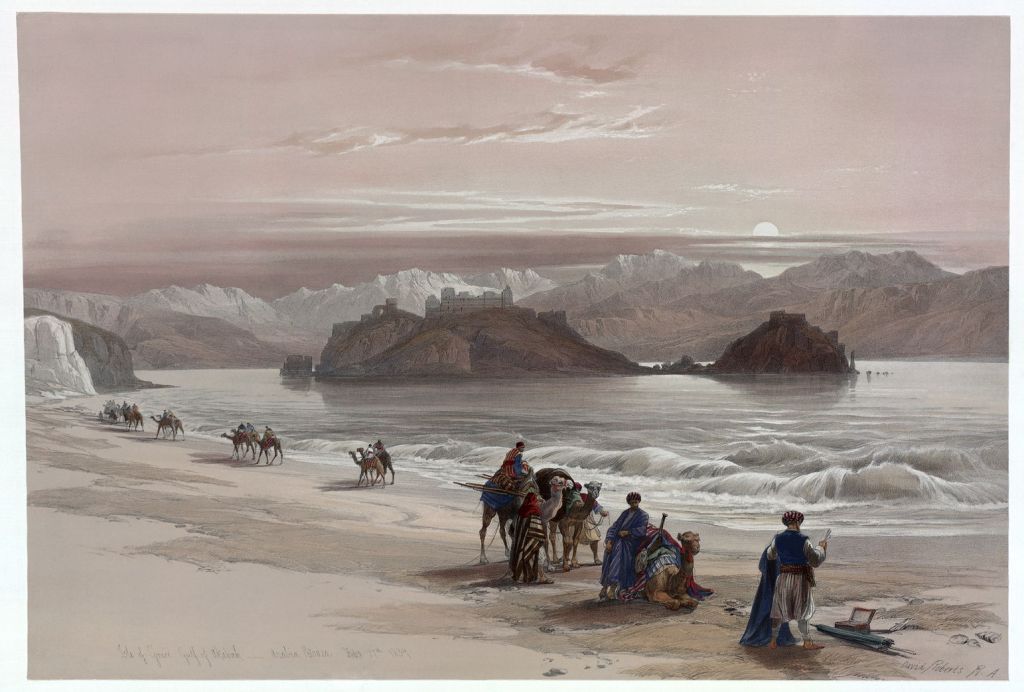
David Roberts’ painting of the Isle of Graia, Gulf of Akabah (1839), shown here as a lithograph, is unusual for showing camels on the beach. We are used to seeing dogs, horses, donkeys, even cows and sheep, but the ‘ship of the desert’ isn’t a common sight on the beach. The coastline of the Gulf of Aqaba (or Gulf of Eilat) is on the eastern side of the Sinai Peninsula, and before urbanisation, development, and the advent of tourists, had a wild beauty.
Elsewhere you could encounter dozens of migrants starting their journey to a new life.

William McTaggart started to paint The Emigrants Leaving the Hebrides in 1883, when he painted the headland from which these emigrants left at Carradale, on the east side of Kintyre, Scotland, but he didn’t complete its details until 1889. This shows migrants loading their few possessions into rowing boats in the foreground, then being rowed out to the waiting ship in the distance.
Beaches and coasts are frequently boundaries and borders. When times become tense, guns and other defences against invasion are put along a threatened coast, and are later left to tell the story of their success, failure, or most commonly irrelevance.

Frederik Kaemmerer’s strange painting of two women walking At the Seashore (c 1895) shows them strolling past a massive cannon, as if it were invisible. One is pointing into the distance, and the pair are locked in conversation as they pass this gun, which may have dated from the Napoleonic wars.
On rare occasions, beaches are transformed into a stage on which man displays his inhumanity to other men. My final painting of the beach at Málaga in Spain comes with clear lessons for us all today.

Antonio Gisbert’s huge painting of The Execution by Firing Squad of Torrijos and his Companions on the Beach at Málaga (1888) shows a terrible scene: the summary execution of nearly fifty people on 11 December 1831.
General José María de Torrijos y Uriarte was highly successful in his military career, and during liberal government in 1820-23 was Captain General of Valencia, and Minister for War. When that regime came to an end in 1823, General Torrijos first fled to France, then to England, where he lived in London, being assisted by the Duke of Wellington, then Prime Minister.
From 1827 liberal Spanish exiles organised themselves for a popular uprising in Spain, and in 1831 Torrijos and his followers travelled to Gibraltar in readiness. They supported several attempts at insurrection in early 1831, each of which was brutally suppressed by the absolutist government under Ferdinand VII.
The Governor of Málaga then tricked General Torrijos into believing that he was a supporter of the planned insurrection. On the morning of 2 December, the General and fifty-nine others landed at Málaga after a surprise attack by the ship Neptune, intending to encourage a liberal uprising, and had brought a printed manifesto and several proclamations they intended to promulgate.
On 4 December they were eventually ambushed after several days of walking, and surrendered, hoping the situation in Málaga had improved. They underwent no trial, but at 1130 on Sunday 11 December 1831, all 49 who had been captured were shot dead by a firing squad on the beach.
Their monument in the city of Málaga is in the Plaza de la Merced, right by the house where Pablo Picasso was born just fifty years later, on 25 October 1881.

