
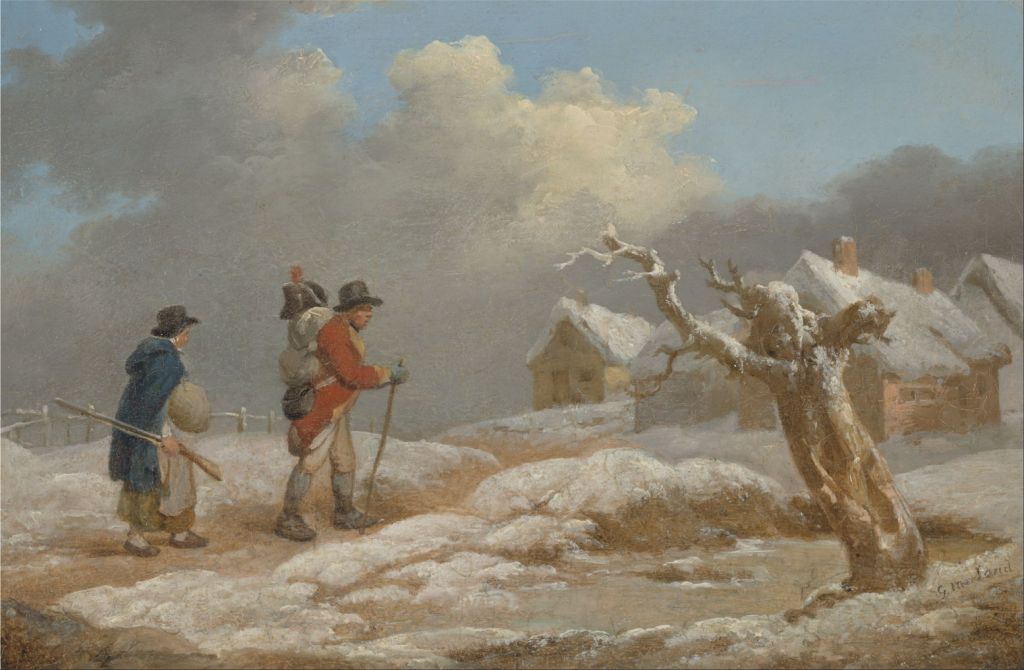
The late eighteenth and early nineteenth centuries were formative in British landscape painting, despite the bitter winters experienced in the Little Ice Age at the time. In this short series, I look at the paintings of two brothers-in-law who were successful artists at that time, but have now been largely forgotten. This article gives a brief account of one of the best British painters who specialised in rural scenes and farm animals: George Morland (1763–1804).
Morland was probably one of the most talented painters in the UK during the 1700s, had one of the most eventful lives, and sadly died in tragic circumstances. I remain surprised that no one has yet used his life as the basis for historical fiction.
He was born in London, into an established family of painters. He was taught to draw at an early age, and when he was only ten he exhibited chalk drawings at the Royal Academy, which had only been established five years earlier. He copied Dutch and Flemish masters, and Sir Joshua Reynolds gave him permission to copy his paintings. When he was only seventeen, his paintings were being engraved, and proved a commercial success.
He left home in 1784 or 1785, and developed a lifestyle of intensive and highly productive painting, combined with heavy drinking, bringing many of his friends to despair. He first lived in the house of a picture dealer, who proved a harder taskmaster than his father.
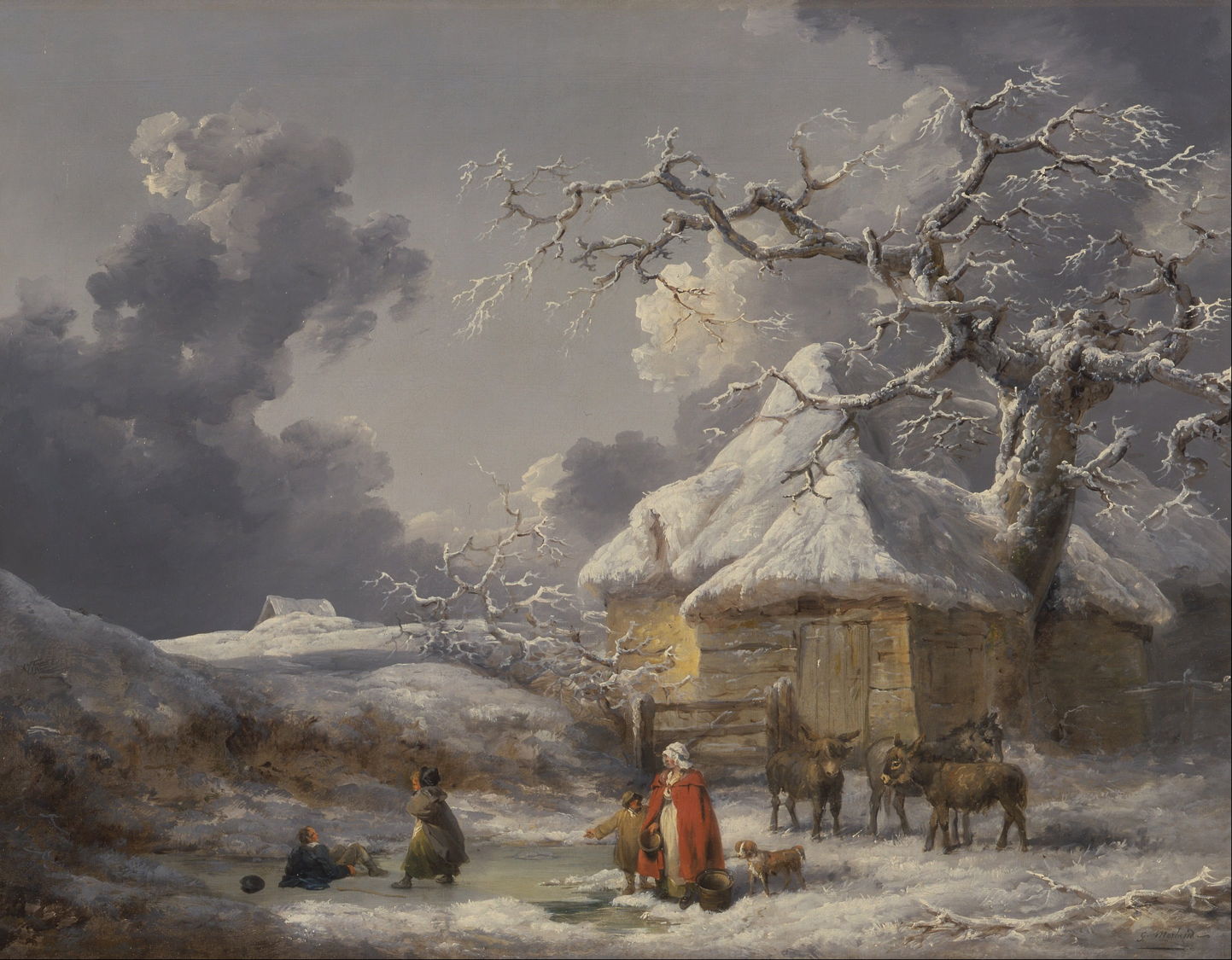
At this time the British climate was unusually harsh, with many winters in which the snow was deep and prolonged, even in the south of the country, as he shows well in his early Winter Landscape with Figures from about 1785.
In the summer of 1785, he escaped from the clutches of the picture dealer, and painted portraits in Margate, where he fell in love with a maid, and visited St Omer in France briefly. He then returned to London the following year, lodging in Kensal Green, where he made friends with William Ward, a famous engraver. In 1786, Morland married Ward’s sister, and just a month later, Ward married Morland’s sister. Unfortunately the two couples decided to live together in Marylebone, London, an arrangement that only worked for three months.
Morland moved around various lodging houses in London, painting intensively, then spending the proceeds on drink. He was particularly fond of rural if not rustic scenes, and visited the Isle of Wight on several occasions from late 1789, to paint the dramatic forms of its coastline.

A Party Angling (1789) is one a series of paintings showing the country sporting pursuits of the gentry of the day. Several of these featured African slaves, and he took a bold stance in support of the abolition of the slave trade.
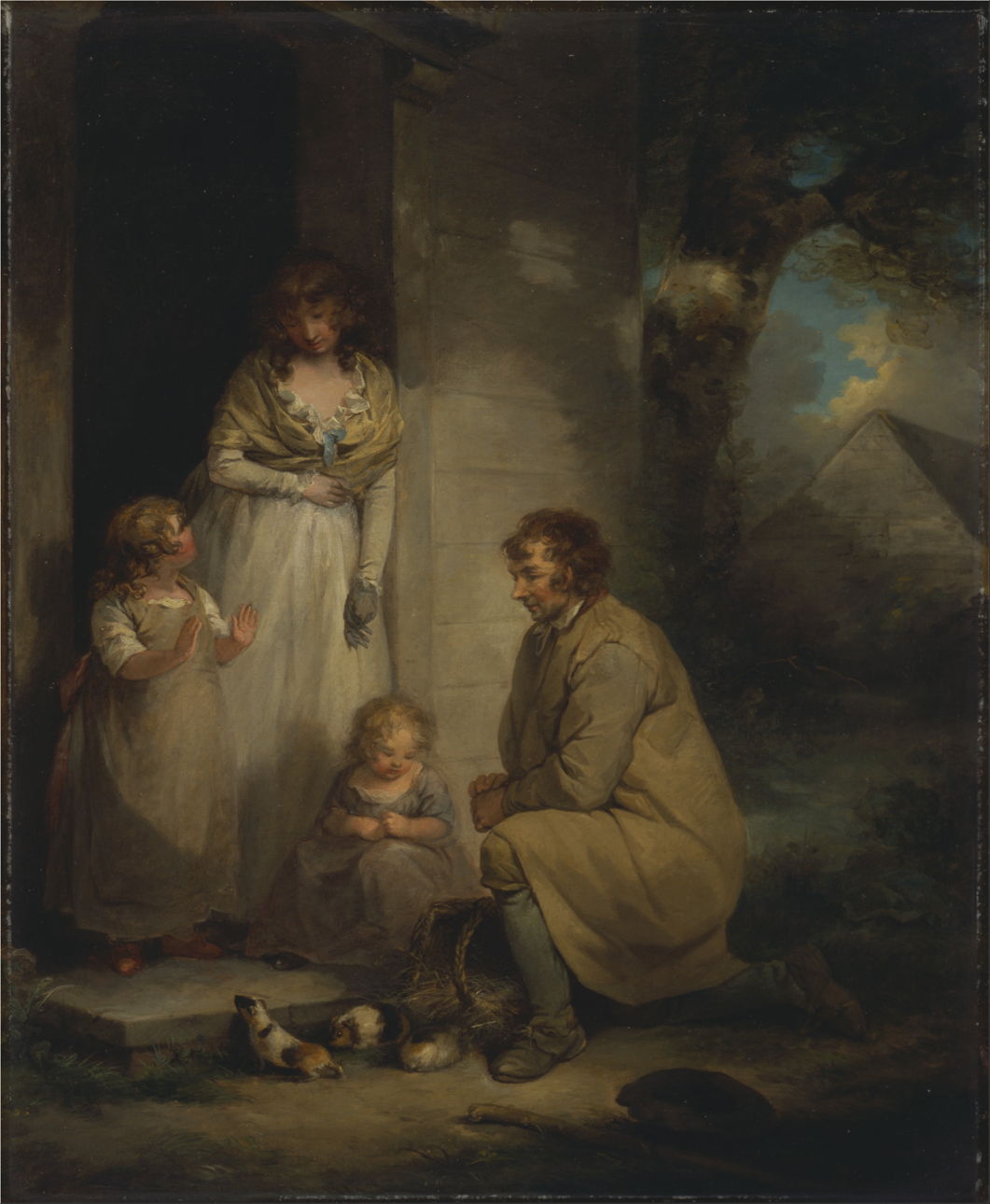
Guinea pigs had been introduced as exotic pets in Europe in about 1575, and still had considerable novelty value when Morland was painting. His Selling Guinea Pigs (c 1789) was highly successful as a print, with 500 copies selling within just a few weeks. In his early career, he painted many works showing children and their lifestyles, which tailed off as he developed his mature style and market.

St. James’s Park (1788-90) shows a military family together in what’s now a central London park, but in Morland’s day was still rural, with the cow being milked at the left. The bright red cheeks may be symbolic reflections of alcohol consumption: several of Morland’s earlier paintings were quite moralising despite his own lifestyle.

The Soldier’s Return (c 1790) is one of an extended series of paintings drawing from themes of military separation, desertion, and loyalty, at a time when Britain had been at war off and on for a long period.

Partridge Shooting (c 1790) is another example of his paintings of sporting pursuits of the country gentry, in which he makes the obvious contrast with the poor farmhouse behind.
In 1790, he was invited by the Prince of Wales to paint him “a room of pictures”, but declined the invitation, and ceased accepting private commissions altogether. At this time, he was observed to be capable of painting one of his smaller canvases in just two and a half hours, then to sell that work for ten guineas (£10.50).

In 1790-91, he painted several larger works, at least one of which was exhibited at the Royal Academy in 1791. The Old Water Mill (1790) is one of his finest landscapes, and one of his few paintings featuring sheep, which appear to have been the only farm animal for which he didn’t have deep affection.

Before a Thunderstorm (1791) is another of these larger canvases, showing well the rising wind and threatening sky just before a summer storm strikes.

Morland appears not to have travelled much beyond London and the south coast of England, but did paint several views of more rugged countryside beyond, including his Rocky Landscape with Two Men on a Horse from 1791.

Old Horses with a Dog in a Stable (c 1791) is one of several classic stable scenes. The white horse is shown with deep empathy for a working animal now wasted, and soon destined for the knacker’s yard.
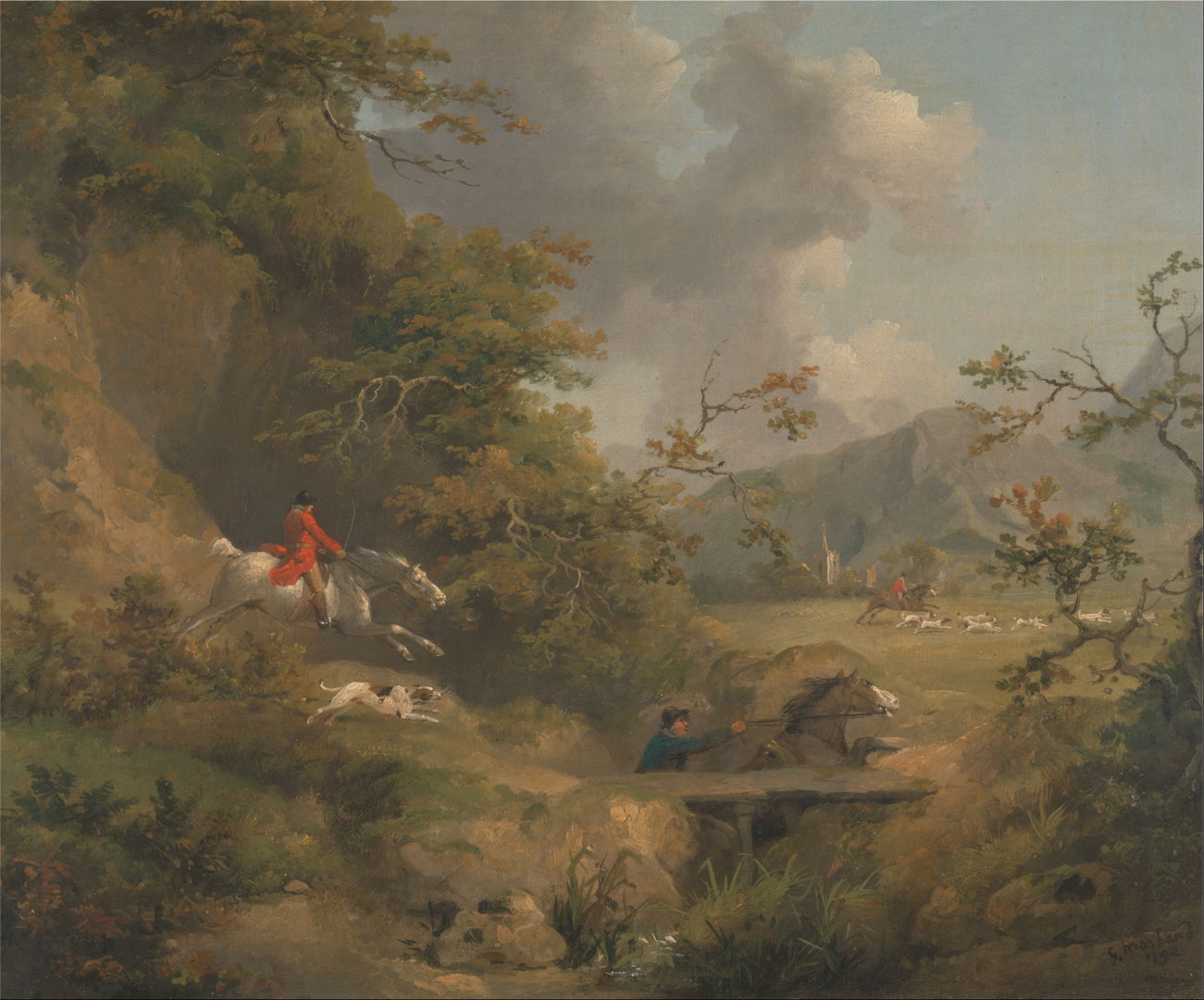
Foxhunting in Hilly Country (1792) is another in his series of country sporting pursuits, here showing his greater empathy with the animals than the riders.
By 1792, over a hundred of his paintings had been turned into engravings, and had proved extremely popular and lucrative, although largely for his publishers. In addition to drinking excessively, he lived a lavish life, at one time allegedly keeping eight horses at the nearby inn. His debts began to mount, and he had to keep moving address to try to keep ahead of them.
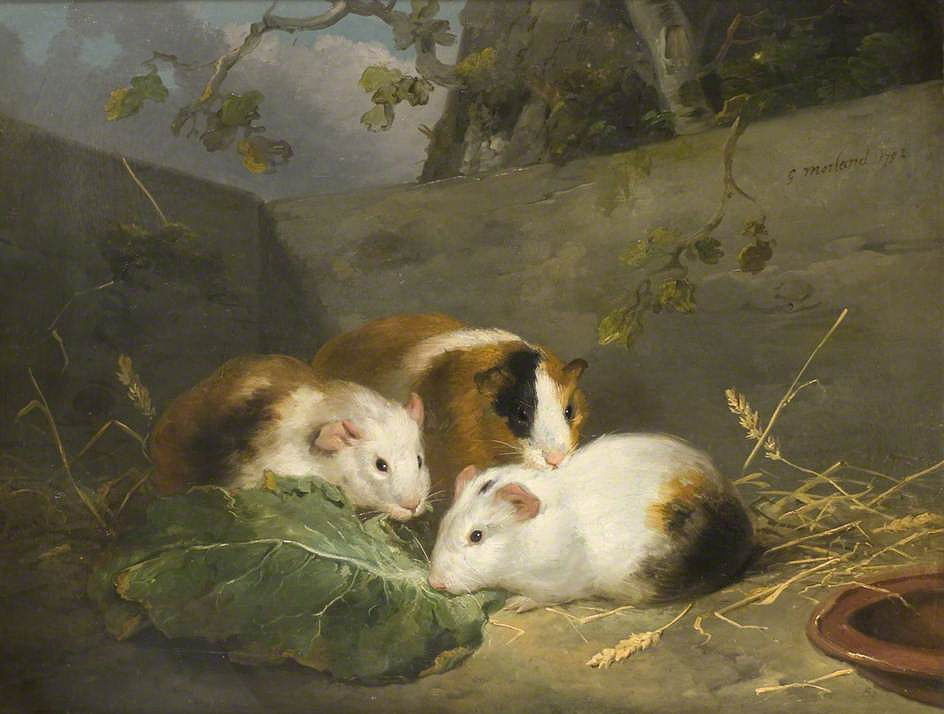
His painting of Guinea Pigs (1792), as with those that he made of rabbits, are probably the finest depictions of these species by any artist.
His dealers were happy to buy and remove his paintings before they were even dry. Once in the hand of some of those less scrupulous, it was common for several copies to be made and sold as originals.
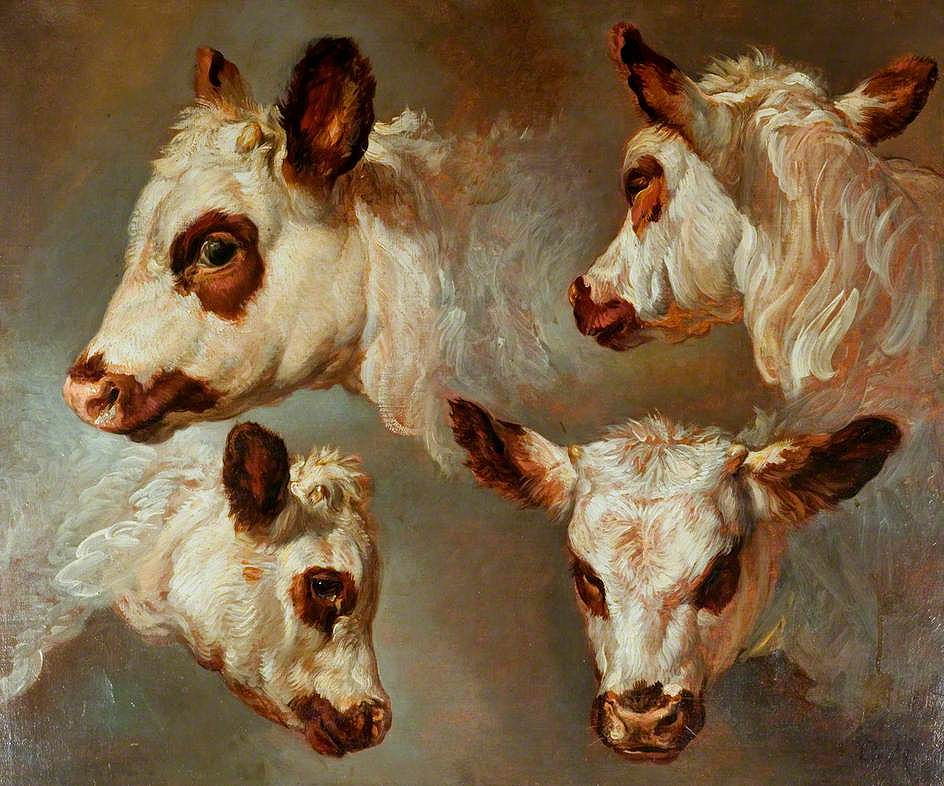
I haven’t been able to locate usable images of his paintings of cattle, apart from this exceptional undated Four Studies of Heads of Cattle.
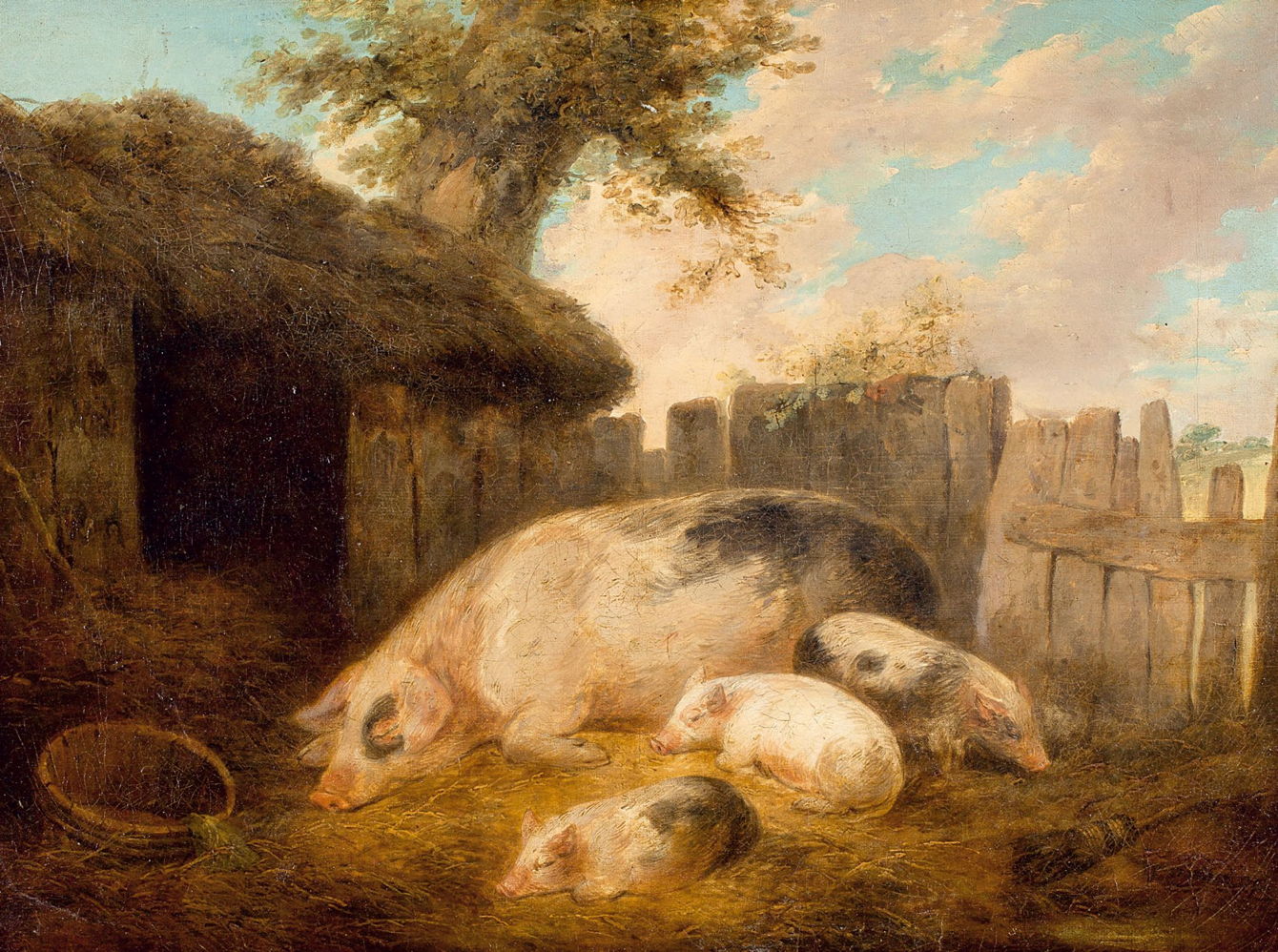
Of farm animals, he appears to have had strongest feelings for pigs. In Front of the Sty (1793) shows what is probably a Gloucester Old Spot or related breed, a sow asleep with three of her well-grown piglets.

His undated Study of Pigs uses a similar composition, and perhaps breed, with perceptive detail. The trunk of the tree in the background appears to bear ‘lungwort’ lichen of the species Lobaria pulmonaria, which is now extinct through the south and east of the UK, but was then commonplace.

The Ratcatchers from 1793 shows a couple of itinerant workers with the dogs they used to catch vermin including rats, as the man on the left holds up one of their successes.

Setters (1798-99) demonstrates his skill in dog portraits, with a fine pair of English Setters. These are gun-dogs, with ‘soft’ mouths that don’t damage the game they retrieve.
In 1798, he lived in Hackney, where his quiet and secluded habits, and overheard discussions about printing plates, aroused local suspicion that he might be forging bank notes. His rooms were searched before the mistake was realised, for which he was given £21 in compensation.
In the spring of 1799, Morland and his sick wife spent some time living in their doctor’s cottage in Cowes, on the Isle of Wight. This was a time of heightened national security, and there was great fear of a French invasion. Unfortunately, locals suspected Morland of being a French spy, and he was arrested when he was observed sketching Yarmouth Castle. When brought before the magistrates in Newport, he was discharged under the instruction that he was to make no more drawings or paintings while he remained on the Island, which he of course ignored.
When he returned to London at the end of 1799, his debts finally caught up with him. He was arrested, and would have been thrown into debtors’ prison, but was allowed to remain in supervised lodgings. Although he continued to paint at a ferocious pace, he gradually succumbed to his excessive drinking. When he was released from confinement as an insolvent in 1802, his health was in decline, and he probably suffered a stroke making it impossible for him to hold his palette.
He was arrested for debts again in 1804, and died a broken man shortly afterwards, aged only 41. It’s estimated that he painted more than four thousand oil paintings during his life, and made more than a thousand drawings. Among them were two serving the cause of the abolition of the slave trade.
References
Gilbey W & Cuming ED (1907) George Morland, His Life and Works, A & C Black. Available from the Internet Archive.

