

Just beyond Chatou, as it meanders its way to the west of Paris, the River Seine sweeps to the right in a bend with a series of long islands with popular bathing houses, among them the famous La Grenouillère. In the summer of 1869, Auguste Renoir was living at his parents’ house in Louveciennes, just to the south of this bend, where Camille Pissarro and his family were also renting a house. Renoir visited Claude Monet and his family, who were living near Bougival, also on that bend, and they often painted together. When the pair visited La Grenouillère they made the leap in style from the sketchy views of the 1860s to the early Impressionism that was to sweep the world over the coming decades.

Renoir painted at least three different views of La Grenouillère that summer: that above is now in Stockholm, and that below, the most similar to Monet’s, is in the Oskar Reinhart Collection in Switzerland; the third (not shown here) is in the Pushkin Museum in Moscow. Originally conceived as plein air sketches preparatory to more finished paintings for submission to the Salon the following year, they came to define these brilliant shimmering images formed from high chroma brushstrokes as Impressionist.

If Impressionism had a single moment of birth, it’s surely in the summer of 1869 at La Grenouillère.

Monet’s Bathers at la Grenouillère is his early statement of his Impressionist agenda, seen in the detail below. The pair realised that Impressionism was about these instants sketched with visible brushstrokes.

Other Impressionist paintings appear at first sight to have been painted quickly in front of the motif, but were more likely worked on during a period of months in the studio. Once the public had come to expect an Impressionist painting to look as if it had been painted quickly, they expected the same look even though some paintings may have required much longer.

Just a decade later, Monet’s Flowering Plum Trees (1879) has a complex structure in its paint layer, as seen from the surface in the detail below. Some marks have been added wet-in-wet, but many wet-on-dry, demonstrating he must have worked on it over a period of weeks or months.

The myth about Monet’s Grainstacks series of 1890-91 is that they depict transient effects of season, weather, and light, as they were painted en plein air over the course of the winter. Looking at all twenty-five, I have long had my doubts, and suspect Monet spent a lot of the time prior to their exhibition making further changes to them. This in no way lessens his sublime achievement, nor their art, it’s just that they aren’t quite the paintings described by the myth that has grown around them.

This is Grainstacks, End of Summer, considered to be one of the earliest in the series, started in 1890 and numbered 1266 in his catalog raisonné. The trees behind the two grainstacks are still in full summer leaf, with no indication of the advent of autumn, yet Monet’s signature gives the year as 1891. Looking at its paint surface in detail (below), some has been applied wet-in-wet and has blended with underlying and adjacent paint, but many other brushstrokes have clearly been applied over dry underlayers.

The blue-grey shadow of this grainstack was applied with relatively dilute paint wet-on-dry over thicker off-white paint with marked surface texture. However, that off-white paint has itself been applied wet-on-dry over a pale green layer. This couldn’t have been achieved in the same day, even when the ambient temperatures were warmer during the early autumn, but probably reflects at least three sessions with ample drying time in between them.
Neither were the Impressionists alone in this new style of painting. Here’s a series showing the facture in Léon Bonnat’s Arabian Sheikhs in the Mountains from 1872. Although known as an academic painter, Bonnat’s brushwork, in this work in particular, is remarkably rough when viewed close up.
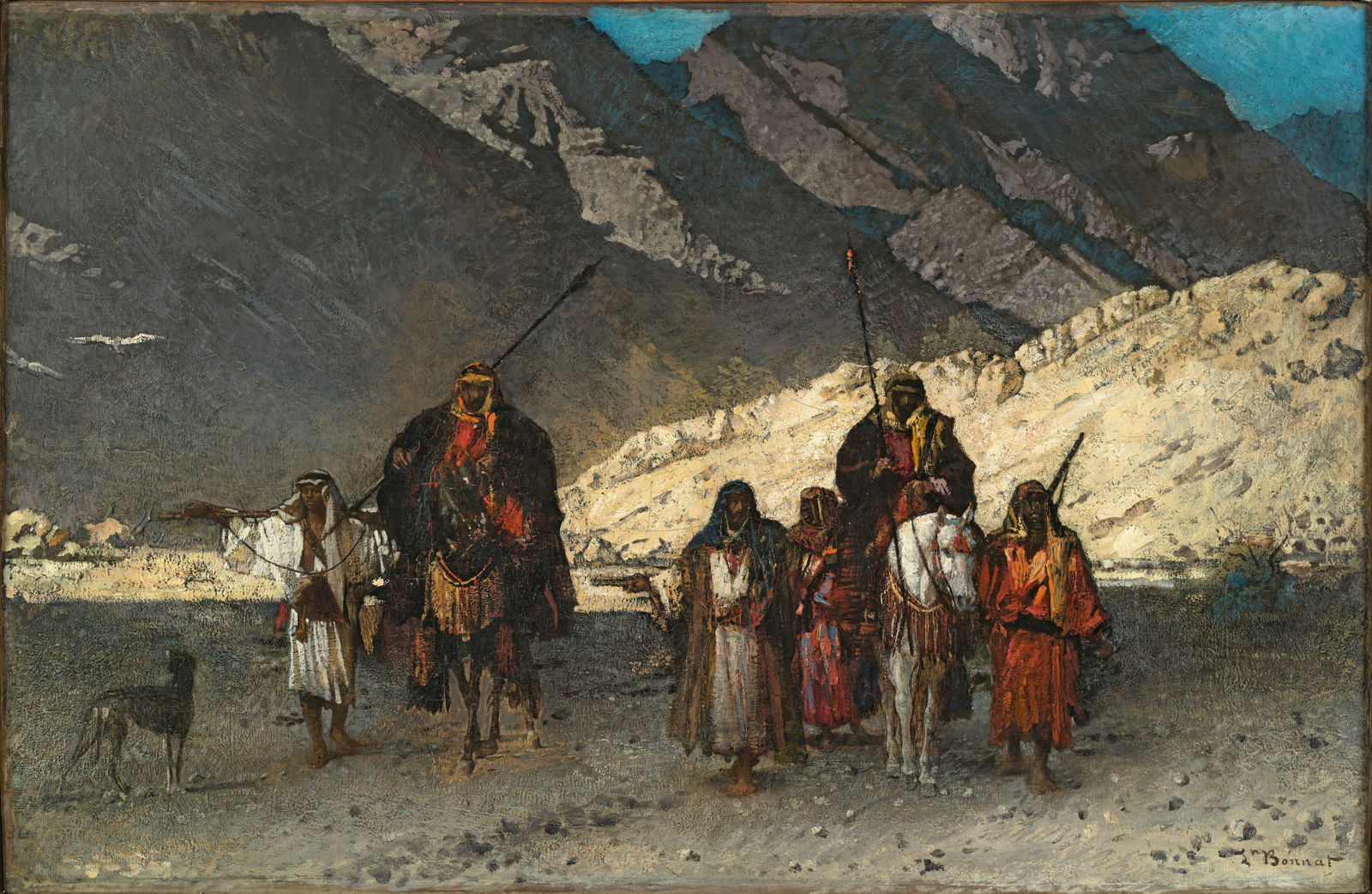
When viewed as a whole, Bonnat’s painting appears finely detailed, and lacks the visible brushstrokes of Impressionist style.
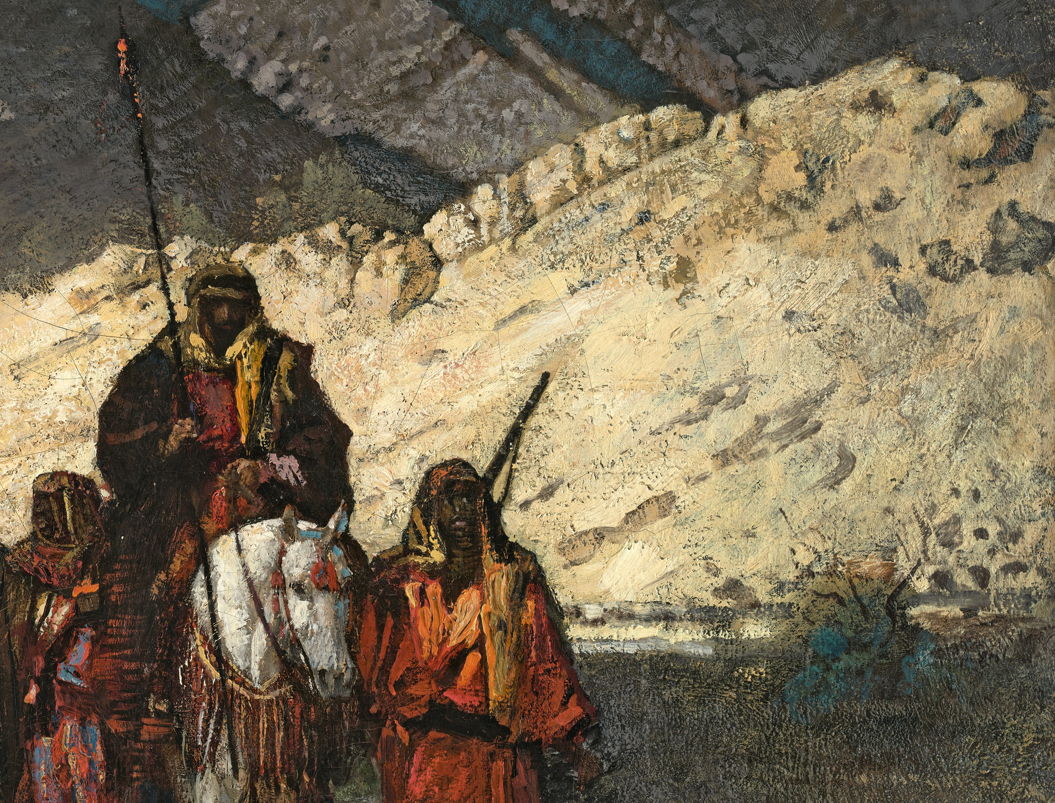
Zooming in, though, its paint has finer texture.
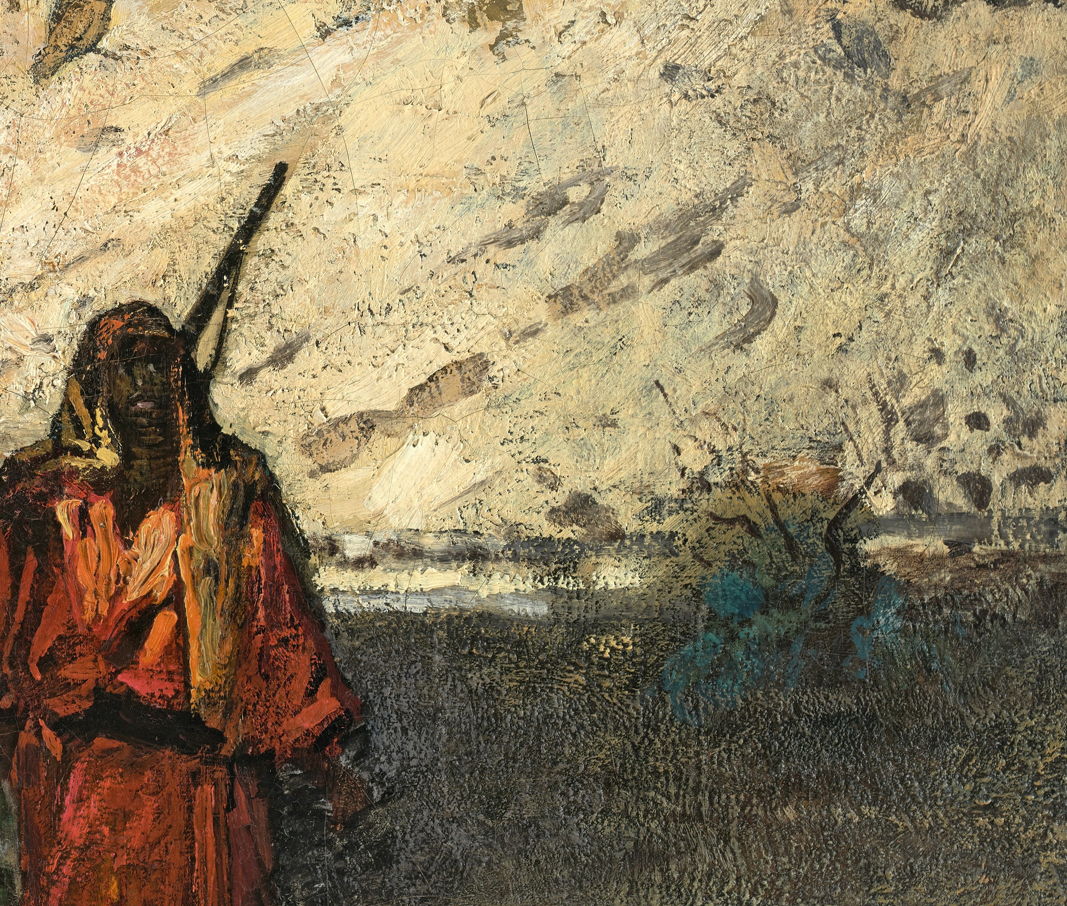
What had appeared to be carefully worked details now looks more painterly, as seen in the man’s clothing.
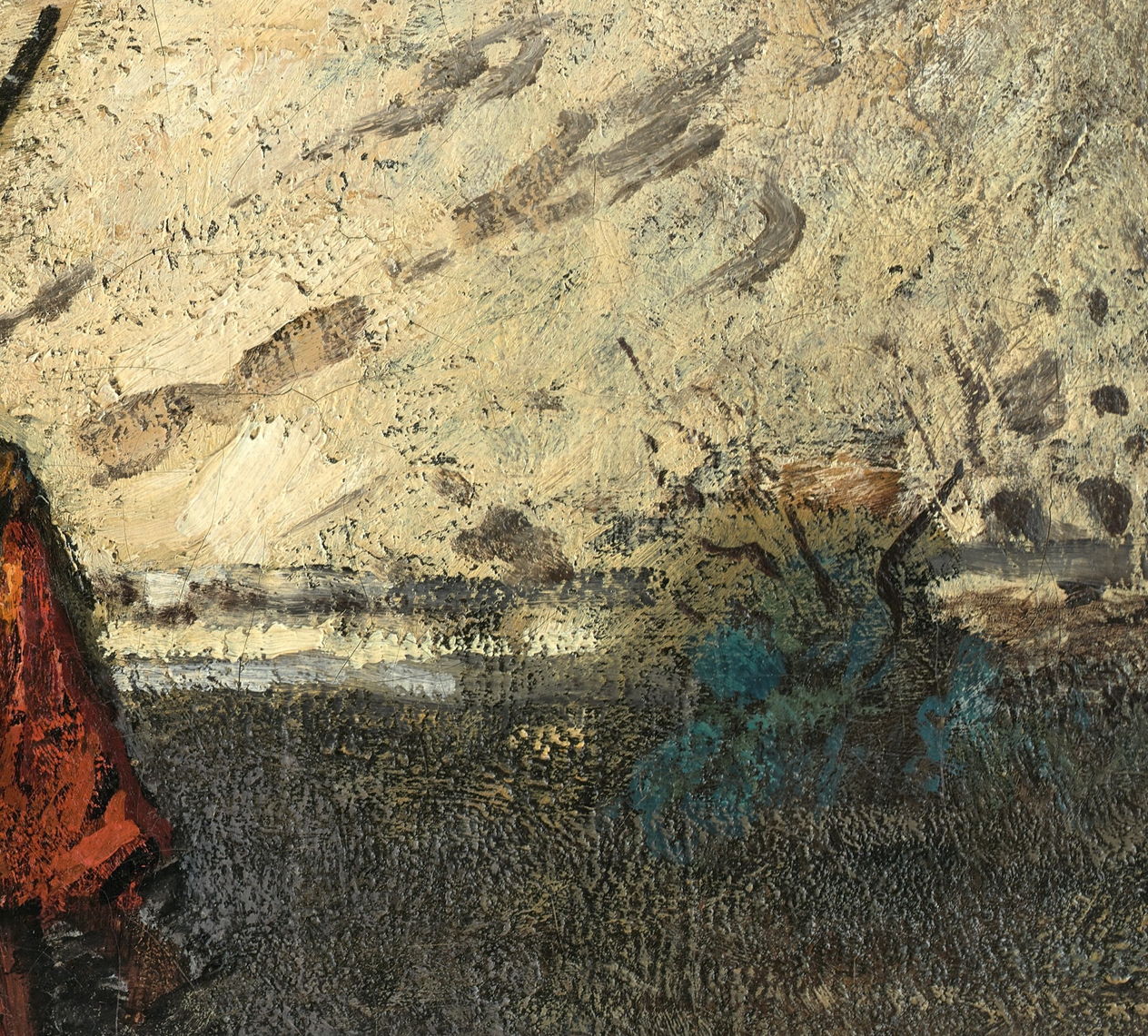
Here there’s a wide range of marks, from strokes of dilute paint to dry scrubbing and textures.
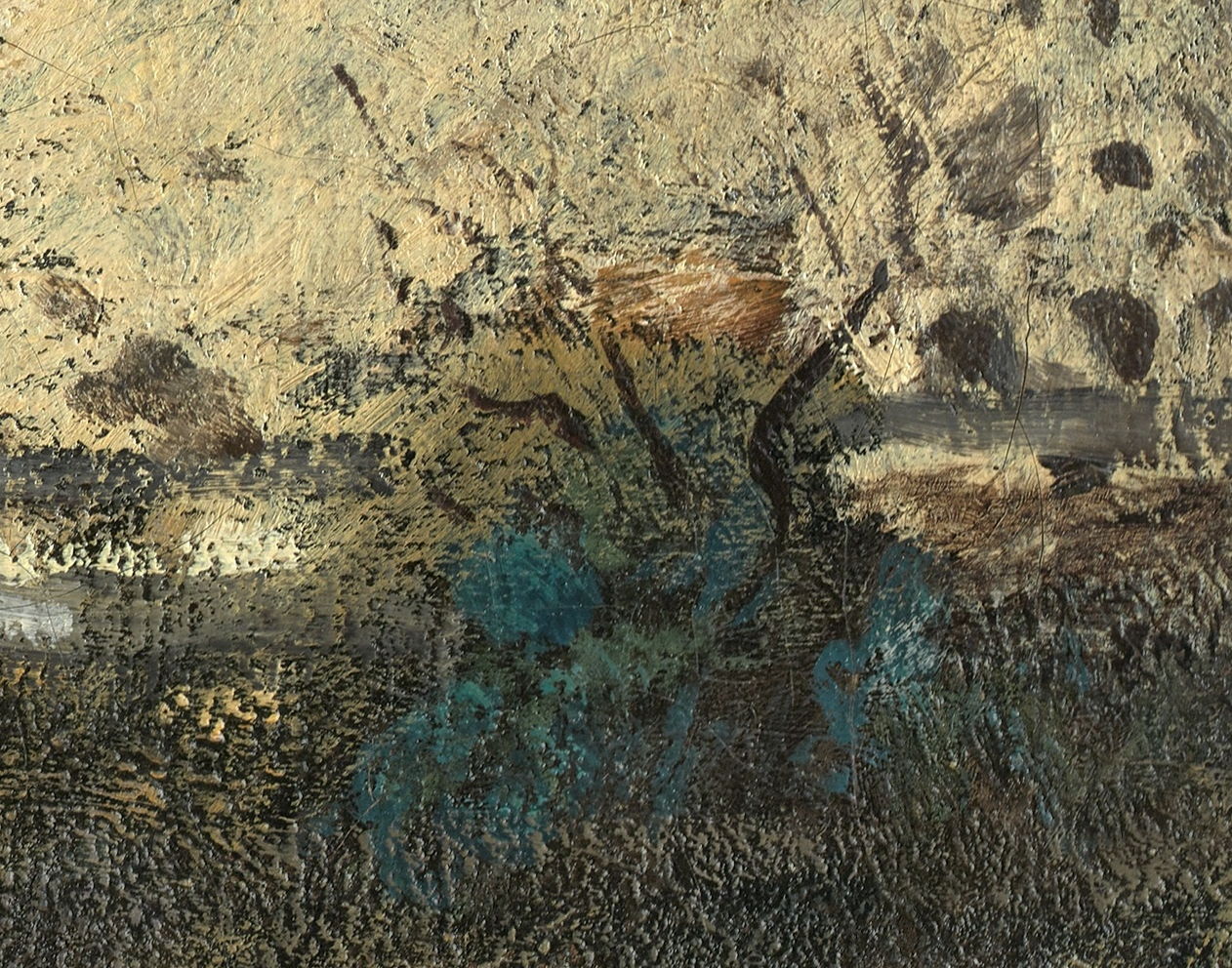
This is an area of about 10 cm (4 inches) across, which appears as rugged as the landscape Bonnat was painting, and was clearly not the detailed academic technique derived from the Northern Renaissance.
Over the next couple of decades this was to change again.
 The Eclectic Light Company