
The one classical hero we know most about is Odysseus, whose ten-year journey back from the war against Troy is recounted by Homer in his Odyssey. However, there’s a surprising lack of information about his life before or after that.
Odysseus was the King of Ithaca, presumed to be the same island as the modern Ithaca, located just off the west coast of the Greek mainland, in the Ionian Sea. Son of Laërtes his predecessor as king, and Anticlea, he was married to Penelope, and at the time of his departure to war the couple had one young son Telemachus. While he was depicted as a brave and skilled warrior, Homer portrays him as intellectually brilliant and cunning as well.
Odysseus was unmarried at the time that Menelaos, King of Sparta, was chosen to be Helen’s husband, and is listed as one of her suitors at that time. That brought him within the scope of the Oath of Tyndareus binding all those suitors to defend Menelaos in the event of any dispute. When that was invoked to precipitate the war against Troy, Odysseus initially feigned madness to avoid becoming involved, until his son Telemachus was taken captive and he was forced to change his mind.
His cunning was key to recovering the warrior Achilles from hiding among the court of King Lycomedes of Skyros. Odysseus knew the prophecy that they wouldn’t triumph over the Trojans without Achilles, so visited Skyros and offered jewellery and other gifts to the women of the court. When they were distracted by this, his companions made noises of the island being attacked, including a trumpet call. At that, Achilles instinctively drew a sword from among the gifts, then admitted his real identity when Odysseus challenged him.

A collaboration between the young Anthony van Dyck and Peter Paul Rubens, Achilles Discovered by Ulysses and Diomedes (1617-18) shows Odysseus’ trick, as Achilles, looking fetching in a red dress, holds a sword aloft, as others sort through the gifts brought by Odysseus.
He was later among those sent to try to persuade Achilles to rejoin the war when the latter had withdrawn over Agamemnon’s possession of the warrior’s concubine Briseis, but was unsuccessful.
Following the death of Achilles, Odysseus was one of the two contenders for the dead warrior’s arms and armour, together with Ajax the Great. When the two put their case, Ajax went first, and claimed that, when Hector tried to set fire to the Greek fleet, it was he who had stayed to fight the Trojans, and that he’d even had to save Odysseus on the battlefield. He concluded by proposing that the two should settle the matter in a duel, to the delight of the other warriors around them.
For his part, Odysseus put an eloquent argument that it was he who had found Achilles hiding on the island of Skyros and brought him to the war. He had also killed a Trojan spy, Dolon, had been wounded in battle, and had later carried Achilles’ body from the battlefield.

Leonaert Bramer’s small painting on copper of The Quarrel between Ajax and Odysseus was made between about 1625-30. The pair stand in their armour, next to tents pitched at the foot of Troy’s mighty walls. At their feet is the armour of Achilles, and all around them are Greek warriors, some in exotic dress suggesting more distant origins.
Achilles’ arms and armour were awarded to Odysseus, driving Ajax mad. Before dawn the following morning, he set out with his sword to avenge his defeat. Athena convinced him that the Greeks’ livestock were his enemy, so he set about slaughtering them. Athena then restored his sanity, and Ajax was so distressed when he saw what he had done, that he killed himself immediately by throwing himself onto his sword.
It was then Odysseus, probably inspired by Athena, who came up with the idea of constructing a wooden horse as a means of getting a team of their warriors inside the impregnable city. While carpenters were at work on that project, Odysseus entered the city in disguise and secretly told Helen of the plan to give Troy the horse. She agreed to signal the Greeks with a torch once the horse had been brought safely inside the city walls, so enabling those forces outside to launch their attack.
The other essential task required to conquer Troy was to remove a protective cult image, the Palladium, from within the city. That required another night visit into the city, this time by Odysseus and Diomedes, who entered through its main sewer. They returned with the talisman, to find the wooden horse ready to deploy.
Once the team of a dozen or so Greeks led by Odysseus had got inside the body of the horse, it was moved to the shore in front of the city, and the rest of the Greek force burned their huts and sailed off, apparently leaving the horse as a peace offering. In fact they sailed just out of sight to await events.
The following morning, the Trojans discovered the Greeks had gone, so hauled the horse up and into the city, dismantling some of their defences to get it through the walls.
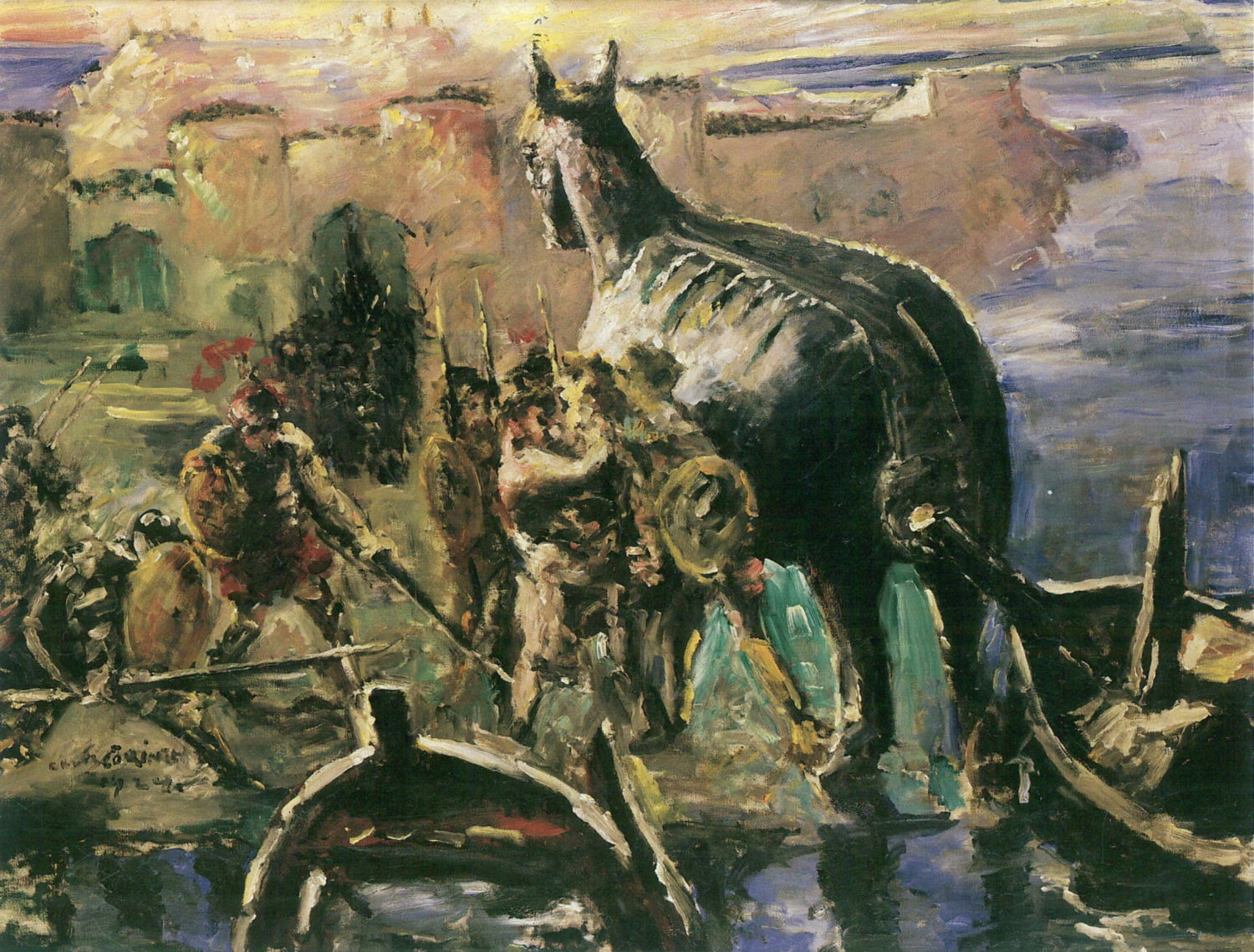
Lovis Corinth’s Trojan Horse from 1924 shows the horse still outside the city’s gate.
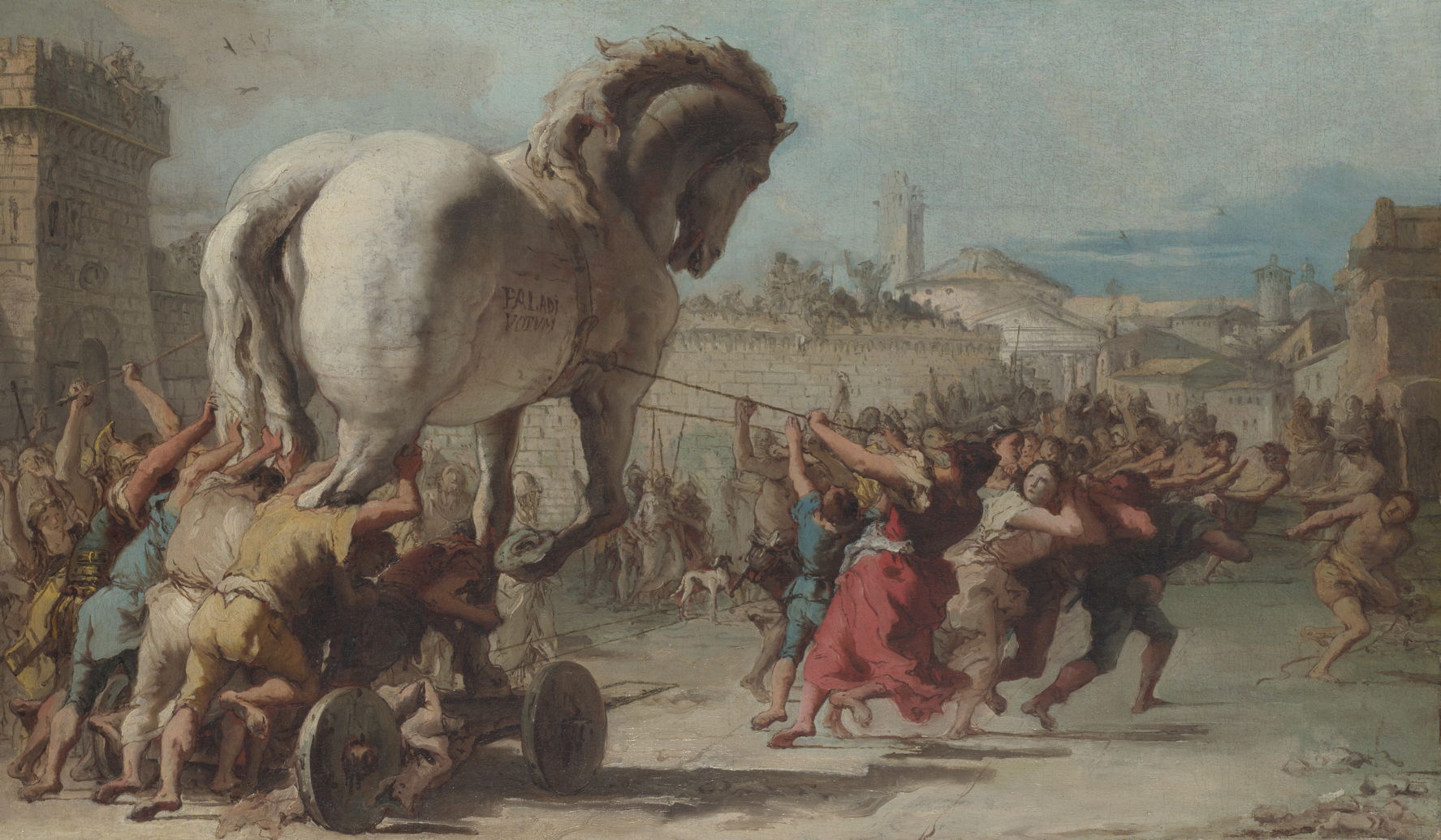
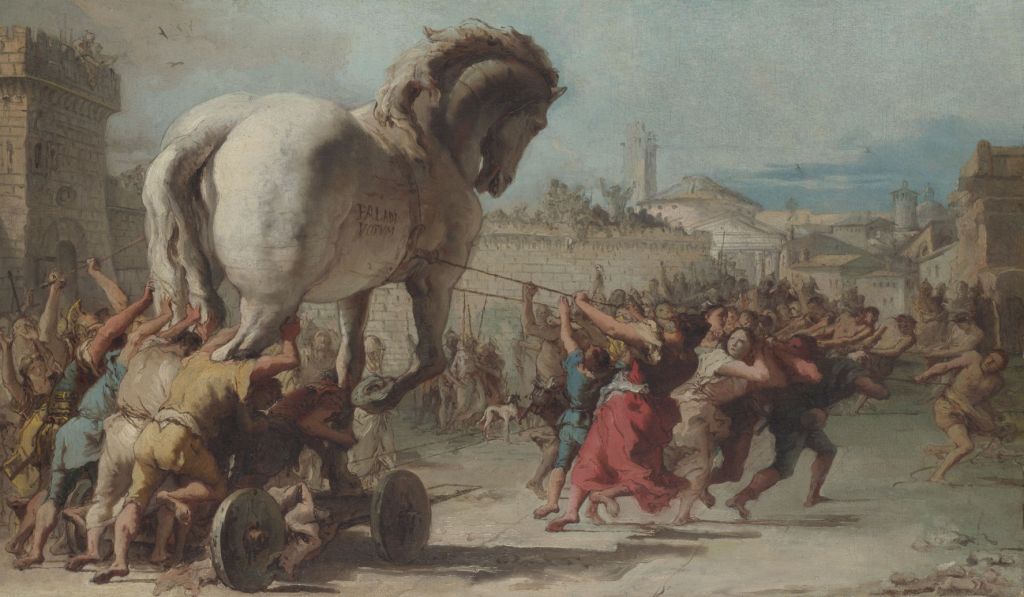
Tiepolo’s Procession of the Trojan Horse in Troy (1773) is one of his series showing the construction and entry of the horse into the city. He follows accounts that refer to Troy’s women and children hauling the structure using lines, and some reporting that it was ostensibly an apology for the theft of the Palladium.
The Trojans then went and drank and feasted what they had presumed to be their victory.
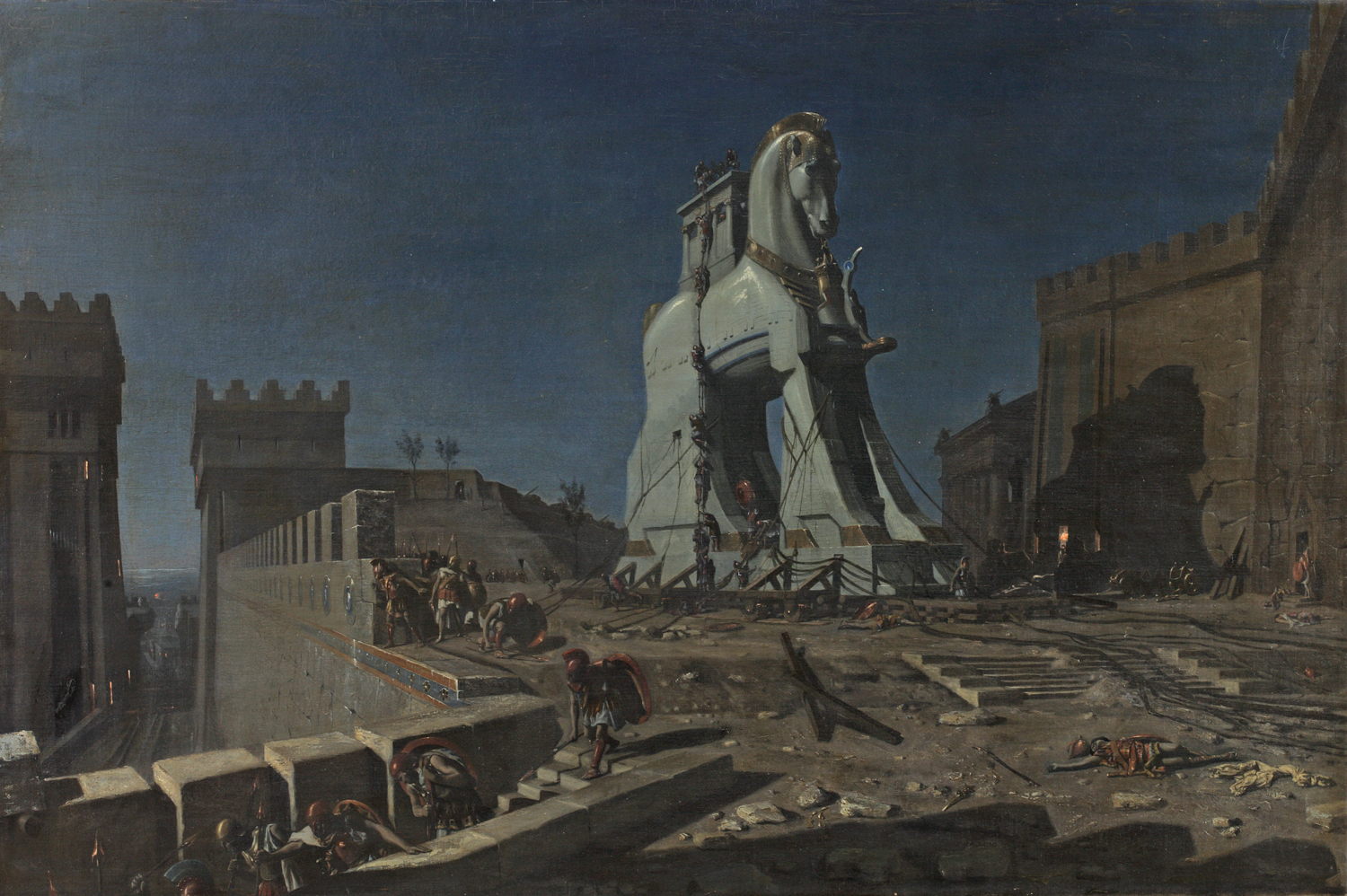
Henri-Paul Motte’s Trojan Horse from 1874 shows the Greek force as they leave the horse later that night, in their bid to seize control of the city from within.
Odysseus thus played a major role in the Trojan War, having conceived the plan for the wooden horse that brought victory and the destruction of the city of Troy after ten years of bitter fighting.
When he had left Ithaca, he left behind a young wife, Penelope, and their son, Telemachus, who had since grown into a man.

Domenico Beccafumi’s painting of Penelope (c 1514) is a sophisticated masterpiece even by today’s standards. By the start of the Odyssey, she had grown from young woman to middle-aged maid. News of what had happened during the war was interminably slow to reach outposts like the small island of Ithaca.
When she heard that Troy had fallen and the victors were returning home, Penelope must have spent days watching and waiting. As she heard reports of other wives regaining their husbands, her hopes must have run like a roller-coaster. Beccafumi’s Penelope holds a thread in her right hand, which refers to her daily task of weaving the funeral shroud for Laërtes, to spinning as a symbol of time and its passage, and to the Fates, who might be the figures at the bottom right.
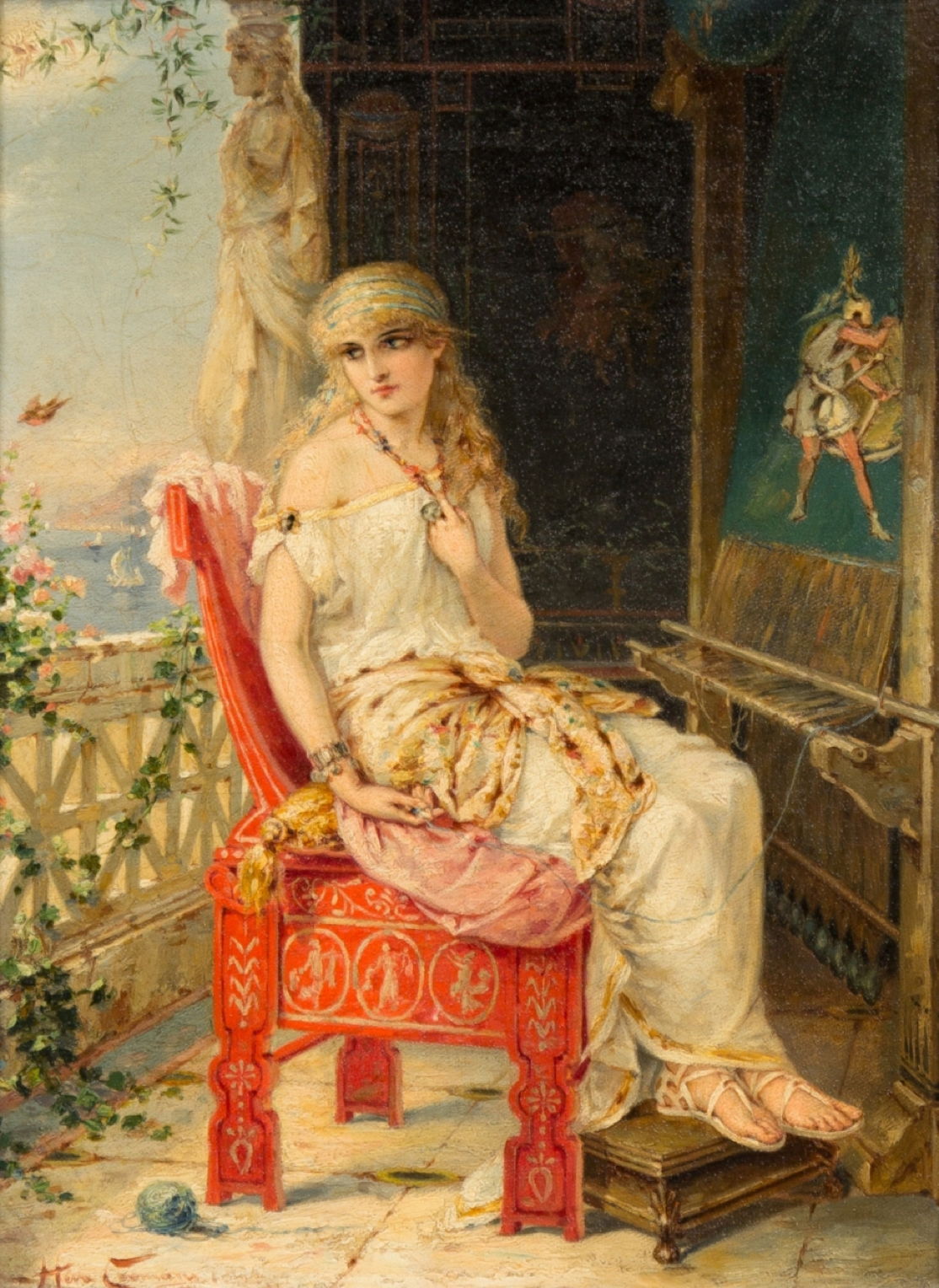
For Heva Coomans, Penelope Awaiting Odysseus (c 1900) is weaving an image of her husband as warrior, celebrating the victory at Troy. She pauses to look over her shoulder in the hope that the sails of his ships might appear any minute now.
Odysseus was delayed in departing as he had angered Poseidon. The king’s tutelary goddess Athena asked Zeus to allow his departure, letting him begin his odyssey. He and his twelve ships were soon driven off course by storms, visited lotus-eaters where the crews nearly forgot where they were heading, and ended up on the island of the Cyclops.
Among these one-eyed giants was Polyphemus, who spent his days tending his flock of sheep then feasted on humans. After Polyphemus had devoured several of Odysseus’ crew, Odysseus got the giant drunk. Polyphemus asked Odysseus his name, and the latter replied Οὖτις (Outis, Greek for nobody). Once the giant had fallen into a stupor, Odysseus drove a hardened stake into his single eye, blinding him. The following morning, Odysseus and his men tied themselves to the undersides of the sheep in Polyphemus’ flock so he couldn’t feel them escaping.

Christoffer Wilhelm Eckersberg’s Ulysses Fleeing the Cave of Polyphemus (1812) shows Odysseus about to make his way out of the Cyclops’ cave, as his captor strokes one of his sheep. With Polyphemus’ face turned away from the viewer, it’s impossible to see whether he has been blinded.

Jacob Jordaens pictures the crew fastening themselves to the underside of the sheep as they prepare to escape, in his Odysseus in the Cave of Polyphemus, probably painted in about 1650. Again, the Cyclops is facing away from the viewer, and it’s hard to be sure this is taking place after his blinding.

Guido Reni’s account in his Polyphemus from 1639-40 is far clearer. The Cyclopean eye socket is now empty, where Odysseus had poked its single eye out. In the distance, Odysseus and his crew are making their way out to their ships in two smaller boats, in their haste to depart.
Recognising he had lost his captives, Polyphemus called out for help from the other Cyclops, telling them that ‘Nobody’ had hurt him. The others therefore didn’t come to his aid.
 The Eclectic Light Company