
Dragonflies have suffered a bad press for too long. Commonly known on both sides of the Atlantic as the devil’s darning needles, they’re more widely associated with evil, biting people, or even sewing their eyelids together, all categorically untrue. In reality they should be our friends, as they’re insectivorous, and amazingly effective at consuming biting flies.
Unfortunately, their associations in paintings are as bad as those old wives’ tales, and they have been depicted infrequently.

Ambrosius Bosschaert (1573–1621) painted this Flower Still Life in oil on copper in 1614, during the early years of the Dutch Golden Age. At first its eclectic mixture of different flowers and flying insects appears haphazard, but they merit a deeper reading. The flowers include carnation, rose, tulip, forget-me-nots, lilies of the valley, cyclamen, violet and hyacinth, which could never, at that time, have bloomed at the same time. The butterflies, bee and dragonfly are as ephemeral as the flowers around them, confirming that it’s a vanitas painting.
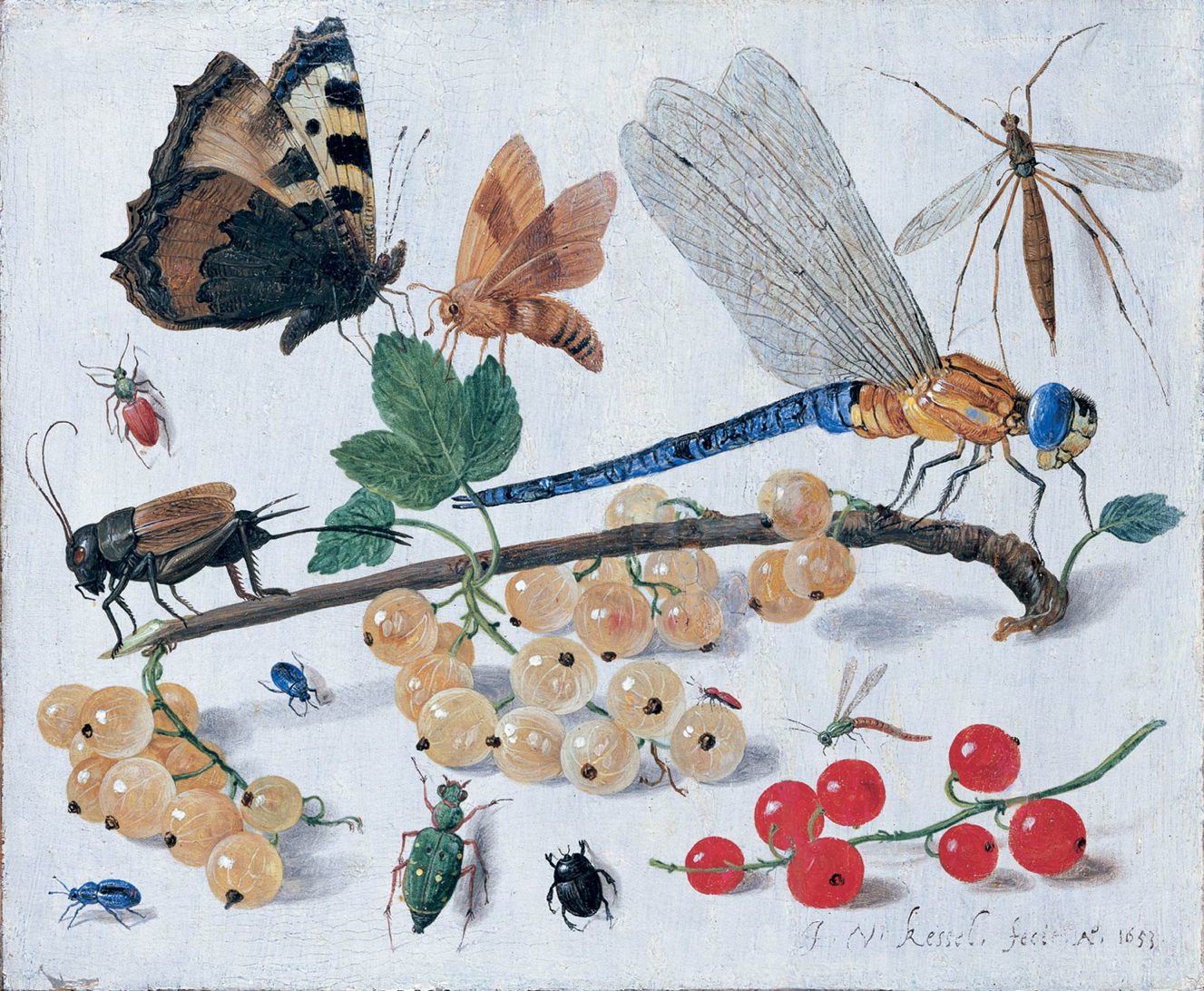
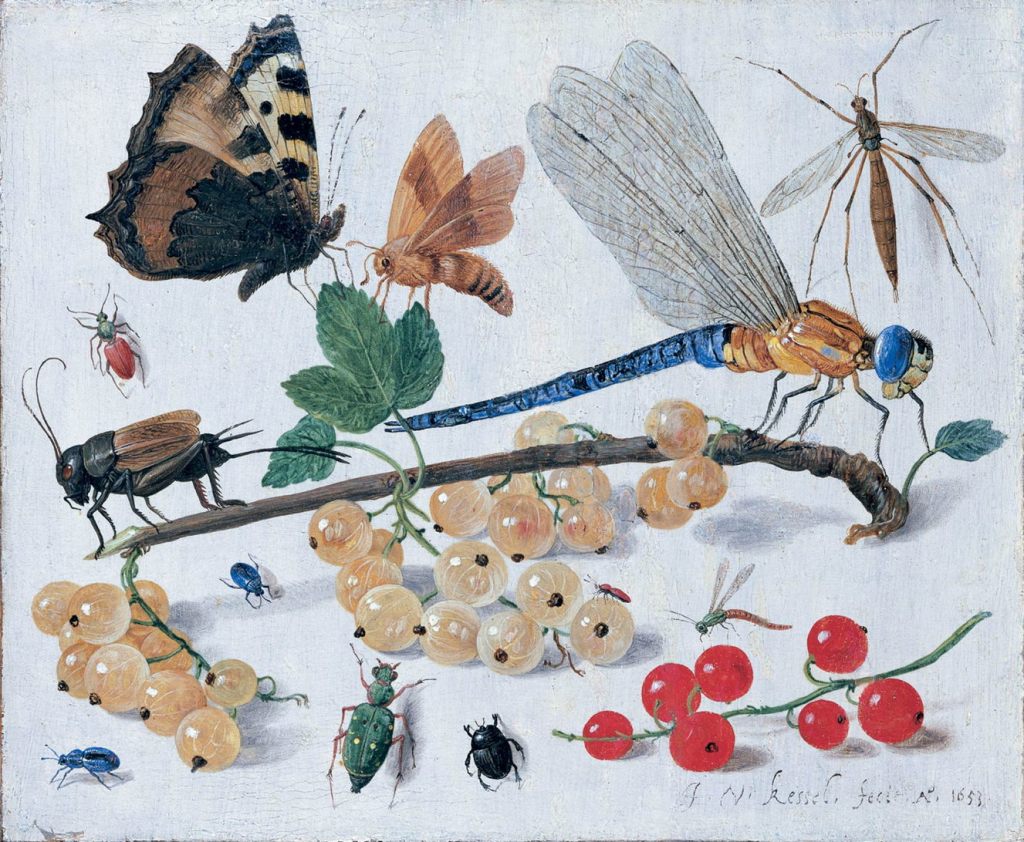
In 1653, Jan van Kessel the Elder painted this collection of insects and berries in oil on copper. The dragonfly shown appears to be a southern hawker (Aeshna cyanea), one of the most common large species found throughout Europe, although its thorax is unusually pale, suggesting it might be a young adult (teneral), or had discoloured after death.
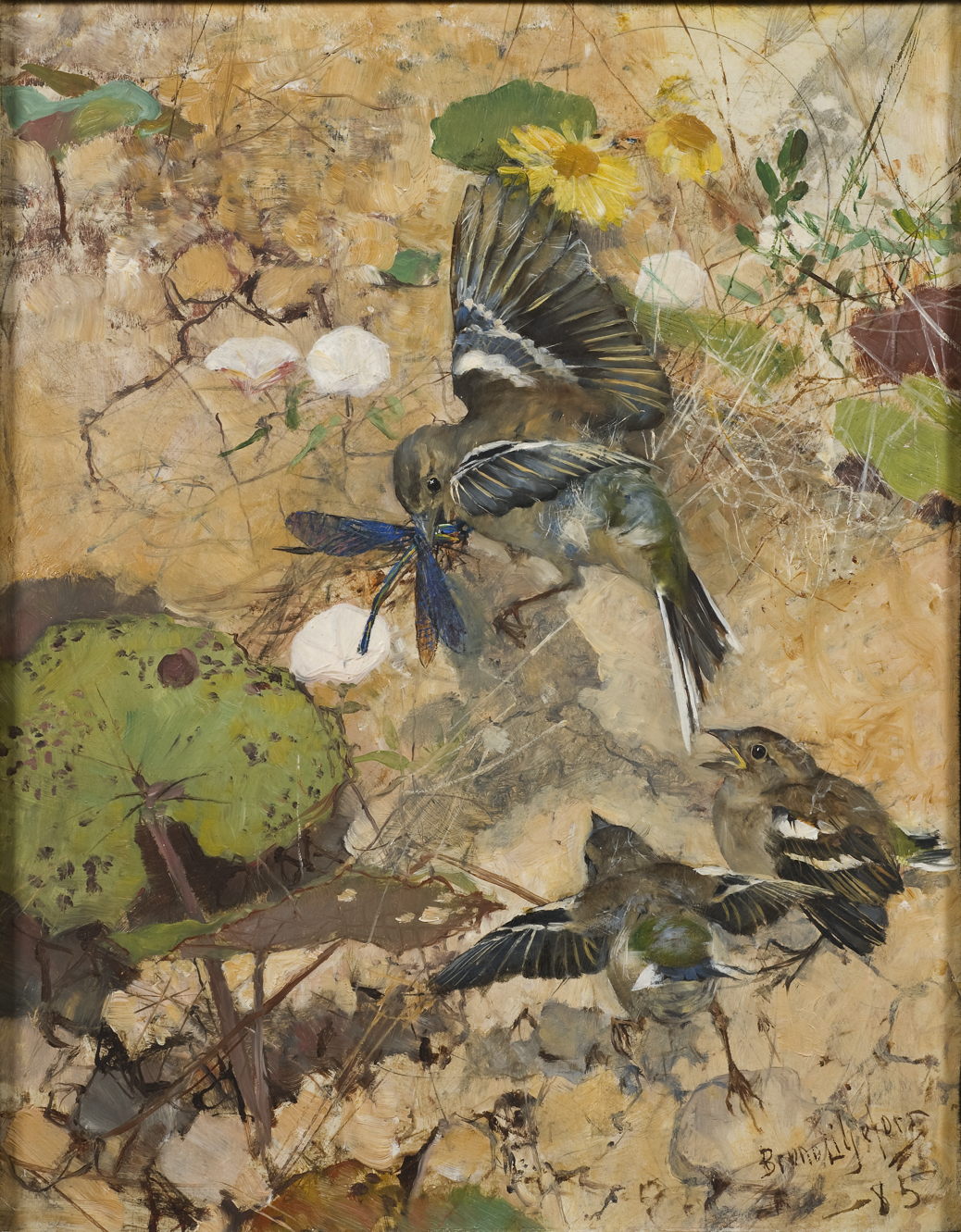
The large meal seen in the centre of Bruno Liljefors’ Chaffinches and Dragonflies. Five studies in one frame (1885) is another common European species, the beautiful demoiselle (Calopteryx virgo). This is considerably smaller than the hawker seen above, and is more correctly termed a damselfly, as its pairs of wings are of equal length, and when resting are folded back against its body.
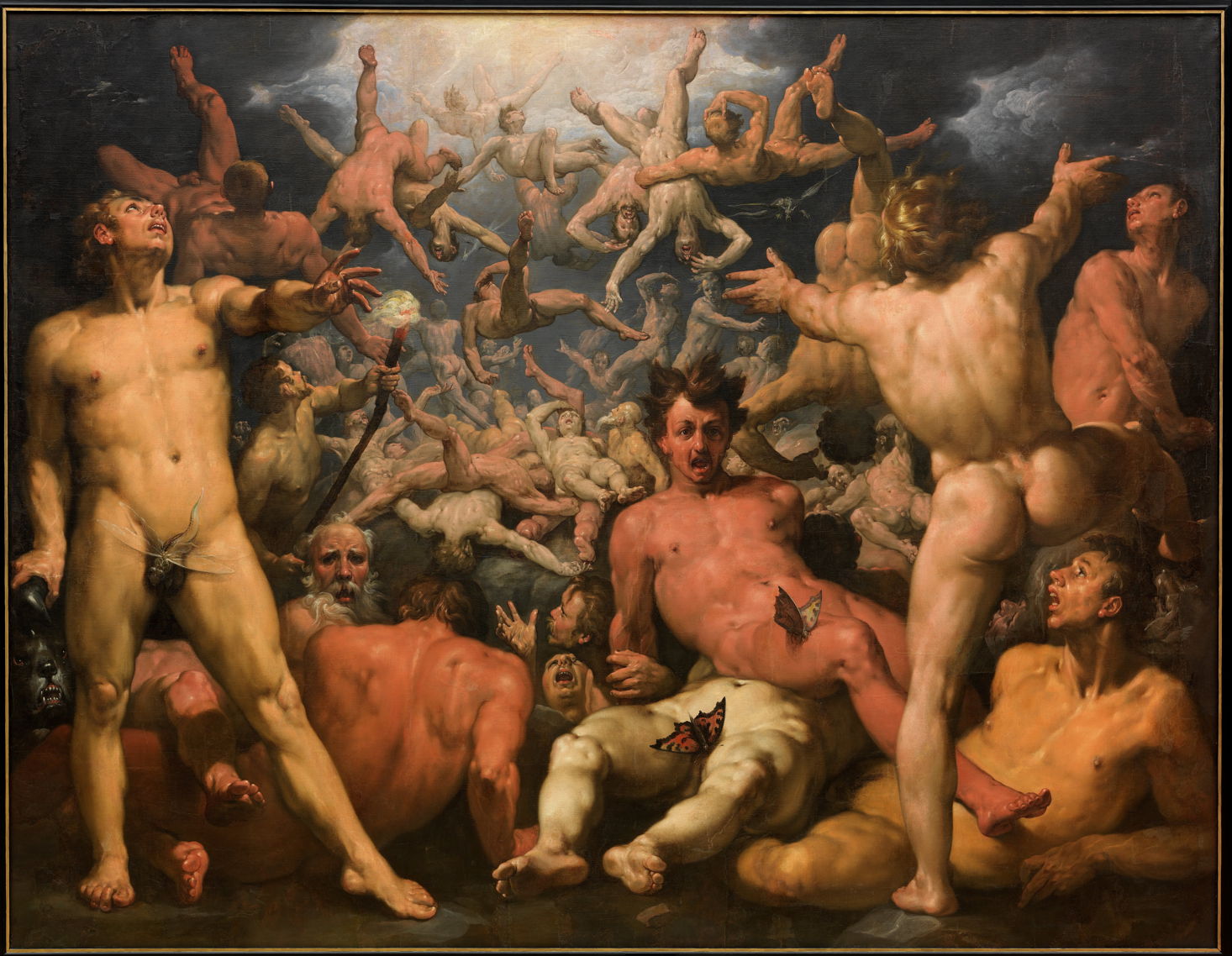
Cornelis van Haarlem’s The Fall of the Titans from 1588-90 might seem a strange painting in which to find flying insects. This shows the classical myth in which the gods have defeated the Titans who preceded them. As a result the Titans fell from the heavens and were imprisoned in Tartarus, or Hell, as shown here. It was claimed that flying insects were associated with the fire of the underworld, although the two butterflies and one dragonfly here appear quite incongruous.
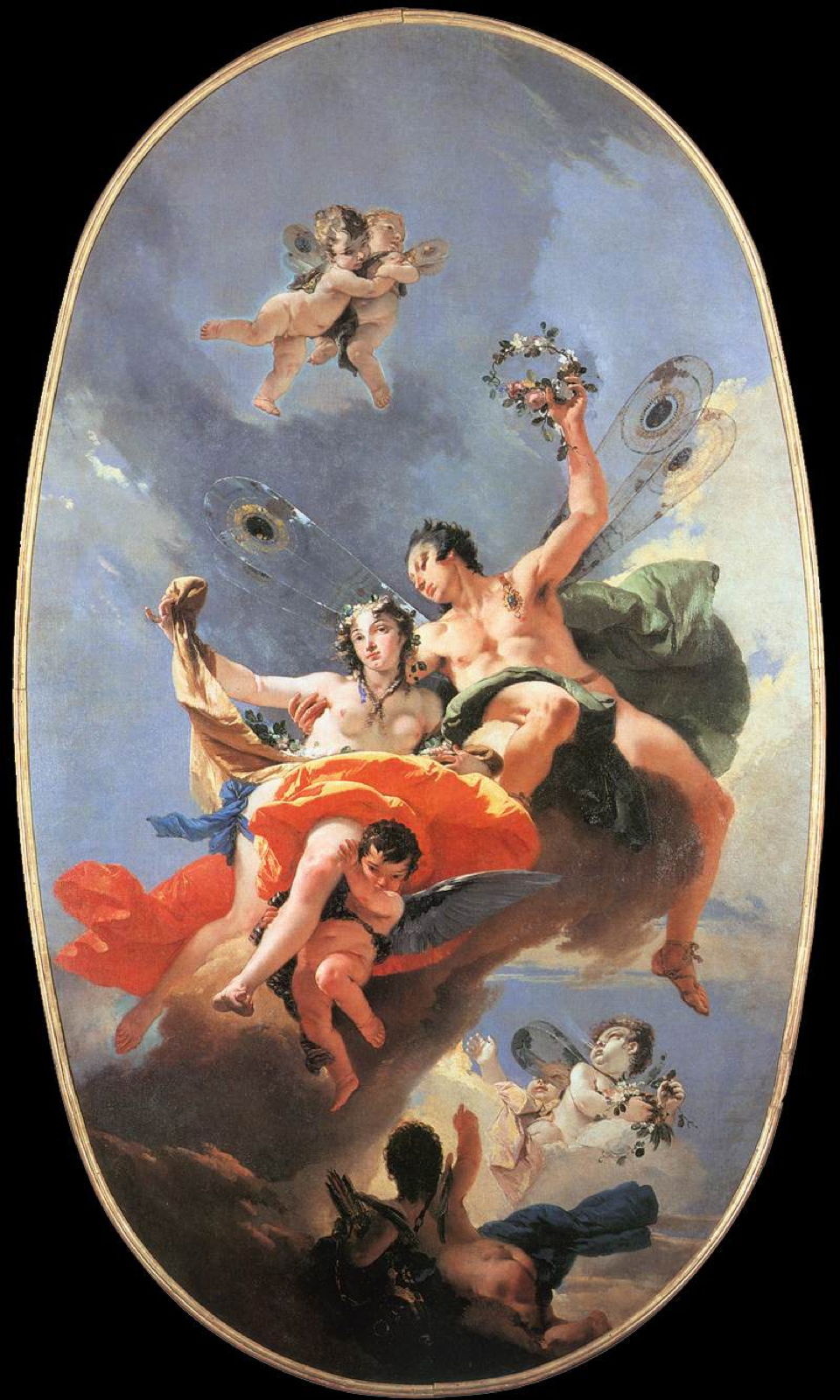
Tiepolo’s The Triumph of Zephyr and Flora from 1734-35 refers to Ovid’s account in his Metamorphoses, and to Botticelli’s Primavera, with Zephyrus in flight with his arm around Flora, just about to crown her with a garland. Unusually, Zephyrus is given the wings of a dragonfly.

In the Roman religion, Fortuna (Greek equivalent Tyche) was the goddess of fortune and luck, both good and bad. More usually depicted as being veiled and/or blind, to indicate the chance involved, she was the embodiment of capriciousness. In this updated portrait of the goddess, Elihu Vedder shows her as a carefree, happy-go-lucky woman, with the wings of a dragonfly, sat next to a sack of gold coins. Vedder first visited Italy in 1858, and lived there from 1906 until his death seventeen years later, so he may well have been referring to Tiepolo’s Zephyrus, which was and remains in Venice.
My last painting of a dragonfly is by far the most complex, and was made by Richard Dadd between 1855-64, when he was a patient in the Bethlem and Broadmoor psychiatric hospitals, after he had murdered his father.
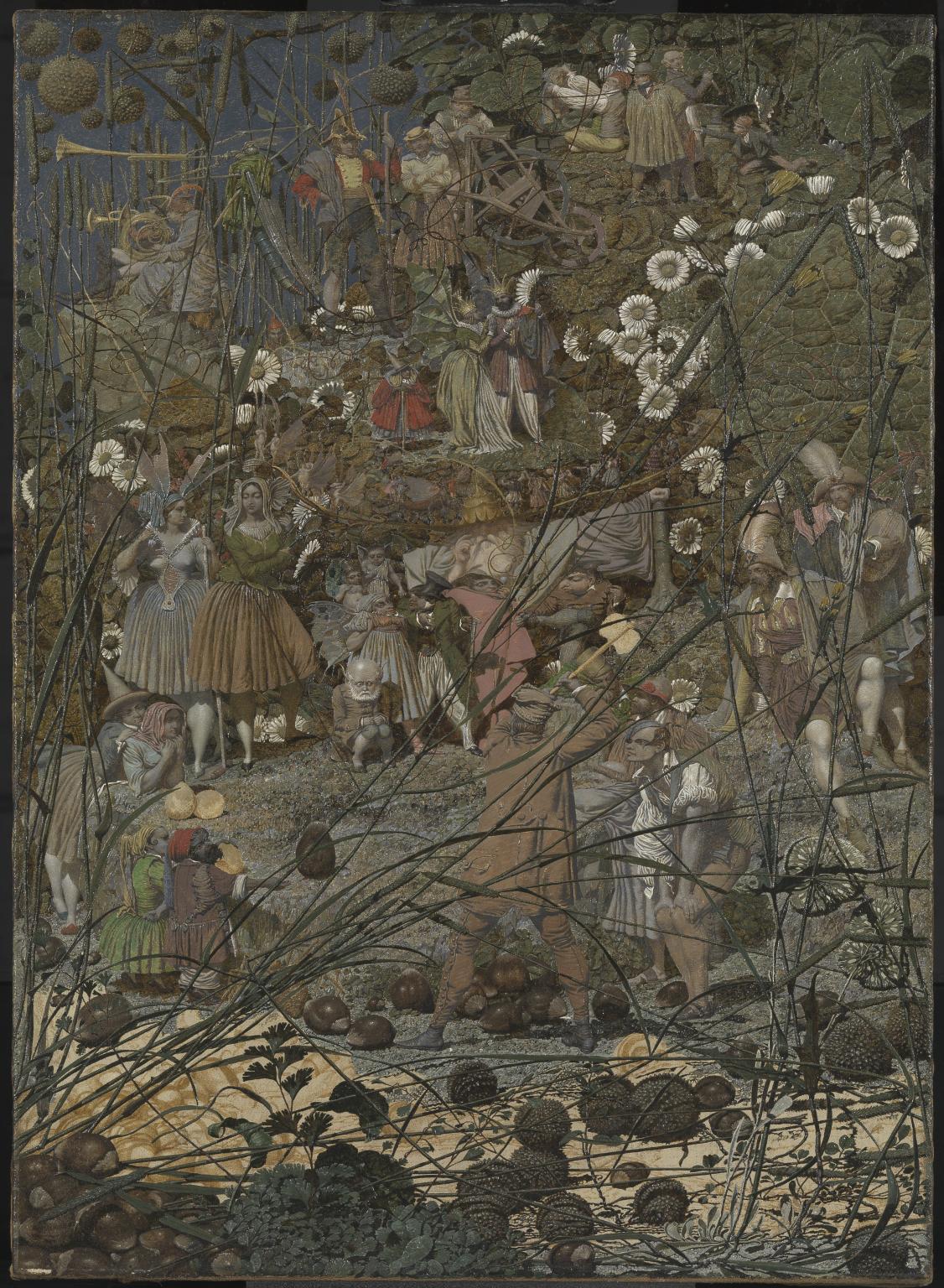
Dadd’s The Fairy Feller’s Master-Stroke has its origins in Shakespeare’s plays, with its main content drawn from A Midsummer Night’s Dream. This looks through fine stalks of Timothy grass at a foreground of scattered hazelnuts and plane tree fruit. Although its perspective is flattened, the figures in the lower half of the painting are stood on a gently rising grassy sward, behind which is a steeper bank and stone walling. Those in the upper third of the painting appear to be on another level, which rises more steeply towards the top edge.
The scene is set in the night-time, although daisy flowers are still unnaturally open, and there is night sky visible at the upper left. The feller himself, a hewer or fellow, seen at the centre, is about to cleave a hazelnut with his axe to provide a new carriage for Queen Mab (pronounced Maeve, to rhyme with rave), who replaces Titania as the queen of fairyland.

Even the distant upper section of the painting is rich in its array of characters. Trumpeters at the left include two boys, given as a ‘tatterdemalion’ and a ‘junketer’, and an insect intended to be a dragonfly. To the right of them are the characters from the still-popular child’s counting saying, of tinker, tailor, soldier, sailor, rich man, poor man, beggar man, and thief, although not quite in that order. The dragonfly may have been based on another large species found throughout Europe, the emperor (Anax imperator).

