
Mythological worlds in classical Mediterranean civilisations often appear confusing and contradictory when stories and beliefs of many centuries and different cultures are merged, as happened in post-classical painting. What might appear to be a single distinctive attribute, such as a snake coiled along the length of a staff, then becomes a muddle.
There are two common combinations of snakes coiled around a rod or staff. Hermes (Roman Mercury) has a caduceus as his attribute, consisting of a rod or staff with a pair of entwined serpents along its length, and sometimes they are shown bearing small wings. This signifies his swiftness as a messenger. The rod of Asclepius (which has several alternative spellings) should have but a single serpent coiled around it, and is associated with healing and medicine, and remains so today long after its divine origins have been forgotten.
Caduceus

Although not known for his paintings of secular stories, William Blake’s Judgement of Paris (c 1806-17) was one of a pair made for Thomas Butts, the other being Philoctetes and Neoptolemus on Lemnos, a more obscure story leading to the death of Paris.
As with almost every artist before and since, Blake shows the three contestants naked in front of Paris, just at the moment that the golden apple is awarded to Aphrodite. Hera and Athena, standing either side of her, are visibly upset. Above them is the naked figure of Hermes, with his caduceus and its pair of intertwined serpents, and a winged helmet. The demonic figure at the top left is presumably a harbinger of the death and destruction to come in the Trojan War.

Renoir’s account of The Judgment of Paris, from about 1908-10 is a carefully composed image of the same moment of peripeteia. Watching on is Hermes, complete with his winged helmet, sandals, and caduceus.

The most popular scene in Ovid’s intertwined stories of the rape of Io and the murder of Argus is that of Hermes lulling Argus to sleep. However, hardly any painters depict Argus having the hundred eyes specified in the Metamorphoses. Abraham Bloemaert is an exception, in his carefully composed Mercury, Argus and Io (c 1592). Hermes is playing his flute at the left, his caduceus at his feet, as Argus falls asleep in front of him, his additional eyes visible over the surface of his head.

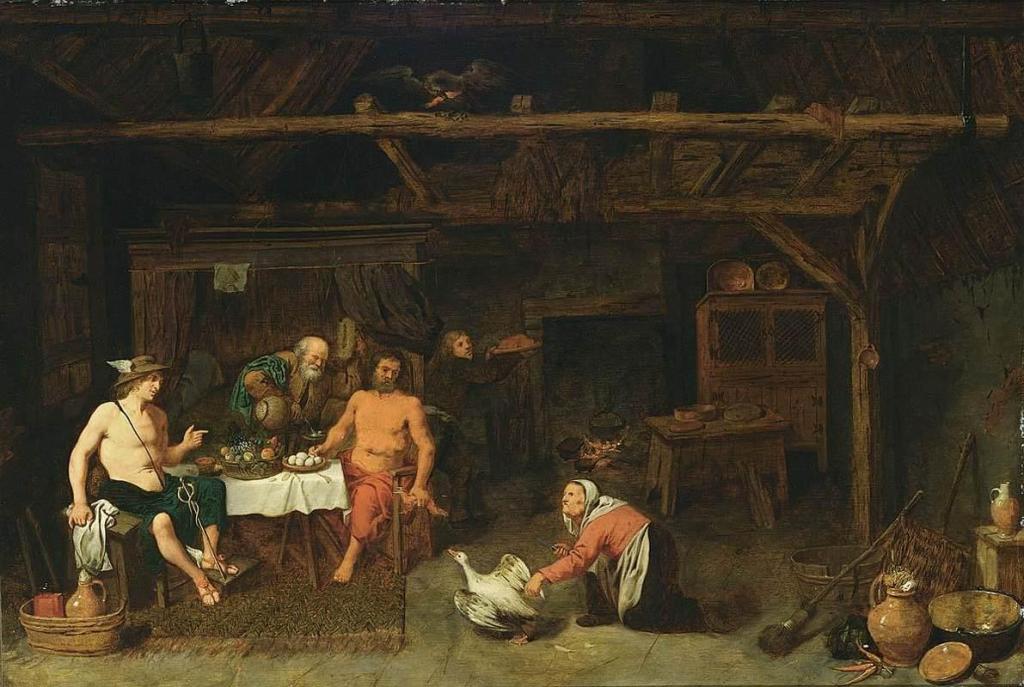
David Rijckaert’s undated Philemon and Baucis Giving Hospitality to Jupiter and Mercury gives the most popular account of the elderly couple entertaining the two gods. Hermes (left) and Zeus (left of centre) are seated at the table, with Philemon (behind the table) and Baucis (centre) waiting on their every need. Once again, Hermes is distinguished by his caduceus as well as a more contemporary winged hat.
Rod of Asclepius

In the eighteenth century, Giovanni Battista Cipriani drew Aesculapius Holding a Staff Encircled by a Snake, following the classical tradition.

Johannes Zacharias Simon Prey painted this group of Aesculapius, Apollo and Hippocrates in 1791. Asclepius, holding his distinctive rod, is shown in the centre of the trio, with Hippocrates, the less legendary ‘father of medicine’, to the right, clutching the basal half of a human skull, and Apollo, father of Asclepius, behind. They have entered a contemporary pharmacy, where an assistant uses a large mortar and pestle, and another works the bellows of a furnace.
Inevitably, the distinction between Hermes’ caduceus and the rod of Asclepius has been lost more recently, and many symbolic representations of medicine have erroneously used a caduceus.

