
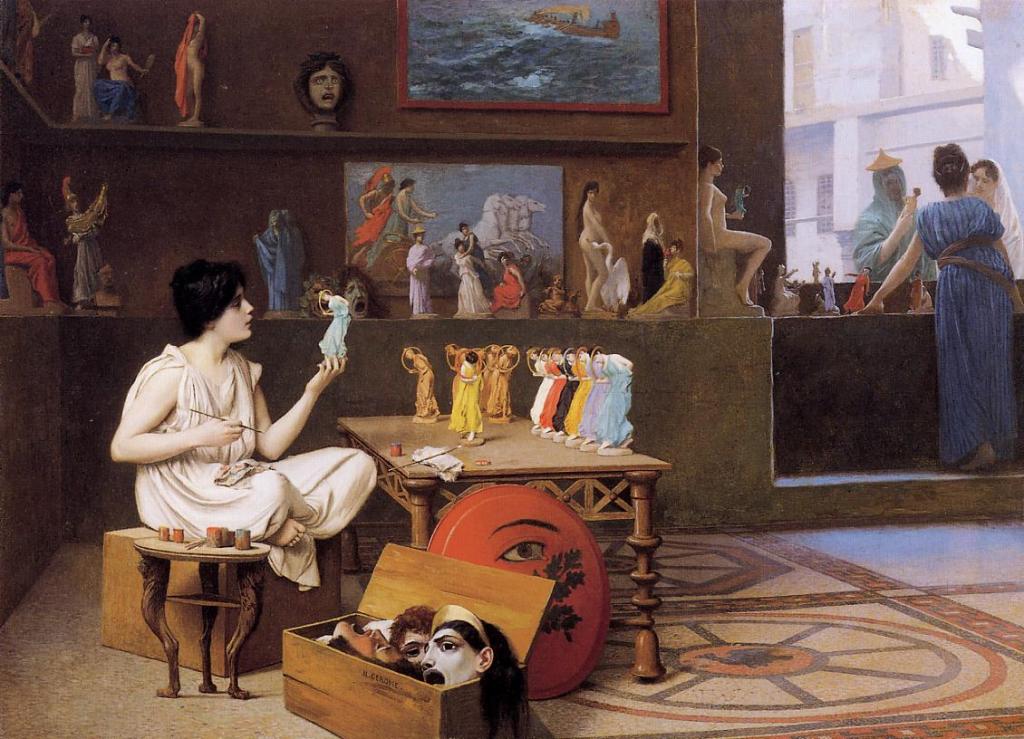
Many of the great buildings, their friezes and statues of classical times, and in the Middle Ages, were painted, a practice known as polychrome. This article looks at some more modern examples made by those who also painted flat surfaces.

Lawrence Alma-Tadema’s beautiful painting of Phidias Showing the Frieze of the Parthenon to his Friends from 1868 shows a group including Pericles (at the right), Aspasia, Alcibiades and Socrates, admiring this famous frieze in the glory of its original colours.

This magnificent polychrome limewood sculpture shows The Last Judgement (c 1520) as an outbreak of plague, and may be based on descriptions of the Black Death.
Much of the output from the workshops of Spanish painters during the seventeenth century wasn’t two-dimensional painting, but polychrome wood carvings destined for religious use.

Juan de Mesa (1583–1627) was a Cordoban sculptor who trained and worked in Seville from 1606 to his death there in 1627. He was responsible for many of the processional effigies which were – and some still are – featured in the celebrations of Holy Week in Seville. The Immaculate Conception is a fine example of his work from about 1610-15.
Many painters have also sculpted, but one specialised in polychrome figures, Jean-Léon Gérôme. Not only that, but he made paintings of him working on his sculptures, and of polychrome sculptures more generally.

Gérôme’s The End of the Pose (1886) is the first of a series of unusual compound paintings, which are at once self-portraits of Gérôme as a sculptor, studies in the relationship between a model and their sculpted double, and forays into issues of what is seen, visual revelation, and truth.
Here, while Gérôme cleans up, his model is seen covering up her sculpted double with sheets, as she remains completely naked. Apart from various diversionary entertainments, including a couple of stuffed birds and a model boat, there is a single red rose on the wooden platform on which the model and statue stand.
It’s not far from here to the myth of the perfect sculptor, Pygmalion, whose creation was given life, turning statue into lover, which was Gérôme’s next step in 1890.

Gérôme’s finished Pygmalion and Galatea (c 1890) just managed to stay on the right side of what in the day was deemed decent. His attention to detail is, as always, delightful, with two masks against the wall at the right, Cupid ready with his bow and arrow, an Aegis bearing the head of Medusa, and a couple of statues about looking and seeing.
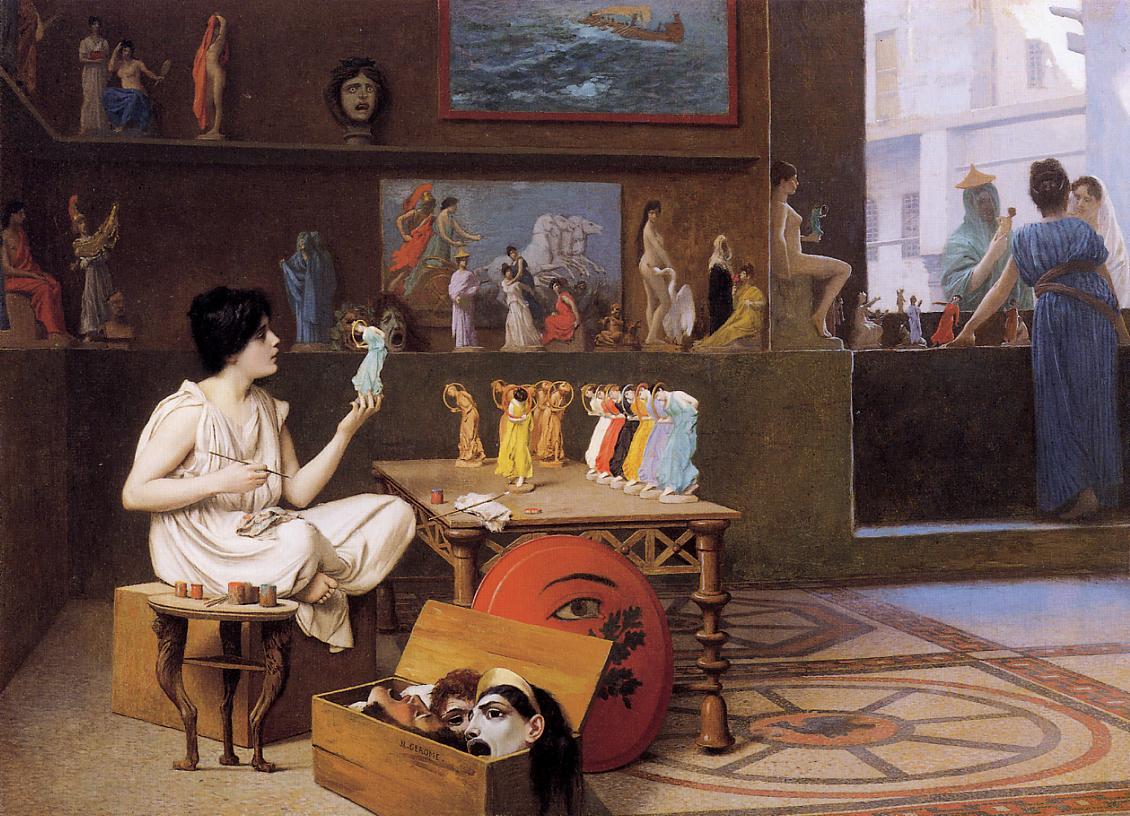
In 1874, archaeologists discovered large numbers of polychrome cast terracotta figurines in the Boeotian town of Tanagra. These dated from Greek civilisations active there during the late fourth century BCE, and their quantity and quality impressed many, including Gérôme.
Having painted the story of Pygmalion and Galatea in 1890, Gérôme moved on to two works in which he built imaginary worlds around the Tanagra figurines. Sculpturae Vitam Insufflat Pictura (Painting Breathes Life into Sculpture) (1893) combines his own love of polychrome sculpture with a celebration of those archaeological discoveries.
In doing so, Gérôme progresses his long-running theme of visual revelation and truth, with these painted miniature humans, mimicking reality, and the wooden box of masks in the foreground. Several of the figurines refer to his own painting and sculpture.
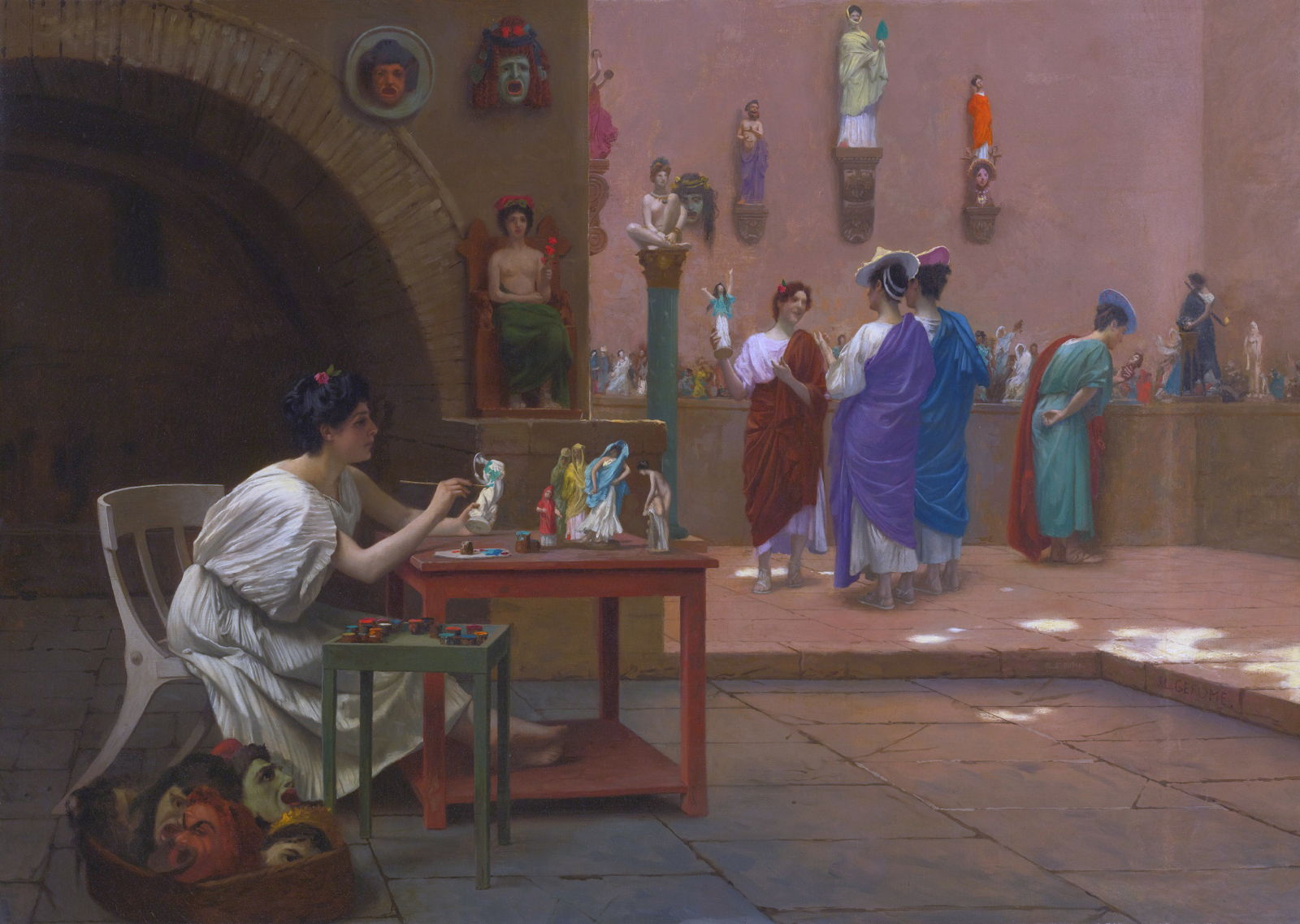
As a painting, I don’t think that his Atelier of Tanagra (1893) is as effective and convincing as the previous work, but its wider range of figurines gives deeper insight into what Gérôme was thinking about. Several of the figurines shown here are his own polychrome sculptures, most obviously that of the naked woman sitting on the top of a blue pillar, in the centreline of the painting.

In The Artist’s Model (1895), Gérôme paints himself at work on his marble figure Tanagra (1890), currently in the Musée d’Orsay, which he had already included among the figurines in his Sculpturae Vitam Insufflat Pictura. He thus painted himself making a sculpture which he had previously painted in a painting as a sculpture. Scattered in the image are reminders of gladiatoral armour and other props used for his paintings, one of his paintings of Pygmalion and Galatea, together with one of his polychrome sculptures of a woman with a hoop, at the right edge.

In 1894, Jean-Léon Gérôme started work on this polychrome marble head of the famous actor Sarah Bernhardt (1894-1901), which he completed in 1901. He bequeathed it to the French nation.

In about 1902 Gérôme returned to his series of paintings of himself as a sculptor. His Self-Portrait Painting The Ball Player is a fascinating variation of the traditional form of self-portrait, in that he is here applying the colour to one of his polychrome sculptures, a figure of a ball player, who closely resembles those seen earlier in his paintings of sculptures, including Pygmalion and Galatea.
Georges Lacombe was the sculptor among the Nabis, who painted Breton motifs and sculptures he created in wood.

Some of Lacombe’s sculptures are stunning: this wood carving in mahogany with added colour shows the goddess Isis, and was made in about 1895. It’s now in the Musée d’Orsay. Lacombe’s symbolism here may refer to the role of this Egyptian goddess in producing and protecting the heir to Osiris, Horus.

