
After yesterday’s visits to some of the city parks of London and Paris, today we resume our tour in the grounds of the Villa Borghese, in central Rome. This covers an area of just under 200 acres (80 hectares) that was originally landscaped in ‘English style’ from a former vineyard. It was bought by the city and made properly public in 1903, and has since hosted many events, including part of the 1960 Olympic Games.

In 1823, when public access to the park was still informal, the German painter Carl Eduard Ferdinand Blechen sketched this view In the Park of the Villa Borghese, showing one of its small fountains in an avenue of trees.
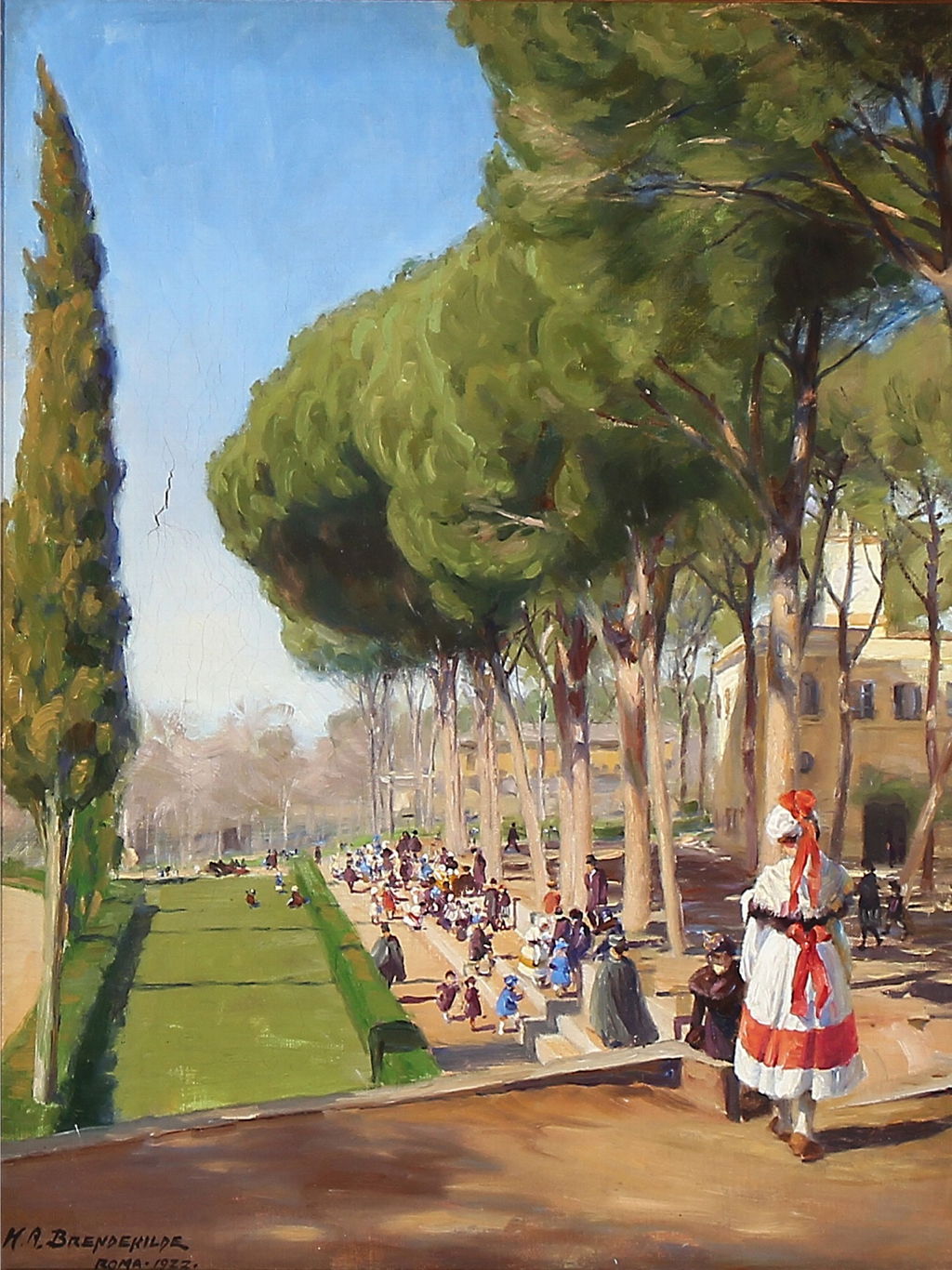
Hans Andersen Brendekilde painted this Summer Day in Villa Borghese in Rome late in his career, in 1922, after it had been made a public park and was being well used by groups of children.
The Leopoldstadt district of Vienna is famous for the Prater, a huge park of about 1,500 acres (600 hectares), a favourite of the Austrian painter Tina Blau.
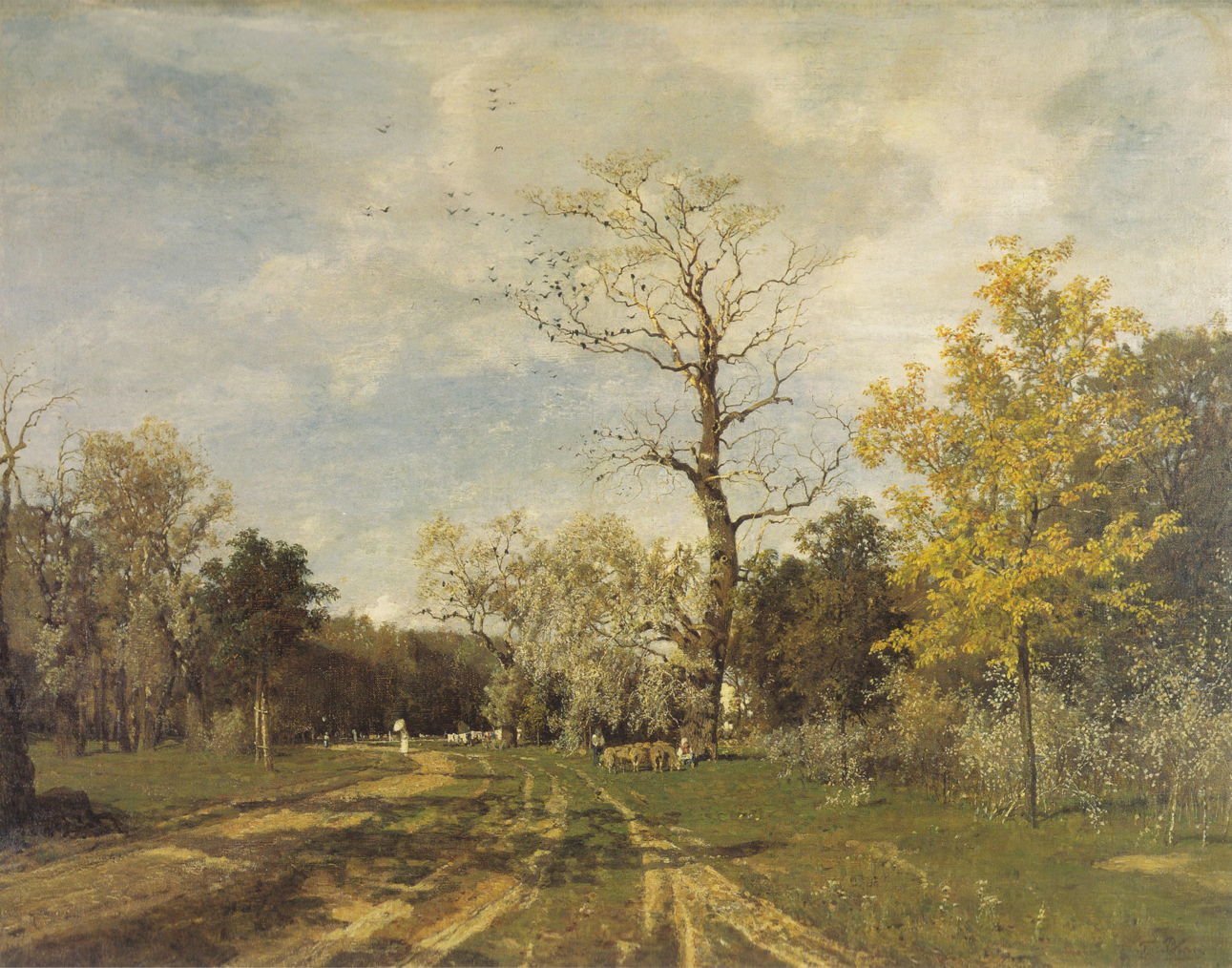
During the early 1880s, she concentrated on painting in the Prater. This area of meadows and woods had been given to the public by Emperor Joseph II in 1766. In 1873 it was used for the Vienna World Fair, but hunting continued in the area until 1920. Spring Day in the Prater (c 1881-2) is one of her studio paintings from this period, with its detailed realist style. It shows the unusual combination of a flock of sheep and the promenade of the fashionably dressed.
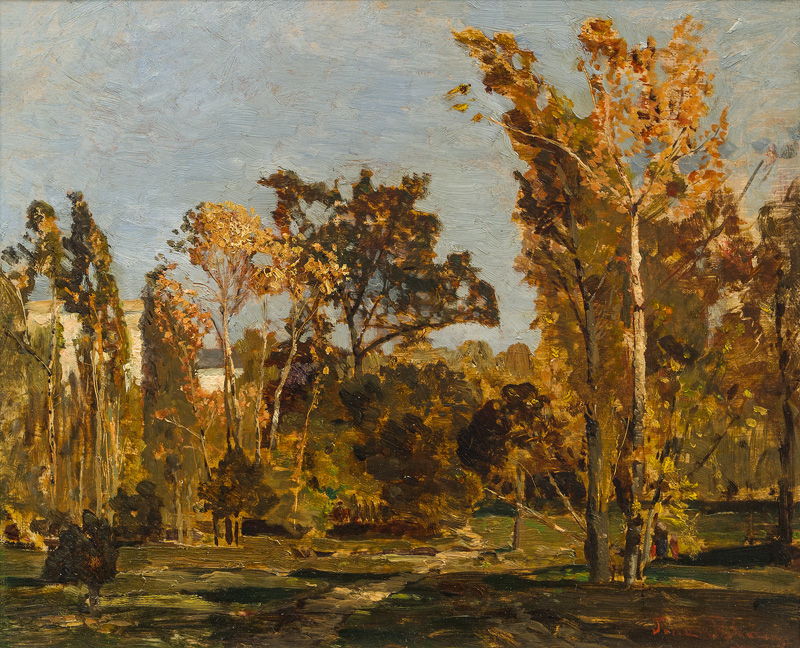
In her undated Prater Gardens, its trees are just starting to change colour one autumn probably around 1890.
We end the weekend on the other shore of the North Atlantic, in New York, where we first visit Central Park in Manhattan. Designed by landscape architects Frederick Law Olmsted and Calvert Vaux, parts were first opened to the public in 1858, although it wasn’t fully completed until 1876. It now occupies a rectangular swathe of 843 acres (341 hectares) between Upper West Side and Upper East Side neighbourhoods.

William Merritt Chase’s View from Central Park shows the park in 1889, and relegates the large buildings of Manhattan to its distant skyline.

Maurice Brazil Prendergast’s view of carriages in Central Park, 1900 (1900) shows how crowded it could become in fine weather.
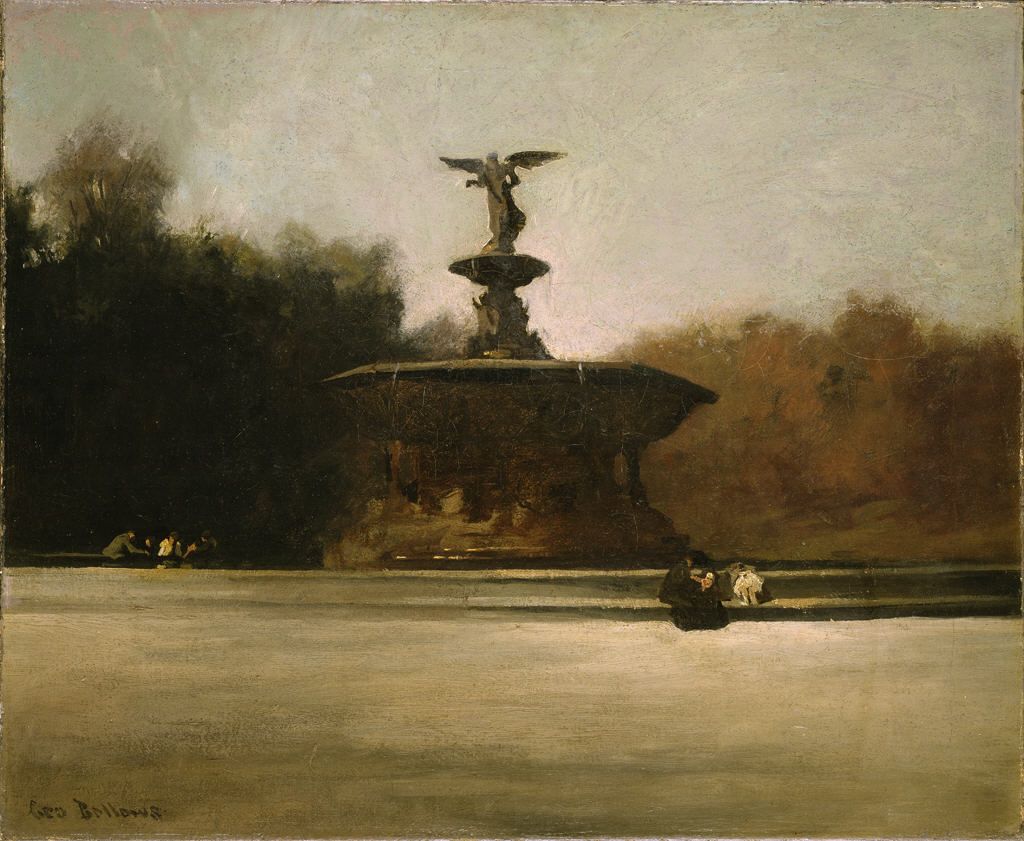
George Bellows painted Bethesda Fountain (Fountain in Central Park) in 1905, when still a student in New York. It shows, in rather sombre earth colours, this central feature of Bethesda Terrace in Central Park. This bronze statue was designed by Emma Stebbins, and in those days was still relatively new, having been unveiled in 1873. Its proper name is “The Angel of the Waters Fountain”, with the reference being made not to Bethesda, Maryland, but to the biblical location.
With Central Park under way, Olmsted and Vaux moved on to lay out what’s now an area of 526 acres (200 hectares) in Brooklyn’s Prospect Park. This first opened in part in 1867, but wasn’t complete until 1873. In the late 1880s it was a favourite haunt and source of motifs for William Merritt Chase when he lived in Brooklyn.
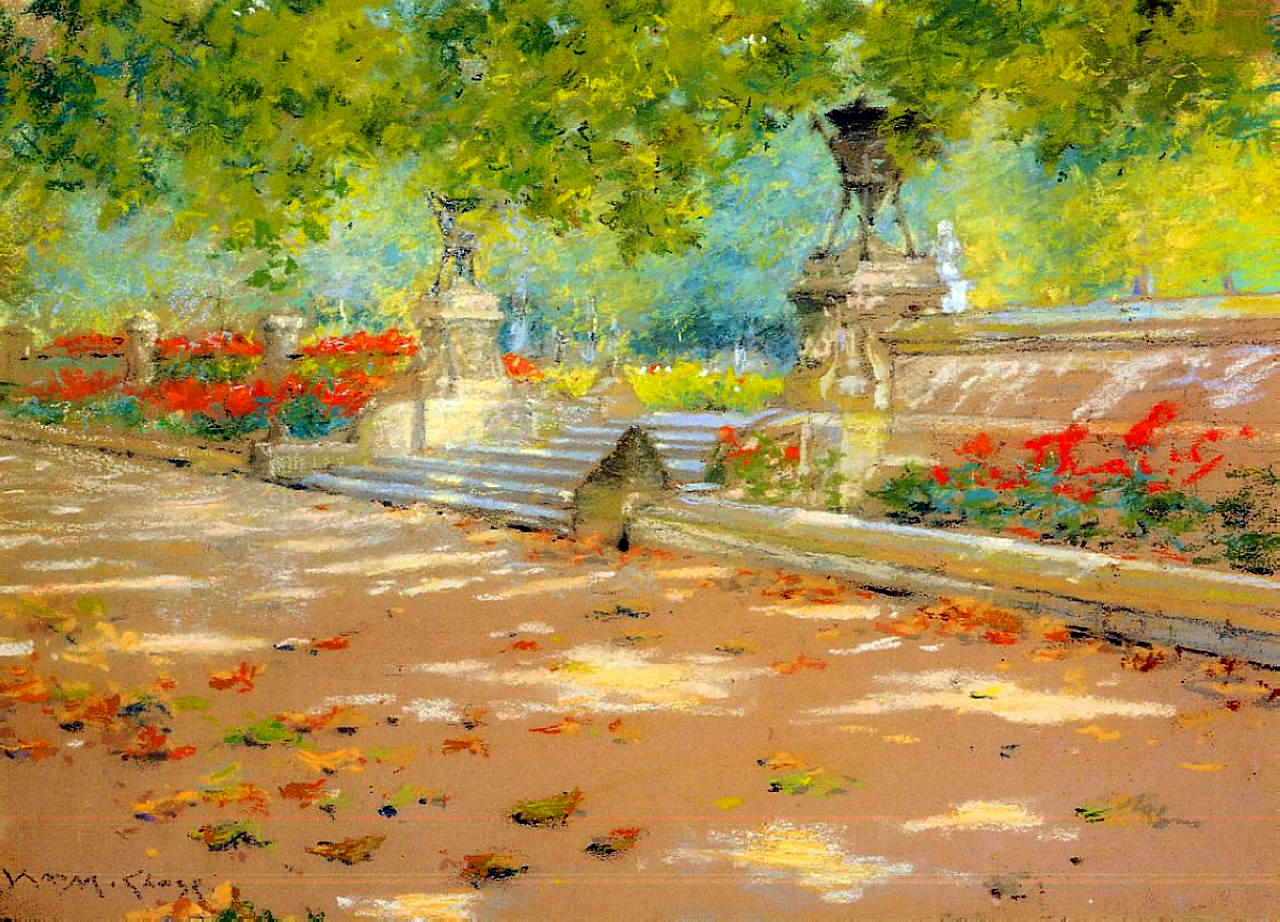
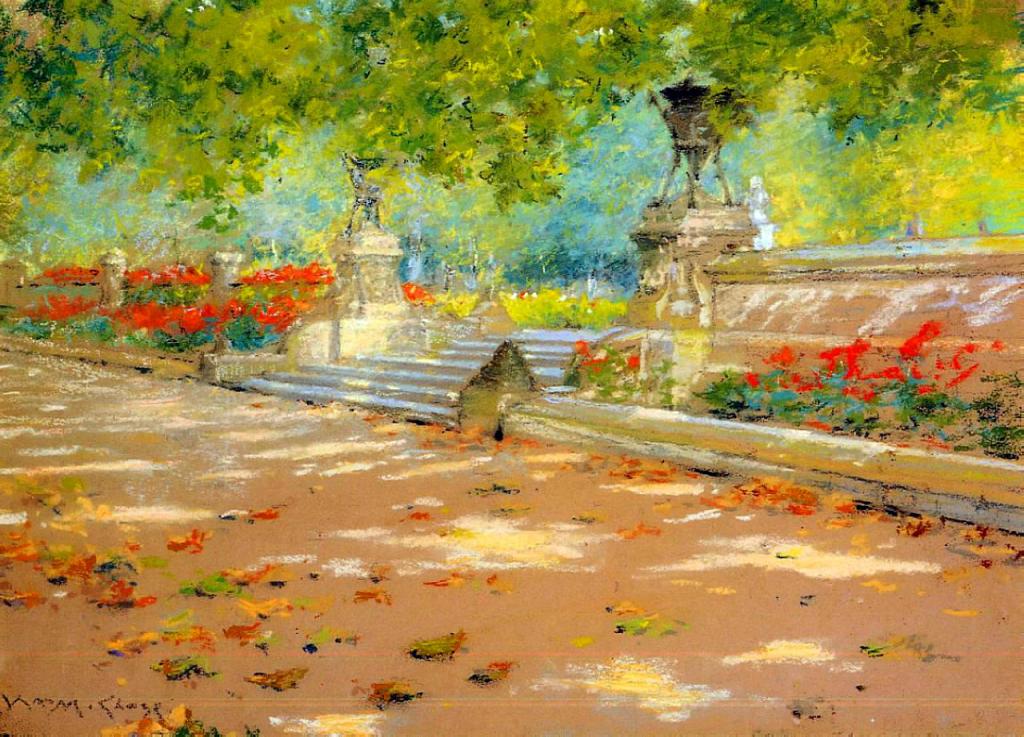
Chase’s Terrace, Prospect Park from about 1886 captures the fresh colours of early summer in pastels.

The following year, his Park in Brooklyn shows housing at the park’s edge, beyond a section of informal garden.

Chase’s Boat House, Prospect Park (1887) shows the park’s original and fairly spartan wooden boathouse. In 1905-07 it was supplanted by a far grander building on the Lullwater of the lake, which is now better known.

