

Given the technical challenge of painting optically faithful reflections on water, the painstaking and protracted work required for Divisionist techniques resulted in the omission of reflections, or only notional depictions. This article gathers some examples of Divisionist paintings that were taken the extra mile, and tried to do better.

Seurat’s first and greatest masterpiece, generally known as La Grande Jatte, uses the technique of optical mixing of colour. Rather than blending pigments on the canvas, it’s constructed of tiny high chroma dots to allow for optical mixing. Recognising the difficulty of recreating reflections when he was laboriously applying those dots to the large canvas for his finished painting, Seurat developed them in smaller studies such as that above.

Those are seen quoted in the finished work, which took him almost eighteen months to paint in three stages between 1884-86.

The Seine at Rouen, the Île Lacroix, Effect of Fog from 1888 is one of Camille Pissarro’s best-known Divisionist paintings, and one of the few to depict reflections in detail. This was based on studies he had made during a visit to the city back in 1883, five years before he started work on this finished painting.

Paul Signac also made use of sketches made in front of the motif, such as this of Les Andelys. Le Quai from 1886, which contains extensive passages of reflections.

His finished view of Les Andelys. Côte d’aval, completed the same year, completely omits reflections, though.

A different view of the same village, Les Andelys. La Berge, from the same year, includes extensive reflections that appear fairly accurate.

Signac’s Sunset, Herblay, painted in September 1889, is a good attempt but has small disparities. For example, reflected images of the trees seen on the bank at the left don’t tally with their originals in either vertical or horizontal dimension.

Evening Calm, Concarneau, Opus 220 (Allegro Maestoso) from 1891 must have been a major challenge that Signac carries off with aplomb. Again there are some small discrepancies: the most prominent boat in the foreground is heeling slightly to the left, but the left side of its reflection if anything leans slightly to the right.

Reflections are even more complex in Signac’s Tartanes pavoisées, or Fishing Boats Dressed Overall, from 1893. To get its triangular composition right, and inform his rendering of the reflections, he painted three studies for this. Despite that, two years later he traded this painting for a bicycle, but in 1910 it became his first painting to enter a public collection, in Wuppertal, Germany.

Another challenging view of The Port of Saint-Tropez from 1901-2 is less precise, but uses reflections to great effect.

Signac’s later Giudecca Anchorage from 1904 uses coarser tiles of colour, giving him more leeway.
Of all the Neo-Impressionist and Divisionist paintings of reflections, the undisputed champion must be Théo van Rysselberghe’s Canal in Flanders from 1894. This too was preceded by a study, but that almost completely excluded any reflections. The artist then moved his viewpoint to the right, and must have spent months getting its reflections right.
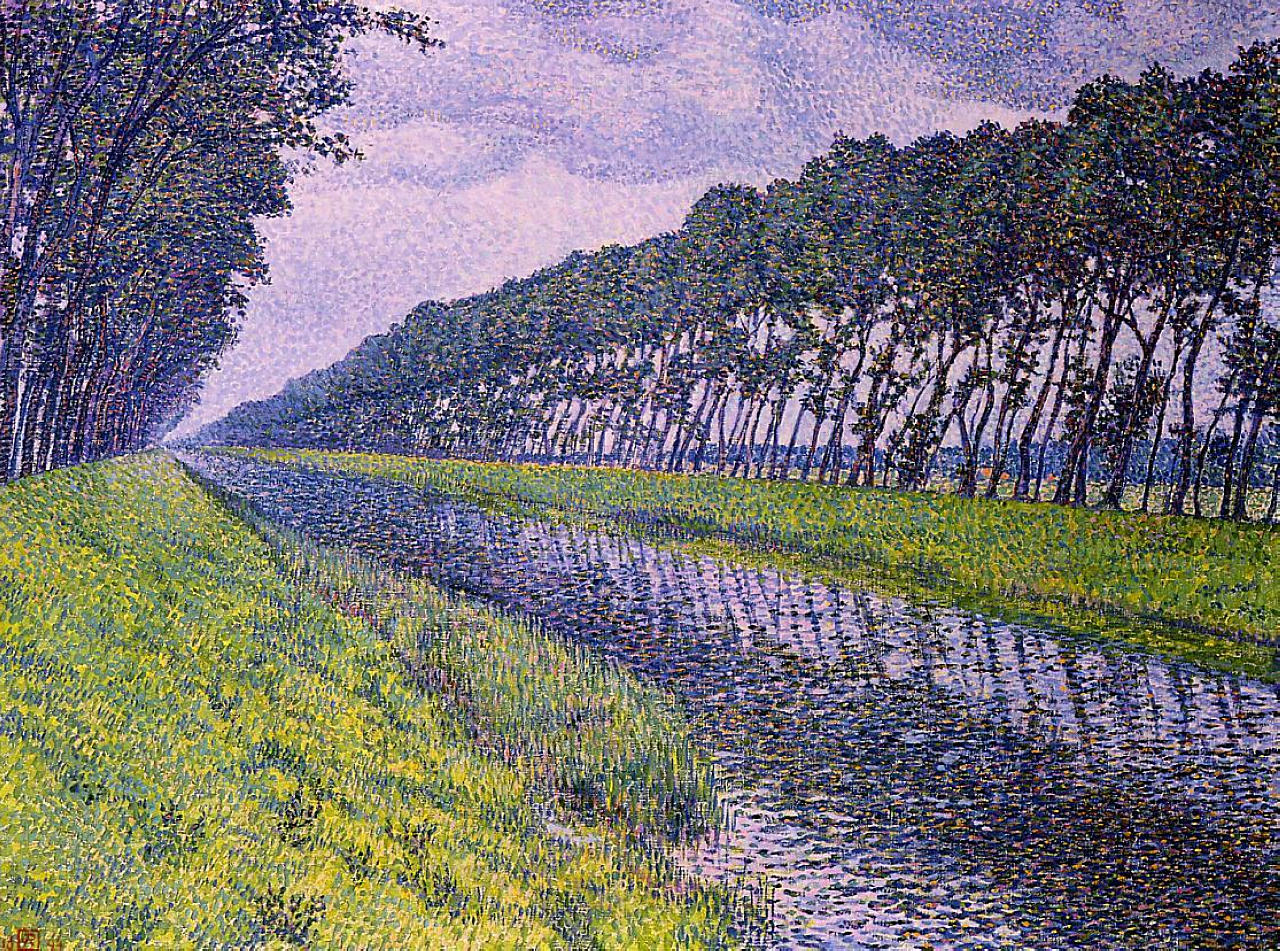
This uniquely combines radical perspective projection, intense rhythm and meticulous reflections. The artist painted few further views with reflections afterwards.
 The Eclectic Light Company