

One hundred years ago today, on 8 April 1926, the American painter, sculptor and educator John Ferguson Weir died. This article briefly summarises his career, his importance in American art, and shows a selection of his paintings.
John Ferguson Weir came from an illustrious artistic family. His father Robert Walter Weir (1803-1889) was a professor of drawing at West Point, New York, and his younger half-brother Julian Alden Weir (1852-1919) was a notable American Impressionist painter.
John trained at West Point, New York, and at the National Academy. This was briefly interrupted in 1861 when he served in the US Civil War. He received his first commission in 1862, when he was only 21, and set up his studio in the Tenth Street Studio, New York.

After that commission, his first major work was An Artist’s Studio from 1864, in which the artist in question is his father, not himself. To his delight it was exhibited, sold, and resulted in his election as an associate of the National Academy.

He next took his dark realism before an unusual motif for American painting at that time, in the hot, harsh, and dangerous world of the West Point Iron and Cannon Factory, in his The Gun Foundry (1866). The moment shown is the casting of a Parrott Gun, in the foundry responsible for making most of the large guns used by Union forces during the Civil War.
This is similar to the earlier works of Joseph Wright of Derby, de Loutherbourg and others who had painted the Industrial Revolution in Europe during the late eighteenth century, and led to his election as a full Academician.

His Forging the Shaft is a replica he painted in 1874-7, after the original of 1868 was destroyed in a fire at a New York gallery. It shows the same foundry, this time working the massive propellor shaft for an ocean liner, more a symbol of peace and trade than past conflict. The success of the original painting led to the offer to become Professor and the first Director of the School of Fine Arts at Yale University, which he accepted.
Seizing the opportunity before he started at Yale, in late 1868 Weir set out for Europe, where he travelled from Paris to Italy, Switzerland, Germany, the Netherlands, and Belgium. He produced a remarkable series of landscapes showing many of the places he visited, a series that compares with any of JMW Turner’s, although Weir generally kept to his detailed realism.

Lago Maggiore, Italy (1869) appears to have been painted en plein air on 31 May 1869, during his return journey from Italy towards Switzerland.

Despite its finish, his Lake Leman (Lake Geneva), Switzerland (1869) may have been painted en plein air, on 11 June 1869.

Although his Cadenabbia on Lake Como has been dated to 1869, it’s larger, and was almost certainly the result of more prolonged work in the studio. Its dramatic use of light on the town and the hills above is remarkable.

The Grand Canal, Venice (1869) is a much larger canvas that was clearly painted in the studio, probably after his return home to the USA in the autumn of 1869.
Weir then started work at the School of Fine Arts at Yale University, where he remained until his retirement in 1913, forty-four years later. With the advice of his younger half-brother, then studying at the École des Beaux-Arts in Paris and becoming steadily more Impressionist, John Ferguson Weir modelled Yale’s programme on European methods. Both brothers were also pioneers in the education of women artists.

Beach at Easthampton (c 1875) shows this Long Island beach, now more usually referred to as East Hampton, with its almost military encampment of huts, shades, and tents.

Weir retained his detailed realism until late in the century, as shown in his impressive depiction of A Rocky Mountain Peak, Idaho Territory from 1882.

However, from the early 1880s, Weir painted several still lifes, including Roses (1898), in which his brushstrokes became increasingly painterly.

He also maintained close contact with his half-brother Julian Alden Weir, visiting his farm in Connecticut to paint with him. This led to experiments with more ‘modern’ styles, such as The Farm, Branchville, Connecticut (around 1890-1900) in which his facture has changed completely.
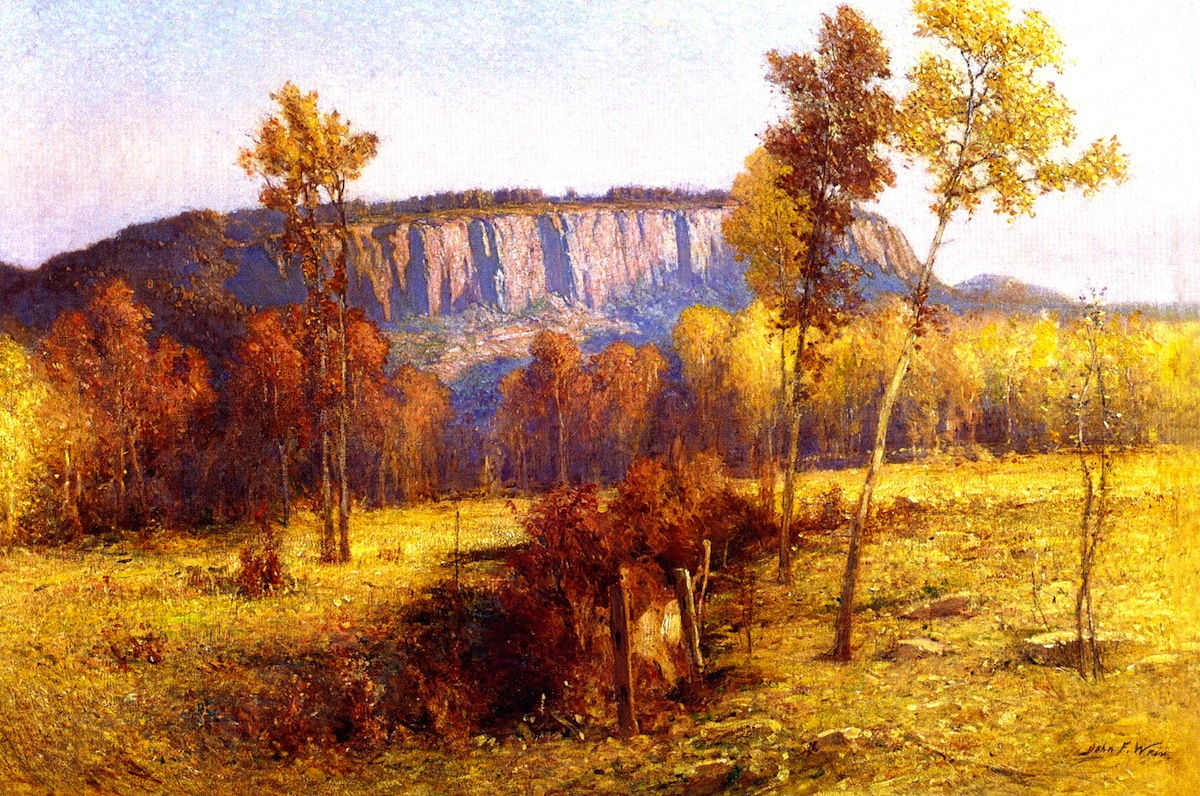
These were followed by an increase in his chroma, as shown in this vibrant painting of East Rock, New Haven (c 1901), which was close to his home and work at Yale.
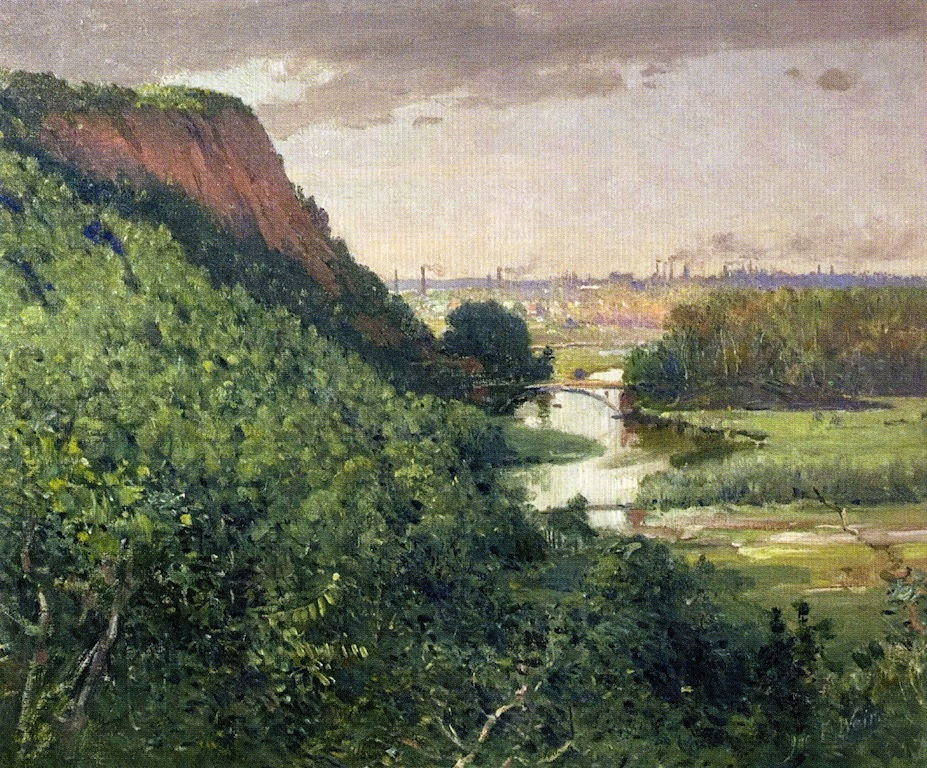
New Haven from East Rock (1900-1) shows almost the reversed view, looking down on the smoking chimneys of the town.

Although his teaching was a heavy commitment, Weir still found time to travel, and returned to Europe several times. The Alhambra, Granada, Spain (c 1901) is one of the finest of his late paintings, and shows how far he had come from his early works.

But of all his late paintings, I think his Basilica of San Francesco d’Assisi, Italy from 1902 is his most accomplished, and, in his quietly academic way, the most radical in style.

Forest of Fontainebleau (c 1902) shows his versatility in responding to a very different motif, with its tiny and solitary figure against the fallen trunk.
On his retirement from Yale in 1913, he and his wife moved to Providence, RI. Although he rented a studio and became involved in local art, his eyesight and health imposed increasing limits. He died in 1926.
John Ferguson Weir was much more than Julian’s half-brother, or even the founding father of fine arts at Yale. He was an innovative painter, who pioneered the depiction of heavy industry in the US, made an exquisitely beautiful series of works showing scenes in Europe, and developed his style through his long career. He was one of America’s master painters.
Reference
 The Eclectic Light Company