
Much of Moreau’s time from 1879 to 1884 was occupied painting more than sixty watercolours illustrating the fables of La Fontaine for a very rich patron. However, he still found time to exhibit at the Salon in 1880, which turned out to be his last.
For the previous twenty-five years, there had been two women in Moreau’s life: his mother, who in her old age had grown so deaf that the artist wrote her notes explaining each of his paintings, and his partner/mistress/muse Alexandrine Dureux, whose very existence was a close-kept secret. When his mother died in 1884, Moreau’s grief caused him to stop painting altogether for some months, and he became a temporary recluse. Over the next couple of years, his paintings reflected his emotions as he came to terms with that grief. As part of that process, he seems to have revisited some of his previous grand themes, and some of his recurrent motifs. But as time went on, he moved on and painted some of his most remarkable works.

The Sacred Elephant (Péri) (1885-6) is a magnificent watercolour showing Moreau’s best-developed painting of a thoroughly Indian motif. The Indian elephant has a long history as a sacred animal, at the heart of Hindu cosmology in supporting and guarding the earth (echoed by Terry Pratchett’s cosmic model of his Discworld).
Traditionally, the elephant is the mount (vāhana) for Lakshmi, Indra, Indrani (Shachi), and Brihaspati – goddesses, apart from the last who is a sage. Indra’s mount is a white elephant named Airavata, and Indrani is the goddess of wrath and jealousy, so I suspect that Moreau intends the figure mounted on the elephant to represent Lakshmi, the Hindu goddess of wealth, fortune, and prosperity, and wife of Vishnu.
The elephant itself represents wisdom, divine knowledge, and royal power. It is walking in a shallow lake which is rich in exotic vegetation, including lotus and lilies, as the sun is setting. Surrounding the mounted figure are four winged angelic creatures.
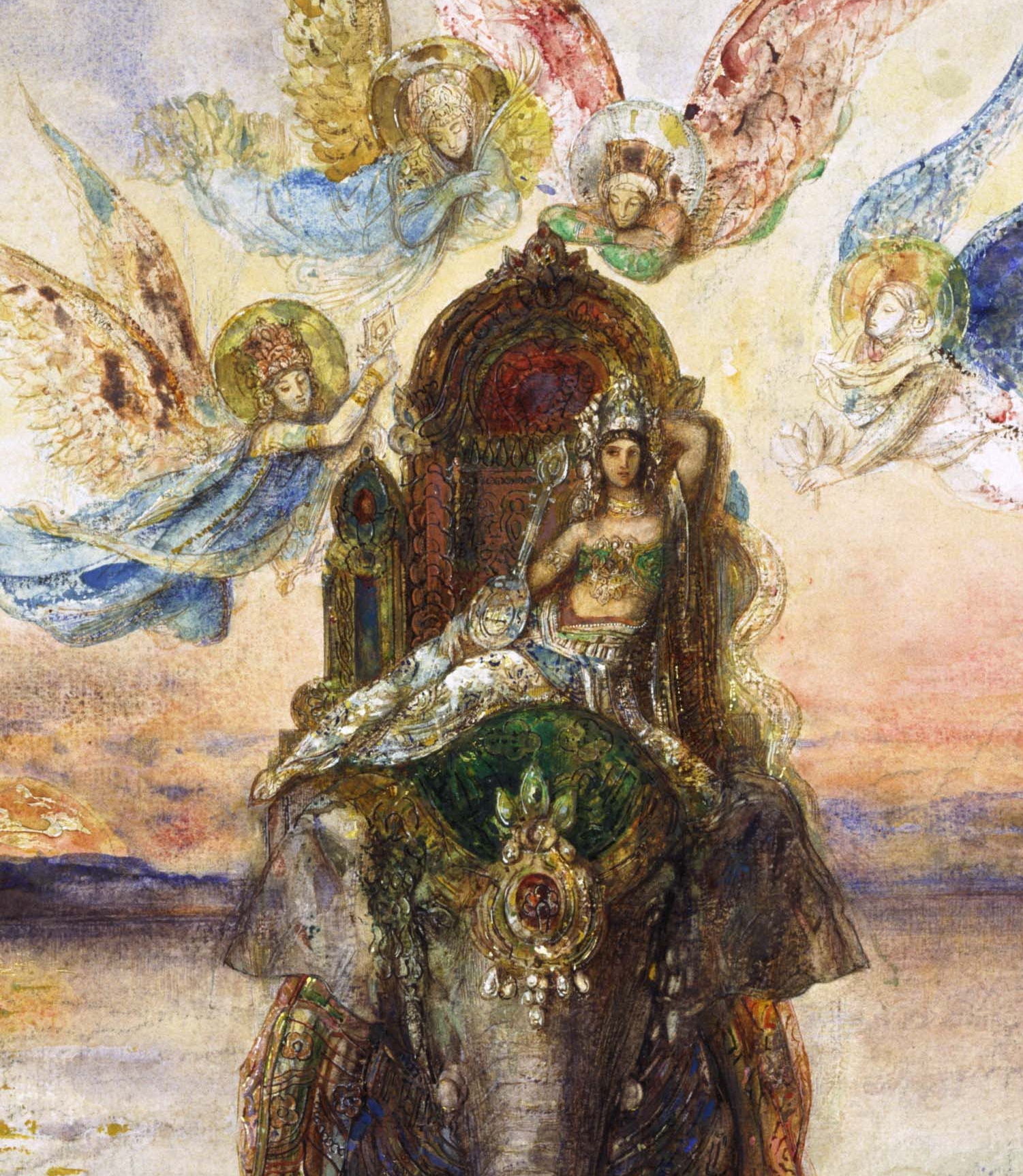
The mounted goddess holds a stringed instrument, probably a sitar or close relative, and is elaborately decorated. Although at first sight the angels might appear European, they too are drawn from the Indian sub-continent, and are richly embellished, apparently paying tribute to the goddess with flowers and a musical instrument.

In 1886, Moreau completed his greatest single work of art, La vie de l’humanité (The Life of Humanity), a large polyptych he had started more than five years previously.
The uppermost lunette shows the figure of Christ, arms outstretched as if still crucified. The uppermost tier of paintings shows the Golden Age of Adam, symbolising childhood. From the left these show morning prayer in the garden of Eden, ecstasy at midday, and repose and sleep in the evening.
The middle tier, from the left, shows the Silver Age of youth in the form of Orpheus and Hesiod: the morning is spent with Hesiod and the muse of inspiration, Orpheus appears at midday with music, then Hesiod returns for the evening, with tears.
The lowest tier, from the left, shows the Age of Fire, with Cain symbolising maturity. The morning shows work, the midday break, and death in the night.
Moreau wrote that these phases of humanity were also phases of life, passing from the purity and innocence of childhood, through the poetic aspirations and sadnesses of youth, to the pain and suffering of adult life, and death, with the redemption of Christ over all. This idiosyncratic combination of Christian symbols with those of myth (Orpheus) and the classical world (Hesiod) gives an important insight into much of his art.

The Triumph of Alexander the Great (c 1873-90) is a magnificent oil painting showing Alexander, dressed in white, sat high on his throne in the foreground. Around him is an extraordinary imagined landscape with imposing buildings forming a gorge, and a stack of grand buildings, towers, and other monumental structures further back. These are set at the foot of a massive rock pinnacle.
Having conquered the Persian (Achaemenid) Empire, in the late spring of 327 BCE, Alexander the Great set his sights on the Indian subcontinent. When he crossed the River Indus and started to campaign in the Punjab, he met determined opposition in the army of King Raja Purushottama, known in the classical literature as King Poros (or Porus).
Alexander fought his last major battle against Poros on the Hydaspes (Jhelum) River, near Bhera, and his own horse Bucephalus was killed during the intense fighting in the summer of 326 BCE. King Poros so impressed Alexander that he made him an ally. Afterwards, Alexander founded Alexandria Nikaia (meaning victory), and his army later revolted near the Ganges River, stopping any further advance into India. Three years later, Alexander the Great died.
Moreau drew on a wide variety of sources for this most elaborate of Indian fantasy cityscapes: miniature paintings of south India, photographs by English travellers, several illustrated books, and Le Magasin Pittoresque, a contemporary illustrated magazine. For example, Geneviève Lacambre has identified within it a borrowed image of a Jain saint from Karnataka (Mysore), India.
His triumph in completing this painting was limited: for the last few years, Moreau’s partner/mistress/muse Alexandrine Dureux had been in poor health. After his mother’s death, she had been his only real friend, and the only woman in his life. On 18 March 1890, she died, aged 51.
In early 1892 Moreau’s teaching studio became one of the three official studios of the École des Beaux-Arts in Paris, the other two being directed by Gérôme and Bonnat. By all accounts he was a popular and respected teacher, and among his more successful students were Georges Rouault, Albert Marquet, and Henri Matisse.
Moreau started work on his last major painting by 1889, and seems to have concentrated on it most in 1894-95. The story at the heart of it is one of the strangest in classical myth, and has never been popular for paintings, despite being drawn from Ovid’s Metamorphoses, Book 3.
Jupiter was the king of the gods according to classical Roman mythology, and the chief deity of the Roman state in classical times. Notoriously promiscuous according to myth, his wife Juno was forever having to deal with his adulterous wanderings. One day he took a fancy to the mortal Semele, a priestess of Jupiter, apparently when she was swimming in a river to cleanse herself of sacrificial blood. Semele became pregnant as a result.
When Juno discovered this, she disguised herself as an old crone and befriended Semele to discover the whole truth, and to sow doubt in Semele’s mind. When she next saw her lover, Semele asked him to grant her a wish. He inevitably agreed, and she asked him to reveal himself in his full glory, so as to prove his divinity.
Jupiter realised that this would put Semele at risk, as being the god of the sky and thunderstorms, she would almost certainly be killed by his divine power. But she insisted, so he gathered his weakest thunderbolts and smallest storms, and revealed himself. Unfortunately Semele was then consumed in flames from Jupiter’s lightning, and died. He rescued the unborn baby, and continued the pregnancy by sewing it into his thigh. The baby was born months later and became Bacchus, who rescued Semele from the underworld, and installed her as a goddess on Mount Olympus.
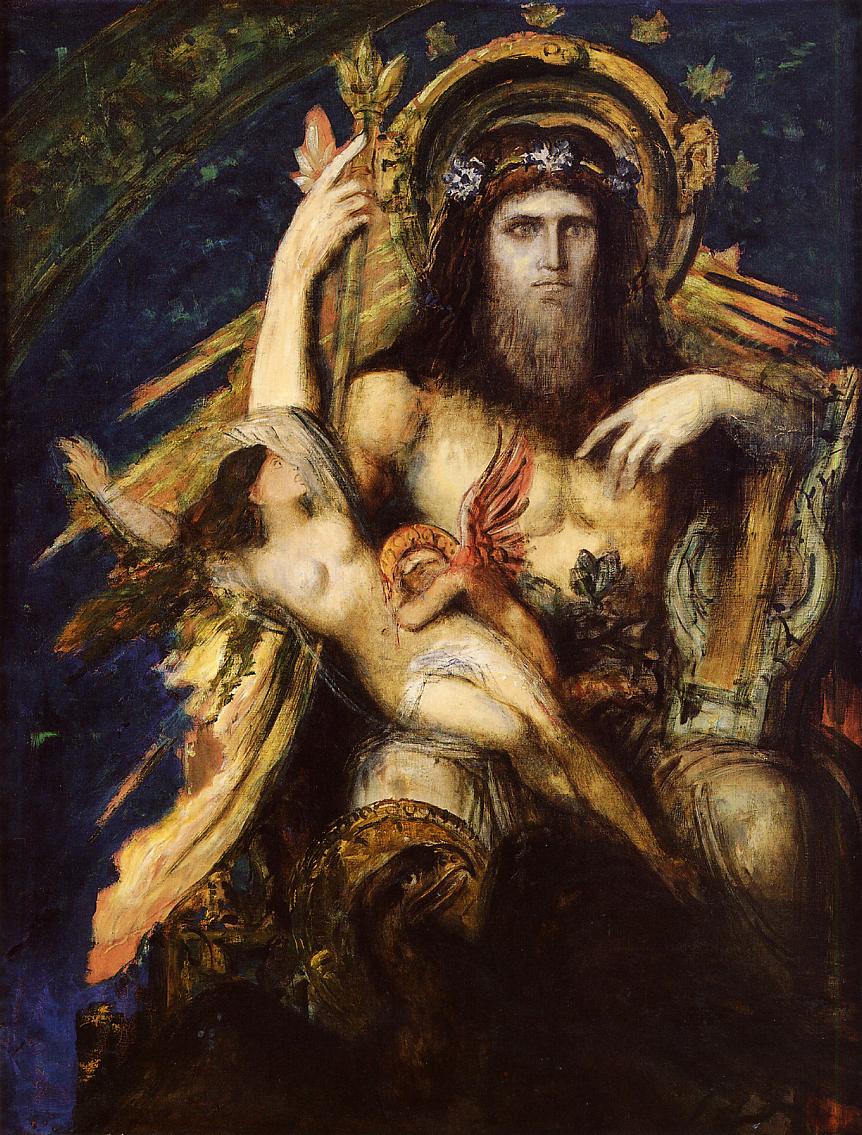
Moreau seems to have worked first on an oil painting showing just Jupiter and Semele in 1889-95. This contains a curious composite of the story, where Semele hasn’t yet been harmed by thunderbolts, but the foetal Bacchus appears to be resting against her, and Jupiter has assumed his divine form. At the foot of the painting is his attribute of an eagle.
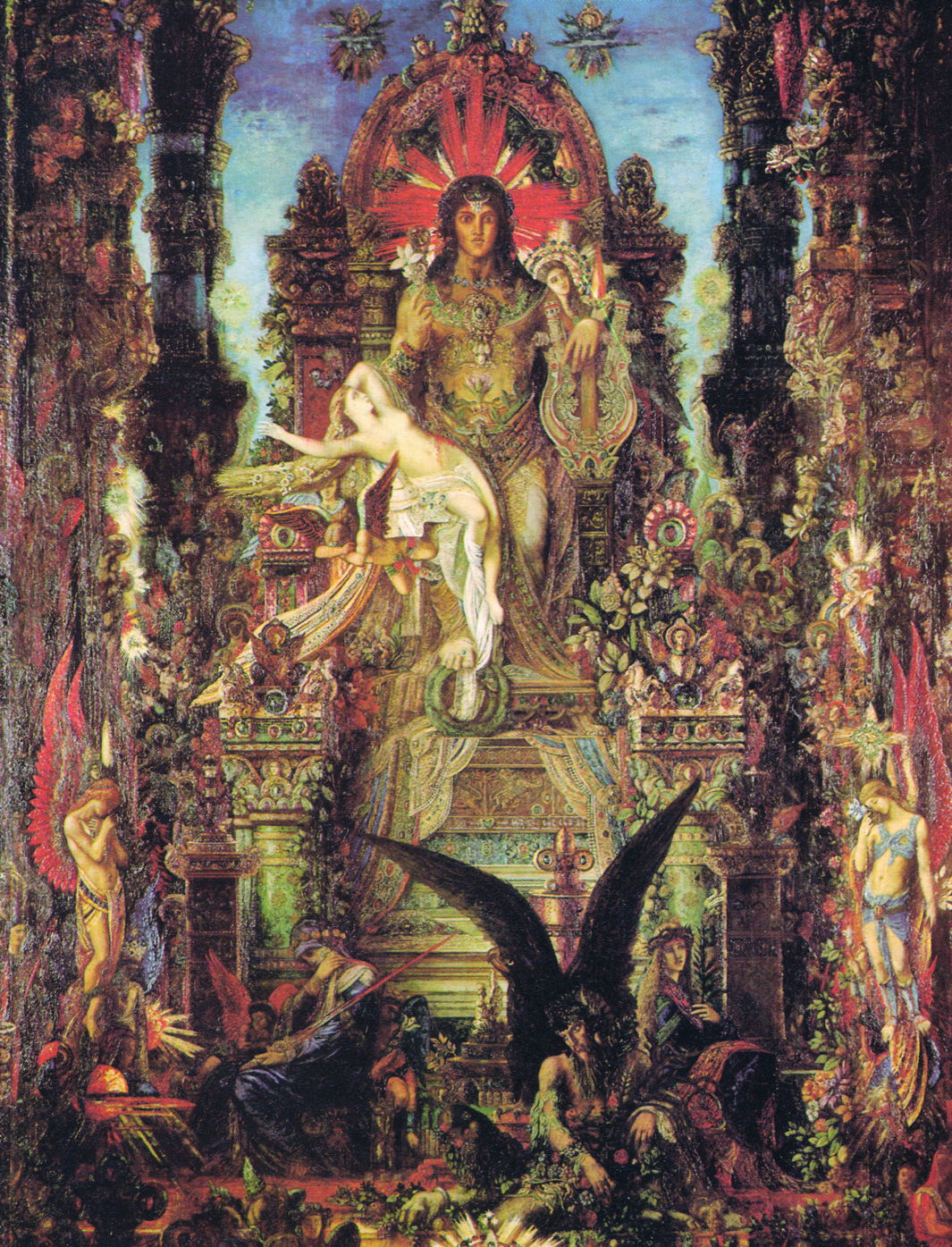
That composition then formed the centre of his large masterpiece, also titled Jupiter and Semele, from 1895. Jupiter now sits on a massive throne, with Semele draped over his right thigh. All around them is phantasmagoric detail, drawn from many different myths and cultures, as seen better in the following details.

Jupiter rests his left forearm on Apollo’s lyre. His right hand holds a lotus flower, and his body or clothing is extensively decorated with further floral and botanical images. He looks, eyes wide open, straight ahead. Behind his left shoulder is a woman deity, perhaps his wife Juno.
Semele is statuesque, her arms cast back in shock. Her left side is covered in blood, presumably from where the foetus has been extracted. Her hair flows off in a long, thick tress, decorated like a peacock’s feathers. Below her is a winged Cupid, its face buried in its forearms, in grief at Semele’s imminent doom.

At the lower left of the painting are two prominent figures: a standing winged angel or deity whose identity is obscure, and a seated woman, who is resting her chin in her right hand. She could, by her modest blue robes, be the Virgin Mary, but her left hand holds a long sword covered with blood.
There are many other smaller figures, putti, and other embellishments scattered around.

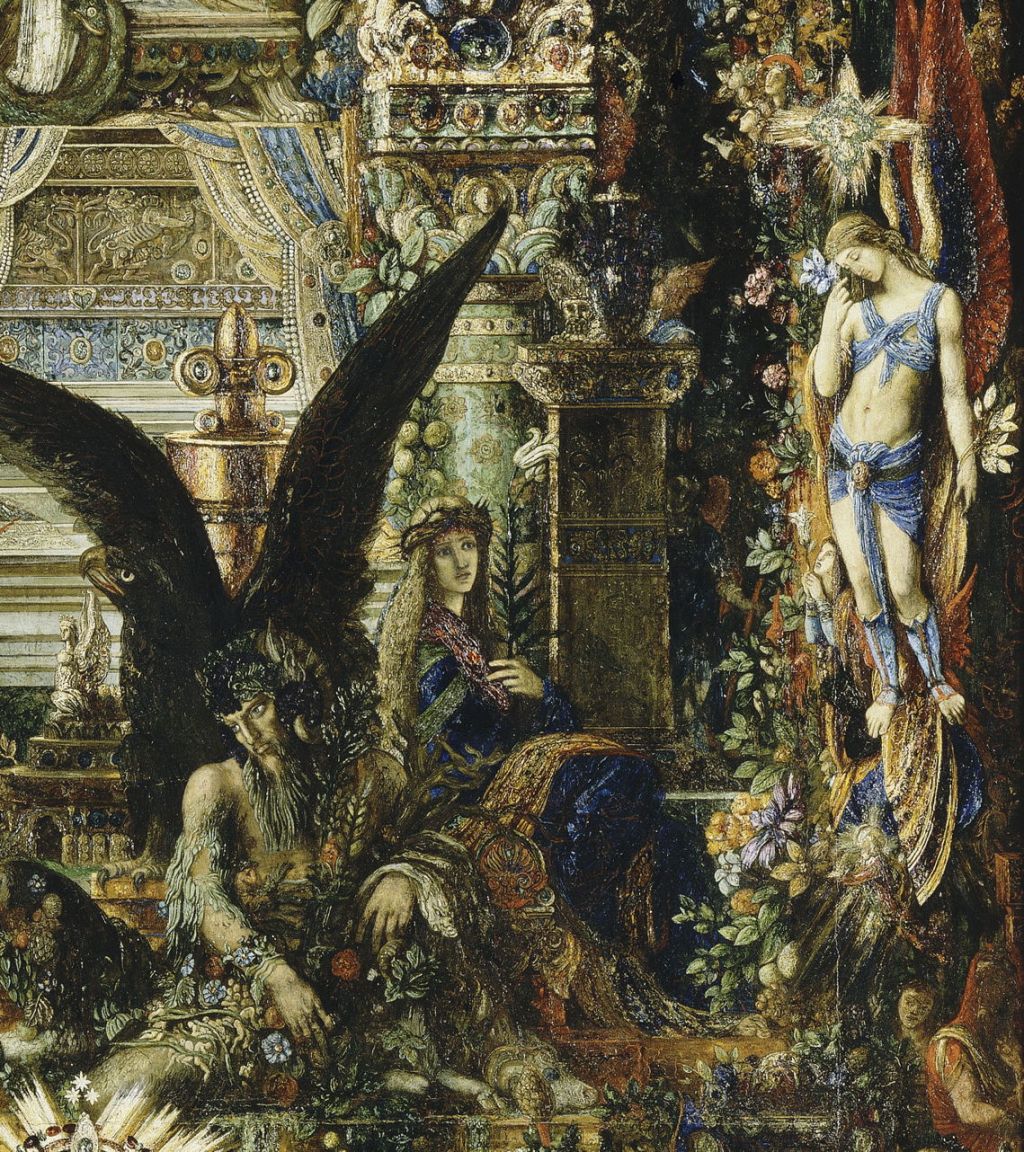
At the lower right of the painting are three prominent figures: a bearded man covered with flowers and fruit who has small horns on his head, a seated woman who appears to have come from mediaeval legend but is wearing a crown of thorns, and another winged angel at the right edge. The male has a goat’s leg to the left, indicating he is Pan, half human and half goat, according to Moreau’s notes the ‘symbol of the earth’. The black wings behind him belong to a large bird, probably an eagle, Jupiter’s attribute.
The seated woman is harder to interpret. The crown of thorns suggests the figure is Jesus Christ, but he should have a prominent halo and wouldn’t have long, golden tresses of hair. She is also holding a large white lily in her left hand.
Below them is the world of Hecate, ‘the sombre army of the monsters of Erebus’.

Moreau has placed a dazzling array of other images from many different cultures and beliefs at the left side of Jupiter’s throne, some of which can be made out in this detail.

There are even more on the right, with many faces shown in halos, flowers, and more.
In the autumn of 1896, Moreau’s health declined markedly. Although he continued to teach for over a year, until early in 1898, his painting slowed, and from 1897 he worked less frequently, and with the aid of his students. He drew up more detailed plans for his museum, for after his death, ensuring it was left to an appropriate custodian in his will.
Moreau now had advanced cancer of the stomach, and died of that on 18 April 1898, at his home. His museum was officially inaugurated in 1903, and remains open today, the bicentenary of his birth.
References
Hesiod’s Brush, the paintings of Gustave Moreau: 14 Overview and index
Cooke P (2014) Gustave Moreau, History Painting, Spirituality and Symbolism, Yale UP. ISBN 978 0 300 20433 9.
Mathieu P-L (1998, 2010) Gustave Moreau, the Assembler of Dreams, PocheCouleur. ISBN 978 2 867 70194 8.
 The Eclectic Light Company