
Of all the painting media, oils give the artist greatest flexibility to change their mind. Even when relatively ‘dry’, they can be scraped back carefully and overpainted, although in many cases overpainting is all that’s required. When such changes are detected by the viewer, they’re often referred to as a pentimento, appropriately the Italian for repentance, with pentimenti in the plural.
Written accounts of artists’ practices and careful examination of their paintings can reveal much about their methods. Some undertake such extensive preparations that painting the finished work invariably goes according to plan. Others may rework their composition extensively as it develops, and leave copious evidence of how they changed their mind.

Several of Leonardo da Vinci’s paintings show how he changed his mind as he worked on the finished painting. His Madonna with a Flower, popularly known as the Benois Madonna, is thought to date from 1481-83, and was preceded in the years 1475-80 by numerous sketches and studies of the Madonna, including several that are strongly linked with this composition. Nevertheless, examination of this painting reveals many pentimenti: the infant’s head was originally larger, and the grasses held by the Madonna in her left hand were originally flowers. Those aren’t visible in this image, though.
Pentimenti can be revealed using special techniques, including infra-red reflectography.

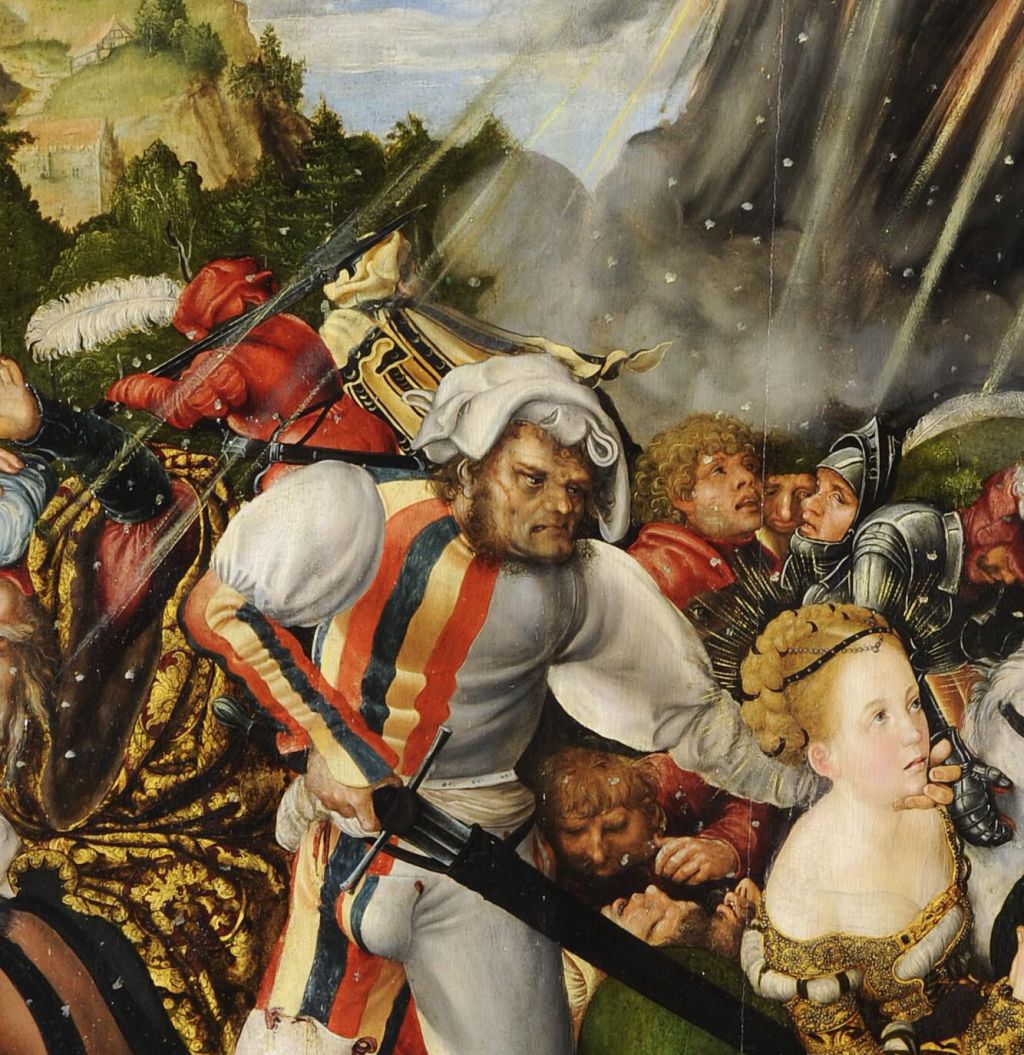
There’s no readily visible evidence that Lucas Cranach the Elder made changes during his painting of The Martyrdom of Saint Catherine in 1504-5.

Cranach had a reputation for being quite an impulsive and rapid painter, which seems to be borne out by more thorough analysis. His early works, in particular, show evidence of repeated adjustments in form and colour. The infra-red reflectogram of the Martyrdom of Saint Catherine, below, shows how he laid down the figures in detail in the underdrawing, but extemporised the pyrotechnic effects.


Considerable changes were made to the details during the painting process, as seen here in the underdrawing of the executioner, and the figures to the right of his head.
Sometimes the ageing of a painting brings pentimenti to light, although they wouldn’t have been visible at the time they were completed.

Christoffer Wilhelm Eckersberg’s Ulysses’ Revenge on Penelope’s Suitors from 1814 shows Odysseus and Telemachus at the left as they attack a small group of the suitors. There are abundant pentimenti visible now in the background, suggesting the artist changed his composition quite radically.
In more modern paintings it can be difficult to distinguish pentimenti from what the artist intended. There are many examples of this in the oil paintings of Paul Cézanne.

Landscape on the Banks of the Oise is an Impressionist view from Cézanne’s first campaign along the River Oise, when he painted in company with Pissarro, and shows the northern bank near the hamlet of Valhermeil.
Closer examination of the reflected image of the house with the red roof merits further study of the painting. Cézanne appears to have made pentimenti to its left edge, at least, and possibly at its right edge too. It appears that an earlier attempt to paint the red roof may have shown it extending more to the left, where it would have been displaced less than now appears.

These can be seen more clearly in the composite image above, in which I have moved the reflected image to the left so that it does align ‘correctly’ with the real image.

In this painting of The Pond of the Jas de Bouffan in Winter, a view Cézanne must have seen almost every day that he went out from his family home, there is evidence of pentimenti in the right side of the reflected image.
Other media are less forgiving. Watercolours can sometimes cope with small changes, but all too often fail completely. Scraping back isn’t normally possible with acrylics, which tend to be overpainted without scraping, as the latter strips the entire paint layer and may also damage the ground.
 The Eclectic Light Company