
Many of the great Masters are known to have painted preparatory studies prior to starting on full-size finished studio paintings. Unfortunately, most of those studies were either destroyed by the artist in their lifetime, or by their heirs following their death. Seeing studies alongside a finished work tells a great deal about the artist’s intent and methods, and some exhibitions have made a point of including as many studies as possible. This article shows a small selection of some whose images I have been able to gather.
Some of the best surviving studies are the oil sketches made by Peter Paul Rubens, some of which were given to assistants in his studio for completion.

Towards the end of his life, he painted this brilliant oil sketch of The Rape of Hippodame (c 1637-38). At the right, Eurytus is trying to carry off Hippodame, the bride, with Theseus just about to rescue her from the centaur’s back. At the left, Lapiths are attacking with their weapons, and behind them another centaur is trying to abduct a woman. Rubens typically sketched on small wood panels, here 26 x 40 cm (10 x 16 inches), with wonderfully painterly brushstrokes.

That became this finished painting, The Rape of Hippodame (Lapiths and Centaurs) (1636-38), which remains faithful to the sketch and its composition. Facial expressions, particularly that of the Lapith at the left bearing a sword, are particularly powerful.
Studies were better preserved in the nineteenth century, when tastes changed and some realised worthwhile sums in posthumous sales of the contents of studios.

Among the most studied are those made by Géricault when he was working up his landmark painting of The Raft of the Medusa. This oil study on canvas was probably made as he was completing his preparations during the autumn of 1818, and reveals some of his compositional thinking, for instance over the size of the ship that rescued the survivors.

The end result is this vast canvas, its figures shown life-sized, which has had huge impact on everyone who has seen it since its completion in 1819. It appears completely authentic, and given the work that Géricault put into making it so, that’s perhaps not surprising. But most gain the impression that the raft was almost square in form, as a result of the tight cropping applied, and that even with those few survivors on board, it was overcrowded. This is because Géricault chose to pack all his figures into one small section of the raft.
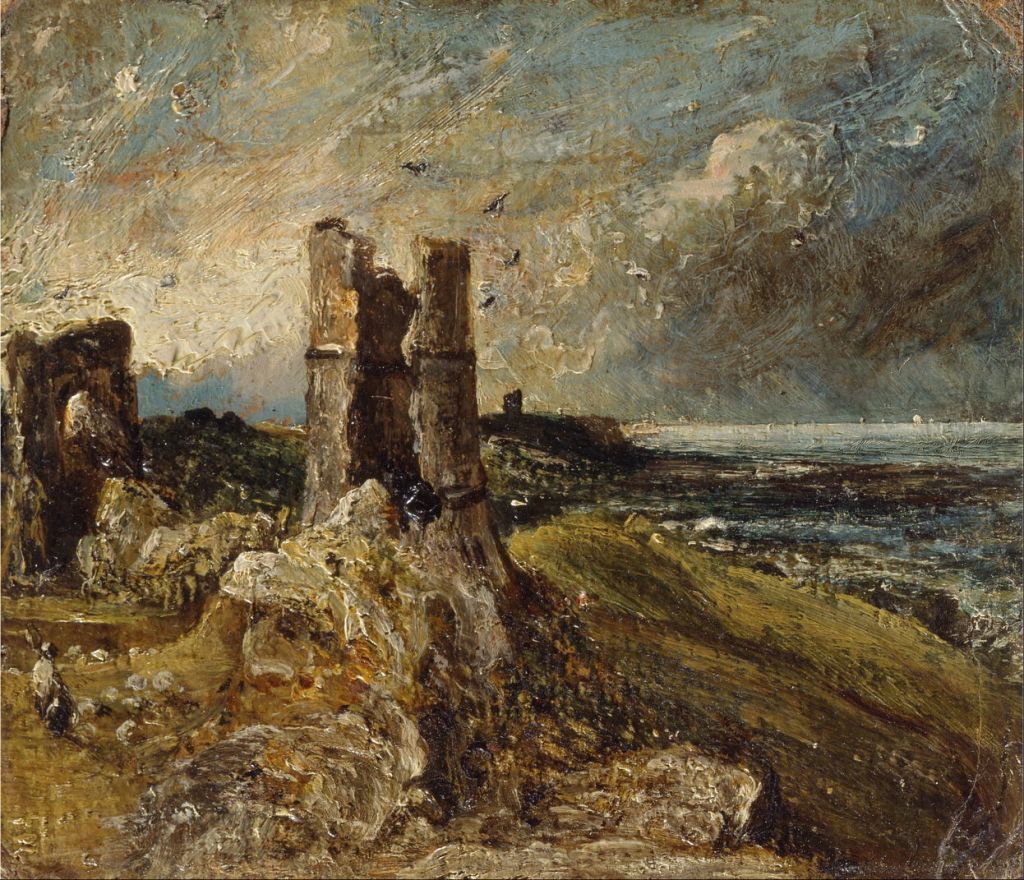
I was fortunate enough to visit an exhibition of some of John Constable’s works, in which his studies were shown alongside finished paintings. Here I show just one example. Had Constable lived fifty years later, he might have been persuaded to stop his paintings when they were still late oil studies, rather than take them to their finished conclusions.

This early sketch of Hadleigh Castle (1828-29) already contains some surprisingly detailed passages: at the far left, a shepherd, his black dog by his side, with a small flock of sheep grazing near the ruined tower. There’s a brown and white blob on the seaward slope, probably a cow grazing there. Wheeling in wrinkles of impasto above the tower are a few birds resembling small runnels of liquid metal like solder. By this time, many artists were painting their oil studies on cheaper millboard, as Constable did here. Millboard is made by pasting together many sheets of fine paper, so isn’t as durable as cheaper stretched canvas.
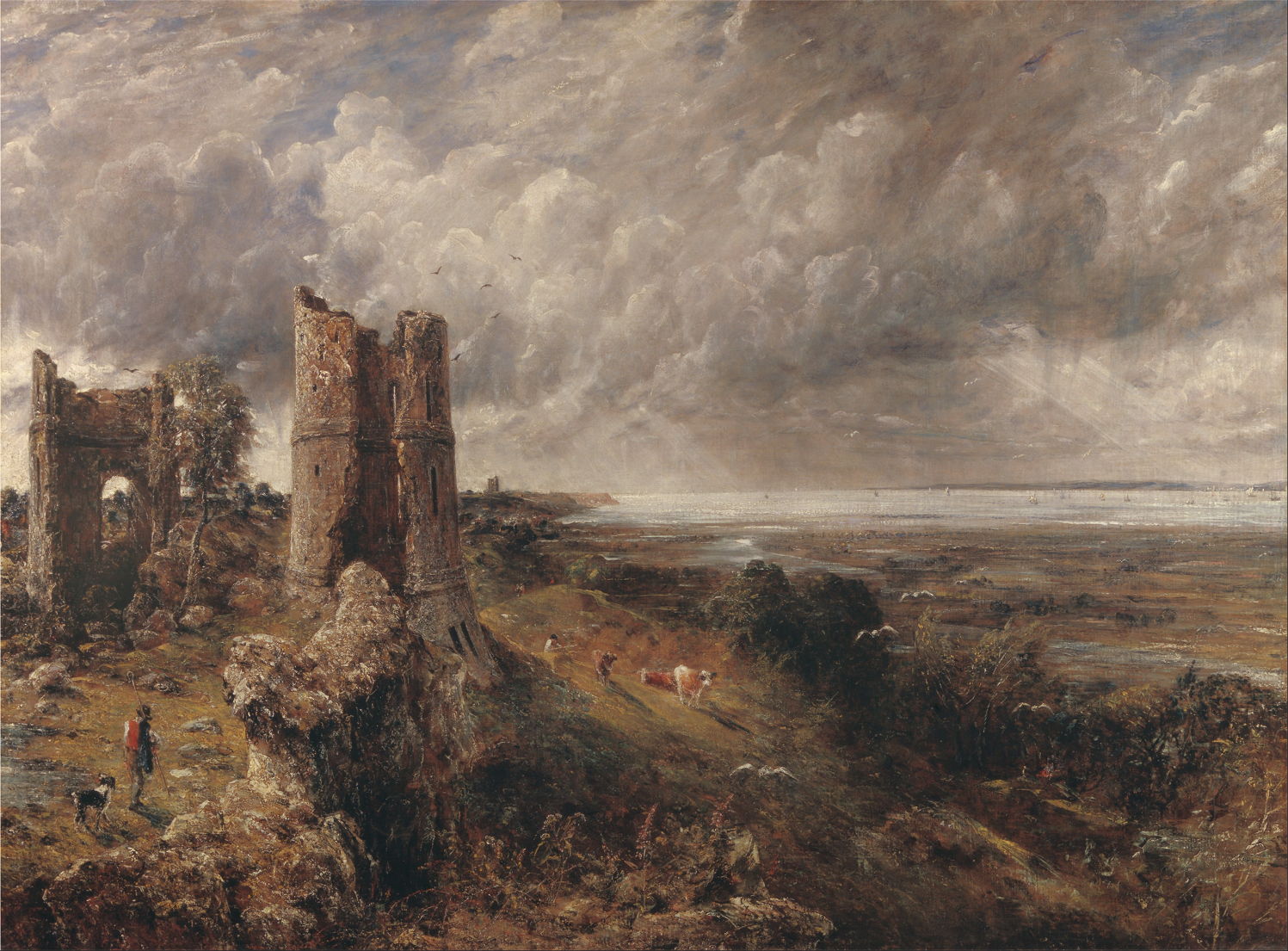
By the finished work, the splendid Hadleigh Castle, The Mouth of the Thames – Morning after a Stormy Night (1829), the basic disposition of those figures has changed little, but Constable has changed each to suit his image. The shepherd, still carrying his long crook, is separated from his dog, and has lost his sheep, which have become scattered rocks. The single cow on the sloping grass has gained a couple of friends, and a cowherd. Beyond them are another couple of tiny specks of figures, and there are more by the wood in the lower right corner.

William Powell Frith’s late study for Derby Day was probably painted in about 1856, and is very close to the finished work shown below, although covering only about a tenth of its area.

Jacob Bell commissioned Frith to paint his finished Derby Day (1856-58) for the huge fee of £1,500, and the artist was paid a further £1,500 for rights to make prints. It was exhibited at the Royal Academy in 1858, and proved so popular that a guard rail had to be installed in front of it to protect the work from the admiring crowds.
Georges Seurat’s preparations are also revealed in his surviving studies, and are very different given his Pointillist technique. Some of the later Divisionists made conventional studies, and there are some experimental examples using larger tiles of colour (see below). Seurat instead rehearsed parts of the overall view when preparing his masterwork.

Seurat’s first and greatest masterpiece, generally known as La Grande Jatte, uses the technique of optical mixing of colour. Rather than blending pigments on the canvas, it’s constructed of tiny dots that are high in chroma, and allow for optical mixing, one of the fundamental techniques in Seurat’s new scientific painting. His theory was that the mixing of colour would then occur in the retina of the viewer, and he tried this in a pure landscape study (above), and in his huge finished painting (below).

He painted his finished version in three phases. In the first, the dots he applied were mixed from available and fairly conventional pigments, including duller earths. In the second phase, he used a limited number of brighter and higher chroma pigments. In the third and final phase he added coloured borders which are distinctive of his paintings.
By the late nineteenth century oil studies were being supplemented by photographs.

Thomas Eakins’ preparatory studies for Swimming (1885) grew from a series of photographs taken by the artist and his friends. But photos never replaced his own sketches: for this work, Eakins made several figure studies, details such as the dog, and different landscape backgrounds, then brought them together in oil sketches.

Once he was happy, he embarked on his final version. In at least some cases, including his paintings of shad fishing from 1881-82, the figures in his Arcadia (c 1883), and Swimming (1885), he put final photographic images into a ‘magic lantern’ projector, which he then projected at the canvas.
He developed a sophisticated system not only for using the projected image to make a graphite underdrawing, but as the painting progressed, to incise key points and lines of reference in the paint surface. This enabled him to create paintings that were accurately calibrated to his reference images: a great advance on the traditional system of enlargement using grids, and one factor in his detailed realism. This technique was discovered by Mark Tucker and Nica Gutman.

Together with other photos and various studies, Eakins then painted Swimming (The Swimming Hole) in 1885.
Albert Bierstadt was more traditional in his preparatory studies for The Last of the Buffalo in 1888.
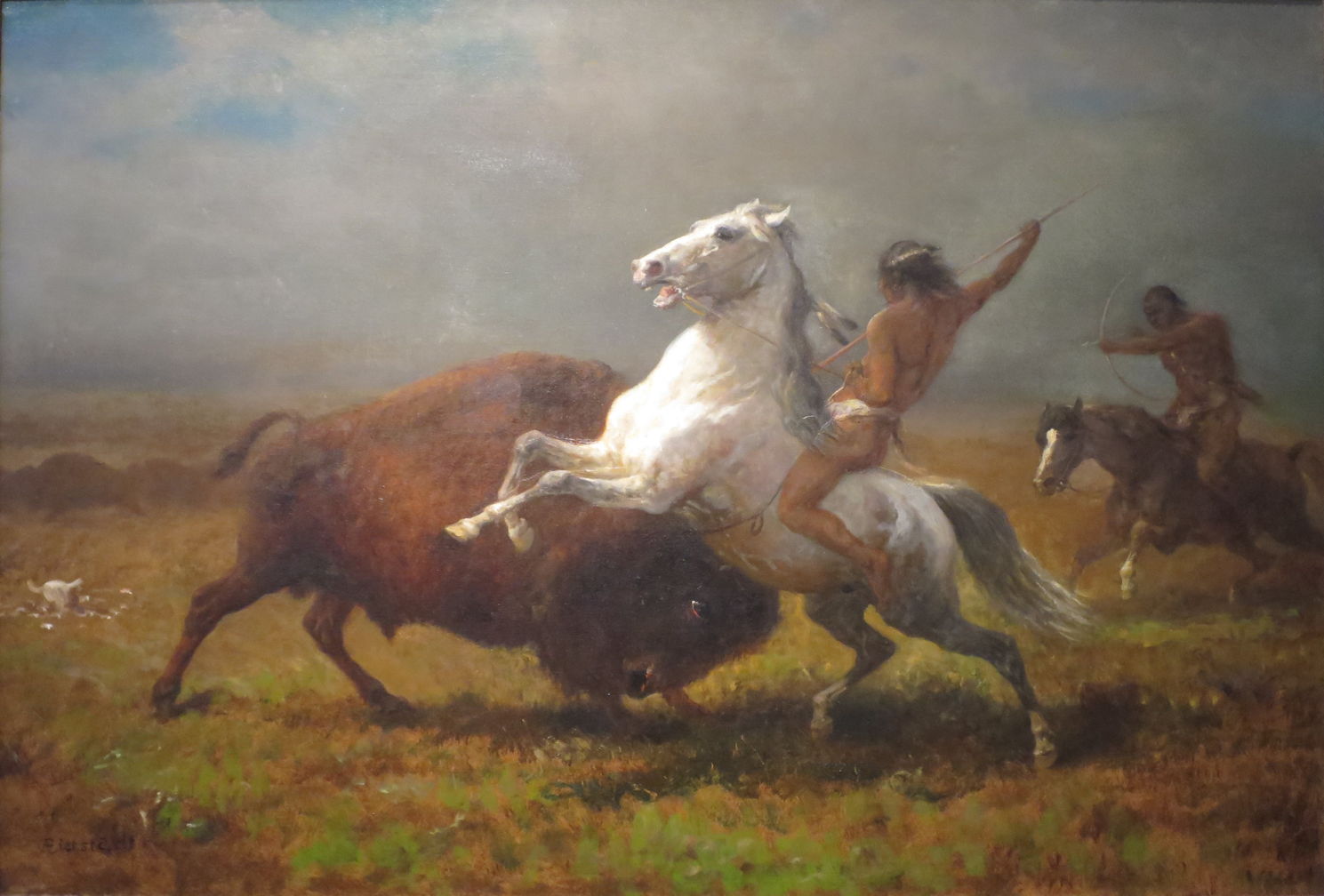
This late study was painted on canvas, and is 63 x 91 cm (25 x 36 inches). It concentrates on the action to be embedded in a broader landscape.

Bierstadt’s finished painting is larger still, and sets that action in a more characteristic grand panorama, with bleached skulls and dying buffalo in the foreground. In the middle distance are hundreds of animals in the herd, suggesting that extinction was by no means the only outcome.
Finally, a pair of paintings by the less-known Divisionist Henri-Edmond Cross shows an alternative approach to Seurat’s, where his study is built of small daubs of colour, which are then reduced in size for the Pointillism of his final version.

His Clearing in Provence from about 1906 was painted on paper, and has subsequently been mounted on canvas for display in the Israel Museum, Jerusalem.
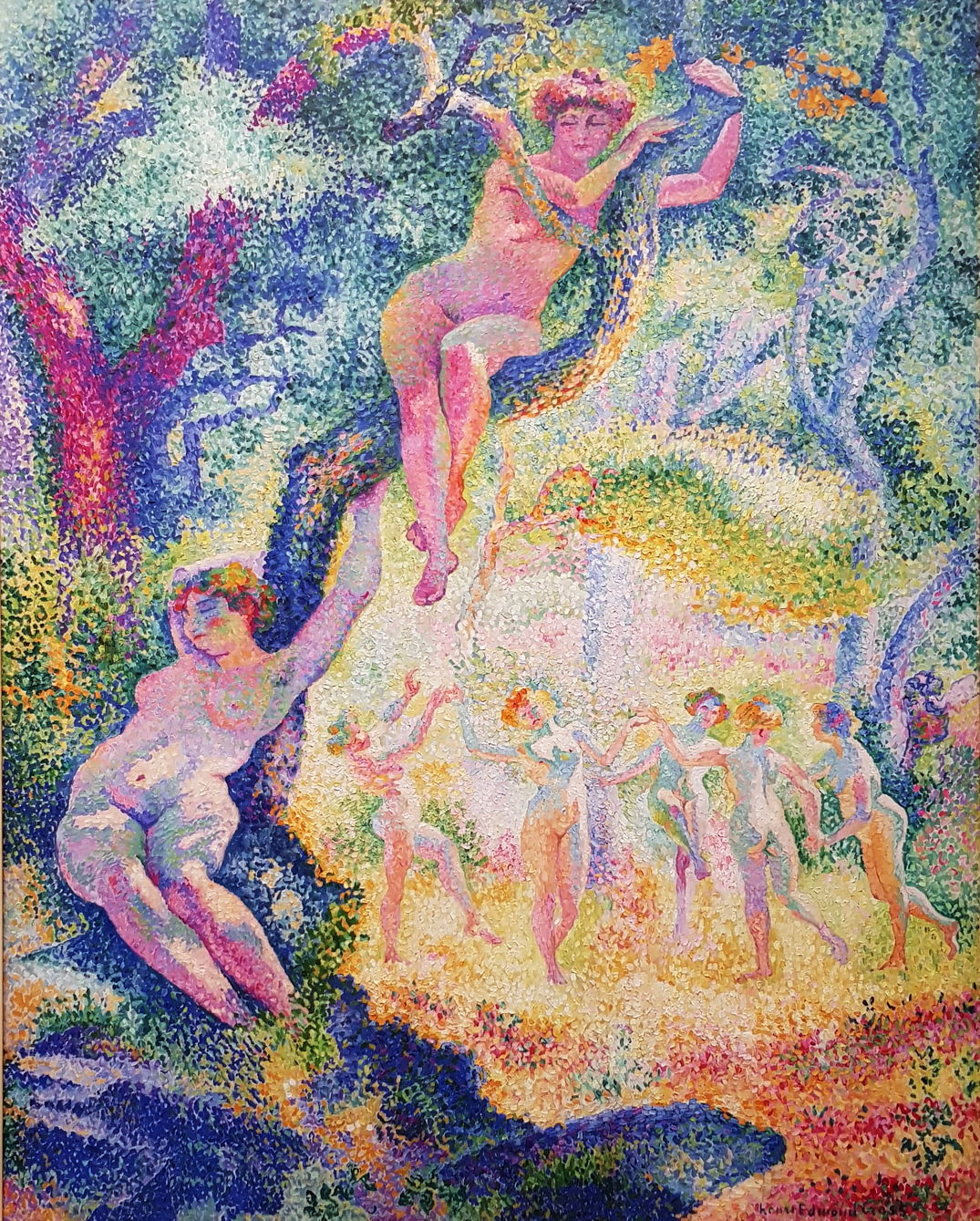
That sketch formed the basis of the woodland setting Cross used in The Glade, painted in oils in 1906. Colour changes are prominent, and the chroma has been considerably enhanced. The size has grown, and it’s on a more permanent support of stretched canvas.
Seen through modern eyes, many of the oil studies of the past deserve to be seen more widely, rather than being kept in storage.
 The Eclectic Light Company