
Every painter wants to create works as good as those of the Masters like Rembrandt and Rubens. Some decide the only way to achieve that is to discover the secrets of their oil paint, how they controlled its viscosity and got it to look just right. A few come to obsess over those secrets and experiment intensively, abandoning all they know about how to paint in that quest. This article looks at two painters who did just that, and the consequences it had on their work.
Sir Joshua Reynolds (1723–1792) was one of the most famous and prolific portrait painters, who completed a conventional training in oil painting with Thomas Hudson (1701-1779), a successful portrait painter who used traditional and conservative methods with roots going back to the late 1600s. This used layers, starting with dead colouring, the laying in of shadows and lights, then blending in transitions of shading and colour wet-on-wet. Highlights were then brought out, and shadows glazed, to produce a series of thin layers, and a smooth, finished paint surface.

Reynolds’ early stages are shown well in this abandoned portrait of Mrs Robinson from about 1784, where much of its paint layer is sufficiently thin as to allow the texture of the canvas to show through.


His finished portrait of Anne Seymour Damer (née Conway) (1773) shows this technique working well, with painterly highlights, and textures in the fabrics. Flesh passages have aged well, with limited fine cracking visible.

Reynolds aspired to the greatness of the Masters, and in his quest to achieve that, he experimented, particularly after visiting Italy in 1749-52. Seeing that the works of Masters like Rembrandt had passages with quite thick applications of paint, Reynolds also applied his paint thickly where appropriate. In order to make his paint sufficiently viscous he took to adding mediums that he felt resembled those used by the Masters. He seldom scraped back paint in order to correct or change his paintings, but applied more paint over the top of as many as ten previous layers, some of them thick and viscous. Reynolds himself admitted that his Infant Hercules Strangling Serpents in his Cradle (1788) had “ten pictures under it, some better, some worse.”
His accounts of ‘experiments’ with paint aren’t recorded in sufficient detail to reproduce any of his materials, but refer to the use of:
- copaiba balsam, a controversial oleo-resin thickener that can inhibit drying;
- wax, which he was convinced was the secret of success of the Masters;
- bitumen, which inhibits drying and commonly causes poor structural integrity in paint layers.
His drying oils were linseed, walnut, and poppy seed, with the latter two mainly used for lighter-coloured paints. They were often heat-treated to pre-polymerise and thicken them.
His greatest error, as far as the longevity of his paintings is concerned, was his excessive use of resins. As a result, contemporaries reported that some of his portraits cracked before they had even left his studio.
Reynolds also experimented with the most dangerous medium of all: Megilp. Known by a variety of similar names, he’s the first British artist known to have referred to its use. Megilp is made by heating a drying oil with a lead drier (usually litharge), then adding substantial amounts of resin until it produces a thick paint of buttery consistency. Variants using different kinds of ‘black oil’ were even more likely to compromise the longevity and structural integrity of paintings. Reynolds seems to have become addicted to them.
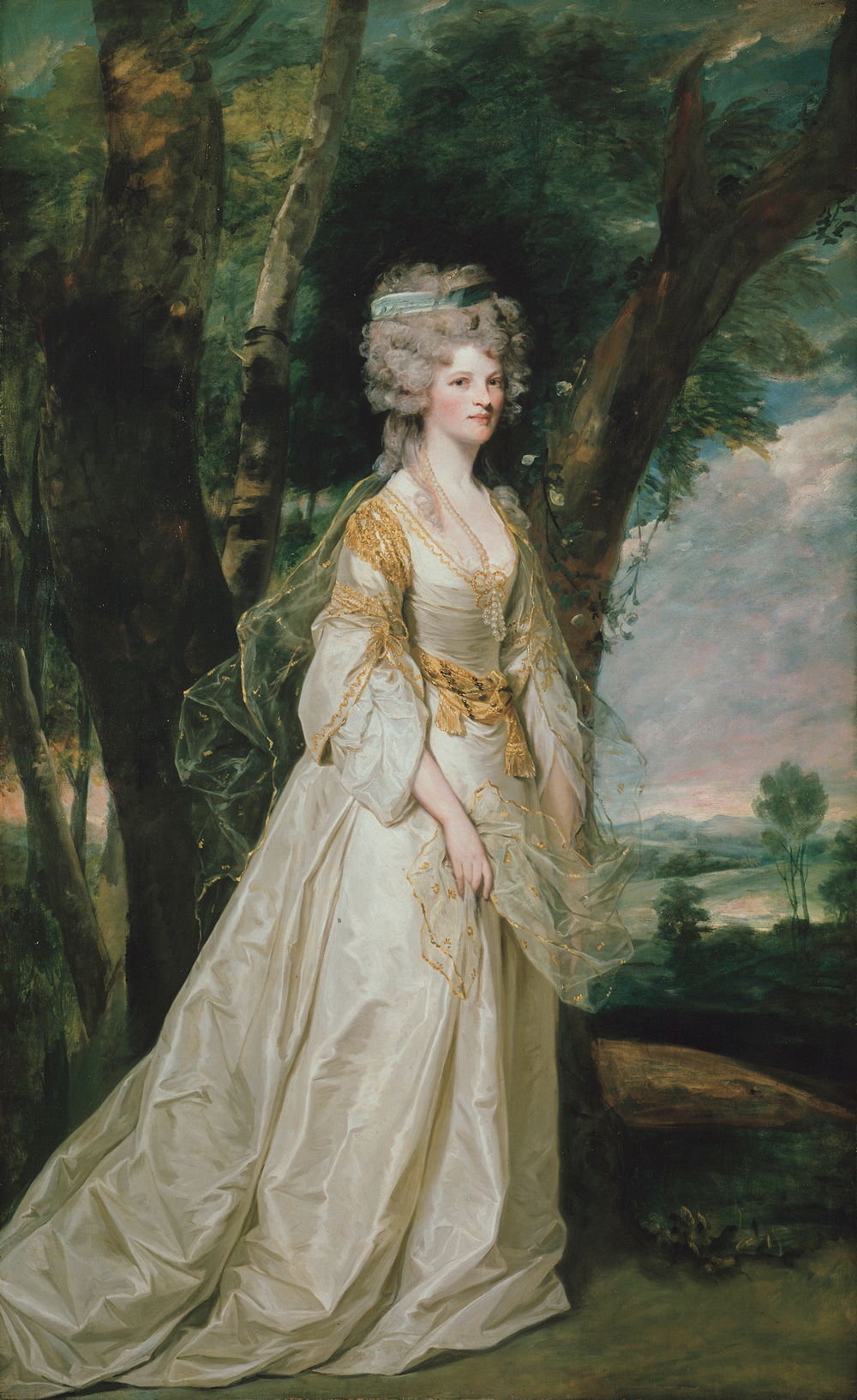
His portrait of Lady Sunderland (1786) appears to have survived rather better than many of his paintings.

But a more careful look at its background shows where paint, presumably diluted with turpentine to aid its rapid application, has run, although other parts of the same brushstroke still show the marks of the brush, indicating the paint had also been thickened prior to dilution.
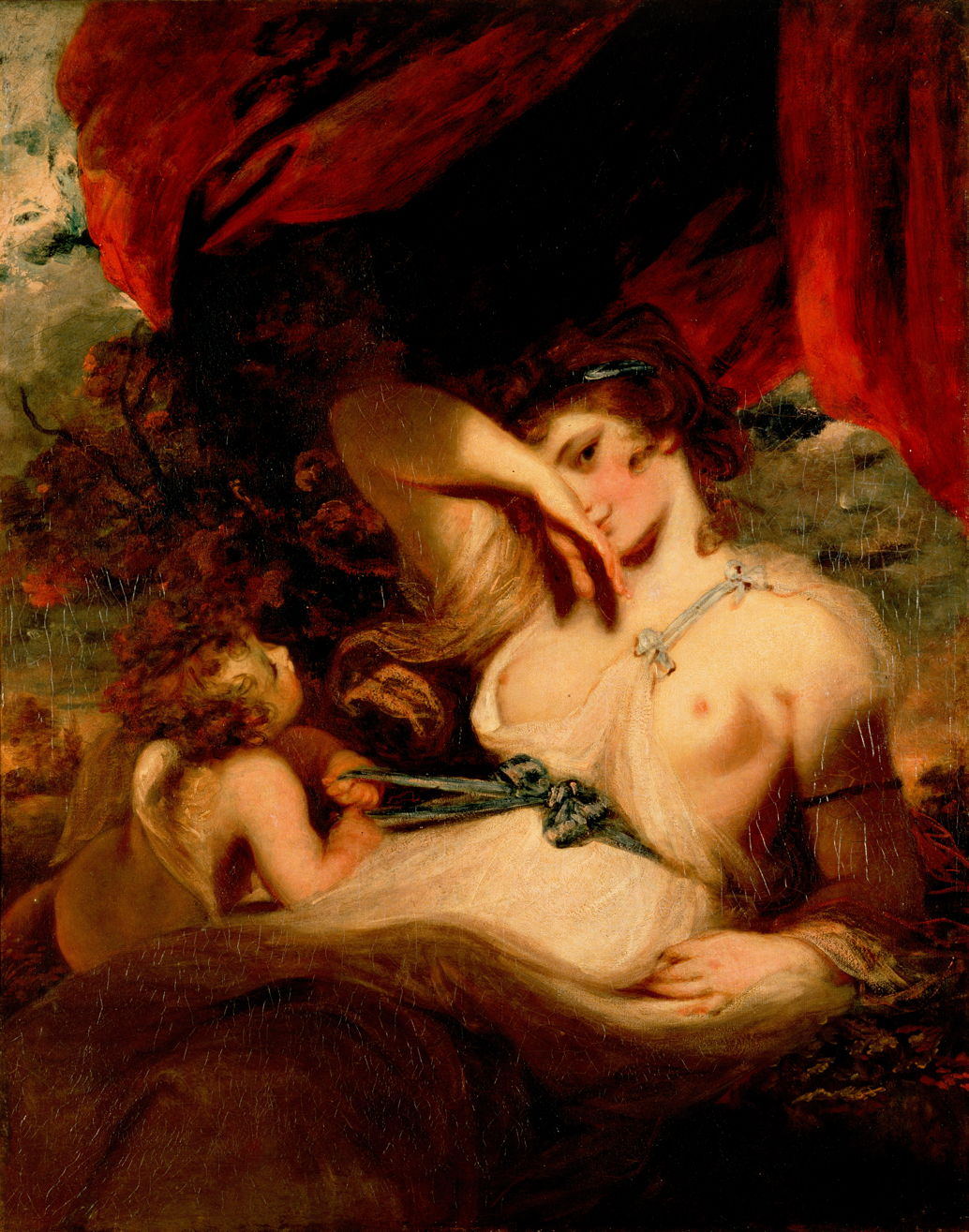
His Cupid Untying the Zone of Venus (1788) has catastrophic cracking indicating that surface layers of paint have detached from lower layers. In parts, those cracks have become filled with lighter paint that has risen up from a lower layer that was drying more slowly than those more superficial. The detail below also shows the wide variation in thickness of his paint layer: some passages are thin enough to allow the texture of the canvas to show through, while others are so thick that layers have separated.

Sadly, Reynolds wasn’t the first, and by no means the last, painter to compromise their oil paintings from their desire to emulate the Masters. There were also many more who were tempted to use Megilp and its variants, in the same forlorn hope.
Albert Pinkham Ryder (1847–1917) studied in New York at the National Academy of Design during the early 1870s, and travelled to Europe four times, although when there he didn’t apparently undergo any training as such. He was also a close and longstanding friend of Julian Alden Weir, who trained at the École des Beaux-Arts under Jean-Léon Gérôme and was conservative in his technique.
Ryder apparently became obsessed with creating unique optical effects in his oil paintings, in the course of which he abandoned the discipline of craft. He interlayered oil, resin, wax, non-drying oils, and protein-rich materials in his paint layers. Even in his lifetime many suffered disastrous cracking, which he claimed that he didn’t mind.
Few of his paintings are either structurally stable or readable any more, and the best records of the artist’s intent are now old monochrome photographs taken of them before they deteriorated so badly.

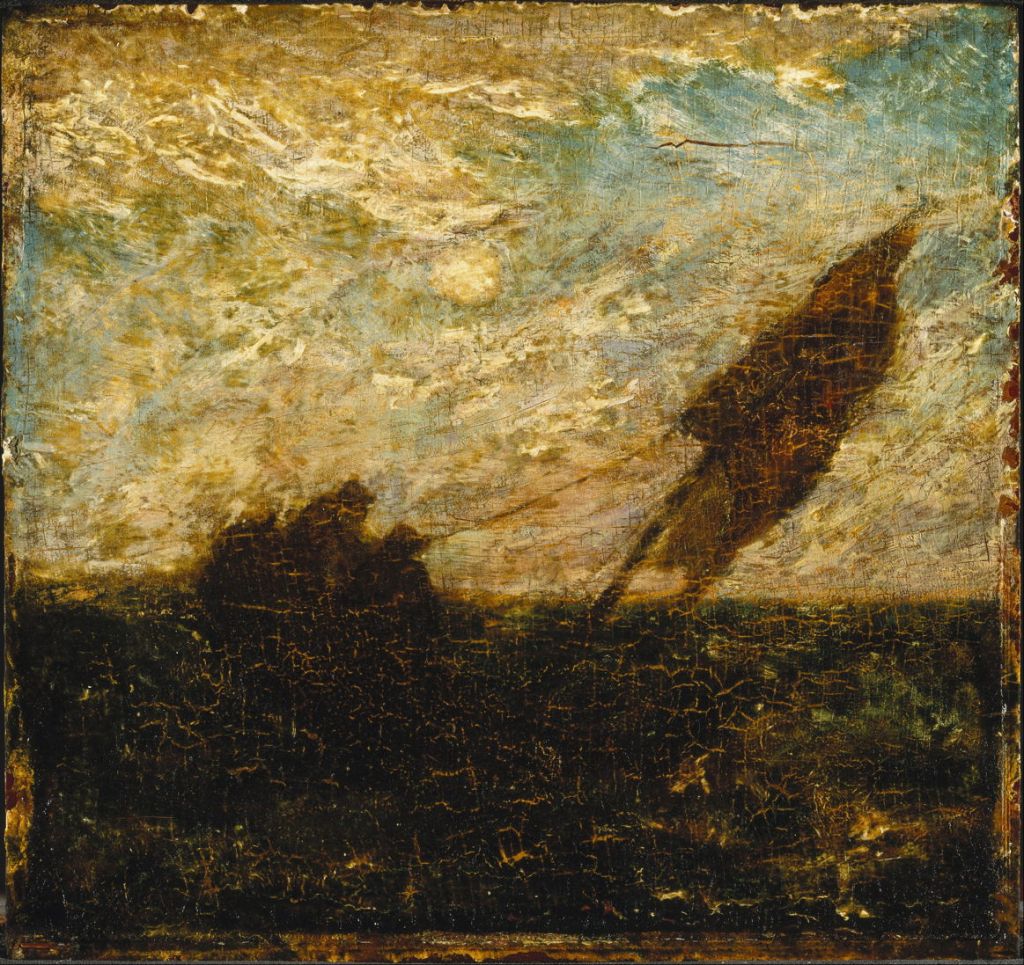
The Waste of Waters is Their Field (c 1883) is a small oil painting that is now almost completely lost, with much of the detail merged into a dark brown mess as its superficial layers have faded, and the deeper layers darkened. The detail below shows that its entire paint layer is dissected by cracks, many of them gaping and oozing lighter wet paint from below.


Details can still be made out in his tiny Resurrection (1885), although even this has changed and cracked severely. Many of the cracks are wide and filled with paint that has risen up from lower layers.

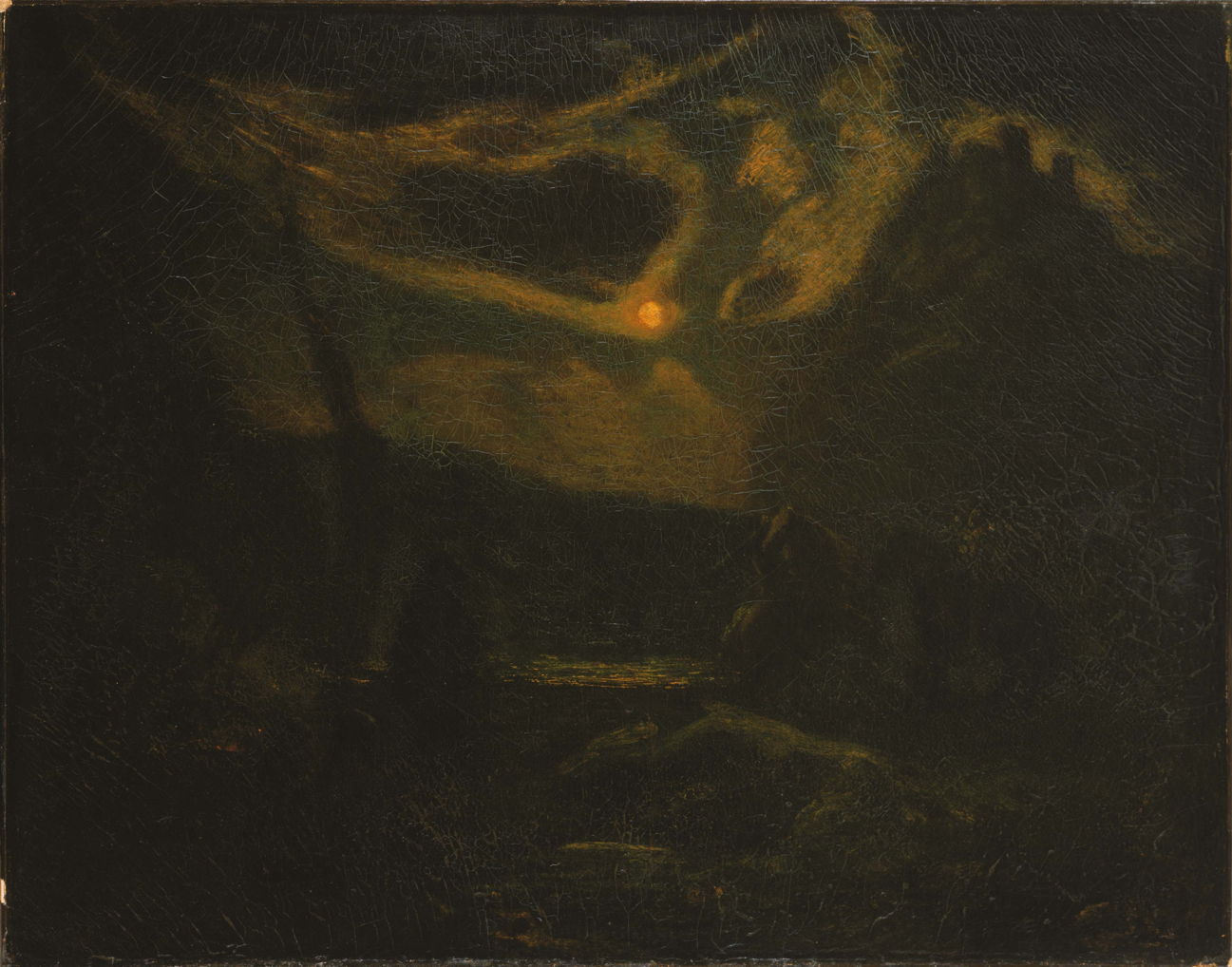
Macbeth and the Witches (c 1895-1915) has also become impossible to read, with its almost universal darkening and dense cracking across its paint layer.
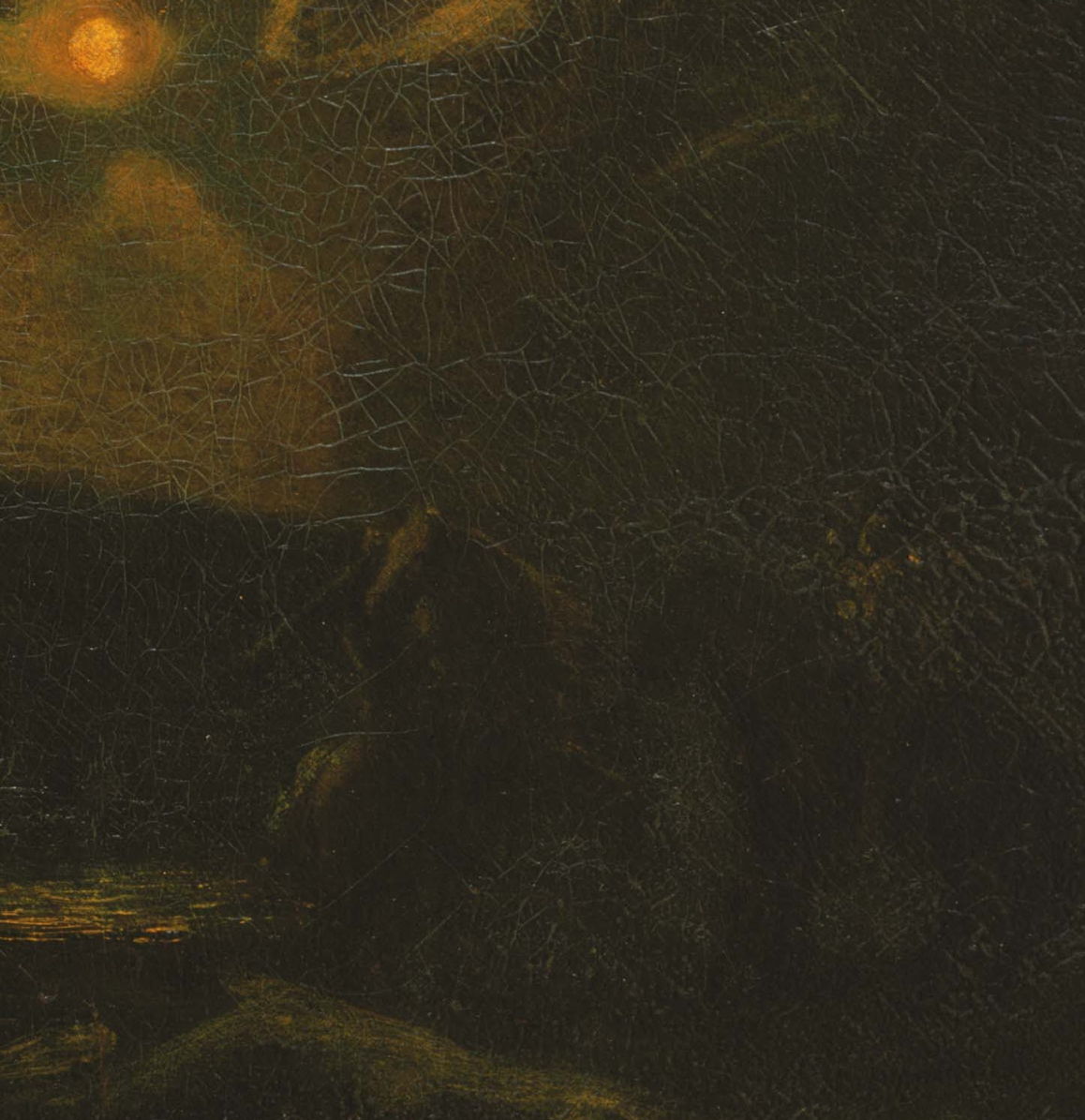
Ryder was deemed an important painter whose work was much admired during his lifetime. Collectors invested heavily in his paintings. Tragically their collections are now left with paintings that are nothing like they were originally, whose recovery is technically impossible.
Reynolds’ paintings are now around 250 years old, and Ryder’s are little more than a century. Those of the Masters they tried to emulate are 400 years old, and thankfully in far better health.
Reference
Gent A (2015) Reynolds, Paint and Painting: a Technical Analysis, in Joshua Reynolds, Experiments in Paint, eds. L Davis & M Hallett, The Wallace Collection & Paul Holberton. ISBN 978 0 9007 8575 7.
 The Eclectic Light Company