
After two unsuccessful attempts to win the Prix de Rome and become a history painter, Jules Bastien-Lepage had specialised in depicting the rural poor, to growing acclaim at the Salon.

Not all his paintings were typically Naturalist. He continued to paint landscapes, of which Snow Effect, Damvillers from about 1882, is one of his finest and most Impressionist.
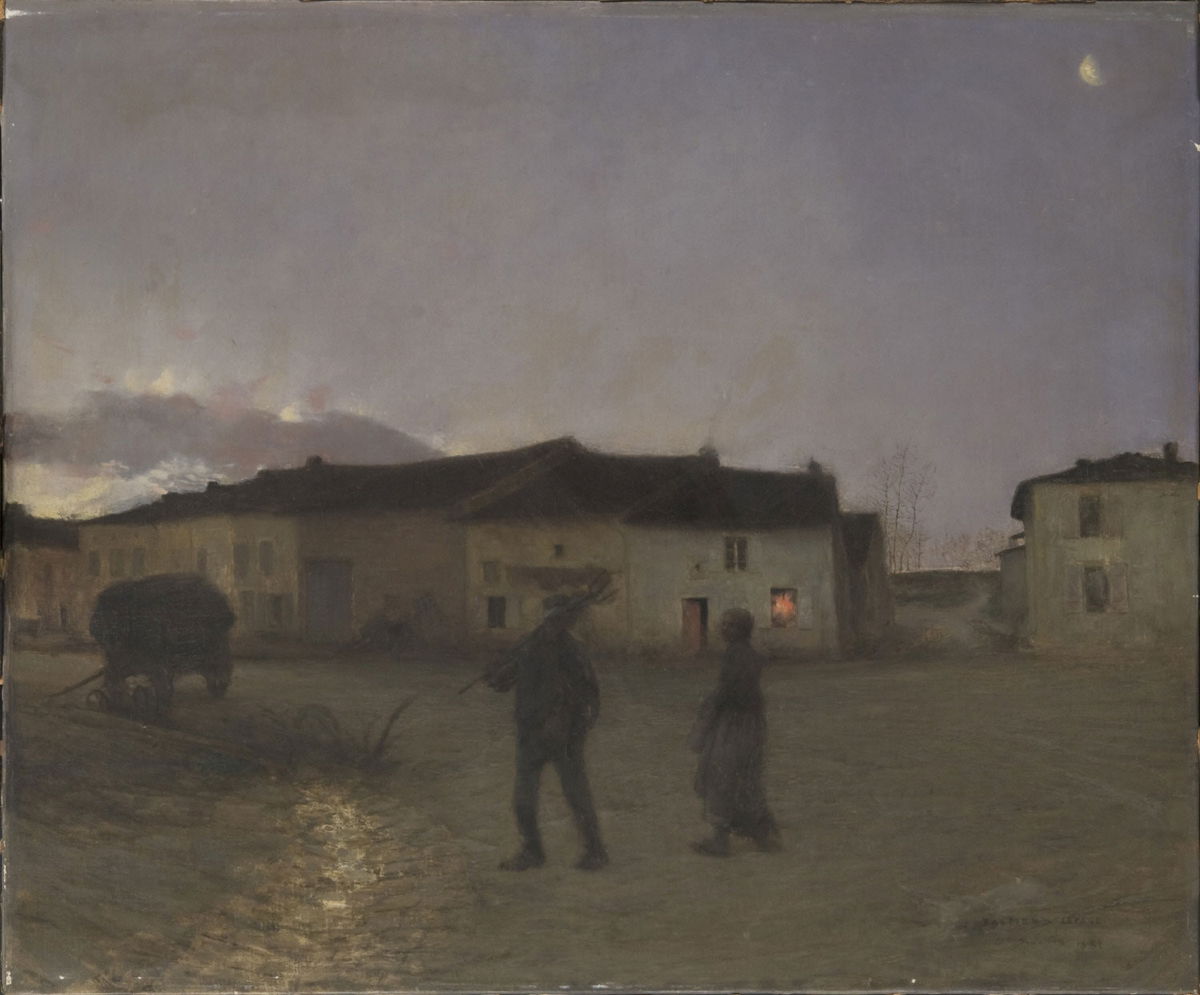
The shadowy figures caught in the late dusk of his Evening at Damvillers (1882) are a reminder that people remained at the centre of his art.
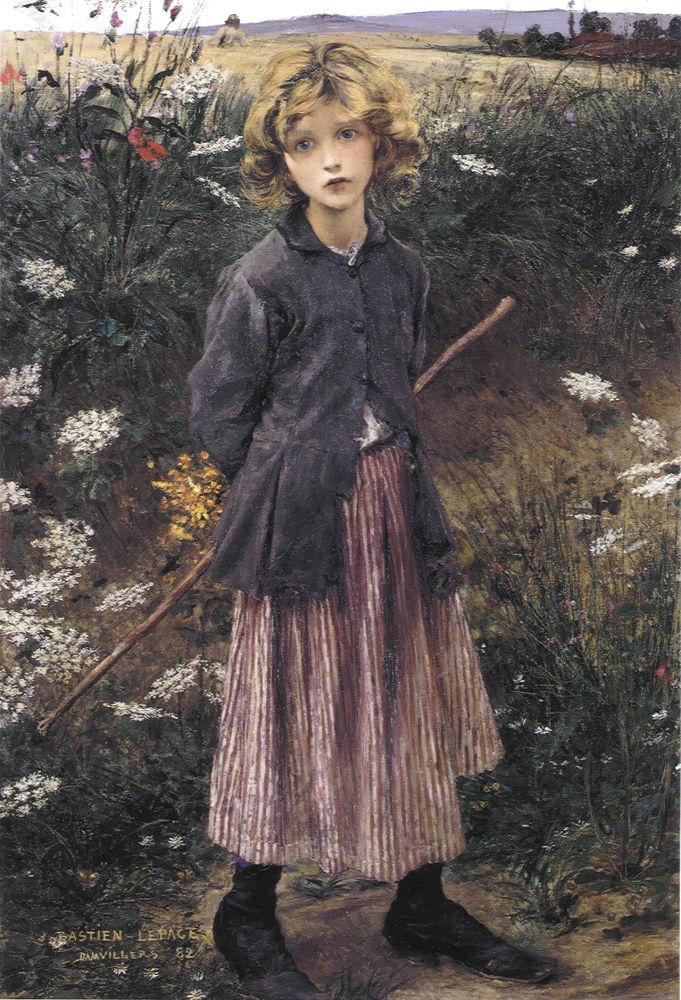
Bastien pushed his compositional formula to the limit in this enchanting painting of Roadside Flowers or The Little Shepherdess (1882). The sky has been reduced to a thin sliver, and almost the whole canvas is devoted to its detailed foreground. Like the weeds behind her, this little girl has a wide-eyed and sad beauty. Although her clothing is visibly tatty, her face and hair are idealistically clean, in keeping with a romantic sentimentalism rather than the objectivity more characteristic of true Naturalism.
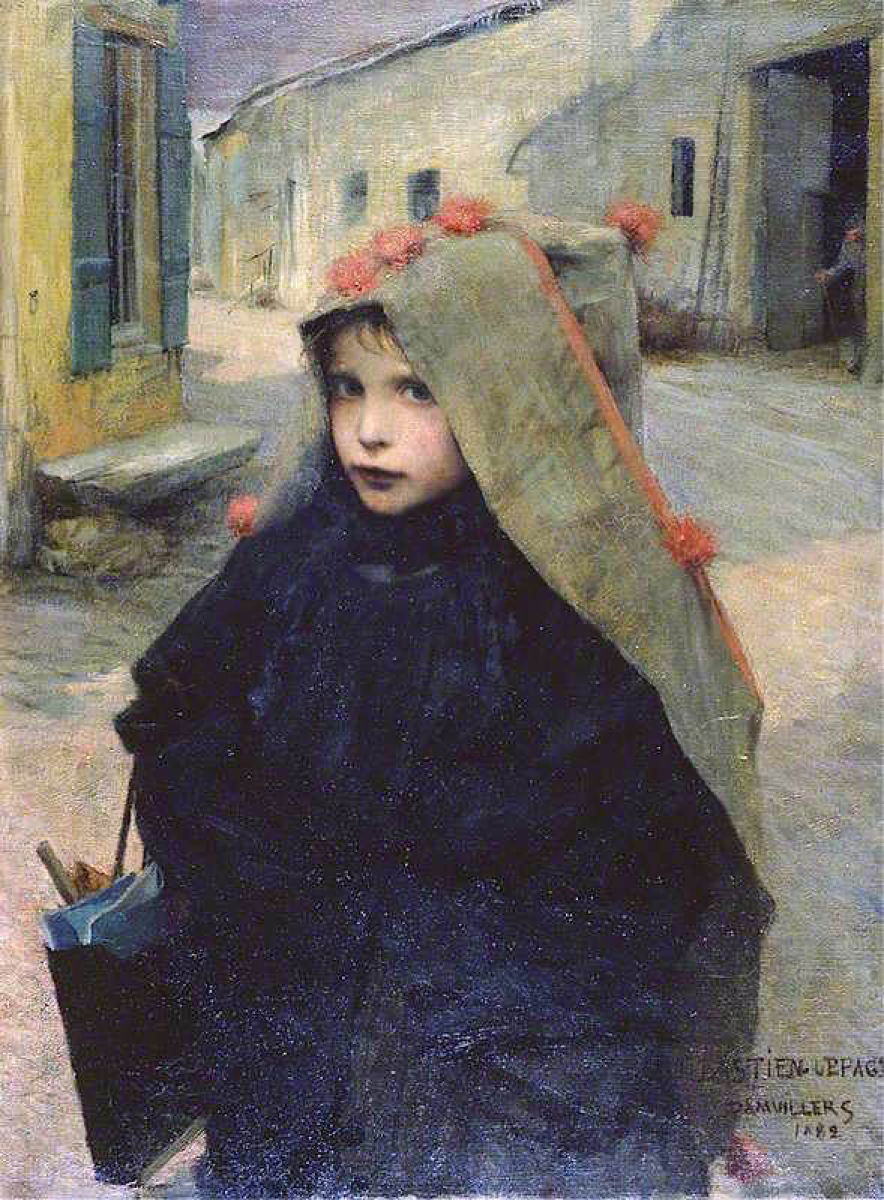
Going to School (1882) takes us back into the village, but again this girl is far too clean and perfect to be an objective account.
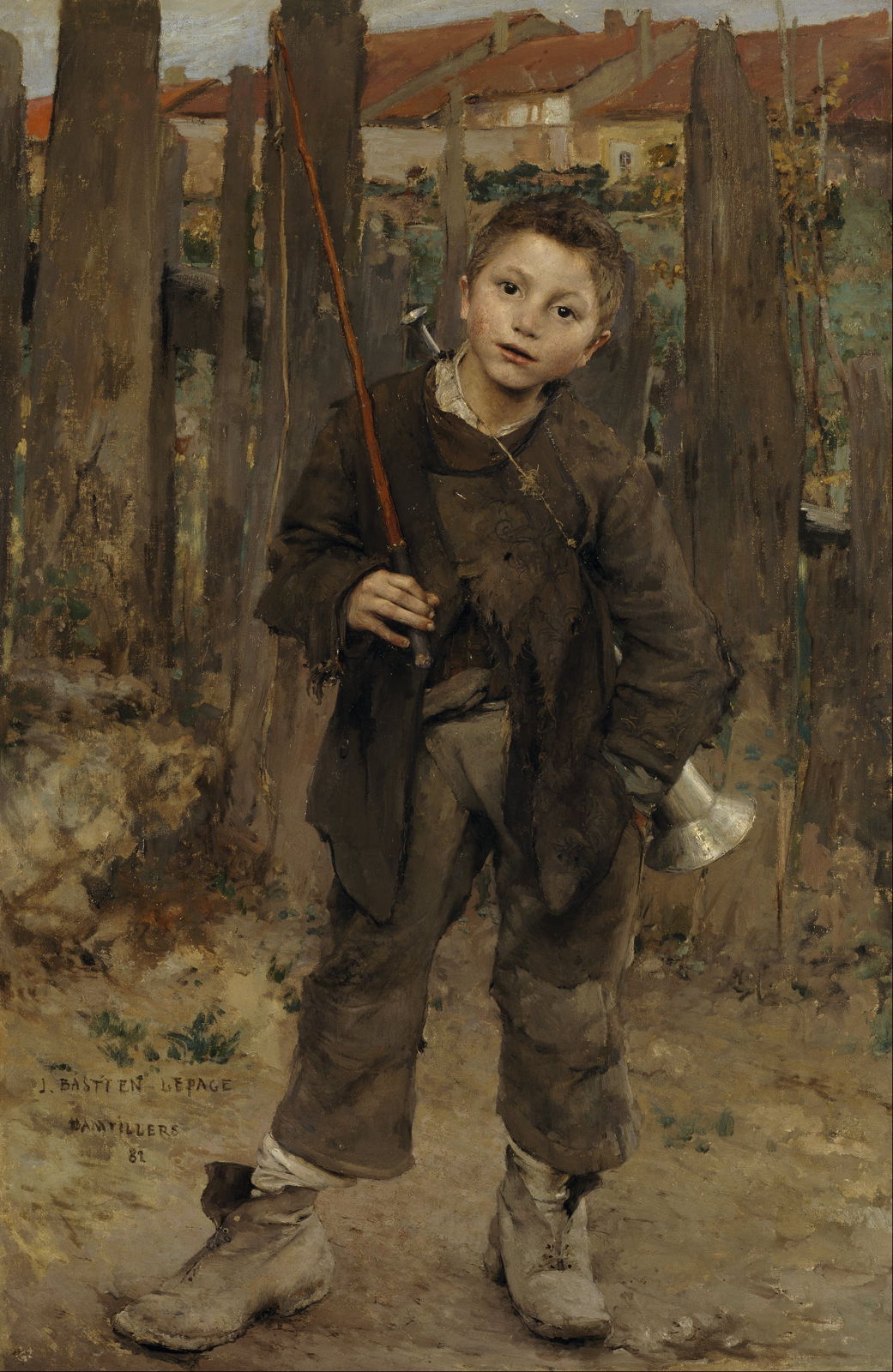
Pas Mèche (Nothing Doing) (1882) is nearer the mark: a cheeky ploughboy equipped with his whip and horn, on his way out to work in the fields. His face is grubby, his clothing frayed, patched, and dirty, and his boots caked in mud and laceless.

Many of his paintings from 1882 were single-figure portraits, mostly of children, but in Love in the Village he shows a young couple on either side of a tumbledown fence, chatting intimately among the vegetable patches. One early reading, by Mette, wife of Paul Gauguin, claimed the girl was under age, and the relationship accordingly beyond the pale. The girl not only faces away from the viewer, but her whole body is turned away, leaving that unresolved.

Bastien visited London, where he painted the river in The Thames, London (1882). This maintains fine detail right into the far distance, except where it’s affected by the smoky and hazy atmosphere, and its horizon is kept well below the middle of the canvas.

While in London he painted one of his most characteristically Naturalistic works, showing a young boy working on the street as a London Bootblack (1882). This could have been taken straight from the journalistic accounts of London’s streetlife by Henry Mayhew, or their fictional reworking in the novels of Charles Dickens. The documentary realism of the foreground gives way to a more sketchy and jumbled background.
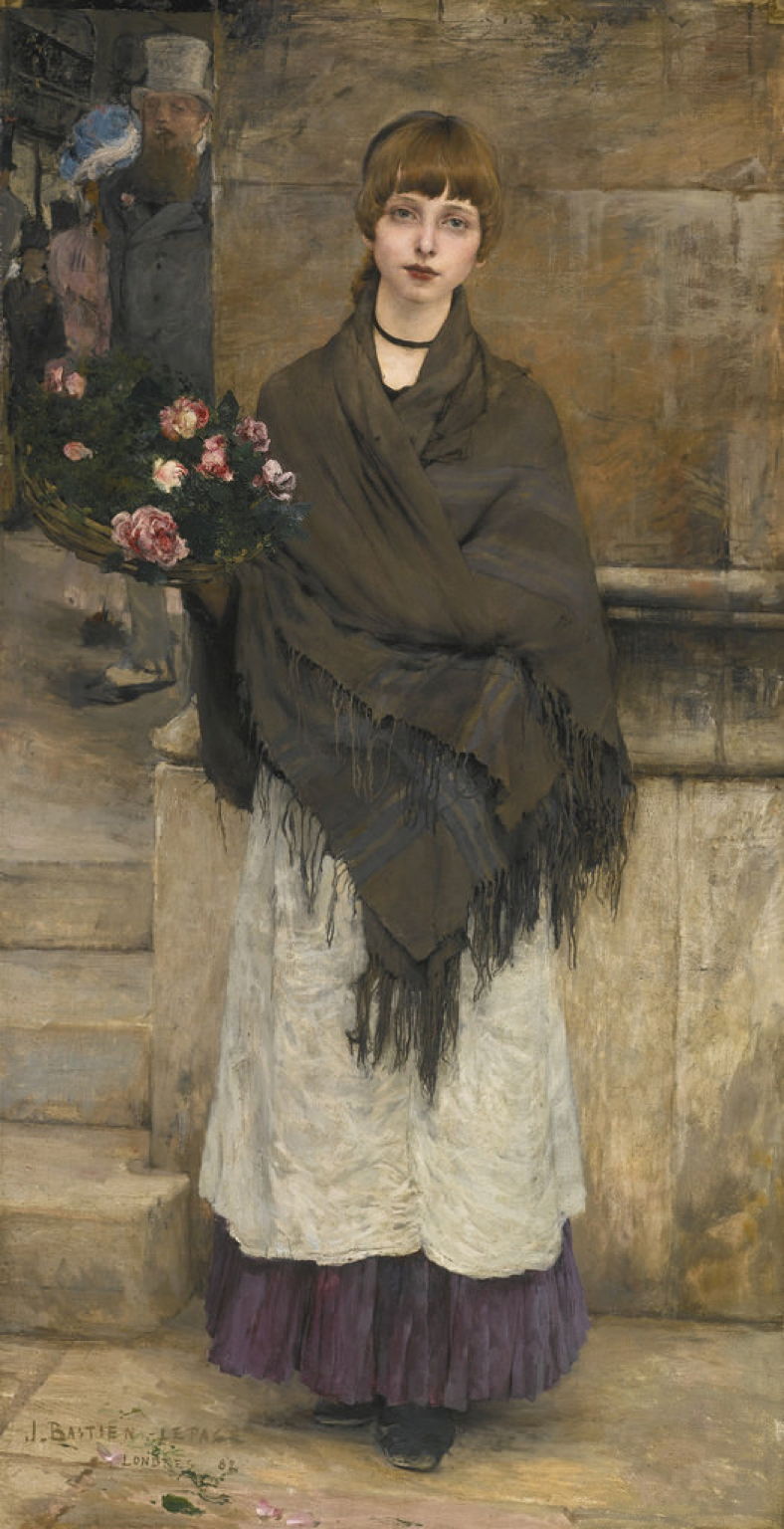
His portrait of a flower seller in a Flower Market in London (1882) is The Little Shepherdess of the city, posed against dull brown stonework. In the background is a reminder of how the other half lived, as an affluent man in a pale top hat walks alongside a woman wearing an exuberant blue hat.
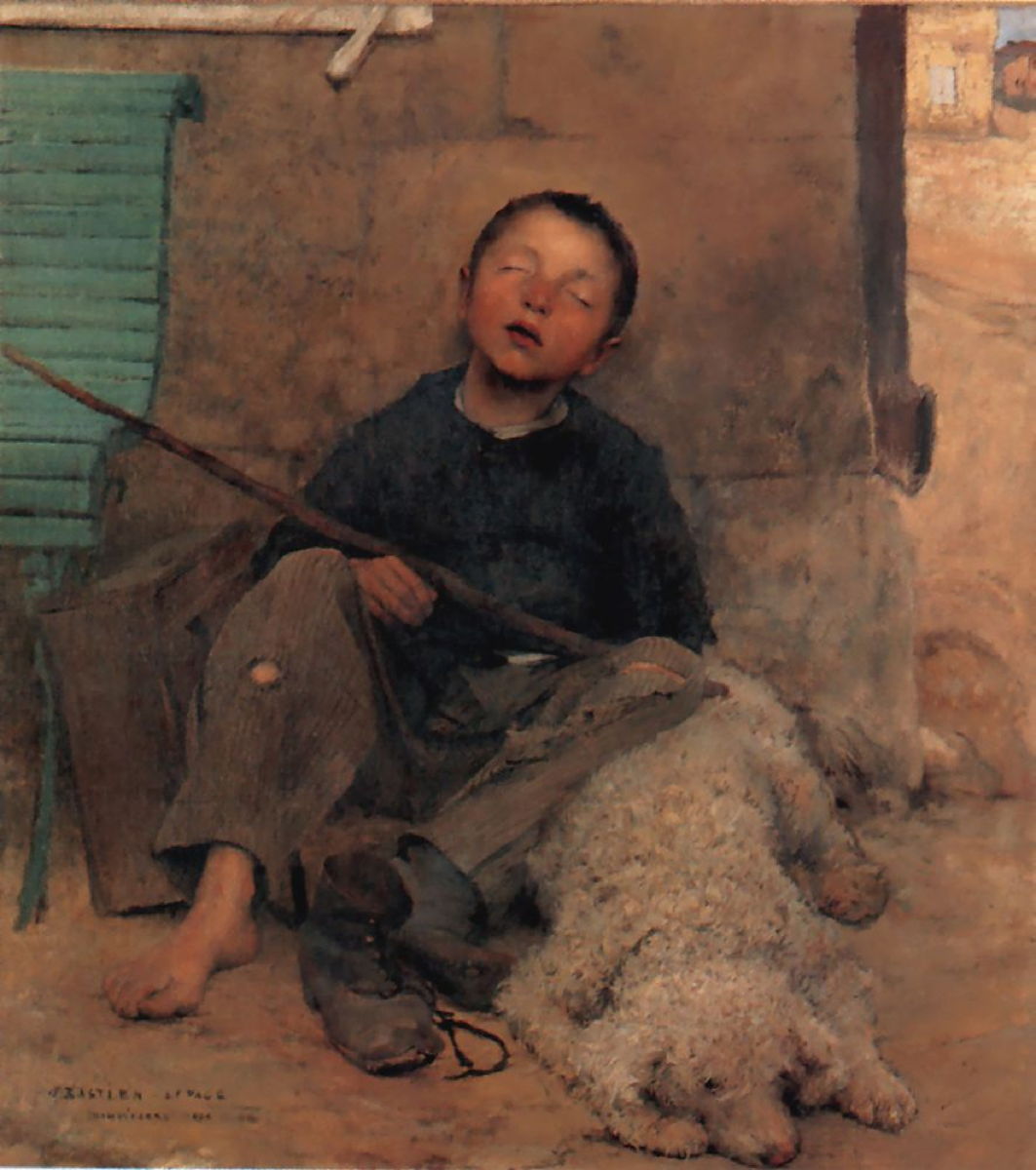
I haven’t been able to read the date on this portrait of The Blind Beggar, painted back in Damvillers, but guess that it was most probably painted between 1880 and 1883.
By 1880, Bastien’s health was starting to deteriorate as a result of what was most probably tuberculosis. He tried a brief stay in Algiers, but that didn’t help, and his output appears to have fallen dramatically in 1883-84.

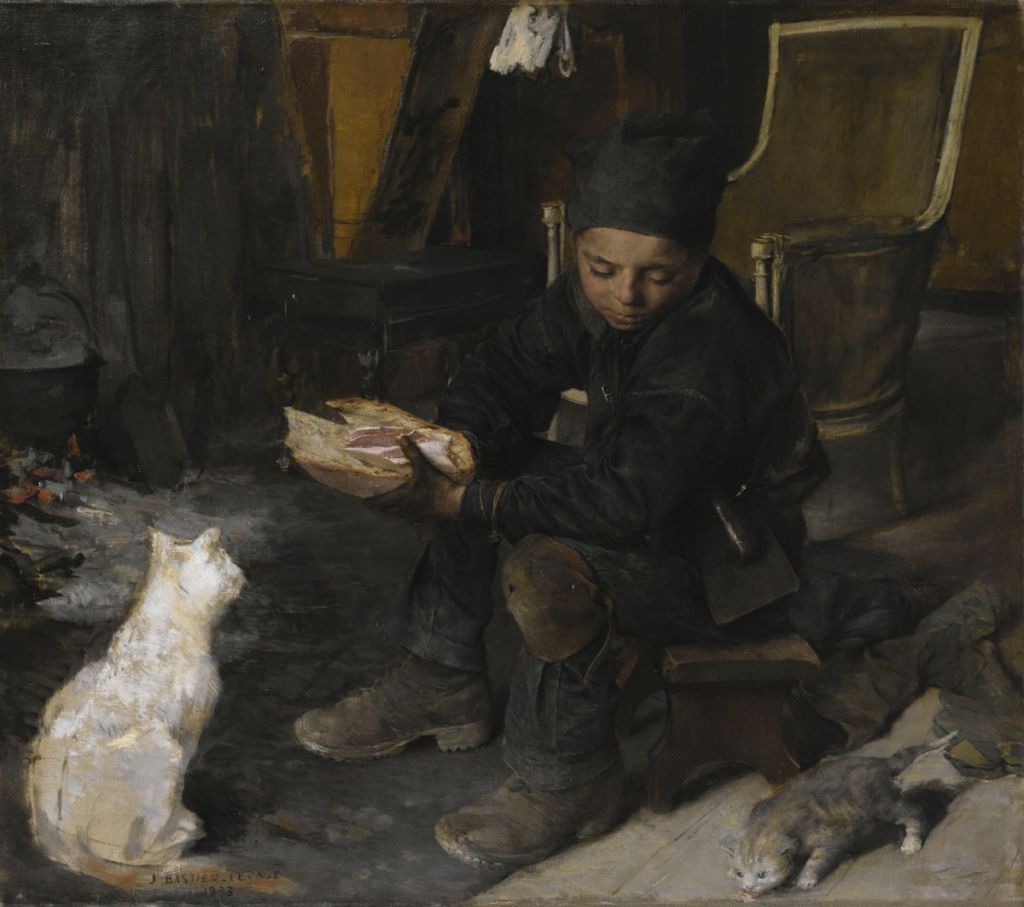
Dated in 1883, The Little Chimneysweep (Damvillers) is unusual as its subject isn’t shown standing, face-on to the viewer, but he sits and looks down at the kitten at the lower right. This young boy is also the dirtiest of Bastien’s waifs, his left hand still being black with soot from his work. He appears to be living in a hovel, with the embers of a fire at the left edge. Although signed, and presumably complete, the prominent white cat in the foreground remains very sketchy, and contrasts with the careful detail of the boy and his large bread roll.
Jules Bastien-Lepage’s declining health forced him to abandon his work in 1884, and he died on 10 December at the age of 36. His paintings continued to influence Naturalist painters well into the 1890s. Even critics like Émile Zola and Roger Fry recognised the importance of his work.
 The Eclectic Light Company