
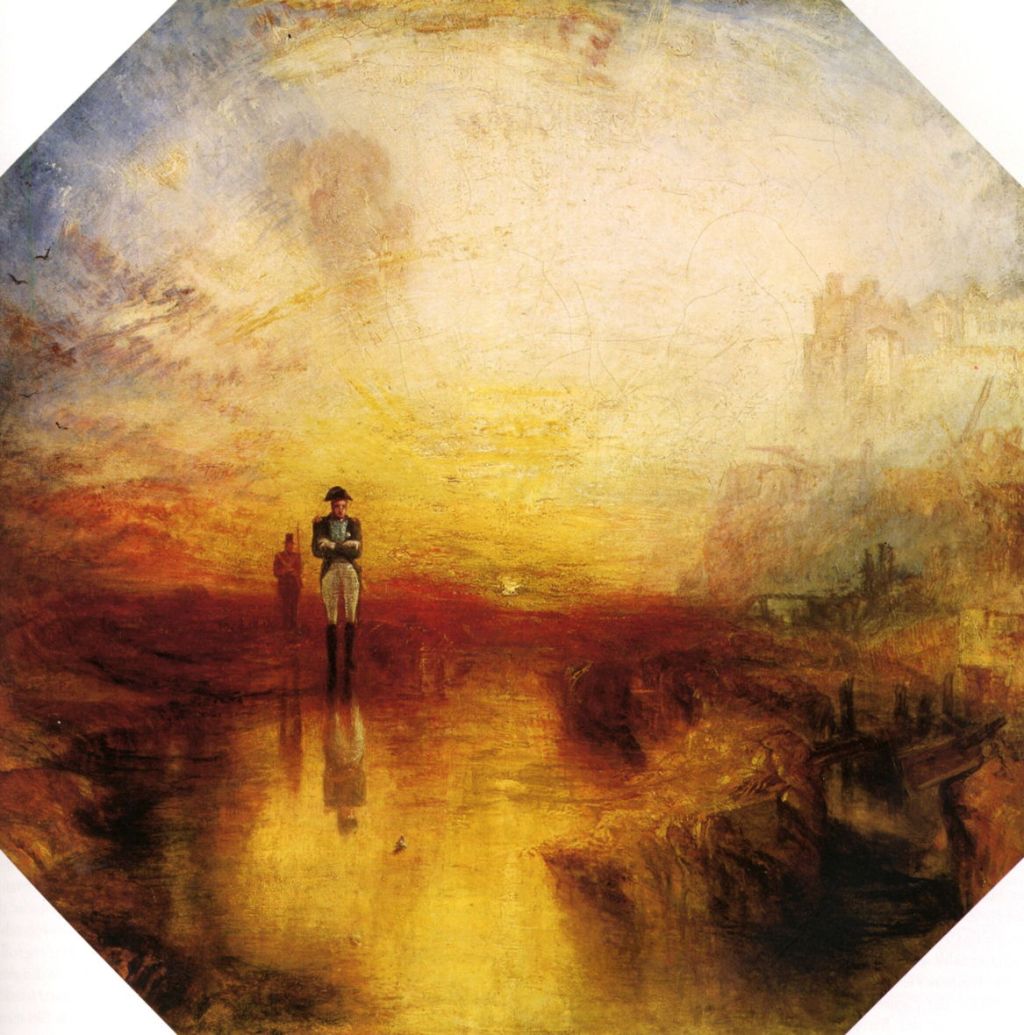
Understanding the optical principles involved in reflections is important for recognising when artists deviate from them, as in many cases that’s intentional. These can readily become complicated when considering mirrors that can be orientated at will, and are at their simplest when the reflecting surface is horizontal with respect to the earth, as with reflections on water.
Basic optics
The fundamental optical principles underlying reflections on water surfaces are:
- light travels in a straight line when passing through a medium of constant refractive index;
- when light reaches the interface between two media of different refractive indexes, some will be reflected from the boundary, and some will be refracted through that boundary;
- the angle of reflection of a ray of light from a boundary surface is equal to the angle of incidence of that light on that boundary;
- a water surface with air above it presents a suitable boundary at which reflection and refraction occur;
- still water surfaces are horizontal planes that act as horizontal planar mirrors as far as incident light rays are concerned.
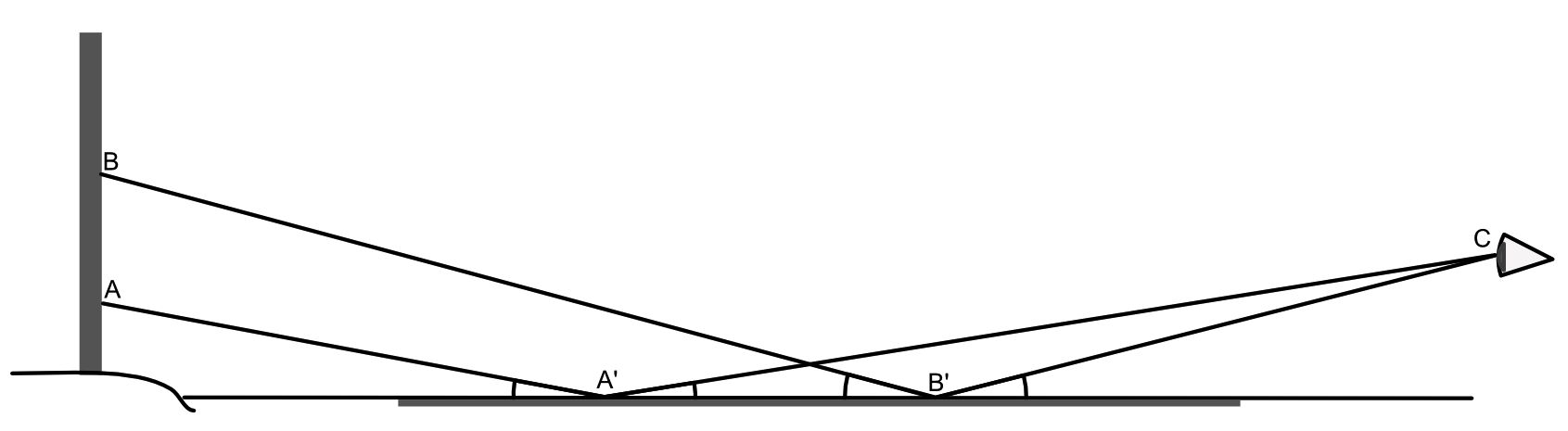
Here a post (with marks A and B), on the left of the diagram, is on the bank of a completely flat lake, with the observer on the opposite side of the lake at C, looking over the lake towards the post. A ray of light scattered from point A on the post passes over the lake to point A’. There, in passing from air to water, it reaches a boundary between media of different refractive indexes, and most of that light will then be reflected towards the observer at C.
Measured at the point of reflection A’ on the lake, the angle of incidence (between the ray and the horizontal water surface) equals the angle of reflection (between the ray and the water surface). The same process of reflection occurs to light scattered from point B on the post, with respect to its reflection at point B’ and the observer’s eye at C, although the angles at point A’ are less than those at point B’.
The relationship between heights above the water plane and the distances from the reflection on the water are a matter of simple geometry. Taking first the right-angled triangle formed by the points B, B’, and the base of the post, the perpendicular height of B above the water (H) and the distance from the base of the post to the point of reflection B’ (D) is the tangent of the angle of incidence of the light ray at B’, as H/D.
As the angle of reflection at B’ must be the same as the angle of incidence (point 3 above), the ratios of the heights at B and C to the distances along the water surface from the base of the post to the point of reflection, and the point of reflection to the observer, must be equal. Hence if three of the four variables are known, the fourth can be calculated, e.g. H = H’.D/D’.
This may seem complex and confuddling, but it’s worth taking the time to understand these basic principles, as they make everything else clearer and more logical.
Putting it together
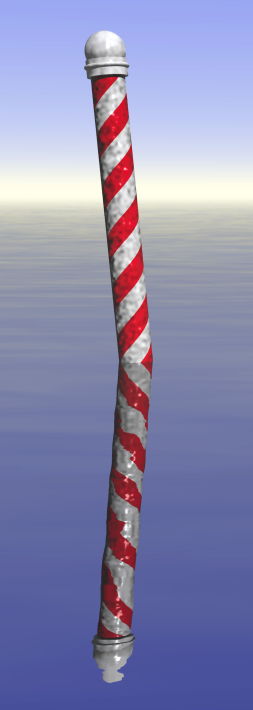
Repeating this simple tracing of light rays enables visualisation of more complex examples of reflection, such as that shown above. It quickly becomes tedious for humans to trace individual light rays in a three-dimensional model, but computers excel at the task of ray-tracing. The resulting image makes it clear that corresponding points in a reflection on water are vertically below their originals, although the slight waves seen here can result in limited lateral shift in the reflected points.
As is well known from real life, the reflected image in a horizontal mirror is effectively reflected on a local horizontal plane, so the left of the original remains on the left of the reflection, but the reflected image is inverted, where the top of the reflection shows the lowest part of the original; that’s unlike reflections in a mirror positioned vertically, such as those in which we inspect our face, shave, or apply make-up, which fortuitously remain uninverted. Whether a mirror is vertical or horizontal, the left of the reflected image shows the left of the real image, and similarly for the right.
The patterning and slant of the pole illustrates the differences between such a reflected image and one that has simply been rotated through 180˚, as might be achieved by a painter rotating the canvas on an easel. In the latter case the chirality (handedness) of the transformed image is opposite, the post would lean the opposite way, and its red spiral pattern would differ too. Surprisingly, rotating the canvas through 180˚ has often been recommended as an aid to painting faithful reflections, when all it can do is further confuse.
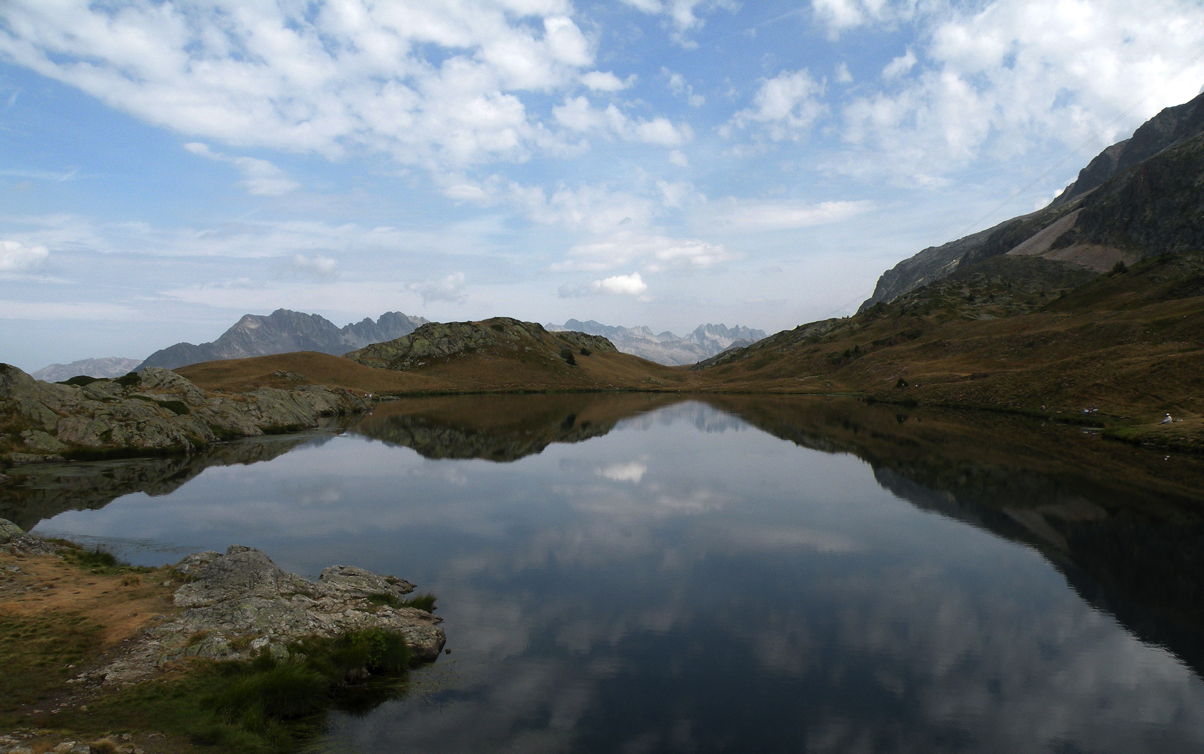
Real world reflections can become complex, as the photo above demonstrates. One method I use to check for discrepancies between the unreflected and reflected images is to un-reflect the reflected image by reflecting it a second time, and align it above the unreflected image. It’s then easy to check the alignment and representation of objects shown in the reflection.

JMW Turner, Crossing the Brook
In the summer of 1811, JMW Turner toured the west of England, where he made studies of the River Tamar, marking the boundary between Devon and Cornwall. The second major painting he exhibited in the summer of 1815 had been developed from one of those plein air studies of the river: Crossing the Brook.
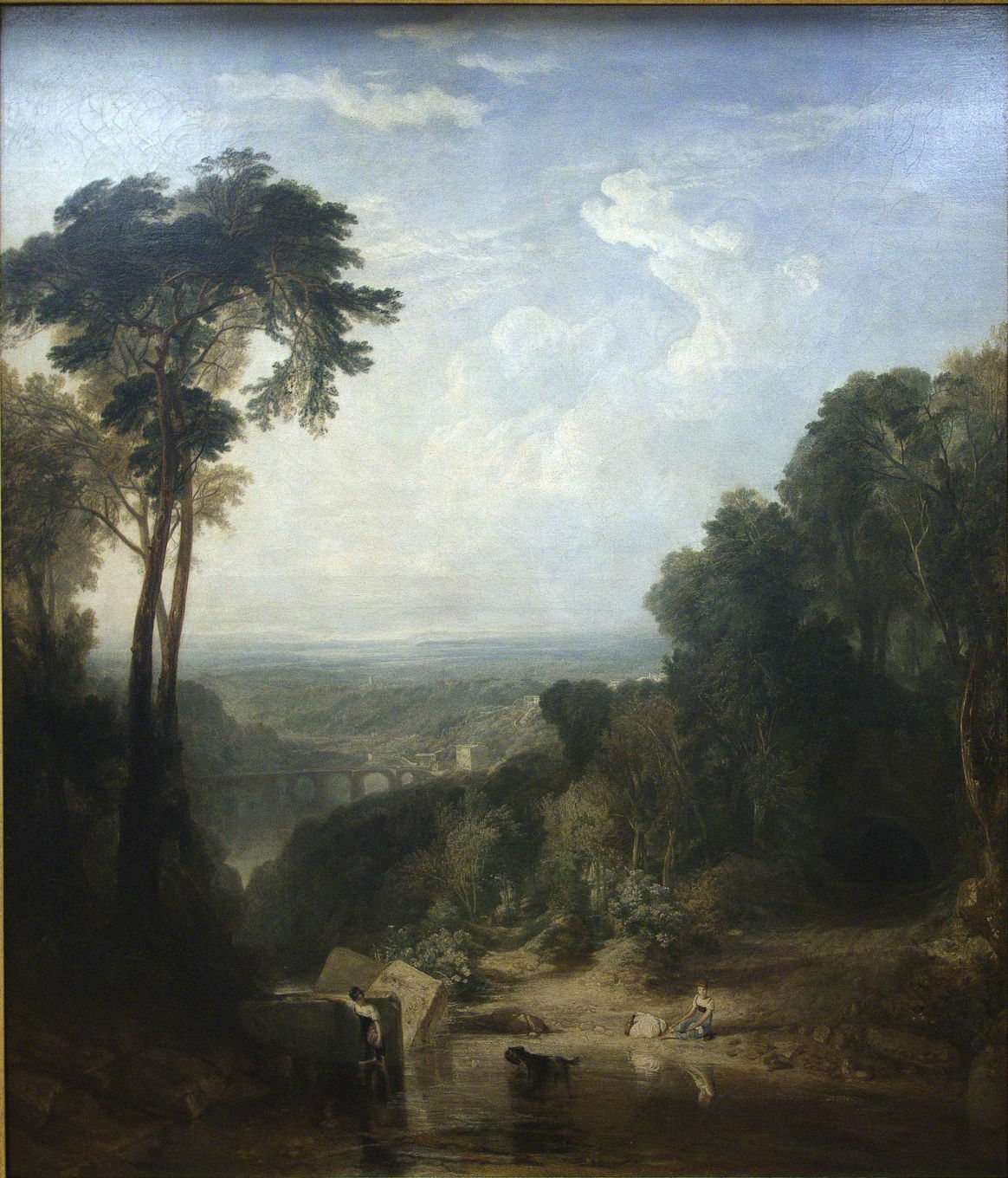
It was inspired by Claude Lorrain, but is more conventional, revealing its influence from the landscape tradition, including the British line tracing back to Richard Wilson (1714-1782). In the light of Turner’s later and more overtly experimental paintings, Crossing the Brook may today seem tame and conservative. It shows two women at a ford across the brook, one (left of centre) wading in the river by some massive stone blocks, and in company with a black dog, seen with a large fish in its mouth. The other sits on the far bank, beside a large bundle wrapped in white cloth, with her shoes removed.
The ford is in an opening within a large wooded area, with tall trees providing repoussoir at both sides of the painting. This drops away to a long bridge with multiple arches in the middle distance, and the river (as it is by then) meanders through rolling and wooded countryside until it reaches the sea at Plymouth in the far distance.
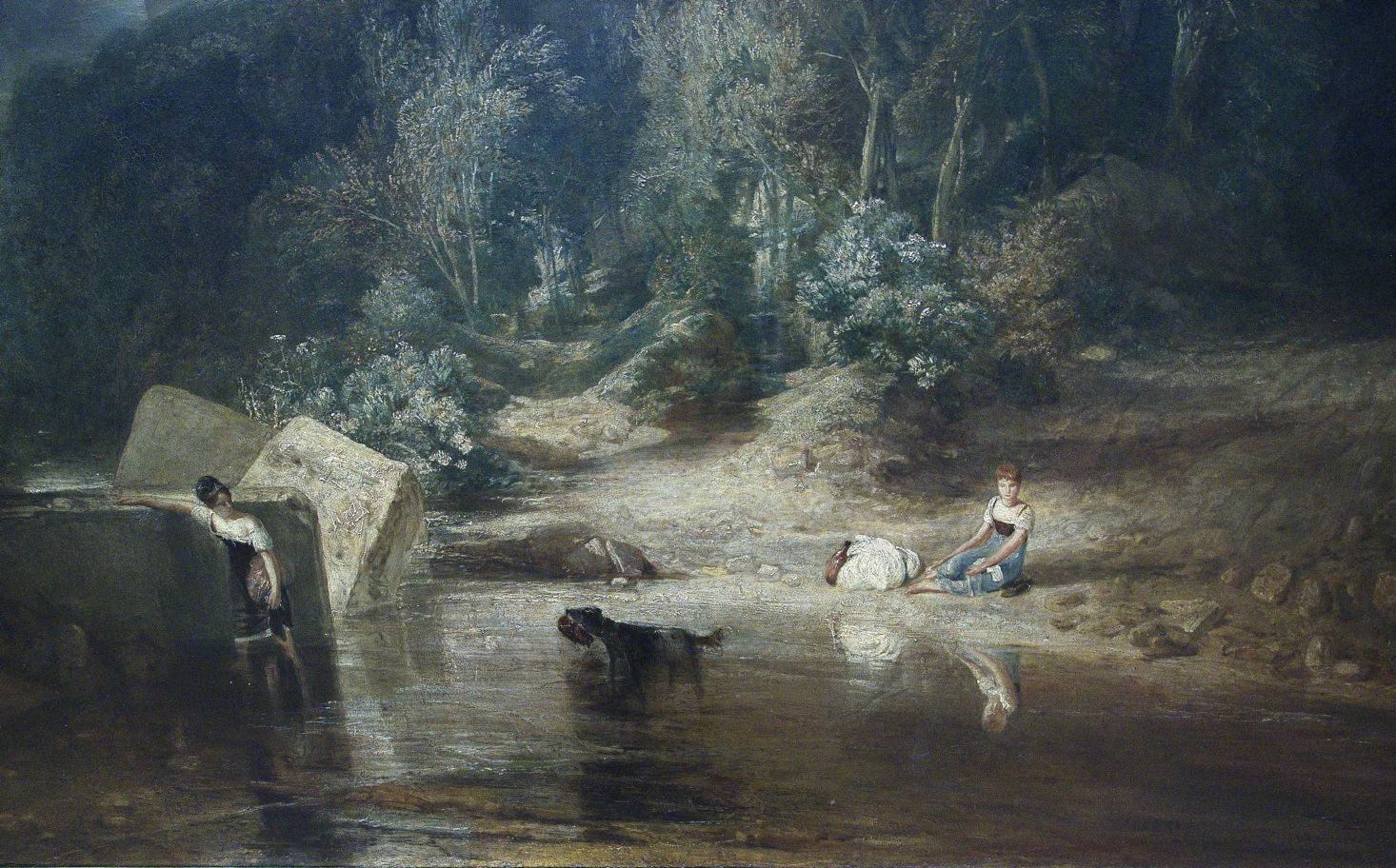
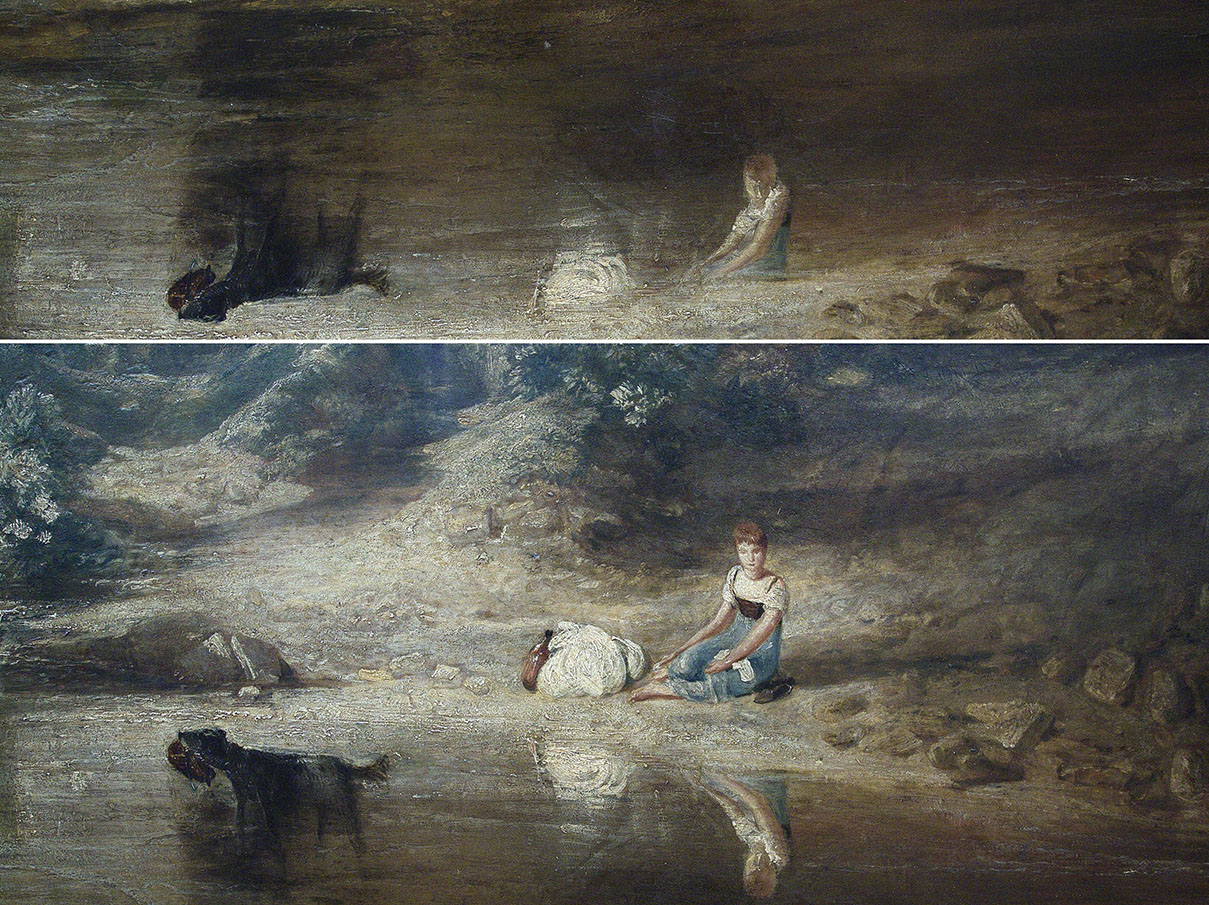
One of the most remarkable features of this painting is Turner’s depiction of the reflections in the water, because there are marked discrepancies between the unreflected image of the woman sat on the bank, and her reflection. Those are shown clearly in the composite detail below.
Throughout his career, and most particularly in his later more radical works, Turner took liberties with optics. One of the best examples of this is in his late oil painting War. The Exile and the Rock Limpet, painted over twenty-five years later, in 1842.

The left, more distant, figure (of the guard to Napoleon) shouldn’t have appeared in reflection at all, let alone been vertically aligned with Napoleon’s reflection. However, strict adherence to optics would have significantly detracted from the effect of this painting. Turner has also omitted shadows that would have been cast by the figures, presumably for the same reason.
3D scenes
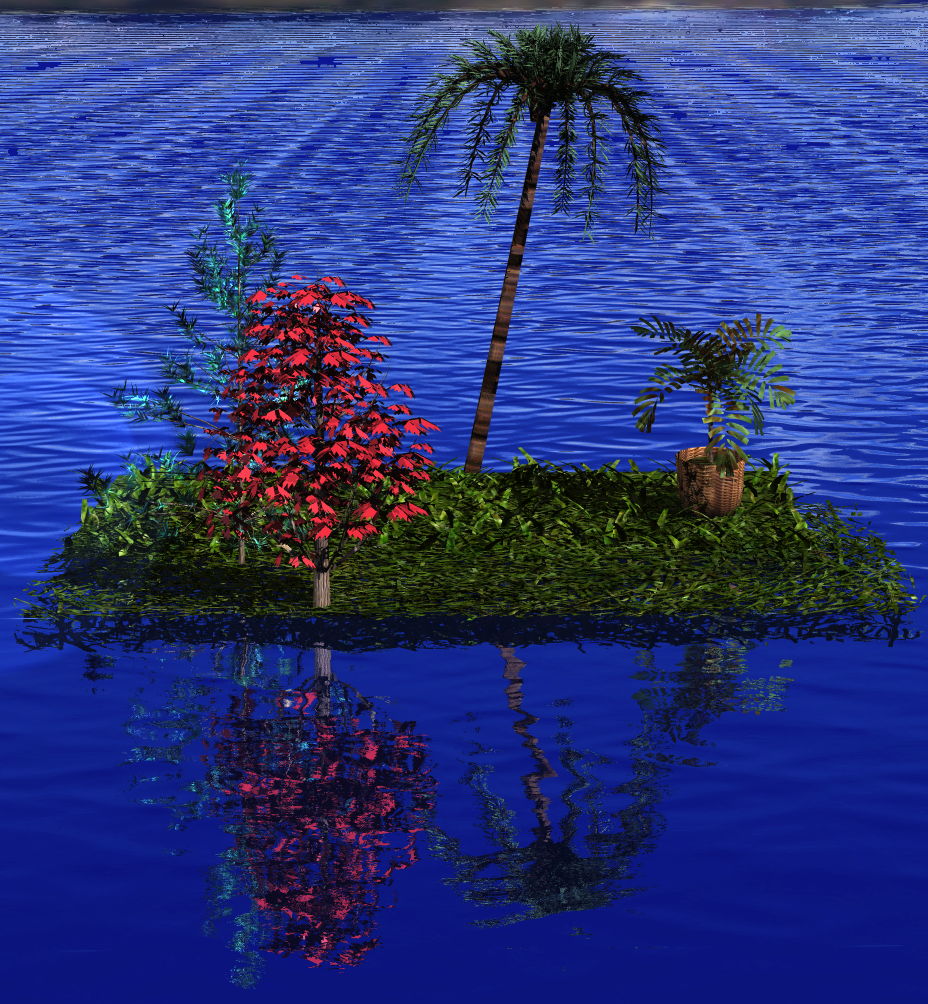
Reflections in a more complex 3D scene, above, show slight alteration in vertical dimensions, but remain strictly aligned with the original. Although the slight waves produce very small lateral displacements in the reflection, every point in the reflection corresponding to a point in the original remains in alignment across the width of the image.
Those objects at the front of the original remain at the front of the reflection: for example, the tree with red leaves retains its position relative to the green conifer tree behind it. The further back from the water’s edge that an object is situated, the more truncated is its reflection; truncation appears as if it occurred at the base of the original.
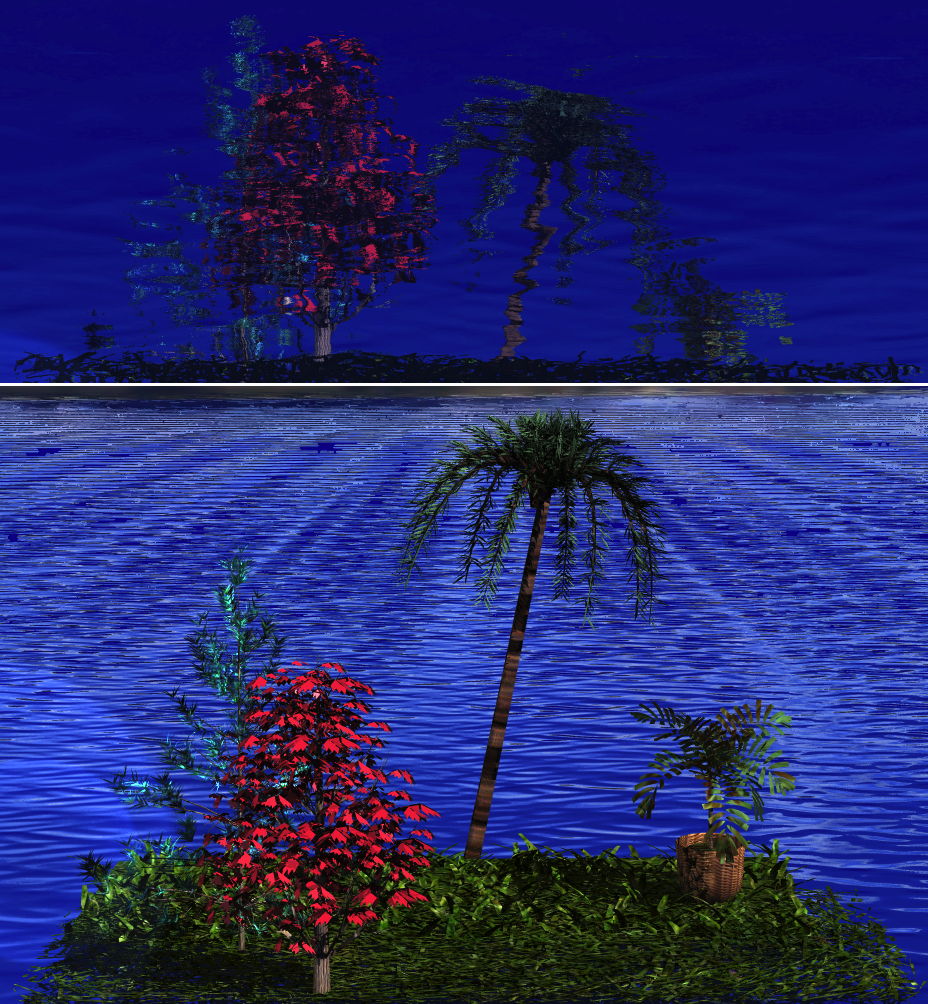
One useful rule of thumb sometimes given to gauge the effect of truncation is to imagine that the water extends right back to the base of the original, then construct the reflection on that imaginary water surface, and to erase the reflection on the water where it doesn’t actually exist.
There are complex differences between the original and its reflection with respect to the position of details, tones and highlights. Although highlights are seen on the red leaves, their pattern isn’t the same, because the original leaves are seen direct, but those in the reflection are viewed as if from below and in front of the tree (from their points of reflection on the water).
This makes it impossible to create a completely accurate representation of a reflection unless you can see that reflection; even using modern ray-tracing software on a computer it is extremely difficult to construct or reconstruct a reflection from real life. Any painter who paints the original en plein air and later attempts to paint its reflection in the studio is only going to be able to guess its form and appearance, and will be unable to get tones and highlights correct with respect to those seen in nature.
The difficulties encountered in extensive reflections on water in the real world are illustrated in the composite image above. Note how the distant mountains almost disappear from the reflection with the change in vertical dimensions, but rigorous vertical alignment is maintained across the entire image. Painting reflections in images such as this is an incredibly difficult task without the complete view in front of the painter at the time.
Practical principles
Any faithful depiction of reflections on water will therefore show the following features:
- a line joining any point on the original with its equivalent on the reflection will be strictly vertical, allowing slight lateral shift resulting from the effects of small waves;
- an object which is behind another object in the original will also remain behind that object in the reflection, as reflections preserve depth order;
- the further back that an original object is from the water’s edge, the more its reflection will be cropped vertically;
- vertical cropping loses the lower section of the original from the reflection, and the upper section remains in the reflection;
- when the water surface is smooth, the position of reflections can be determined by simple geometry relating the height above the water surface to the distance between the point of reflection on the water and the perpendicular projection down onto the water plane (the tangent of the angle or incidence or reflection being equal to height/distance);
- the view of each part of the original seen in the reflection will be that as seen from the points of reflection, those being lower than the observer and closer to the original;
- what is seen on the (observer’s) left of the original appears on the left of the reflection, and what is seen on the right remains on the right of the reflection;
- because the reflection is vertically inverted, what is seen at the top of the original appears at the bottom of the reflection;
- the more the water surface departs from being a flat and smooth mirror, the more distortion will be introduced into the reflection, until eventually its form is lost in a series of vague areas of broken colour.
References
Brook Taylor (1719) New Principles of Linear Perspective, or the Art of Designing on a Plane the Representations of All Sorts of Objects, in a more General and Simple Method than has been done before, London. (Not available online, and later editions omit much of the material on reflections.)
Cole, Rex Vicat (1921) Perspective, Seeley, Service and Co, London. (Available in various reprints, and Archive.org.)
de Piles, Roger (1708) Cours de Peinture par Principes, Paris. (Available at Archive.org.)
de Valenciennes P-H (1820) Élémens de Perspective Pratique à l’usage des artistes, 2nd edn., Paris.
 The Eclectic Light Company