

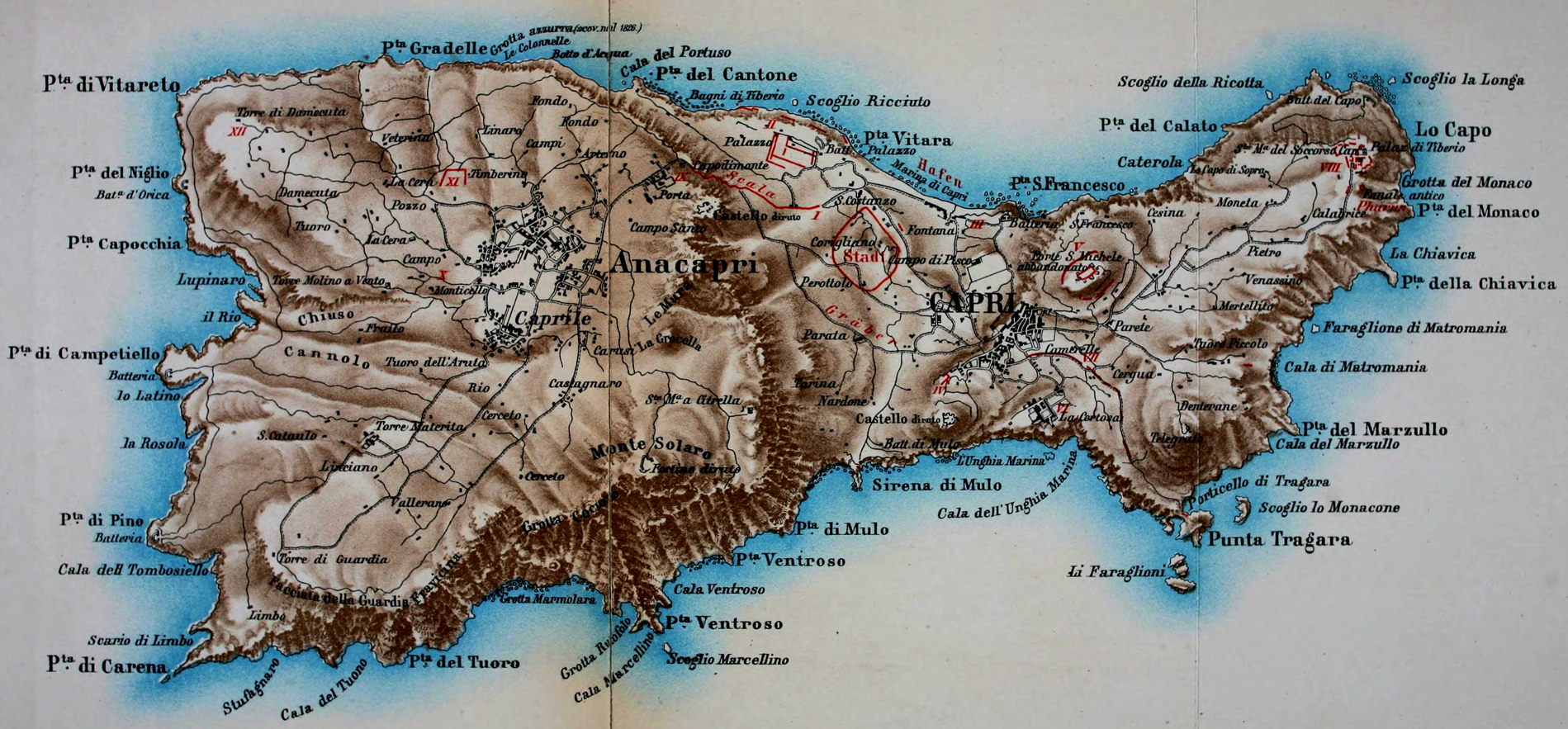
This weekend we’re sheltering on the island of Capri, at the southern end of the Bay of Naples, Italy, where we’ve reached the 1880s, a time when Capri had become popular with landscape painters.
Among the many artists who visited the island during the nineteenth century were several who had trained in Düsseldorf, Germany, whose works became popular both in Germany and in the USA.

Oswald Achenbach’s View of Capri from 1884 shows the island from a vantage point in the hills above Sorrento on the mainland. Achenbach was another member of the Düsseldorf School who visited Italy on several occasions during his career. His last extended visit started in 1882, and took him to Sorrento, but he had visited Capri a decade earlier, in 1871.

Hercules Brabazon Brabazon’s undated gouache painting of Capri is an unusual nocturne, showing a lonely and rugged section of the coast. An isolated villa stands in the bay, steps curving their way from it down to the tiny beach. This was most probably painted around 1890.
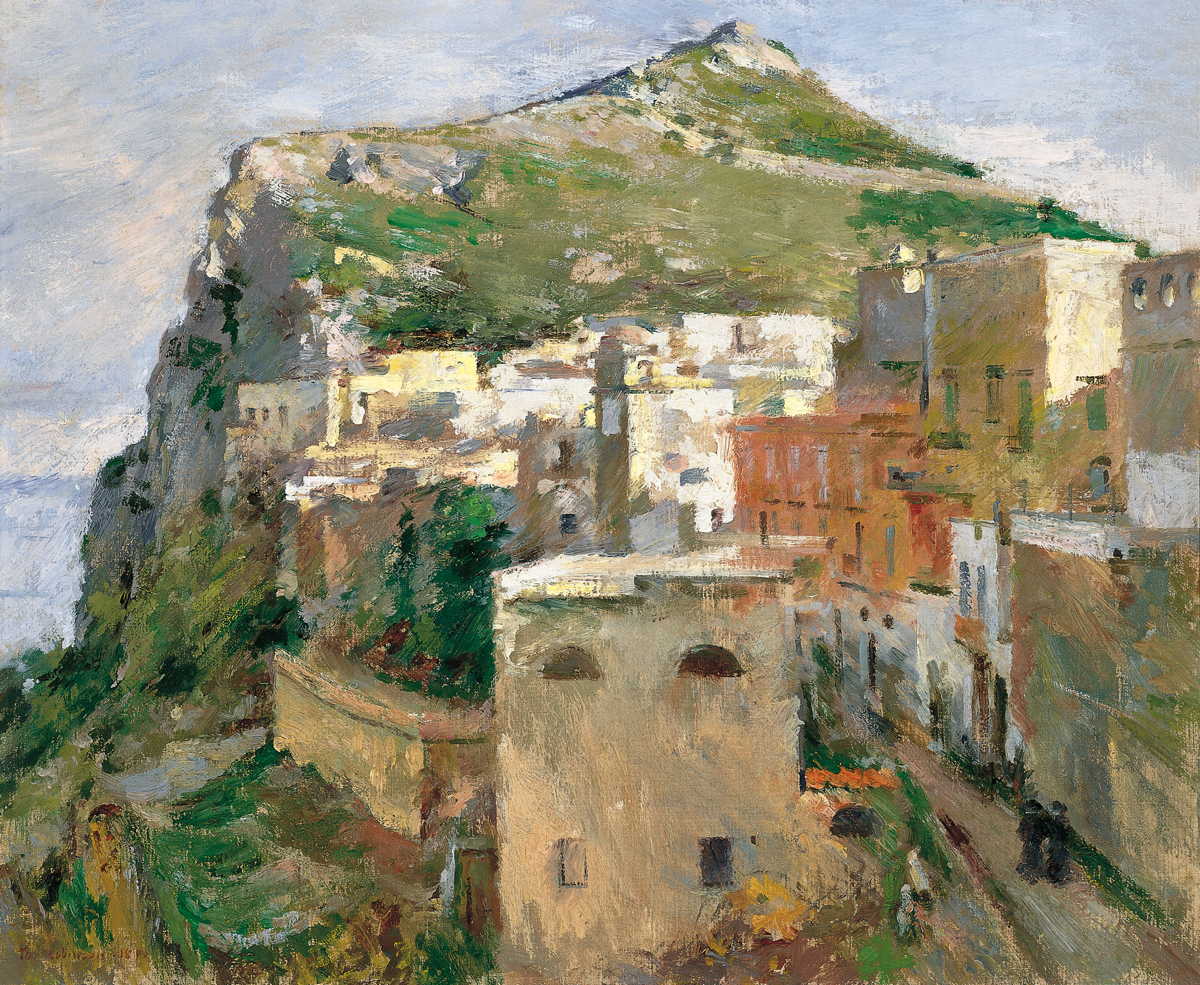
Theodore Robinson was an American Impressionist who trained in New York before heading to Europe in 1876, and must have painted this view of Capri when visiting the island in 1890. It appears to show Monte Tiberio in the far north-east, from the west. Robinson is most famous for his Impressionist landscapes from Giverny, mostly painted after he had moved into the property next door to Claude Monet. Although Monet doesn’t appear to have visited Capri, Robinson here adapted Monet’s style from his views of the cliffs at Étretat and other rugged coasts. Robinson tragically died of an asthma attack in 1896 when he was only 43.

Nicholas Chevalier’s View of the Faraglioni, Capri (1892) is a detailed watercolour view painted from the Marina Piccola on the south coast, looking south-east to the rock stacks of the Faraglione in the distance. He trained in Munich rather than Düsseldorf, and from 1851 painted in Britain, then in Australia and New Zealand. This was made during a visit to the island in his late career, when he was growing old and less active.
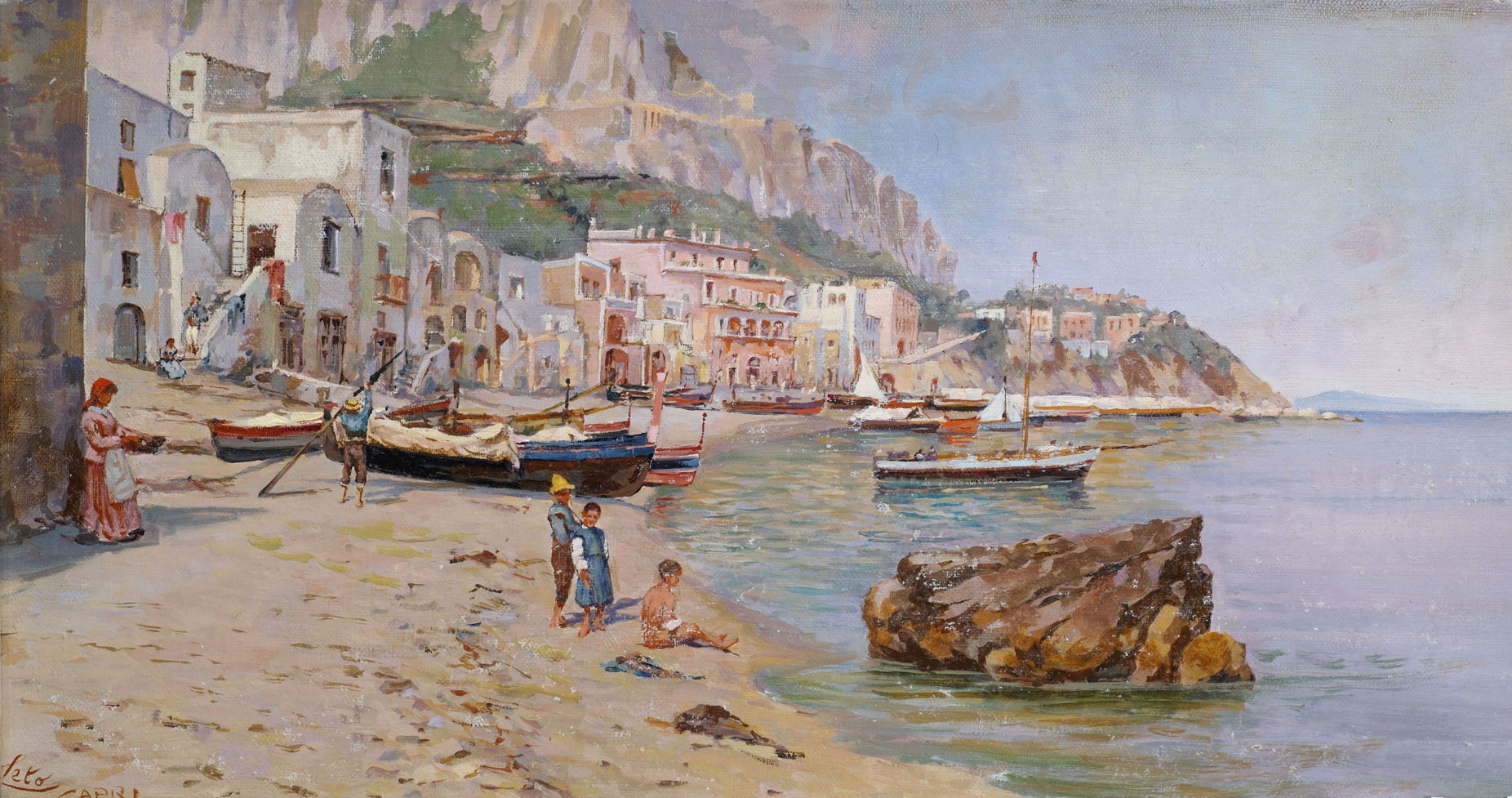
Antonino Leto’s undated view of Capri was most probably painted after he had retired to the island in 1882, following his career of painting landscapes and genre views in Impressionist style. I think that this shows the Marina Grande on the north coast, viewed from the east. Leto was originally inspired by the work of Giuseppe De Nittis, and in 1879 joined him and the group of Italian Impressionists who had gathered in Paris.
By the start of the twentieth century, painting in Capri was changing again. After his naturist and vegan painters’ commune and colony near Vienna went bankrupt from 1899, Karl Wilhelm Diefenbach moved to the island, where others joined him in another commune, perhaps in a more appropriate climate.
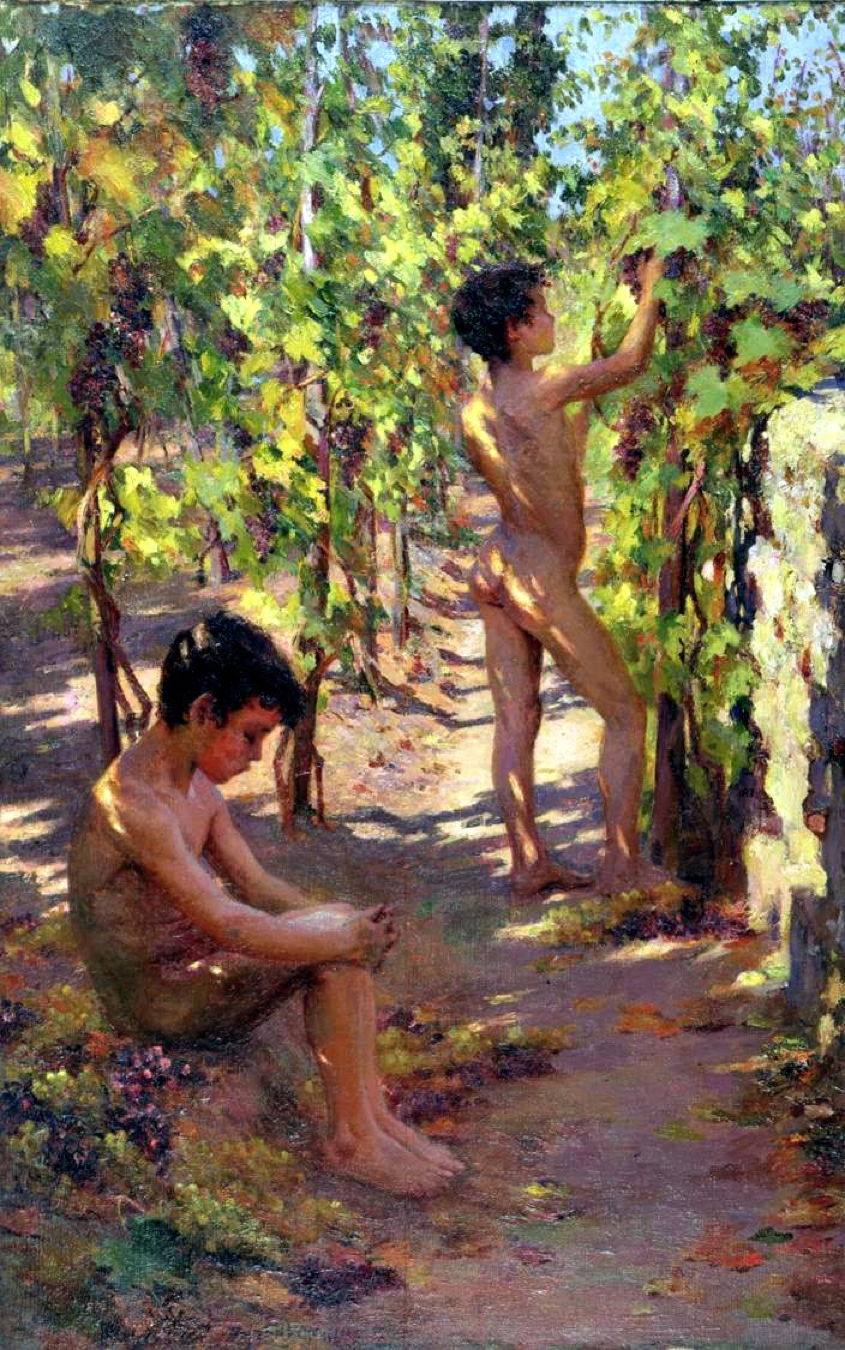
In about 1906, Susan Watkins appears to have visited the island. When there, she painted two superb studies for one of her finest works, showing local boys picking grapes on the island. Her finished painting of Boys Picking Grapes at Capri (c 1906) shows the much looser, more painterly, and richly chromatic style typical of her more mature work.
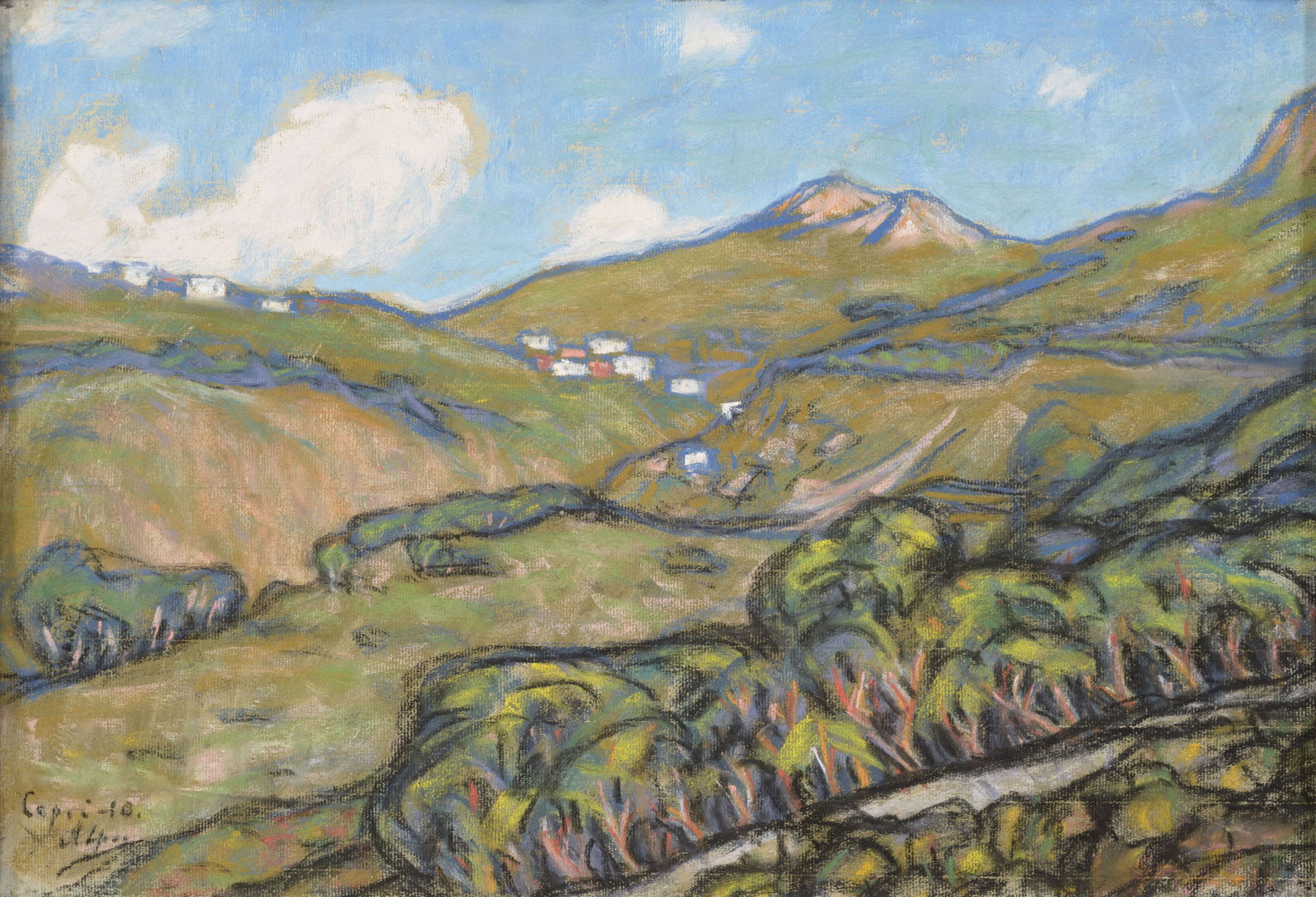
Between 1910 and 1912, the Estonian pastellist Ants Laikmaa (1866–1942) lived on Capri, where he painted many landscapes. His Capri Landscape from 1910 is unusual for showing the interior of the island with its scattered white houses.
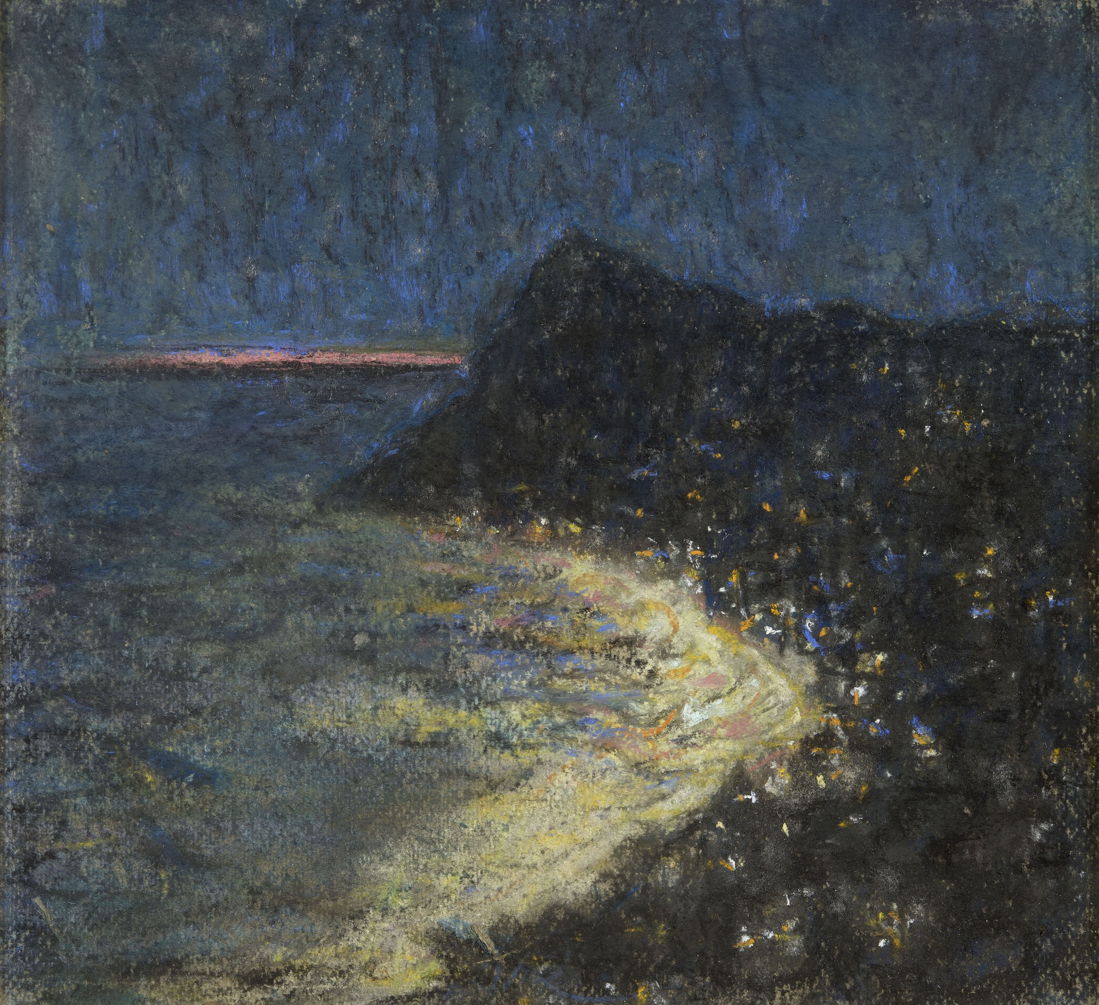
Laikmaa’s Night Motif from Capri from the same year is more of an impression of the coast, dotted with lights.

Paul von Spaun painted this striking view of The Faraglioni Cliffs on Capri from above in 1913. As far as I can gather, he was Diefenbach’s son in law, an Austrian painter who lived in Diefenbach’s commune and fathered Fridolin von Spaun, who went on to research Diefenbach’s life and works, and collected his paintings in a museum on the island, in the Carthusian monastery at Certosa di San Giacomo, painted by Marie-Caroline de Bourbon, shown in the first of these two articles.
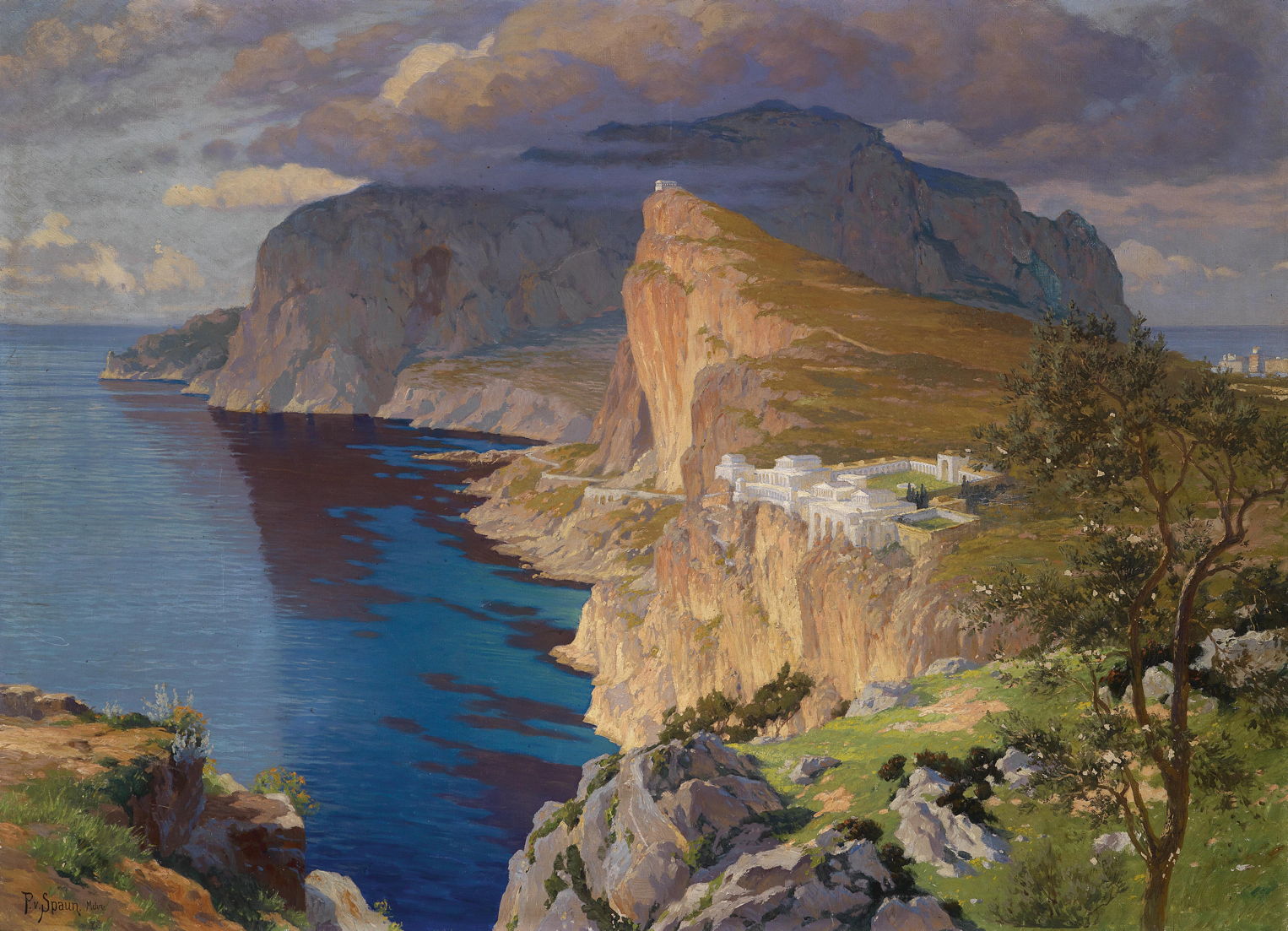
Von Spaun’s undated Idealised View of Villa Jovis on the Island of Capri is one of the most outstanding paintings of the island. But it isn’t a ‘real’ view, as far as I can tell, rather a composite cleverly built from several different features, much in the way that landscape Masters like Nicolas Poussin assembled their idealised landscapes.
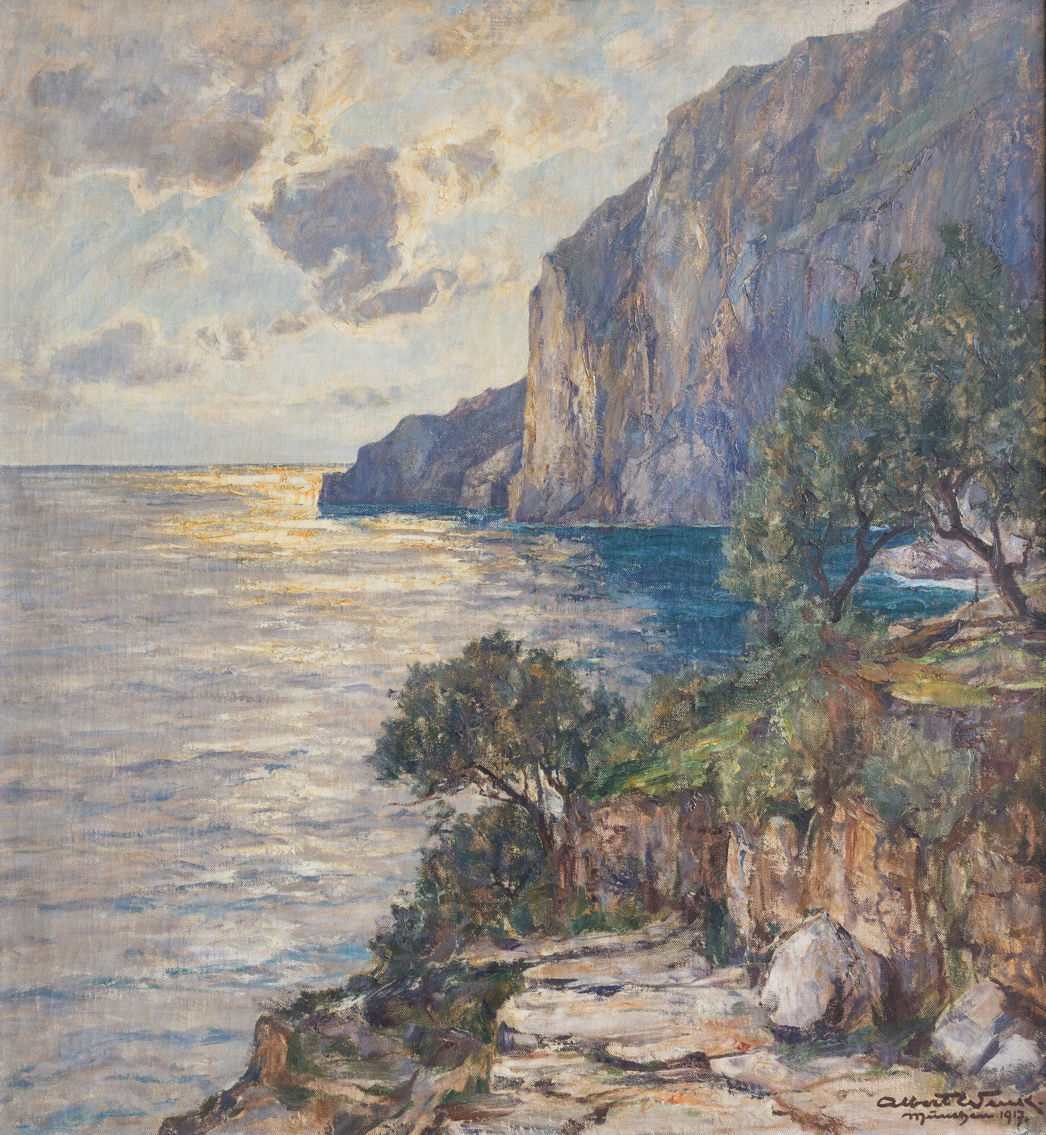
Albert Wenk’s view of Capri, painted in 1917, may look as if it was painted en plein air, but was probably made, or at least completed, in his Munich studio. It shows the vertiginous steps of the Via Krupp tumbling down the cliff on the south coast to the Marina Piccola, looking to the west in the late afternoon. Wenk had also trained in Düsseldorf.
My final three paintings are by the Russian Post-Impressionist Konstantin Ivanovich Gorbatov. He initially studied civil engineering, but in 1904 started training as an artist. He won a travelling scholarship taking him to Rome, from where he first visited Capri. He left Russia in 1922, and from then until 1926 lived and painted on the island. He next moved to Berlin, where he was an active member of a group of Russian emigré artists, and during the 1930s travelled widely across Europe and the Middle East. His career ended with the outbreak of the Second World War, and he died in Germany just after the Allied victory.
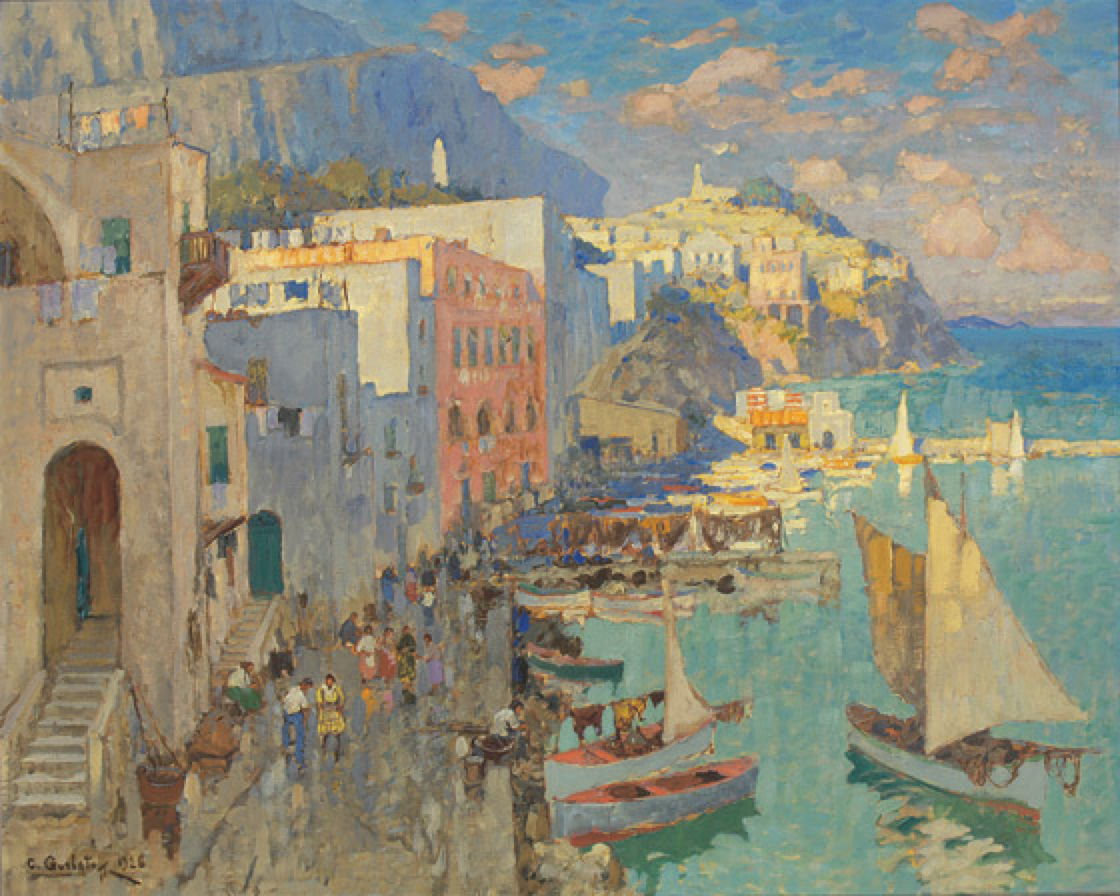
Gorbatov’s view of The Port of Capri (1926) shows the Marina Grande with the first of its jetties that now provide a more sheltered harbour. This looks west over the harbour on the north coast.

His slightly more distant view in Capri, painted in 1928, shows the high chroma style that he appears to have adopted when he moved to Berlin.

This undated watercolour reverses those previous views, and looks east along the north coast, towards Monte San Michele and the more distant Monte Tiberio, at the far north-eastern tip of the island.
 The Eclectic Light Company