
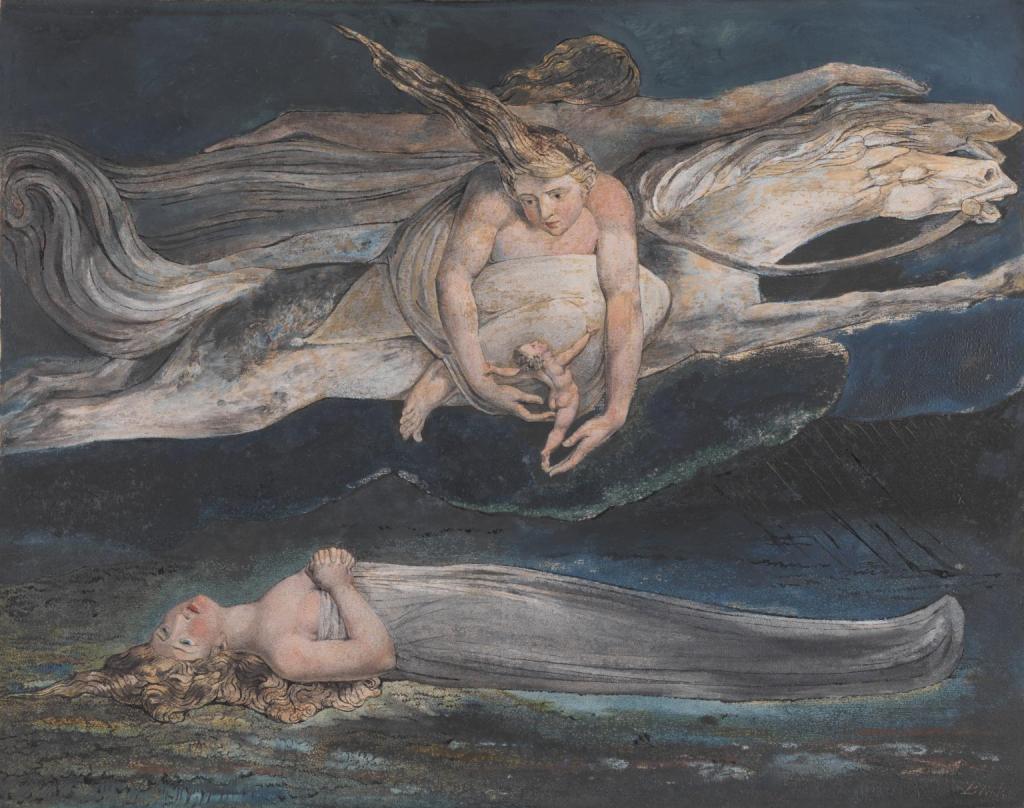
The art of William Blake (1757–1827) is among the most innovative in Europe, and has had enduring influence. His work not only looks different, but an important part of that is in his unusual media. This article looks at how he created those striking images.
Blake initially trained as an engraver, and throughout his subsequent career returned to commercial engraving work to supplement his income. On completion of that apprenticeship he became a pupil in the newly formed Royal Academy Schools, where he trained as a painter. From the outset he refused to paint in oils, at the time the major medium used by professional painters. That decision condemned his work to relative obscurity during his lifetime.
Instead, Blake painted almost exclusively in watercolour and two media he developed himself and called fresco, although neither bears any resemblance to what is normally meant by that word. Blake was convinced that one of the secrets of success of older paintings was their use of the fresco medium, although as he never left the south-east of England his experience of Italian fresco painting was extremely limited.
Watercolour
Throughout his career, Blake painted using watercolour on paper in relatively conventional methods.

After completing his training he aspired to create a series of paintings showing scenes from British history. One that he worked up into a complete painting, albeit rather later, is The Penance of Jane Shore in St Paul’s Church (c 1793), using watercolour and gouache.
King Edward IV of England had kept many mistresses, among them Elizabeth Shore, known as Jane Shore (c 1445-1527), who had also had affairs with the King’s close associates. Following the King’s death in 1483, Jane Shore was charged with conspiracy and promiscuity. As part of her penance for the latter, she had to stand at Paul’s Cross, by Saint Paul’s Cathedral in London, and it is that penance which Blake shows here: she is seen holding a candle and wrapped in a sheet.
Unfortunately, once he had completed this watercolour Blake broke with convention by applying a glue varnish, which has caused yellowing and masks its subtle colours. Other watercolours have survived better, including the series of studies he made in his final years as illustrations for Dante’s Divine Comedy.

The Punishment of the Thieves, a study made between 1824–27, anticipates figurative painting of a century or more later, and the darker psychological recesses of sex and snakes. This uses mixed media of chalk, ink and watercolour to great effect.
Watercolour monoprints
Blake produced his first works using a process for illuminated printing in 1788, and the following year he published his first major independent works: Tiriel, Songs of Innocence, and The Book of Thel. That process was based on an acid etch leaving the design standing in relief, so is sometimes known as relief etching.
He continued to develop this until it was perfected in 1794 for publication of a series of illuminated books. In 1793, he published For Children: The Gates of Paradise, Visions of the Daughters of Albion, and America: A Prophecy. In 1794, he published Europe: A Prophecy, The First Book of Urizen, and Songs of Experience. Then in 1795 he was ready to use it to produce a limited run of twelve large colour paintings. These formed the first major collection of paintings which he offered for sale: one mark of the importance that he accorded them was his use of the term fresco to describe their medium.
In fact, they were not made using a technique resembling fresco painting in any way. Although there remains some debate as to exactly what he did, the process was probably:
- Develop the work using sketches and studies until a design was ready to print. In some cases, these large prints were derived from earlier work, in others (such as Pity), he made fresh sketches.
- Draw the finished work onto a sheet of thick millboard, ready to colour.
- Produce a wet watercolour, using pigment, binder, and a honey additive, on the millboard.
- Print approximately three copies from the millboard ‘plate’.
- Touch up each print by hand using pen and ink and watercolour to produce the finished painting.
Although it’s possible he may have used oil-based inks or paints on some, his lifelong aversion to oil paints suggests that he used water-based media throughout, and analyses support that. These ‘large prints’ (also known as his Lambeth Prints, as that is where they were made) are therefore watercolour monoprints that have then been individually retouched and further painted. Given the variation between the different ‘pulls’ or impressions made of each, they are less prints and more print-based paintings.
Neither were they illustrations in the way that the images within his illuminated books may be. They were supplied as individual sheets for mounting and framing as paintings. We don’t know whether Blake intended them to be viewed in pairs, groups, or as a complete set of twelve, and there is uncertainty as to his own title for several. Indeed, some of them appear to have been mistitled following Blake’s death, and that has led to confusion as to what they actually depict.

Elohim Creating Adam (1795, c 1805) is the only surviving impression of this work, which appears to have been listed by Blake as God Creating Adam. It is based on the book of Genesis chapter 2 verse 7:
And the Lord God formed man of the dust of the ground, and breathed into his nostrils the breath of life; and man became a living soul.
Blake shows this fairly literally, with Adam’s body still being formed out of the earth, and a large worm (not a serpent) is coiled around his left leg. The worm is also a symbol of mortality.
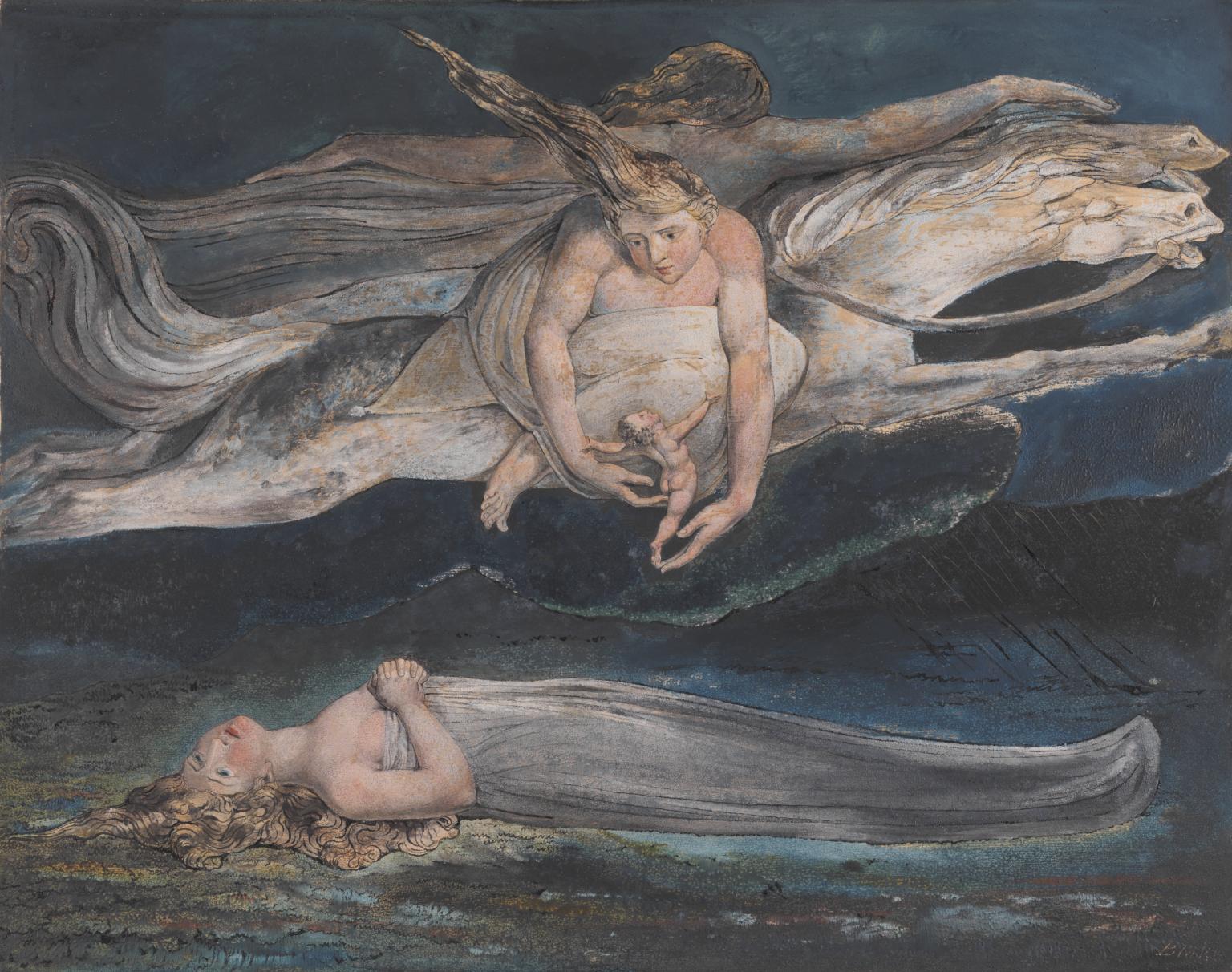
Pity is another remarkable example of this technique from 1795.
Glue tempera
Those experiments in self-publishing weren’t commercially successful. Extraordinary and beautiful as his illuminated books are to us, neither his poetry nor its presentation in that form had achieved any recognition, nor brought in money to keep him and his wife from poverty. This changed in 1799, when he gained Thomas Butts as a patron, and started painting fifty glue tempera works illustrating the Bible for him. These were the first paintings for which Blake used this medium which appears to have been key in his quest for what he termed fresco. As with his illuminated printing methods, he did not document the processes, and certain aspects remain controversial.
His use of glue tempera was not novel – similar methods had been used several centuries earlier, and by some of the great Flemish masters – and a version had been popular at one time in Germany, as tüchlein. However, it had generally been replaced quickly by oil paints.
His technique appears to have consisted of the following:
- Preparation of the support (canvas, copper, or even iron) by roughening, then application of glue size.
- Application of a bright white priming layer of chalk or gypsum with animal glue, containing a little honey (for flexibility) and possibly plant gum.
- Underdrawing using ink or paint.
- Sealing with a layer of animal glue, possibly containing a little honey.
- Application of layers of colour, in the form of water-based paints using mainly plant gums as binder, with some further layers of animal glue.
- Reinforcement of lines using black ink, and enhancement of highlights using impasto chalk-based white paint with animal glue.
- A final ‘varnish’ coat of animal glue.
Unfortunately some of his paintings have later been varnished using conventional varnishes. As these inevitably become dirty over time, conservation professionals have been posed the near-impossible task of removing that varnish without destroying the delicate glue layers underneath.
This method of glue tempera painting isn’t in itself unsound, but animal glues are sensitive to the atmosphere: they absorb water when it’s damp, and crack when it’s drier. They’re also prone to take up dust and small particles, which are almost impossible to clean. The tragic result is that many of Blake’s glue tempera paintings are now but shadows of their former selves. When newly completed, they would have been bright, light, and colourful.

Eve Tempted by the Serpent has retained its colours well, and shows the biblical narrative from Genesis chapter 3 verses 1-5, in the light of Milton’s elaboration in his epic Paradise Lost, in book 9, lines 496-500 and 670-677. Blake’s exuberant serpent is almost calligraphic in its coils, and the tree beside them twists in the same sense, then arches over the top of the painting. This uses a copper plate as its support.

The Christ Child Asleep on the Cross, or Our Lady Adoring the Infant Jesus Asleep on the Cross (1799-1800) was painted on a stretched canvas support, and has kept its colours rather better than most.
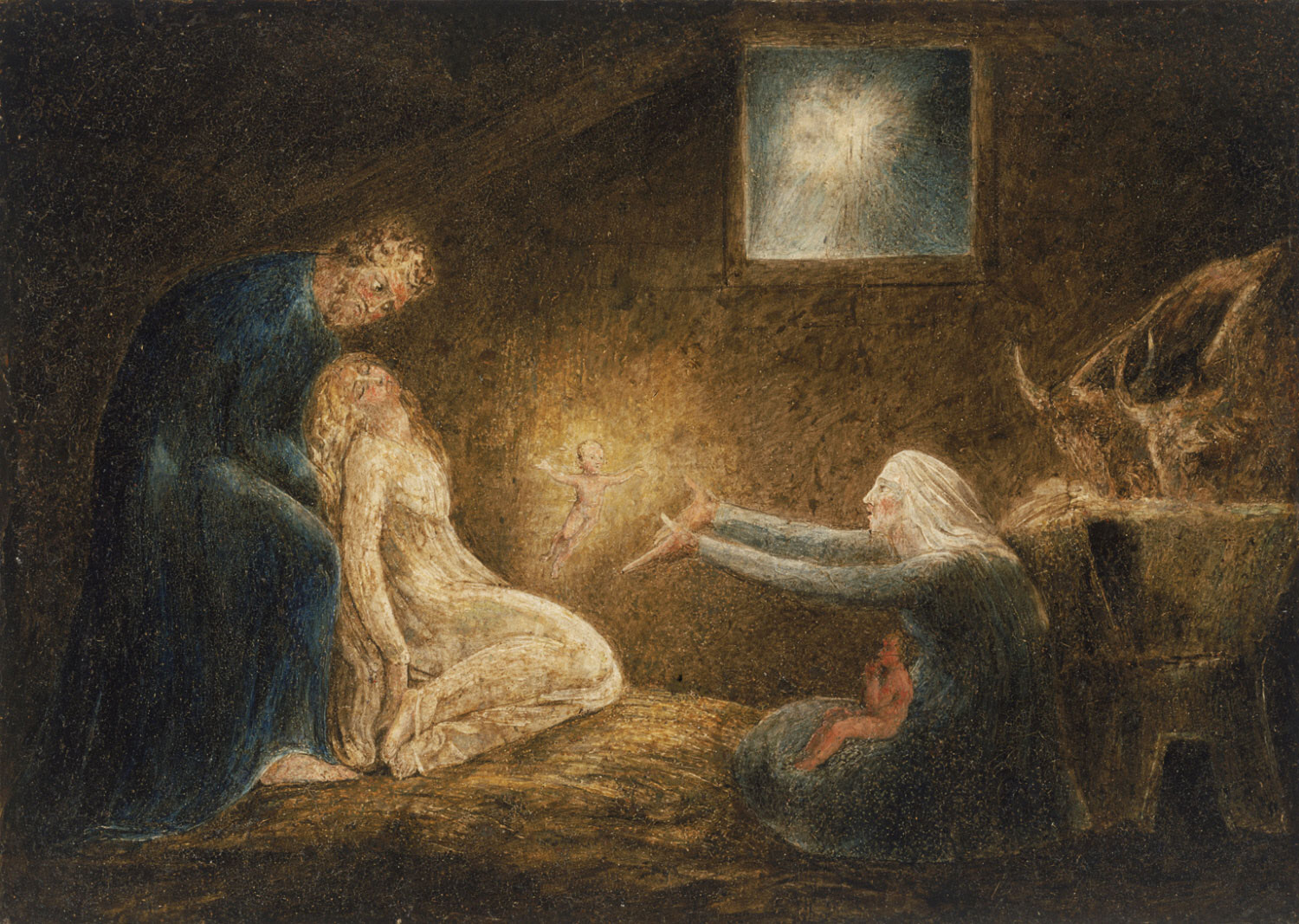
The Nativity (1799-1800), painted for Thomas Butts on a copper plate, is a unique interpretation of this very popular scene. On the left, Joseph supports the Virgin Mary, who appears to have fainted. Jesus has somehow sprung from her womb, and hovers arms outstretched in mid-air. On the right, Mary’s cousin Elizabeth greets the infant, with her own son, John the Baptist, on her lap.
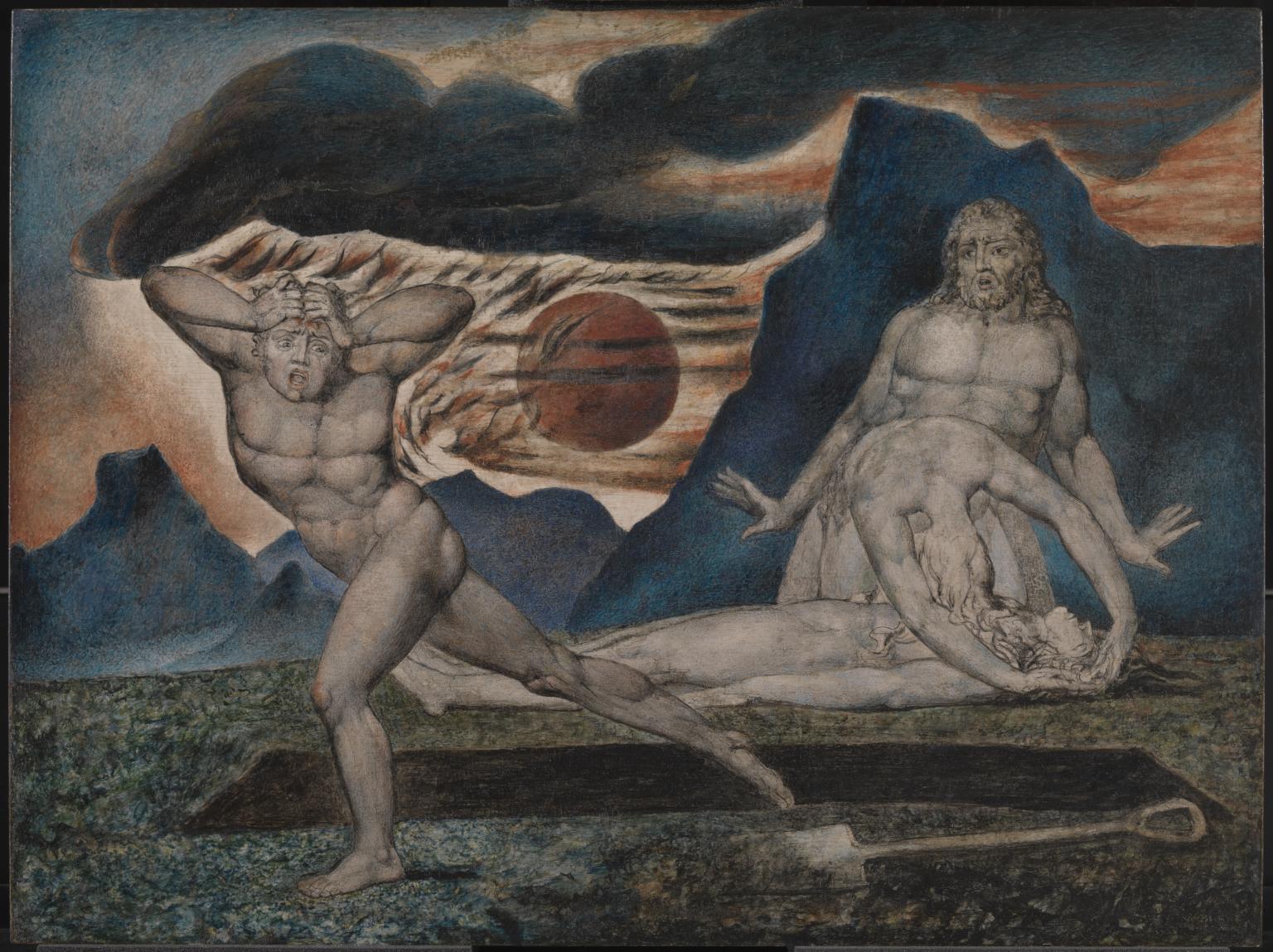
The Body of Abel Found by Adam and Eve (c 1826) was painted using thinner paint films, so has also survived much better. It’s a revised version of a watercolour that Blake had exhibited earlier, and shows Cain with the dead Abel, and his parents, Adam and Eve. The latter couple are shown behind, Eve mourning on Abel’s body, and Adam looking shocked at Cain, as he tries to flee the scene. He had been attempting to bury the body of his brother, after he had murdered him. This has a mahogany panel as its support.

One of his last glue tempera paintings, Count Ugolino and His Sons in Prison (c 1826) shows a complex episode from Dante’s Inferno Cantos 32 and 33, of a nobleman accused of treason. Thrown into prison for his alleged crime, Ugolino and his sons were starved to death. This is painted on a wooden panel.
Sadly many of Blake’s other glue tempera paintings have suffered badly, and some are now almost unreadable as a result.
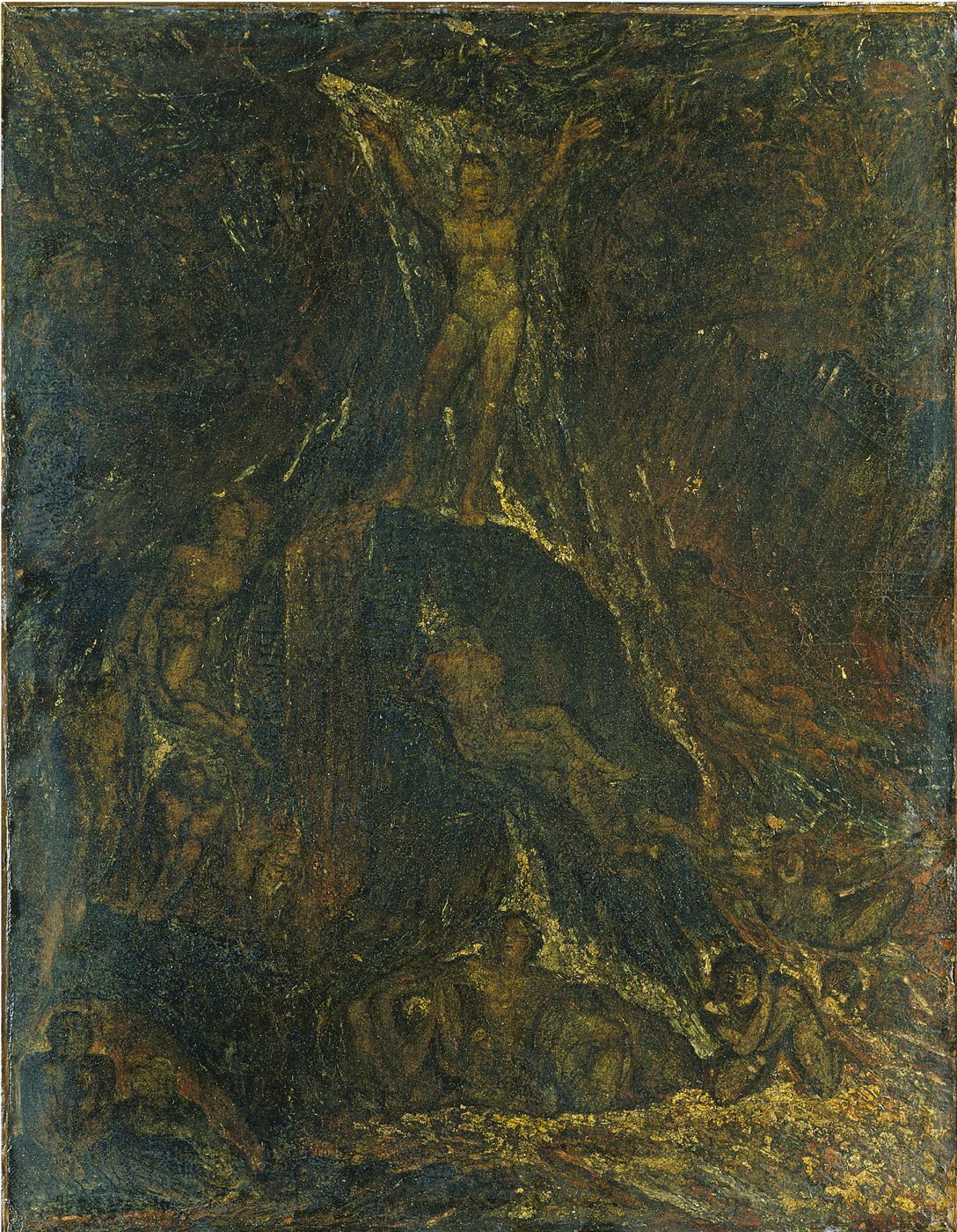
The version of Satan Calling Up His Legions (c 1809) now in the Tate in London is that dubbed by Blake “an experiment picture”, and has not aged at all well.
 The Eclectic Light Company