
The axe is one of the oldest hand tools used by humans, with stone axes dating back to the dawn of the species and those made from metal being prominent relics of the ancient past. Most consist of a heavy wedged blade mounted at the end of a wooden haft used to swing the blade to cleave wood, or wielded as a weapon. Hafts vary in length from short in compact hatchets to over two metres (six feet) in halberds used to attack cavalry.
Although uncommon in paintings, as in real life, an axe can’t be ignored.

Most more recent paintings of the sacrifice of Agamemnon’s daughter Iphigenia at the start of the war against Troy show the use of a ceremonial knife. A notable exception is Domenichino’s fresco in Viterbo, Italy, from about 1609, one of its earliest post-classical depictions. The princess kneels, her wrists bound together, as an axe is about to be swung at her neck. Onlookers at the left are distraught, as her father Agamemnon at the right watches impassively.

Much later in the history of classical Rome, an axe is seen being used to demolish the Sublicius bridge as it was defended by the Roman hero, in Horatius Cocles Defending Rome Against the Etruscans, painted by a follower of Giovanni Battista Tiepolo. This bridge is made to look quite flimsy and ad hoc, when in fact it was more substantial at the time.
In Roman times, axes became incorporated in symbols of authority, notably those borne by lictors, bodyguards and attendants to magistrates and all with imperial powers, including the emperor himself.

Henryk Siemiradzki’s Christian Dirce of 1897 is an account of the killing of a Christian woman in a re-enactment of the death of Dirce, in which a woman’s near-naked body is draped over the body of a bull. This shows the emperor and his entourage, including two lictors holding their fasces, symbolic rods and axes, gazing at the grim aftermath. The word Fascism is derived from those fasces, which are themselves often symbolic of Fascist groups.
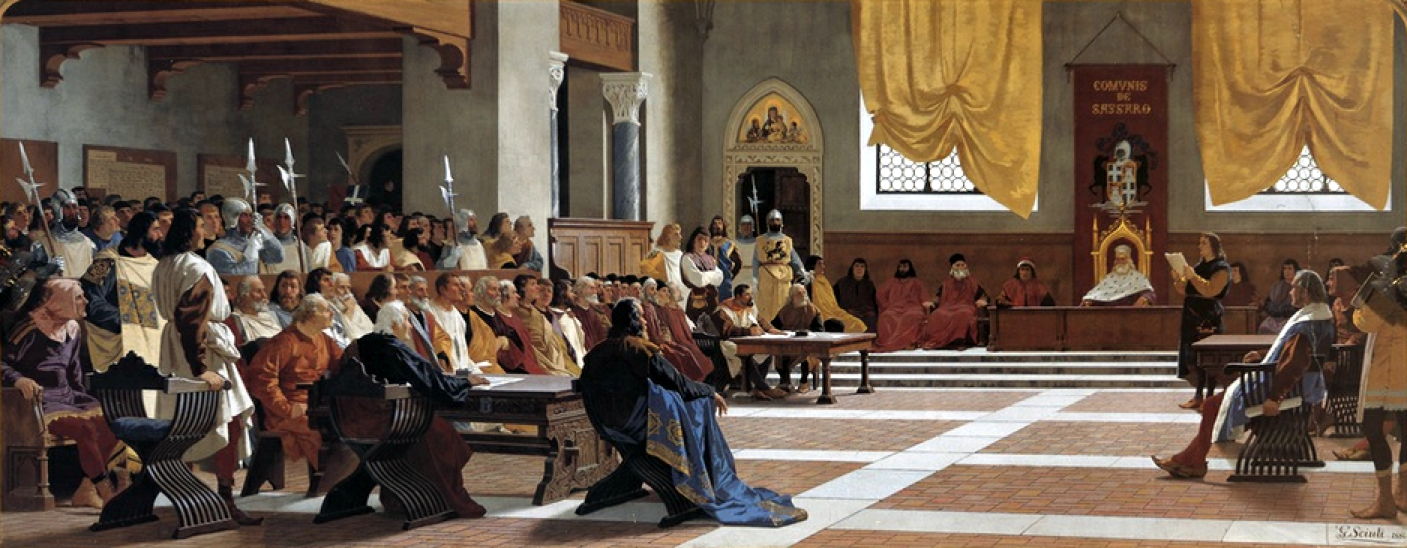
In 1284, the city of Sassari became the first and only independent city-state of Sardinia, joining more famous city-states such as Florence on the mainland. Proclamation of the Republic of Sassari (The Council of the Republic of Sassari) (1880) is Giuseppe Sciuti’s fresco in the Palazzo della Provincia, Sassari, showing his re-imagining of the moment of creation of that city-state, complete with knights in armour bearing long-hafted halberds.
One of the most unusual paintings of an axe being swung is Richard Dadd’s phantasmagoric Fairy Feller’s Master-Stroke, completed over the period 1855-64 during his stay in Bethlem psychiatric hospital.
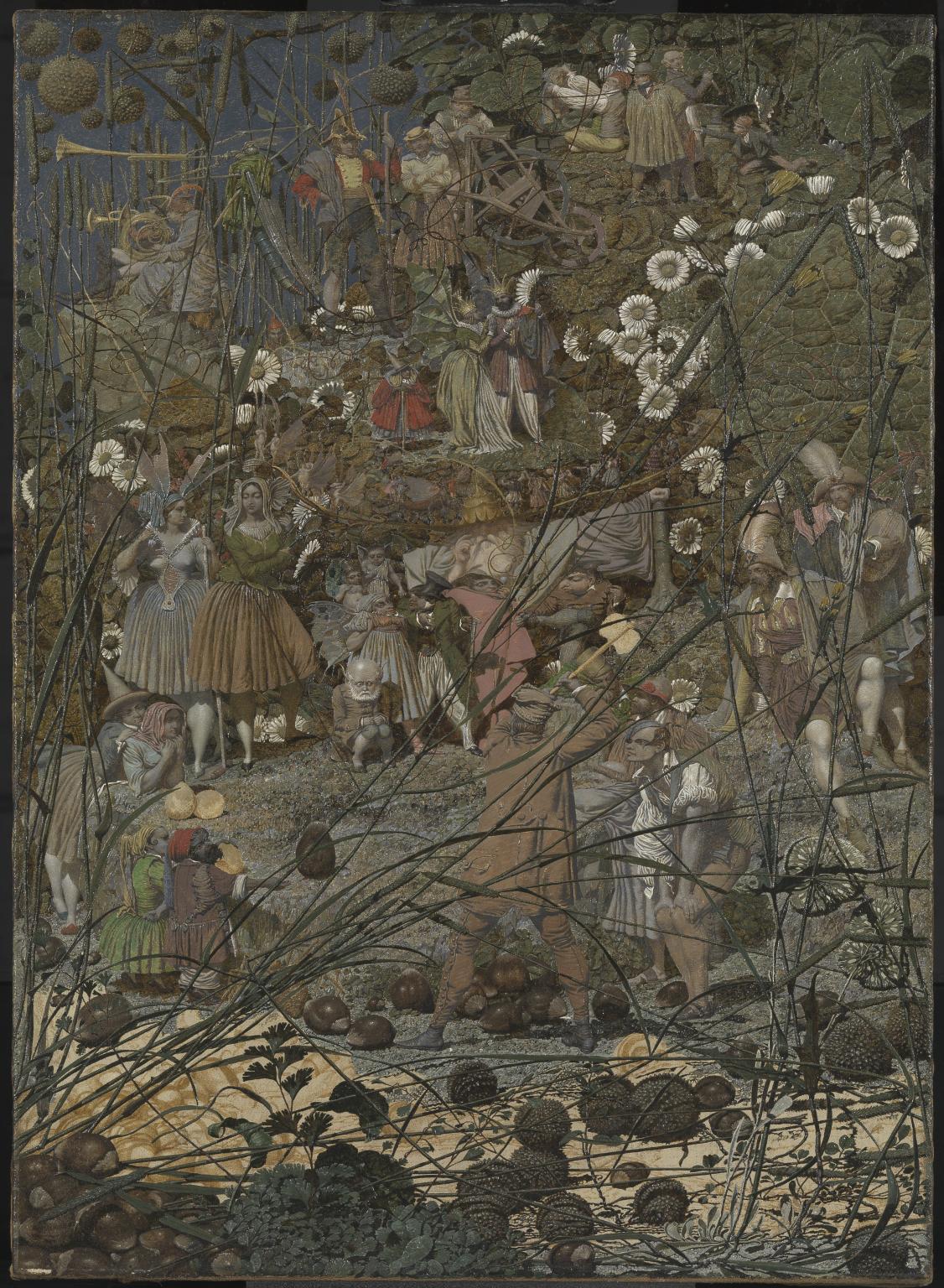
This has its origins in Shakespeare’s plays, with inspiration from Mercutio in Romeo and Juliet, and its main content drawn from A Midsummer Night’s Dream. We see Dadd’s scene through fine stalks of Timothy grass, the foreground with scattered hazelnuts and plane tree fruit. Although its perspective is flattened, the figures in the lower half of the painting are stood on a gently rising grassy sward, behind which is a steeper bank and stone walling (prominent at the right). Those in the upper third of the painting appear to be on another level, which rises more steeply towards the top edge.
The scene is set in the night-time, although daisy flowers are still unnaturally open, and there is night sky visible at the upper left. The feller himself, a hewer or fellow, seen at the centre (in the detail below), is about to cleave a hazelnut with his axe to provide a new carriage for Queen Mab (pronounced Maeve, to rhyme with rave), the queen of fairyland.


Lawrence Alma-Tadema’s The Education of the Children of Clovis (also known as The School of Vengeance, or The Training of Clotilde’s Sons) (1861) is a scene from Merovingian history, showing Saint Clotilde watching her young sons being taught the royal art of axe-throwing. It’s no wonder that later one of them was to murder two of her grandchildren.
Axe-throwing has recently been revived as a sport, although axes have a more sinister history in their use for executions.
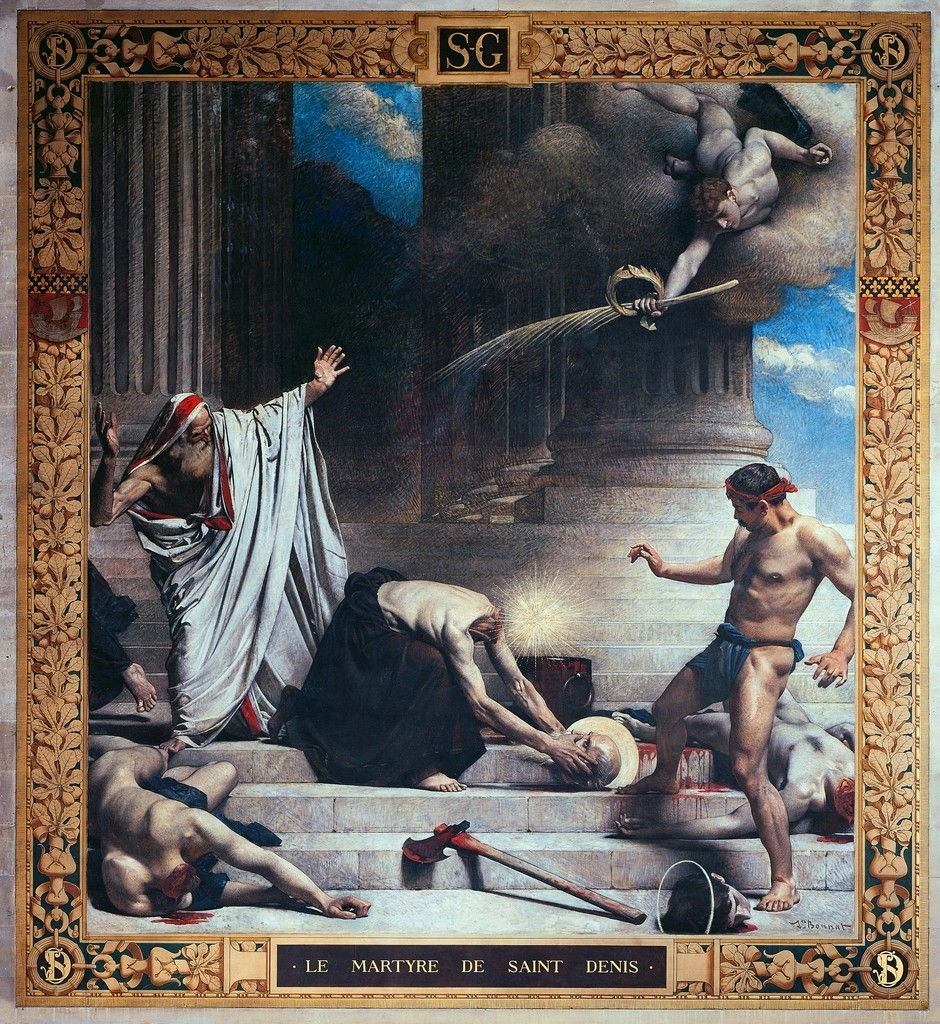
Léon Bonnat’s ornate showpiece in the Panthéon of The Martyrdom of Saint Denis (1874-88) tells this celebrated legend. Saint Denis, patron saint of Paris, was martyred by beheading on Montmartre hill at the edge of the city. It’s claimed that after his head had been cut off, Denis picked it up and walked around preaching a sermon. The legendary location became a place of veneration, then the Saint Denis Basilica, and the burial place for the kings of France.

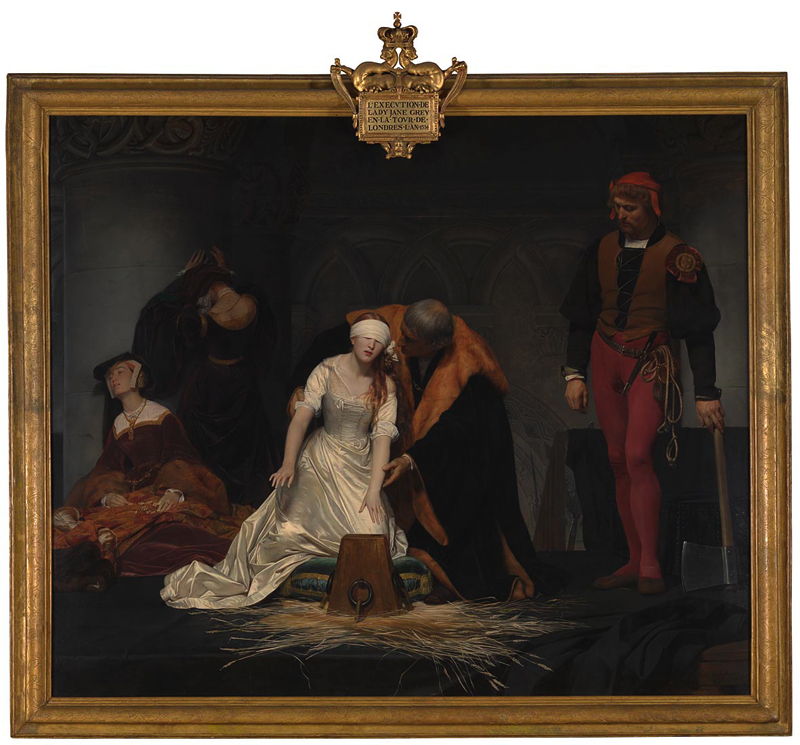
Paul Delaroche’s convincing painting of The Execution of Lady Jane Grey (1833) shows the fate of a contender for the crown of England following the early death of King Edward VI at the age of just 15 in 1553. As he had no natural successor, he had drawn up a plan for a cousin, Lady Jane Grey, to become Queen. Her rule started on 10 July 1553, but King Edward’s half sister Mary deposed her on 19 July. She was committed to the Tower of London, convicted of high treason in November 1553, and executed on Tower Green by beheading on 12 February 1554 at the age of just 16 (or 17).
Lady Jane Grey and the Lieutenant of the Tower, Sir John Bridges, take the centre of the canvas. She is blindfolded, the rest of her face almost expressionless. As she can no longer see, the Lieutenant is guiding her towards the executioner’s block, in front of her. Her arms are outstretched, hands with fingers spread in their quest for the block. Under the block, straw has been placed to take up her blood.
At the right, the executioner stands high and coldly detached, his left hand holding the haft of the axe he will shortly use to kill the young woman. Coils of rope hang from his waist, ready to tie his victim down if necessary. At the left, two of Lady Jane Grey’s attendants or family are resigned in their grief.
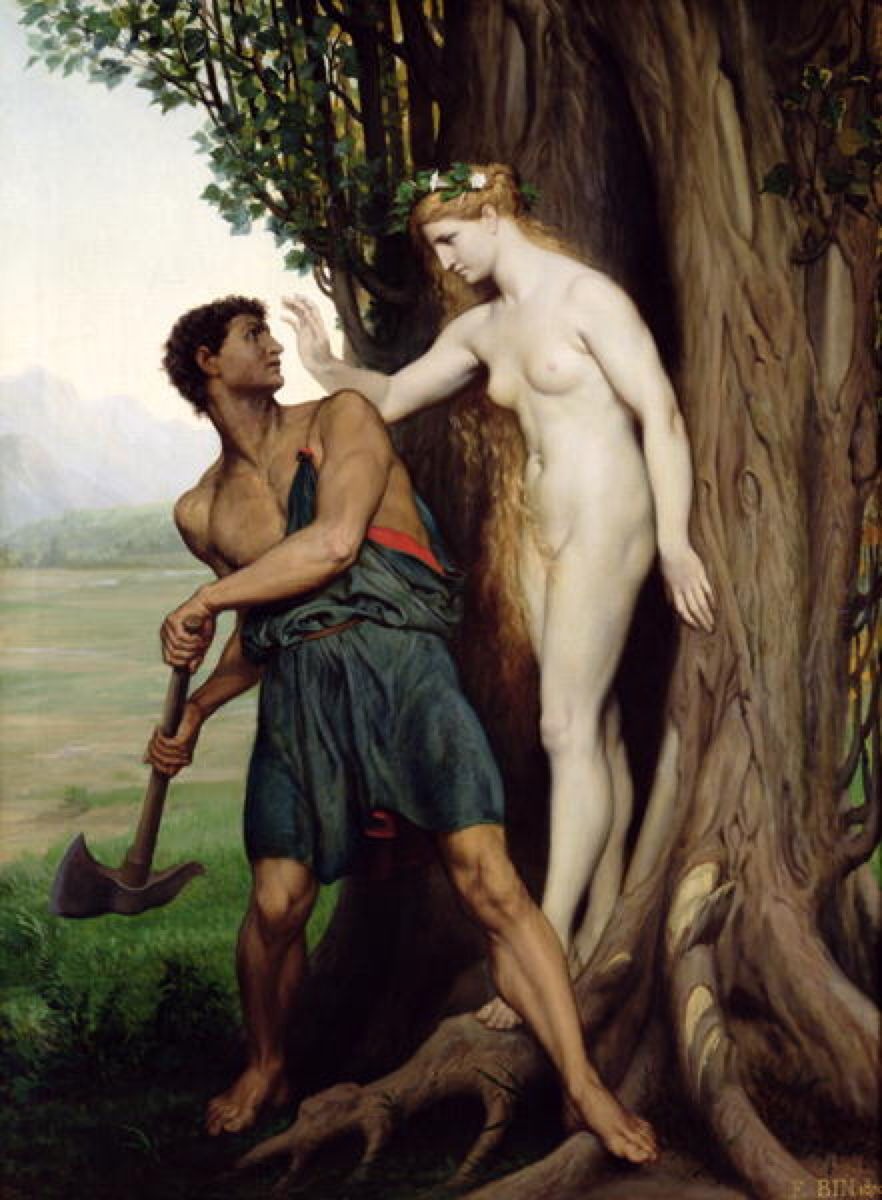
Axes are sometimes shown in their primary role for felling trees, as seen in Émile Bin’s The Hamadryad from 1870, shown in yesterday’s article.

They also make an occasional appearance as a commonplace tool of those who live in wilder surroundings. François-Auguste Biard’s sketchy view In a Mountain Hut may have been made in front of the motif. This has a strong vein of social realism, showing the abject poverty and spartan conditions of many who lived in the more remote areas of France, with an axe beside a well-worn besom in the left foreground.
 The Eclectic Light Company