

Many notable painters have also made their own prints, and the two arts have informed one another. We’ve seen this most recently in the paintings of Félix Vallotton, where his late works have become simplified in the way that’s often used when making successful prints. A few artists have gone one step further and produced images that combine both techniques, where their work consists of a painted print.
Most forms of printmaking involve the production of a plate of metal or wood in which cuts or marks are made. The surface is then covered in printing ink, and the paper (or other medium) is then pressed against that to transfer patterns of ink onto it. Monotypes are different in that the plate remains intact, and the image to be printed is formed on its surface before making a single impression from it. As with most types of printmaking, there are many variations.
In 1794, William Blake had perfected his colour illuminated printing process, in publishing a series of illuminated books, and the following year he used it to produce a limited run of twelve large colour paintings. These formed the first major collection of paintings he offered for sale: one mark of the importance that he accorded them was his use of the term fresco to describe their medium.
In fact, they weren’t made using a technique that resembled fresco painting at all. Although there remains some debate as to exactly what he did, the process was probably:
- Develop the work using sketches, etc., until a design was ready to print. In some cases, these large prints were derived from earlier work, in others he made fresh sketches.
- Draw the finished work onto a sheet of thick millboard, ready to colour.
- Produce a wet watercolour, using pigment, binder, and a honey additive, on the millboard.
- Print approximately three copies from the millboard ‘plate’.
- Touch up each print by hand using pen and ink and watercolour to produce the finished painting.
Although it’s possible he may have used oil-based inks or paints on some, Blake’s lifelong aversion to the use of oil paints suggests that he used water-based media throughout, and analyses support that. These ‘large prints’ (also known as his Lambeth Prints, as that is where they were made) are therefore watercolour monotypes then individually retouched and painted further. Given the variation between the different ‘pulls’ or impressions made of each, they are less prints and more print-based paintings.
Neither were they illustrations in the way that the images within his illuminated books may be. They were supplied as individual sheets for mounting and framing as paintings. We don’t know whether Blake intended them to be viewed in pairs, groups, or as a complete set of twelve, and there’s uncertainty as to his own title for several. Indeed, some of them appear to have been mistitled following Blake’s death, and that has led to confusion as to what they actually depict.

Satan Exulting over Eve (c 1795) is thought to be the first impression of this work, with roots in the story of the Fall in Genesis, and in Milton’s Paradise Lost. In book 5 (lines 28-92), Milton writes a more detailed account of the Fall, in which Eve has a dream of Satan giving her the fateful apple, sweeping her up into the cloud before she sinks down and falls asleep. Blake shows Satan flying low over the sleeping body of Eve; he carries a shield and spear. The serpent has already coiled itself around Eve’s legs and body, and there is an apple by her right hand.

Newton (1795–c 1805), another first impression, is one of Blake’s most famous images. It shows the brilliant mathematician and physicist completely absorbed in a geometrical problem, oblivious to the wondrous rock on which he sits. Its standard interpretation is that Newton’s scientific rationalism was inadequate without imagination and the creativity of the artist, a surprisingly negative view of the man who is still considered a towering genius.

The Night of Enitharmon’s Joy (c 1795) has proved the most enigmatic of all the dozen paintings to read. For a long time, it was believed to show Hecate, as proposed by Dante Gabriel Rossetti. It’s more likely that the woman seen at the front of the figures is from Blake’s own mythology, Enitharmon: partner, twin, and inspiration to Los (and mother of Orc). She represents spiritual beauty, and was modelled on Blake’s wife, Catherine (who may have been the model for her figure here too). In her ‘night of joy’, she establishes her Woman’s World, with a false religion of chastity and vengeance – which was Blake’s view of the 1800 year history of the ‘official’ Christian church.

Blake’s Christ Appearing to His Disciples/Apostles After the Resurrection refers to the gospel of Luke, chapter 24 verses 36-40:
And as they thus spake, Jesus himself stood in the midst of them, and saith unto them, “Peace be unto you.” But they were terrified and affrighted, and supposed that they had seen a spirit. And he said unto them, “Why are ye troubled? and why do thoughts arise in your hearts? Behold my hands and my feet, that it is I myself: handle me, and see; for a spirit hath not flesh and bones, as ye see me have.” And when he had thus spoken, he shewed them his hands and his feet.
Edgar Degas’ monotypes are thought to have been more conventional, made on a lightweight aluminium sheet using oil-based printing ink, then extensively retouched and painted, often using soft pastels.

During the late 1870s, Degas devoted series of monotypes to women’s ‘toilet’ preparations, of which Intimacy from about 1877 is an example. He appears to have been fascinated at the craft and care used to prepare a woman for public viewing, something a single man who had no known amorous relationships would find quite strange. This print appears to have undergone retouching and modification, but hasn’t been painted using pigment or colours.

The same year Degas applied soft pastel to the print, in the Ballet at the Paris Opéra (1877), which more closely resembles a true painting.

Also dating from 1876-77 is his Woman Drying Herself after the Bath, one his first works showing a woman bathing. It’s also one of the few in this series setting the woman in a broader context, here a plain and simple bedroom with a single bed. The woman, wearing only bright red ‘mule’ slippers, stands just behind the shallow metal tub, watching herself in the mirror of her dressing table, as she dries her body with a towel. On its shelf is a small range of cosmetics, with the mandatory mirror behind. This too is the result of applying pastels to a monotype.
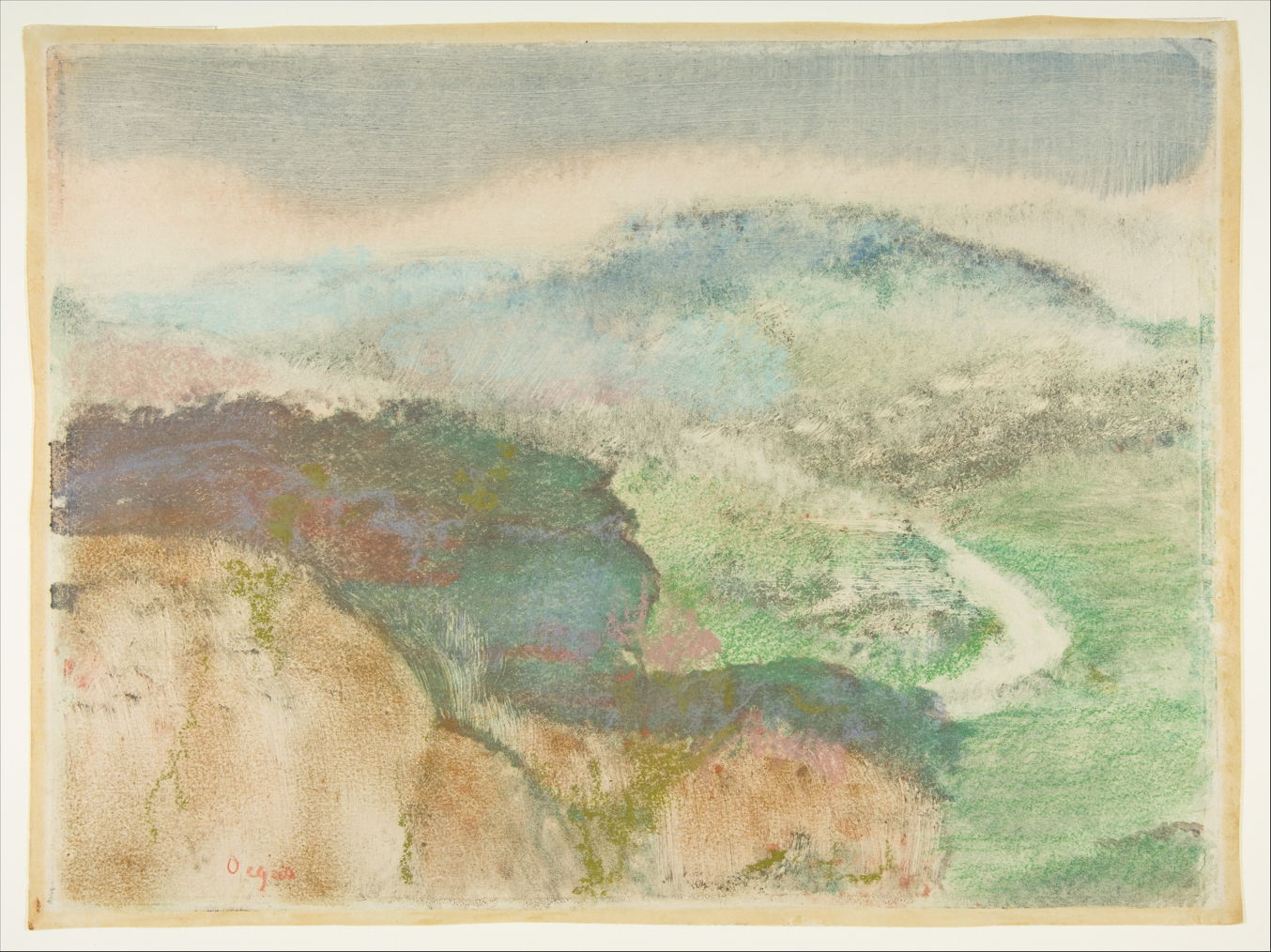
Degas’ late landscapes are based on the same combination of media, as shown in his Landscape above, and Wheat Field and Green Hill below, both from the early 1890s.

The American Impressionist Mary Cassatt learned her printmaking techniques with Degas, so it’s not surprising to see some of her monotypes forming the basis of paintings.
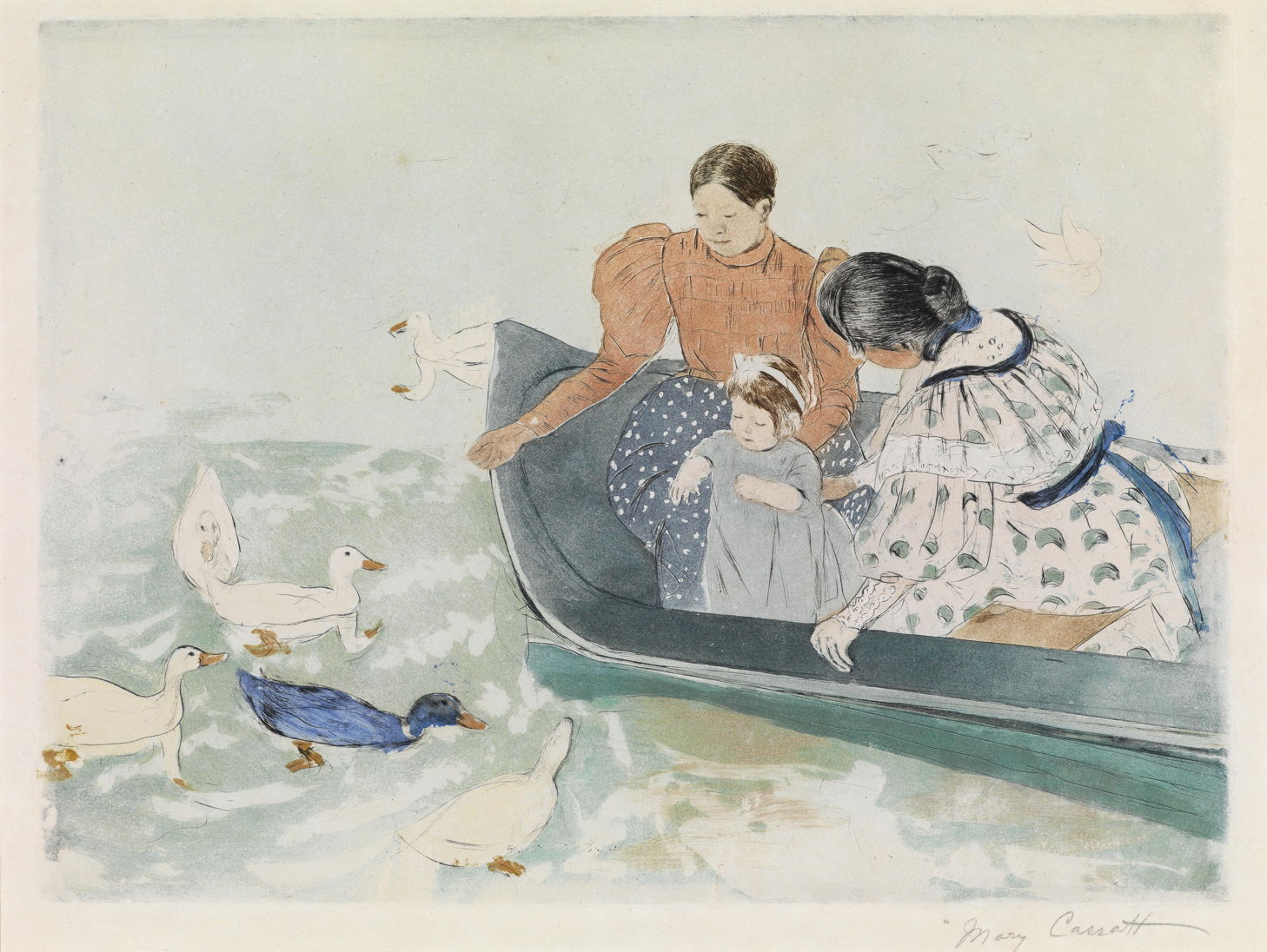
For her Feeding the Ducks from about 1894 she combined a mature use of drypoint with aquatint, to which she added monotype using oil-based inks. In drypoint, the plate is scratched to form lines with the raised burrs that result. This was most probably produced by applying a fine acid-resistant powder such as rosin to form the ‘ground’, etching it in acid, then applying drypoint lines before printing using oil-based ink.
These techniques were developed further and became more popular in the twentieth century, in the work of artists such as Marc Chagall from the 1960s.
 The Eclectic Light Company