
Sculptors and painters are kindred spirits. Although their tools and skills differ, they are all visual artists, and many have mastered both means of expressing their art. In today’s selection of paintings I include depictions of sculptors at work, rather than those merely showing the fruit of their labour in the form of sculpture.
The best-known sculptor in classical mythology is Pygmalion, whose quest for the perfect woman was only satisfied by the statue he made of her.

The Hand Refrainsis one of Edward Burne-Jones’s series telling this myth. Pygmalion stands back, his tools still in his hands and scattered at the foot of his work. Too scared to touch the statue now, he looks longingly at it, as if falling in love, which he did when it came to life.

Jean-Léon Gérôme’s study for Pygmalion and Galatea from 1890 was an early attempt at its composition, where the sculptor’s future bride is still a marble statue at her feet, but very much flesh and blood from the waist up. That visual device was perfect, but Gérôme recognised his painting could be shunned because of its full-frontal nudity, so reversed the view.

His finished Pygmalion and Galatea (c 1890) extends the marble effect a little higher, and by showing Galatea’s buttocks and back and concealing the kiss, it stays on the right side of contemporary standards of decency. His attention to detail is delightful, with two masks against the wall at the right, Cupid ready with his bow and arrow, an Aegis bearing the head of Medusa, and a couple of statues about looking and seeing. For Gérôme recognised other stories about sculpture and seeing that could be brought in to enrich Ovid’s original narrative.

Lawrence Alma-Tadema imagined ancient Greeks admiring this painted frieze as it neared completion in his beautiful painting of its sculptor Phidias Showing the Frieze of the Parthenon to his Friends (1868). The admiring figures include Pericles (at the right), Aspasia, Alcibiades and Socrates.

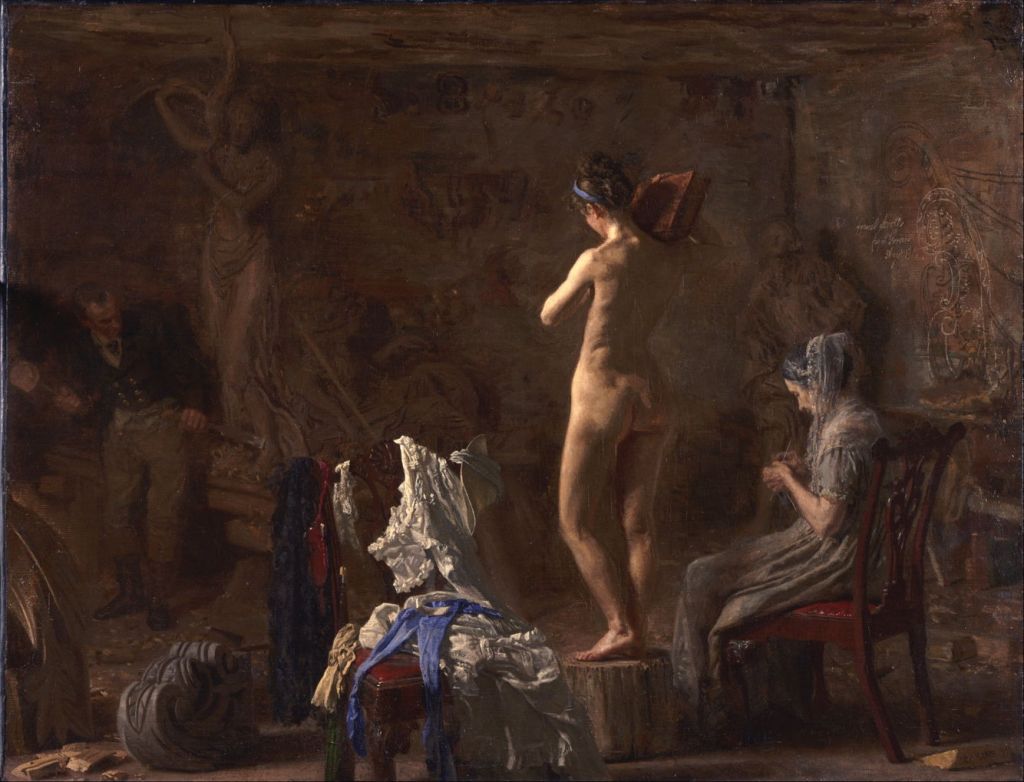
William Rush Carving His Allegorical Figure of the Schuylkill River (1876-77) is the first of three paintings by Thomas Eakins showing William Rush, a wood sculptor, carving his Water Nymph and Bittern for a fountain in Philadelphia’s waterworks, in 1808. The water nymph is an allegory of the Schuylkill River, the city’s primary source of water at that time.
Rush had been a founder of the Pennsylvania Academy of the Fine Arts, and an enthusiast for the use of nude models in art, as was Eakins. This painting was therefore, at least in part, an attempt to promote Rush’s name, and the practice of working from nude models. Rush prepared thoroughly, as usual, in carving wax studies, and making a series of drawings and oil sketches.
Seated at the right of the model is a chaperone, more interested in her knitting. The model’s complicated clothing is hung and scattered in the light, as if to emphasise her total nudity (apart from a hair-band!), and the sculptor is working in the gloom at the left. Eakins anachronistically included several later works by Rush, as if to provide a resumé of his output. Unfortunately, the scattered garments didn’t go down well, and were deemed scandalous at the time.

Gérôme’s relatively small and simple painting of Michelangelo from 1849 shows Michelangelo in his dotage, hunched over and blind, being led by a young boy whose dress would have aroused his master’s homoerotic desires. The broken sculpture is the Belvedere Torso, a huge fragment of marble statuary so loved by the sculptor that it was nicknamed the School of Michelangelo. The young boy is leading his master’s hands to stroke and caress the marble, now that he was unable to enjoy looking at its classical and very male form.
This is perhaps the first step in his developing theme of sight, and the role of vision in establishing truth. In his blindness, Michelangelo can only feel what we can see, and cannot see the figure of the young boy. This is particularly appropriate to Gérôme, who later in his career became a successful sculptor himself, and whose later paintings referred to his sculptures and the act of creating them.

The End of the Pose (1886) is the first of Gérôme’s series of unusual compound paintings, at the same time self-portraits of the artist as a sculptor, studies in the relationship between a model and their sculpted double, and forays into issues of what is seen, visual revelation, and truth. Here, while Gérôme cleans up, his model is seen covering up her sculpted double with sheets, as she remains naked. Apart from various diversionary entertainments, including a couple of stuffed birds and a model boat, there is a single red rose on the wooden platform on which the model and statue stand. Presumably this is a symbol of thanks from the artist to his model.

In The Artist’s Model (1895), Gérôme paints himself at work on his marble figure of Tanagra (1890), currently in the Musée d’Orsay, already included among the figurines in his painting Sculpturae Vitam Insufflat Pictura. He thus painted himself making a sculpture that he had previously painted in a painting as a sculpture. Not only that, but his model is his favourite Emma Dupont, who over a period of twenty years posed for many of his best-known Orientalist and other works.
Scattered in the image are reminders of gladiatorial armour and other props used for his paintings, one of his paintings of Pygmalion and Galatea, together with one of his polychrome sculptures of a woman with a hoop, at the right edge. In this single image, Gérôme has captured much of his professional career.

This wonderful Portrait of the Sculptor Nikolaus Friedrich (1912) at work wasn’t the first to be painted by Lovis Corinth, who had made a previous portrait in 1904, when the sculptor was young and muscular. Eight years later he’s seen in the midst of a broad and representative range of his work. Friedrich died two years later, when he was only 48.
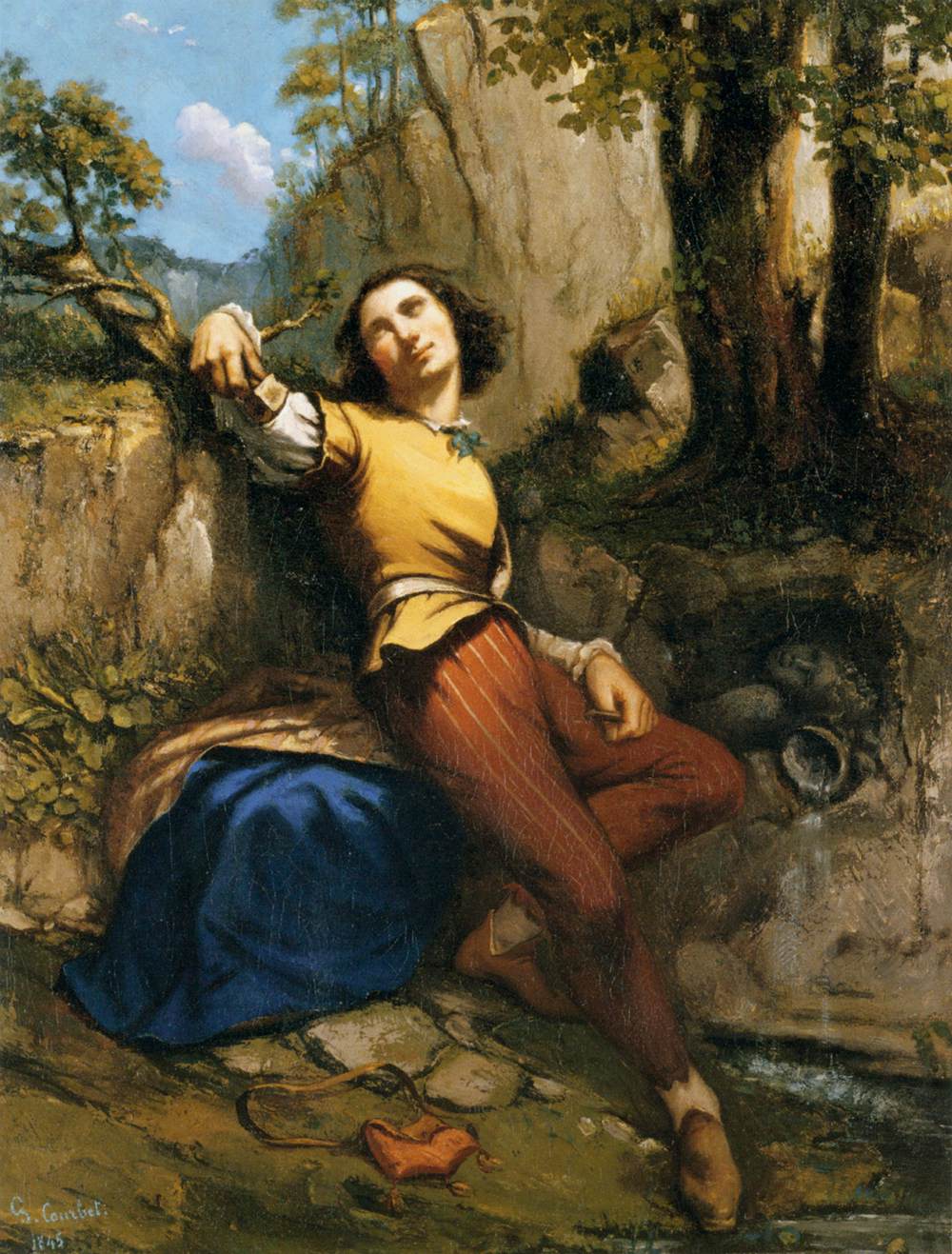
Early in his career, Gustave Courbet planted a gaudily-dressed figure at the foot of some cliffs near his home town of Ornans, put a small mallet in his right hand and a chisel in the other, and painted The Sculptor (1845). The subject of this sculptor’s inattention is the emerging form of a woman in the rock just above his left knee, over a small pipe from which water is pouring into the stream.

Antoine Watteau’s tondo of The Monkey Sculptor from about 1710 is a singerie set in the sculptor’s studio, as if to say that even a monkey can be a good sculptor.
 The Eclectic Light Company