

Carlos Schwabe (1866–1926) died a century ago, on 22 January 1926, and this is the first of two articles to mark his death with a brief account of his career and art. Like others strongly associated with Symbolism at the end of the nineteenth and early twentieth centuries, his paintings have largely been forgotten in the enthusiasm for Post-Impressionism that swept Europe and North America in the following decades.
Schwabe was born in Altona, Germany, now absorbed into the western part of the city of Hamburg, but moved with his family to Geneva in Switzerland, where he studied art at the academy. When he completed that training, he moved to Paris and designed wallpaper. He seems to have continued to work in decorative art for much of his career, adopting an Art Nouveau style, and became a leading book illustrator.
One of his first major sets of illustrations accompanied an edition of Émile Zola’s Le Rêve (The Dream), the sixteenth in his Rougon-Macquart cycle, first published in book form in 1888. I suspect the first two paintings of his shown below are from that set. Zola was a Naturalist, and the Symbolists of the day expressed strong opposition to his Naturalist art; this makes Schwabe’s illustrations of particular interest.

His watercolour of Day of Death from 1890-92, sets a trend in his paintings for overlaying decorative elements on his figures, here a curtain of long tendrils dissecting the dark figure standing behind. Various mystical symbols include a triangle set in light rays at the top, and the artist signs his name as an inscription on a stone plinth at the lower left.

Evening Bells, a watercolour from 1891, may also have been destined for this set of illustrations. It’s an unusual composite of three views: dominating the right and lower areas is a view of a bell-tower, with a rhythmic series of angels emerging from one of the windows and flying downwards. At the lower left is an aerial view of a contemporary French town, and at the upper left a coastal view with water lapping on a flat shore.
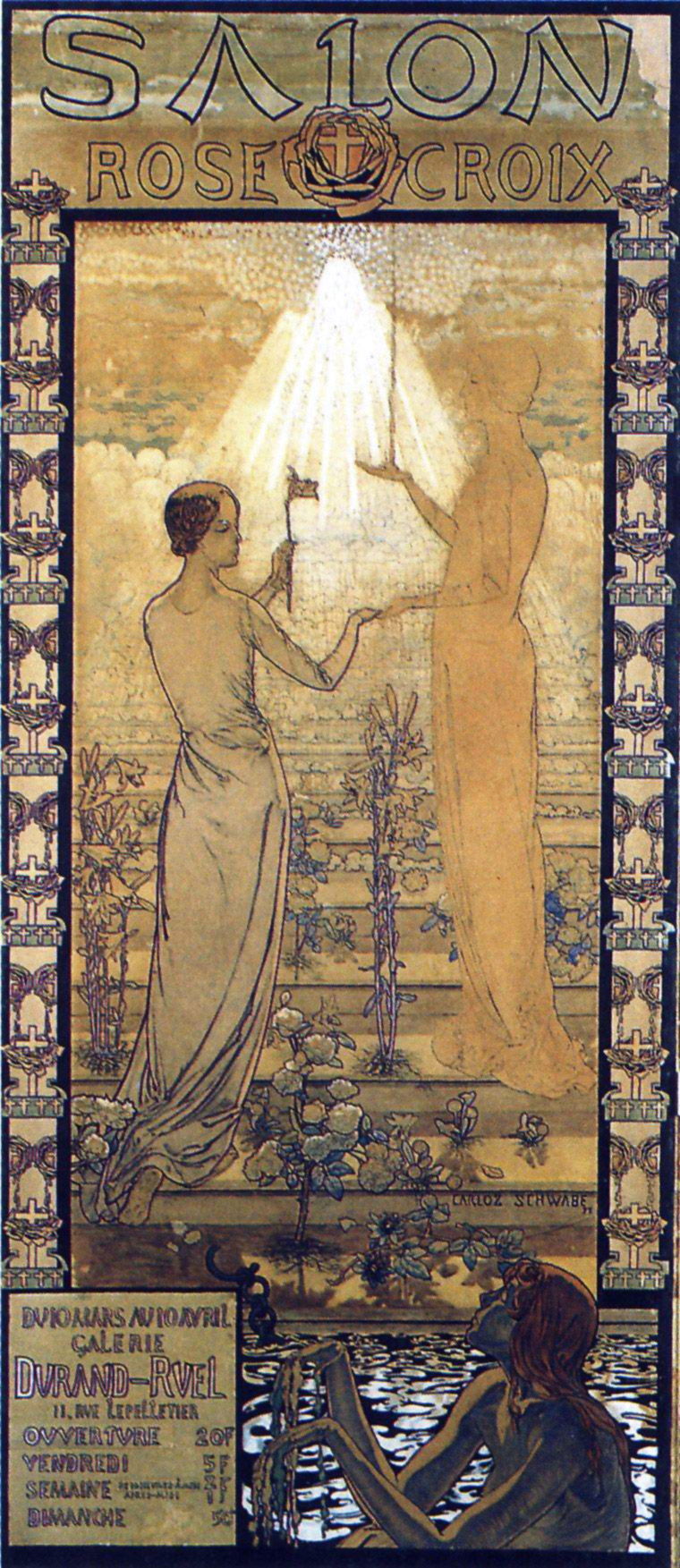
By the time that Schwabe made this famous design for a poster for the Salon de la Rose+Croix in 1892, he had moved away from any early Naturalism and was an active member of the Rosicrucian and Symbolist group founded by Joséphin Péladan, the avant garde of Symbolist art. Schwabe had probably been introduced to its ranks as a result of his friendship with other members of the movement including the composer Vincent d’Indy. This was the first of a total of six of these Salons, led regally by Péladan, a controversial figure who wanted to revive a mediaeval secret society, the Rosicrucians, and named himself its new high priest, employing the suspicious title of Sâr.
Although supported by the Durand-Ruel Gallery, Péladan’s invitations to selected artists weren’t well received, and their Salon of 1897 proved to be the last.
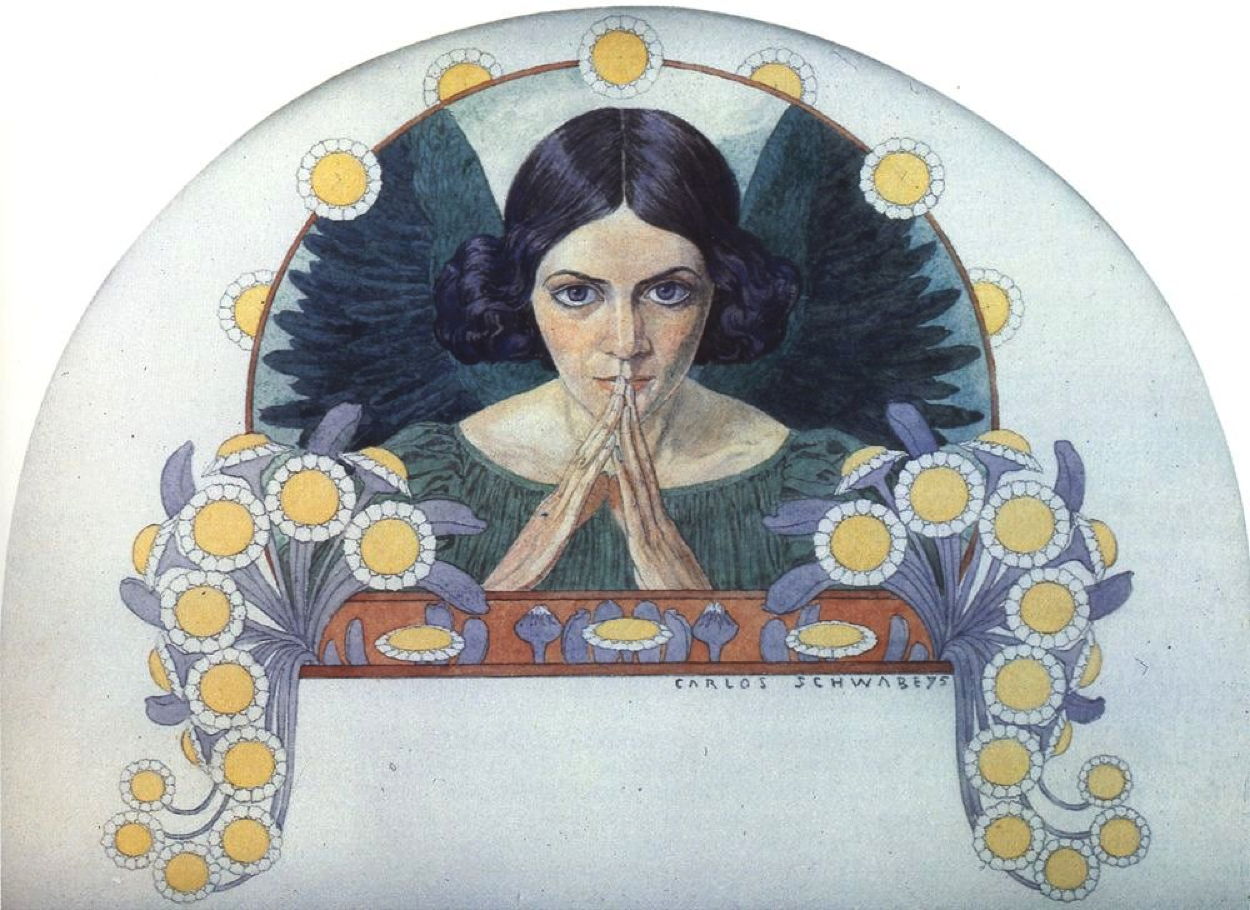
This painting of an Angel of Hope from 1895 also appears to have been intended for use in print. As with many of Schwabe’s angelic figures, it is unmistakably female and has black wings.

His watercolour tondo portrait of Medusa from the same year has startlingly feline eyes and that characteristic wide-mouthed look of utter horror. This is unusual for being one of the few close portraits of Medusa before her beheading by Perseus.
Around 1895, Schwabe started work on a set of colour illustrations for a new edition of Charles Baudelaire’s notorious poems Les Fleurs du Mal (Flowers of Evil), to be published in 1900. These had first been published in 1857, but their author and publisher were prosecuted for offending public decency and six poems were removed, and weren’t restored in full until 1949. Themes range through decadence and sex, with explicit references to practices that the affluent of the day considered should be kept in the brothels they frequented, for instance. These poems became a touchstone for more ‘progressive’ movements in art, including Symbolism.
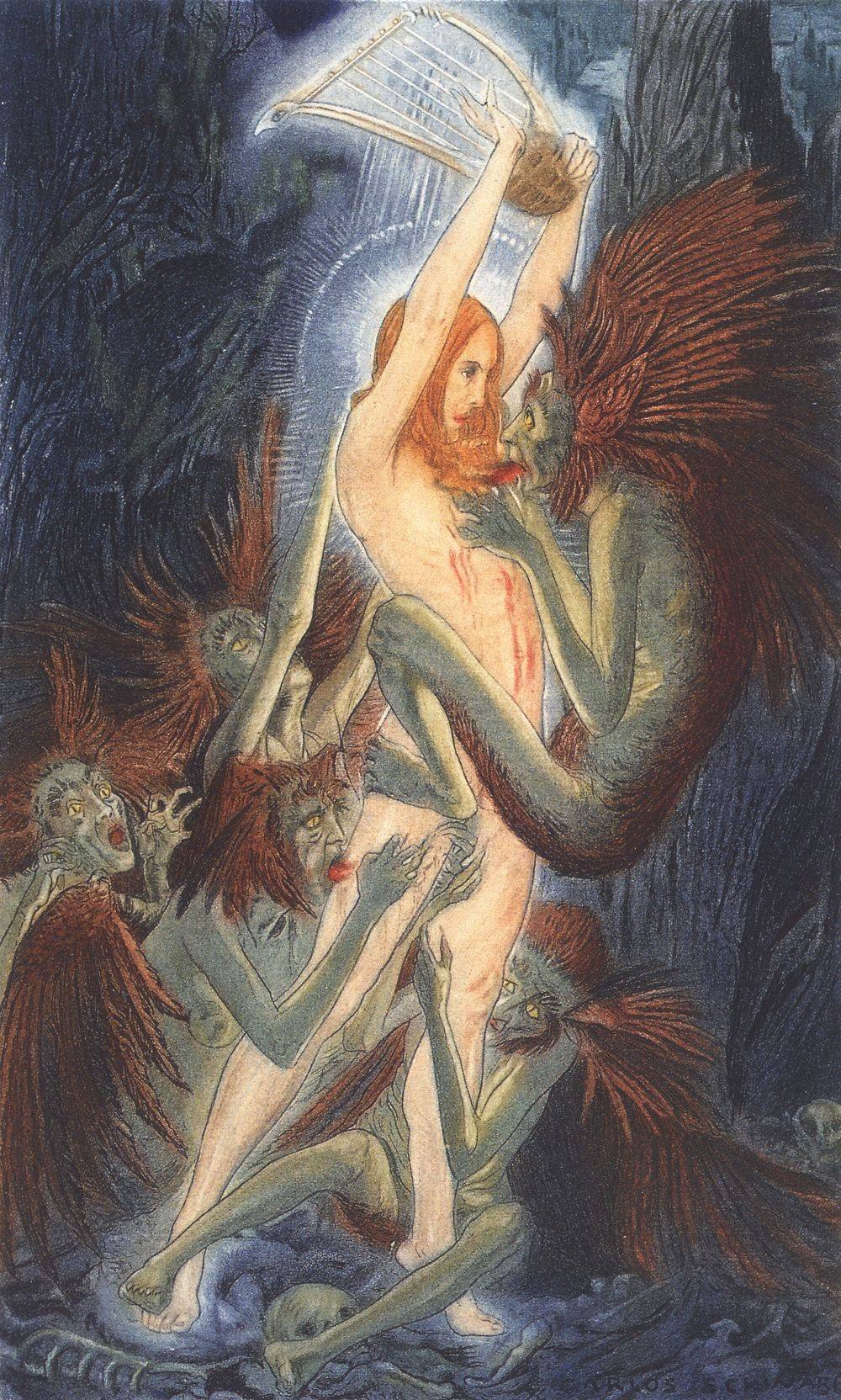
Benediction accompanies the poem of that name, whose text is available in the original French and English translations here. A haggard devil is extracting the heart from a beautiful young woman, while apparently copulating with her. She is identified as a poet by the lyre she wields above her head. Other devils are trying to lick and suck parts of her legs.

This painting is titled Crépuscule in the original, which is here more likely to refer to Dawn rather than dusk, as it seems a better fit with the text. This giant female figure of “dawn, shivering in her green and rose garment, was moving slowly along the deserted Seine”. Hanging from each hand is a column of the citizens she is awakening.
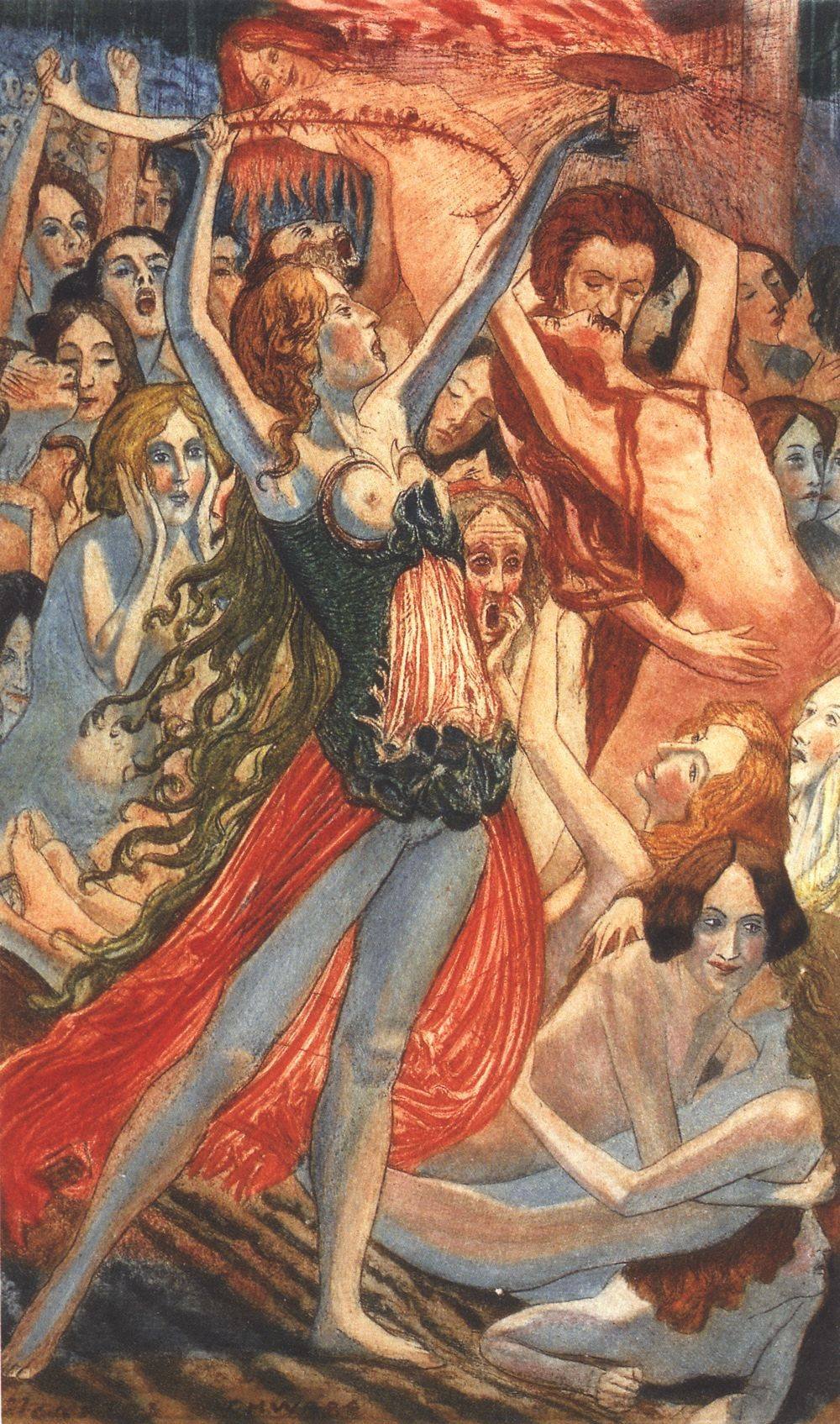
Doomed or Damned Women most probably refers to the shorter post-censor version of the text. This celebrates lesbian practices including flagellation.
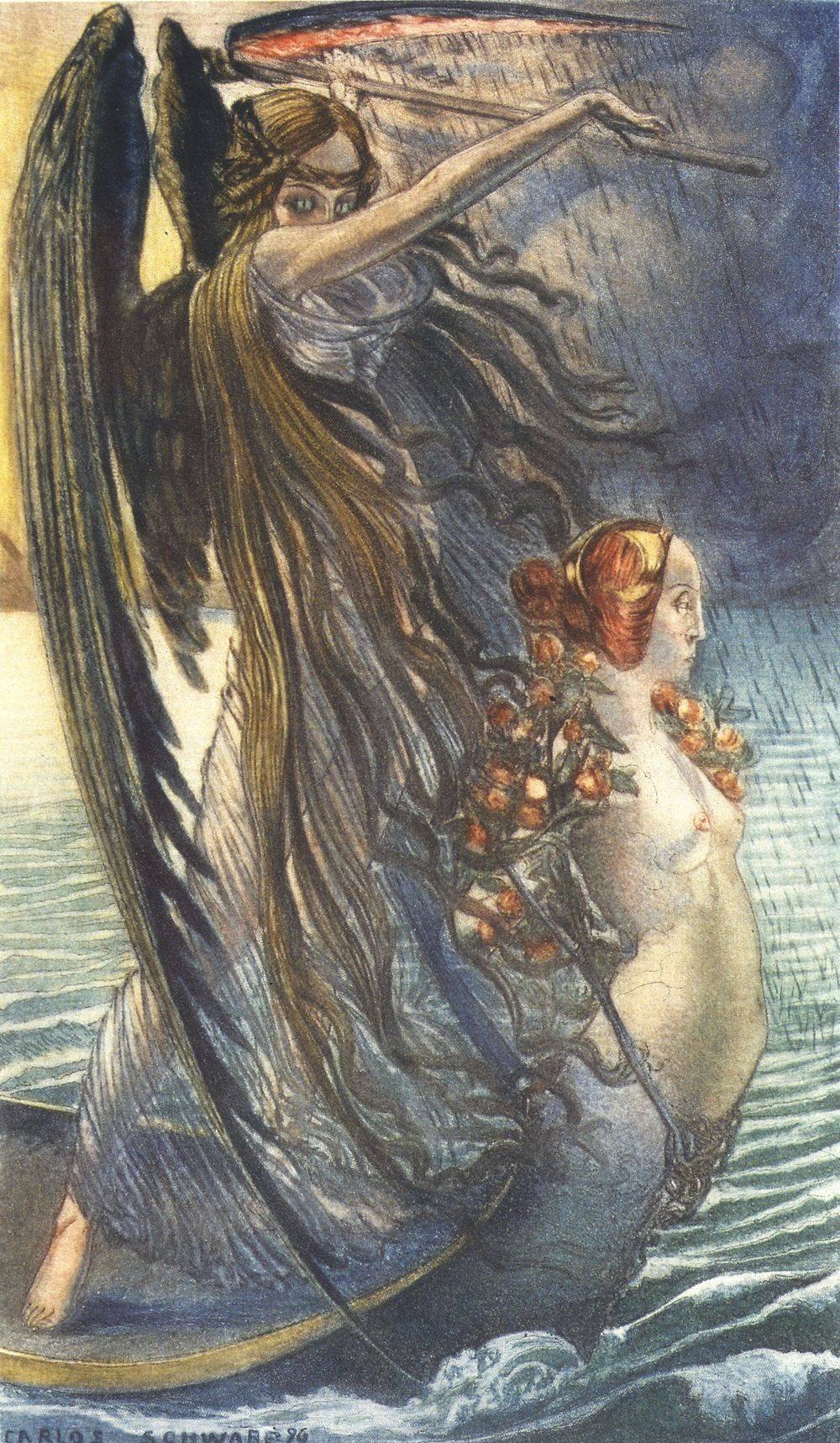
Death, dated 1896, was probably intended as the frontispiece for the final group of poems. It shows a vengeful female version of the Grim Reaper figure well known through the history of modern painting, with feline eyes. She swings her scythe high above her head as she stands at the prow of a boat with an elaborate figurehead adorned with red roses.
 The Eclectic Light Company