
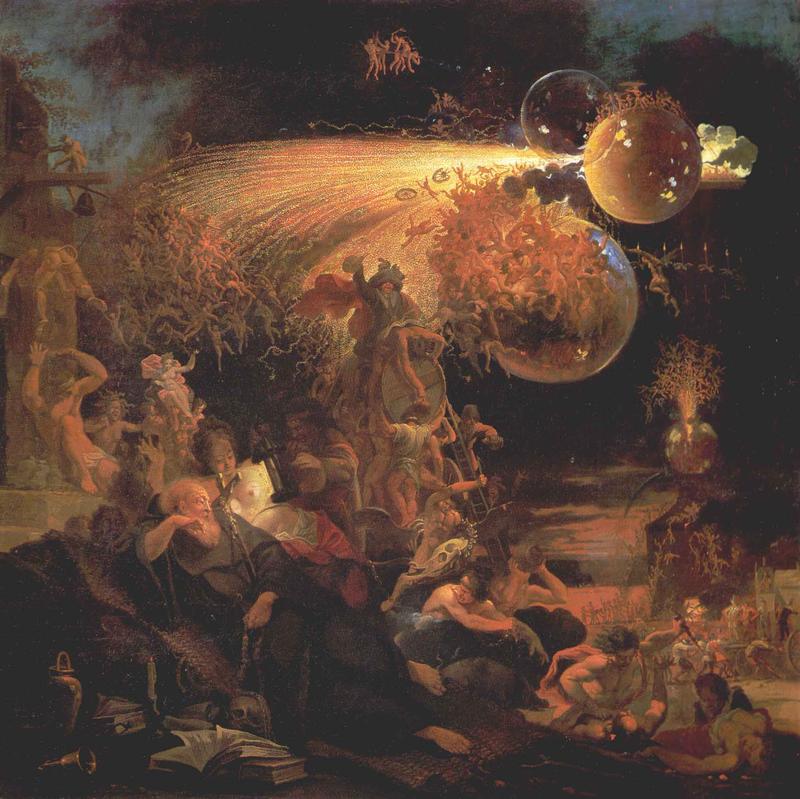
It must be challenging to make a reputation for your art when there are thousands of others trying to do the same. Among those who rose to that challenge during the Dutch Golden Age was Domenicus (or Dominicus) van Wijnen (1661-1698), whose themes were unique, two centuries ahead of their time.
Very little is now known about van Wijnen. He was born in Amsterdam, was in training with Willem Doudijns in The Hague in 1674, and is believed to have worked in Rome at the end of the Golden Age, between about 1680 and 1690. He then returned to Amsterdam, where he is thought to have died late in 1698.
He was one of many painters who worked in Rome. At that time, painting was regulated by the guilds in both the Dutch Republic and Italy, and van Wijnen is believed to have been admitted to the Guild of Saint Luke in the Republic, probably on completion of his training with Doudijns. This qualified him to work in Rome, where the local guild respected the freedom of movement of artists. Like other Flemish and Dutch painters there, he joined the group of expatriate painters known as the Bentvueghels (meaning birds of a feather, also known as Schildersbent or Bentvogels), which was active for around a century from 1620.
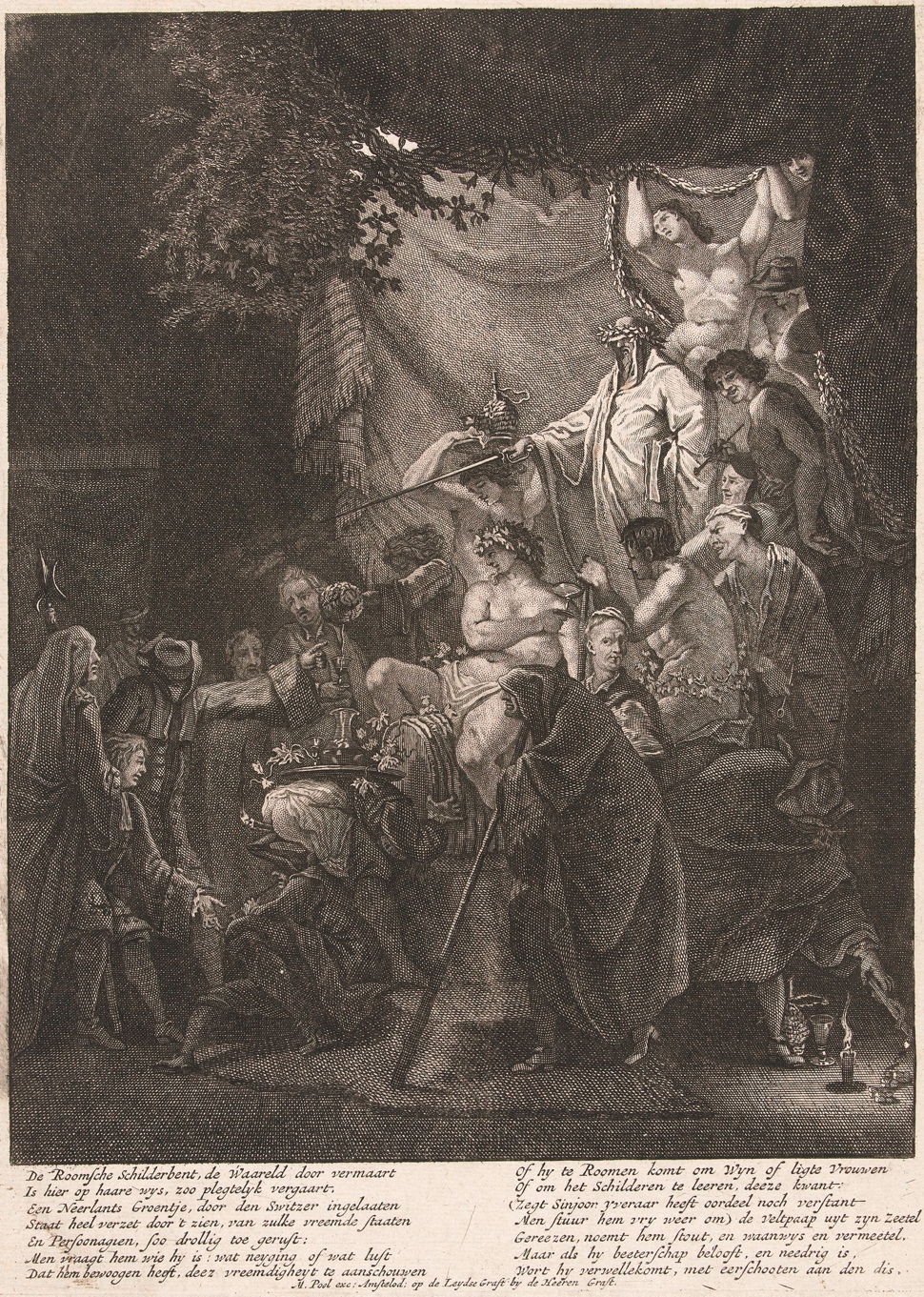
Van Wijnen probably painted his initiation into the Bentvueghels, which was later turned into this engraving by Matthijs Pool. It was, by all accounts, a rowdy and thoroughly Bacchic procedure, also shown by an anonymous artist, below.
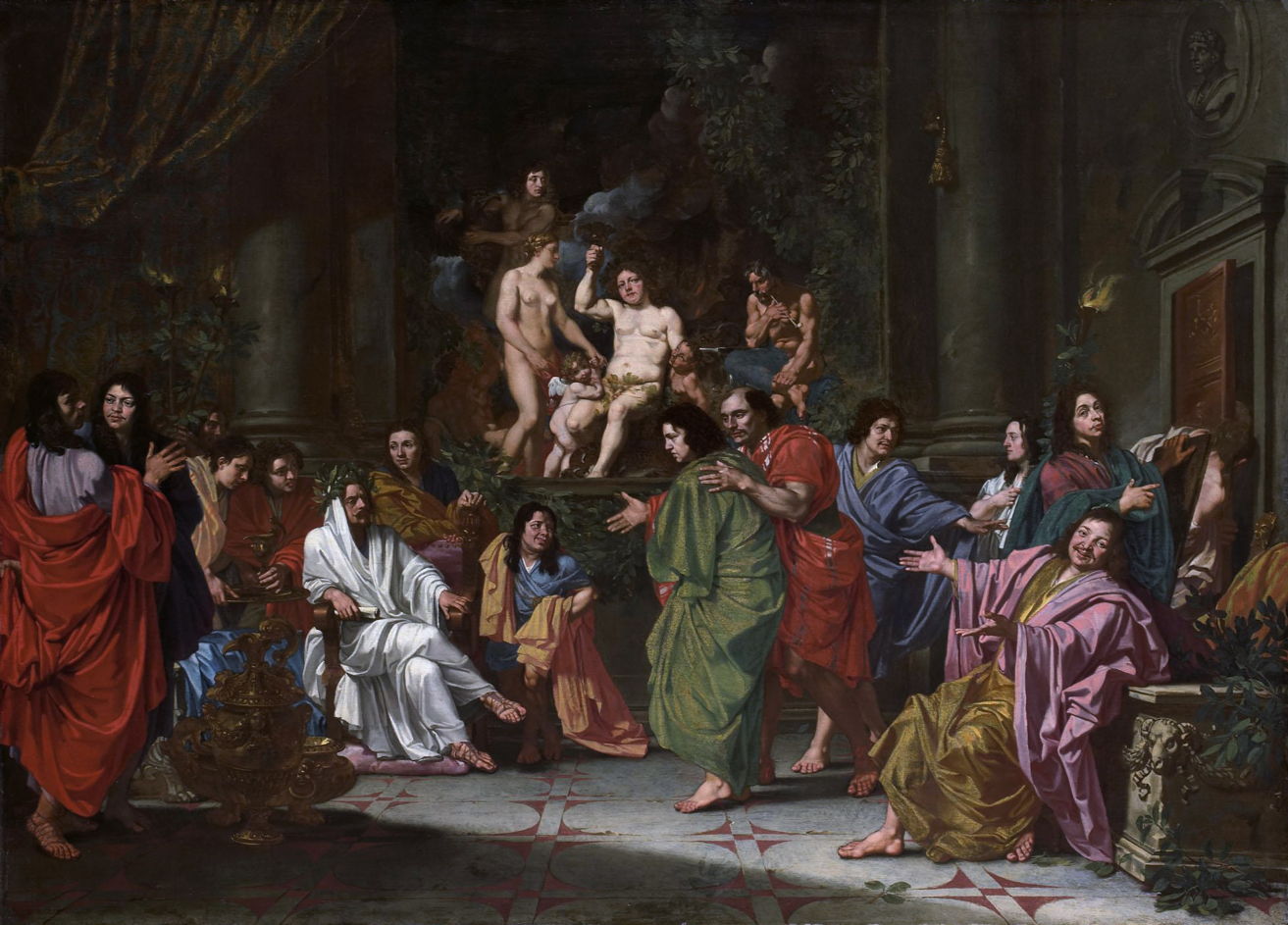
Once a member, van Wijnen painted under the name of Ascanius, the son of Aeneas, also Aescanius or Askaan. Few of his works have been dated, but most of the survivors seem to have originated during the decade that he spent in Rome, and centred on the theme of the Dark Arts.
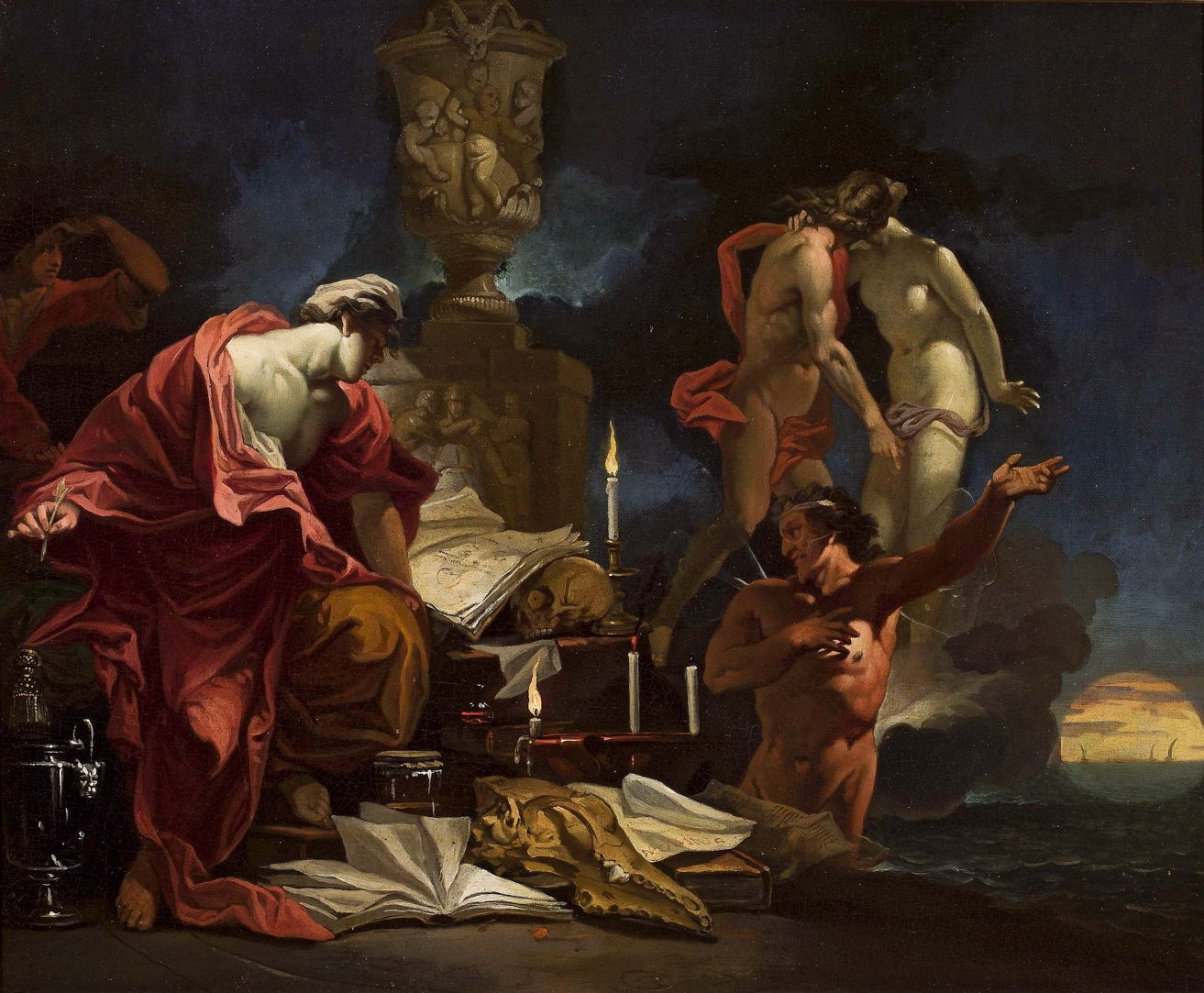
Astrologer Observing the Equinox and a Scene of Parting Adonis and Venus is probably one of his earlier works from this period, and shows a curious combination of an astrologer (not astronomer) at the left, who is studying celestial charts, with the mythical lovers Venus and Adonis, at the right. In front of the couple is a muscular male with transparent wings, who might be a rather different form of cupid.
Adonis was a notoriously beautiful young man born from a myrrh tree. Both Venus and Persephone fell in love with him, but he was killed by a wild boar. The love between Venus and Adonis is the subject of what was probably William Shakespeare’s first published work, a poem recorded in 1593. It was also a popular theme for painting, although rarely in such a strange setting.

Medea Rejuvenating Aeson invokes alchemy and witchcraft in telling the story of the sorceress Medea, who reclines naked in Hecate’s golden chariot, pointing her wand at the body of Aeson lying on the ground, as she casts a spell to rejuvenate him. Above her, a glass sphere containing a small devil shoots a trail of flame and sparks like a rocket.
Medea is assisted by four putti and has what appears to be Hecate herself behind her, and a full moon is seen rising above the horizon. Scattered around the scene are objects associated with witchcraft, including a glass cauldron, a jar of brown liquid, a sacrificial knife, old books, and a burning candle.

Van Wijnen explores the theme of witchcraft further in The Witches’ Sabbath by Moonlight, set in a moonlit Italian landscape. This combines many of the now-classical symbols associated with the Dark Arts, and is taking place at an outdoor altar set up at the foot of the gallows, on which a dead body hangs.
Two women are shown as witches: an older one riding a horned goat facing backwards, who is leaping over a large smoking cauldron, and a younger woman at the left, who has a wand in her left hand and is accompanied by a boy. Clustered in front of the altar at the right is a soldier in armour, who is looking in a mirror at the image of another, and another woman who is kneeling and holding a snake in her right hand.
Nearby is the dead body of a robber, his gun by his head, an infant, and a cat. The surface of the altar has been prepared with bread and wine, and there is a small chimera by it. A bat flies in the distance, and a transparent figure is passing through a hoop mounted on top of the gallows.
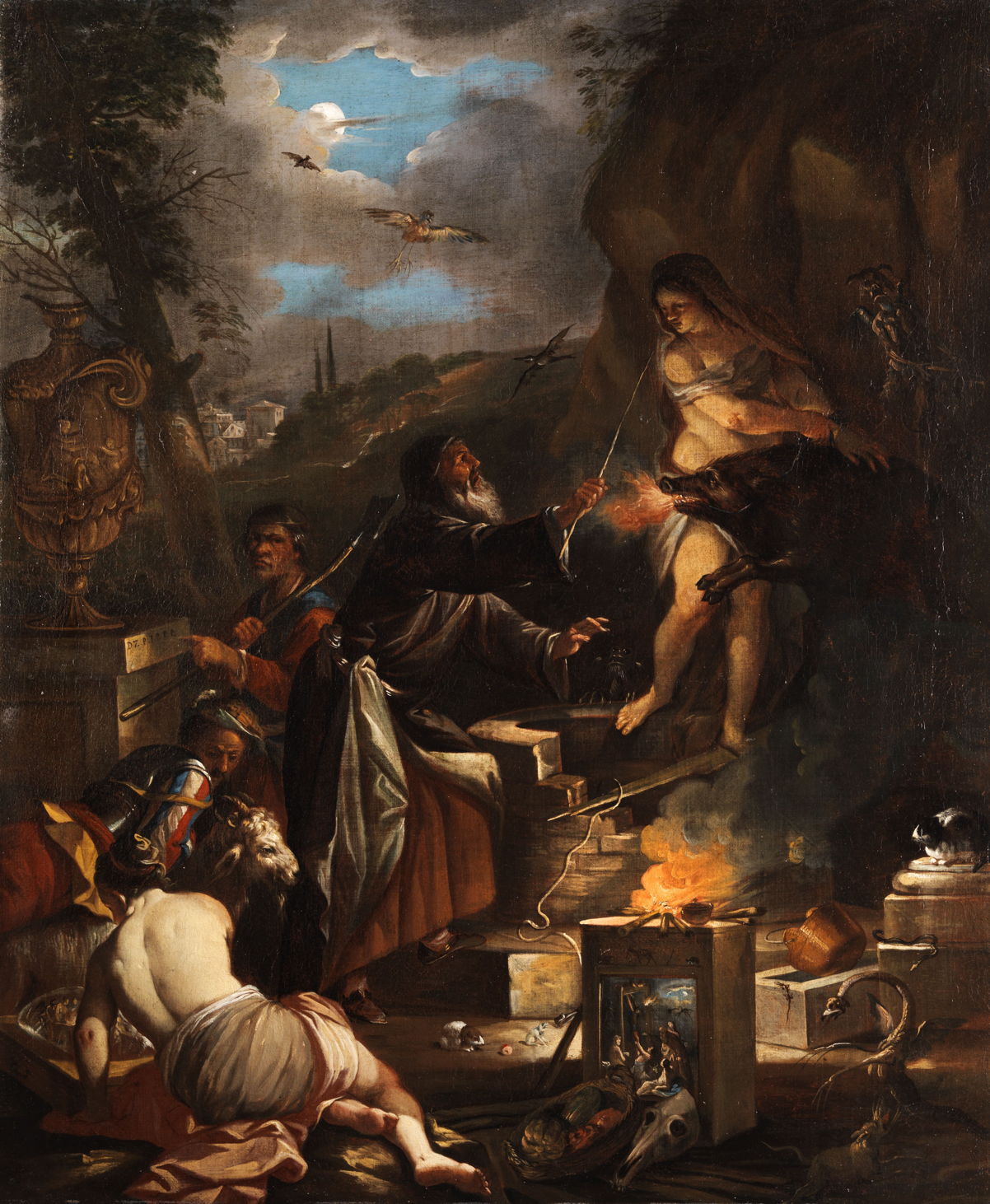
In The Witchmaster, also set in the Italian countryside at night, van Wijnen has adjusted the symbolic objects, removing the altar and making the supervising witch into a bearded man. There are two novel introductions: a wild boar breathing fire resembling that emerging from the glass sphere in Medea Rejuvenating Aeson, and references to images in the form of a reflection in a mirror of the woman at the lower left corner, and an odd viewing box in the centre of the foreground, with its painting within the painting.
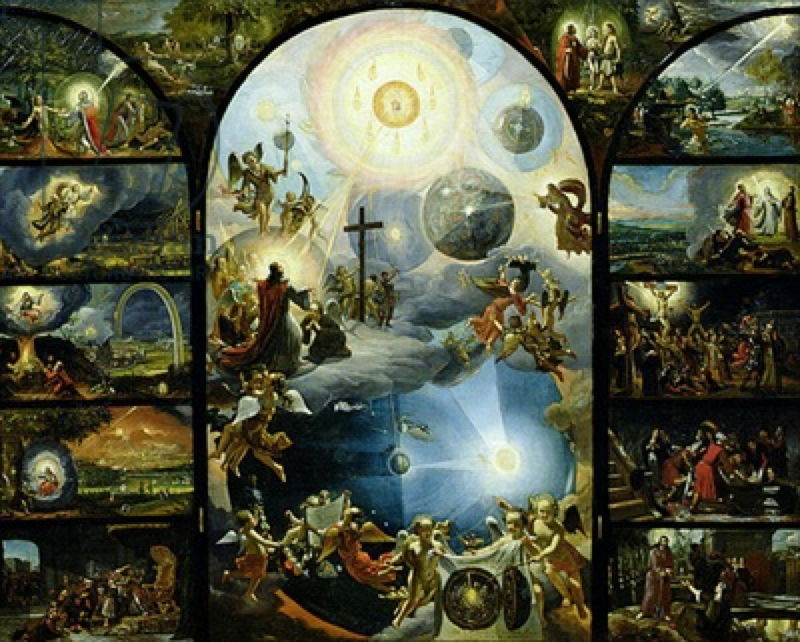
Van Wijnen seems to have painted some religious works too, although the only example I have been able to find is his remarkable Allegory of the Creation of the Cosmos now in the Pavlovsk Palace in Saint Petersburg, Russia, and only accessible in this poor-quality image. The smaller scenes at its edges appear to trace the Biblical account of the Creation and the life of Christ.
Most remarkable of all van Wijnen’s works are two featuring distinctive streams of figures.

Allegorical Scene looks like one of the more extreme faerie paintings from Victorian Britain, but was painted almost two centuries earlier. A strange collection of objects lies at the foot of a terracotta urn, including a large tortoise, a shield, an open book, a trumpet, a quiver full of arrows, a spear, and an oil lamp.
Hundreds of small putti at the upper right are being ejected from below, arcing over the top of the painting, and coalescing around a goddess who is lit brightly from behind. Below her is a river, in which many naked bathers are congregated, and they too appear to rise up into the sky in another stream of figures.

Similar streams, and a jet of sparks and fire from a sphere, appear in van Wijnen’s Temptation of Saint Anthony. There’s another complex collection of symbols in and around the figures on the ground.
When faerie paintings came into vogue in the middle of the nineteenth century, artists like Richard Dadd in his Come unto These Yellow Sands from 1842 (below) appear to have followed in van Wijnen’s brushstrokes.

By the time Domenicus van Wijnen was painting his unique works, the art market in the Dutch Republic had collapsed. The Republic had been invaded by both the French and the English, and it was sliding into financial crisis.
 The Eclectic Light Company