

Towards the end of the nineteenth century artists started migrating to Le Midi, the south of France, for its favourable climate and distinctive light. Henri-Edmond Cross moved there in 1891, Paul Signac from 1897, Pierre-Auguste Renoir overwintered regularly from 1901, Théo van Rysselberghe in 1911, Henri Matisse in 1917, and Pierre Bonnard finally settled there in 1924.
Just inland of the now major tourist resort of Cannes is what used to be the quiet village of Le Cannet. Situated amid gently rolling hills, it affords fine views towards the Mediterranean to the south, and inland to the foothills of the Maritime Alps in the north. In 1901, Le Cannet had a population of just over three thousand, and by the Second World War had grown to ten thousand. This weekend we’ll join them, even though Le Cannet now has a population of over forty thousand, and has effectively merged with Cannes.

Renoir sought refuge there as his arthritis grew worse, and threatened his ability to paint. He painted this View of Le Cannet in 1901 as a plein air oil sketch of the village tumbling down the hill overlooking Cannes. He has applied thinned paint sparingly over the canvas, although little of the ground is showing through.
Early the following year, he moved to Le Cannet, and his family joined him a little later.

Le Cannet from about 1902 shows one of the villas at the edge of the village, where a woman is hanging her washing to dry over a fence.
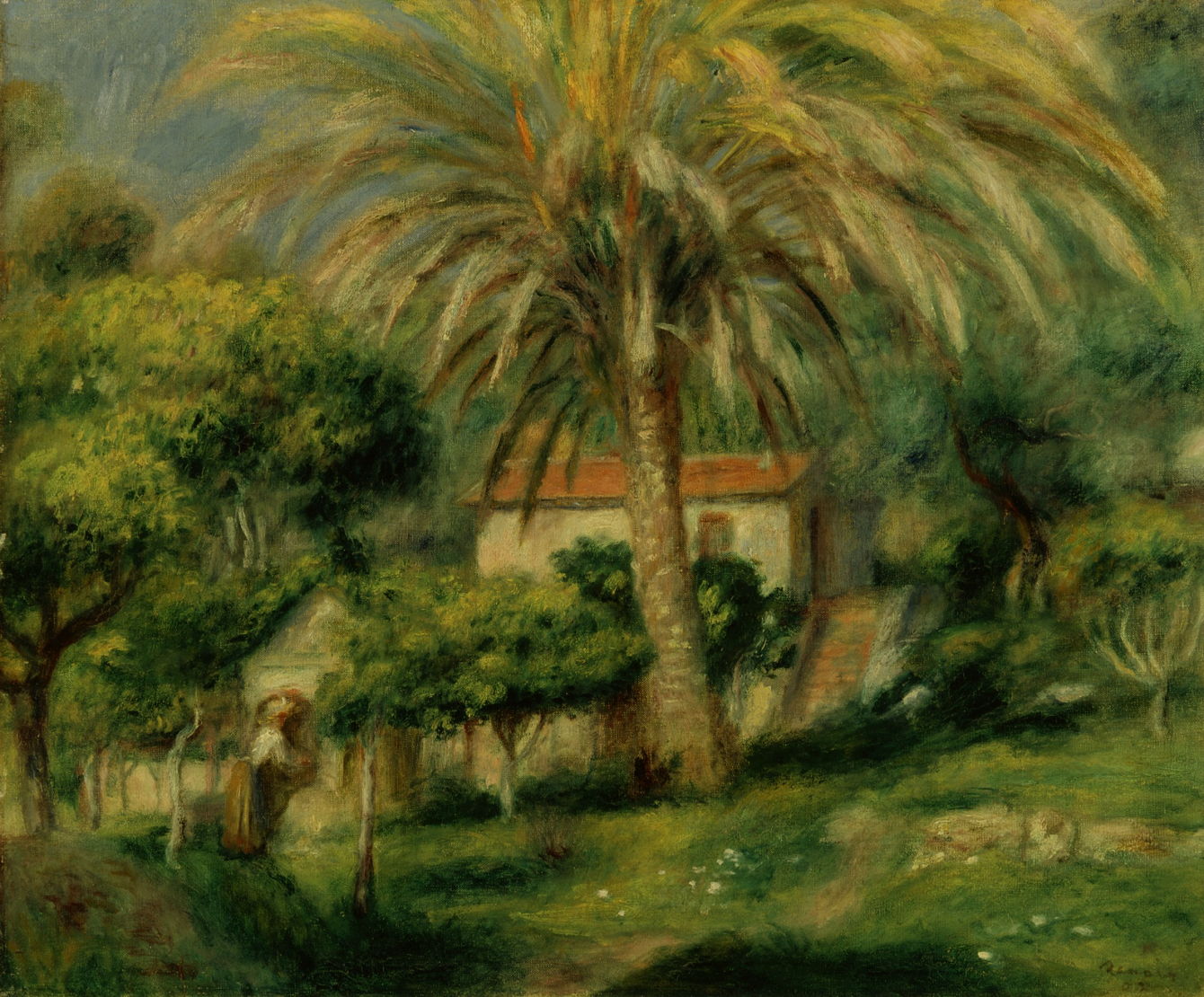
Renoir’s The Palm from 1902 shows a fine palm tree standing outside another villa near Le Cannet.
Early the following year Renoir’s health wasn’t good, and he was forced to delay his departure for his winter quarters at Le Cannet until February. In April, he moved from there to the town of Cagnes-sur-Mer, to the east, close to the city of Nice, where he first rented a property in the centre, but was later to make the town his home.
At the end of 1924, Pierre Bonnard and his partner Marthe started renting a villa named La Rêve (‘The Dream’), in Le Cannet, close to his patrons and close friends the Hahnlosers. From then on, Bonnard and Marthe were to spend increasing amounts of their time living in Le Cannet, rather than in the north.

Bonnard painted at least two variations of this view of a Pink Palm at Le Cannet (1924), in which he clearly enjoyed its unusual colour contrasts and the rich textures of its vegetation.

La Fenêtre (The Window) (1925) gave Bonnard the opportunity to frame a view from his villa in Le Cannet looking inland. That year, Bonnard finally married Marthe in Paris.
In February 1926, the Bonnards bought a villa in Le Cannet, which they named Le Bosquet (‘The Grove’). In September and October, Bonnard visited the USA, as a member of the jury for the Carnegie Prize. He toured in Pittsburgh, Philadelphia, Chicago, Washington and New York. Among others, he met the collector Duncan Phillips, who was already becoming his most important patron outside Europe.

Le Cannet, View from the Pink House (1926) shows the spectacular view the Bonnards enjoyed from their villa in Le Cannet.

I suspect that this painting of The Palm from 1926 was made from the Bonnards’ garden, or nearby. The woman in the foreground, holding up fruit, is pale and ghostly against the dazzling light and colour of the houses behind her.
In May 1927, he bought a plot of land adjacent to the villa, into which he extended its garden. In late November, the Bonnards effectively left Paris to live in the Mediterranean climate of Le Cannet.

Bonnard had considerable work performed on their villa in Le Cannet, but probably hadn’t expected to find his new balcony there covered with snow. Effect of Snow (Le Cannet Under the Snow) (1927) is an unusual version of his favourite view over the small town.

The villa’s ‘French window’ doors leading out onto his new balcony formed an excellent frame for The French Windows with Dog (1927), with its fragmentary glimpses of the town below.
 The Eclectic Light Company