
It’s already the second day of January, the first month of 2026, the month named after Janus, the Roman god of transitions including the start of the year. Only there are several flaws in that sentence.
First, for the Romans and Greeks, the New Year didn’t normally occur in the middle of winter, but more commonly, at least when their calendars were in proper sync, at the start of Spring. In classical times, calendars were often chaotic: two adjacent Greek cities could be running as much as six months out of sync with one another. The Roman Empire brought a more uniform approach, but until the introduction of the Julian calendar on 1 January 45 BCE, it was usually many days or even weeks out of kilter with the seasons.
The Romans did name the first month of the year Ianuarius, hence the starting date of the Julian calendar. That sounds promising until you look at the origins of the name. It’s equally as likely that it was named after Juno rather than Janus, as was made plain in some ancient almanacs. But the more modern assumption that January, now a winter month, was named after Janus makes a more plausible story.
Janus characteristically has two faces on a single head, one looking backward to the old year, the other forward to the new: Ianus Bifrons in Latin.

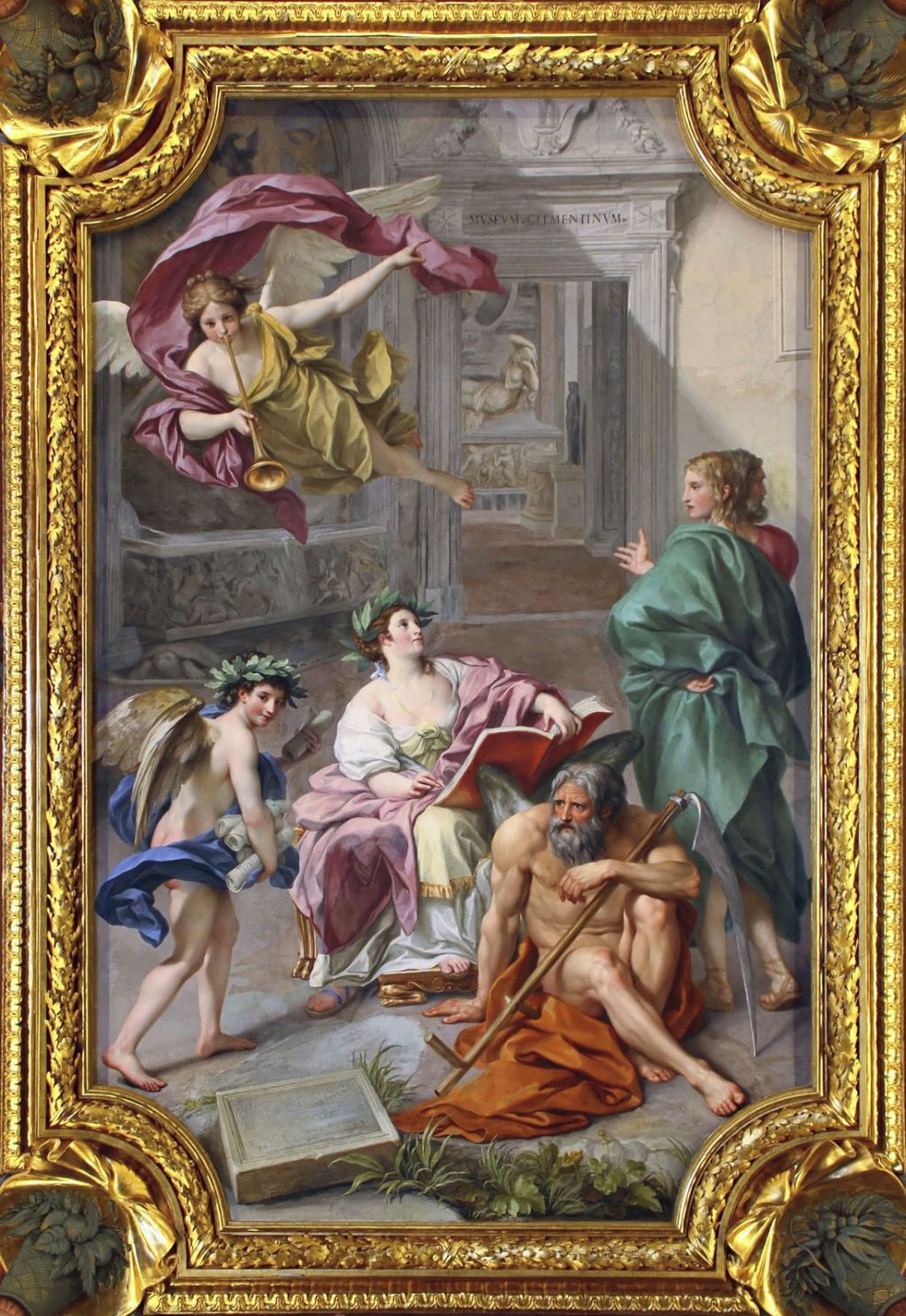
So he appears in Anton Raphael Mengs’ wonderful fresco in the Vatican’s Camera dei Papiri, The Triumph of History over Time (1772). You’ll no doubt recognise Father Time with his long grey beard and scythe in the foreground, behind whom History is busy keeping records. She looks up to the fresh young face of Janus, as the old one looks away to the right.
For all his importance to ancient Rome, Janus has hardly been painted in more modern times. This is because he doesn’t appear in any of the major references to myths, such as Ovid’s Metamorphoses, the sources used by artists from the Renaissance onwards.

One of Andrea Mantegna’s final commissions completed five years after his death by Lorenzo Costa, The Reign of Comus, places Janus in its complex composition. Comus, ruler of a land of bacchanalia, sits talking to a near-naked Venus in the left foreground. Just to the right of the centre foreground, Nicaea is lying unconscious through alcohol, against Bacchus, who got her into a stupor so he could rape her. Under the arch at the right is the unmistakable two-faced Janus with Hermes, apparently repelling potential newcomers to the bacchanal. In the centre is a small group of musicians, and various naked figures are cavorting in the waters behind. Maybe it was a New Year’s bacchanal?

Janus also appears as the occasional statue. In Nicolas Poussin’s brilliant Dance to the Music of Time (c 1634-6), opposite the dancing figure of Pleasure is a small herm of Janus, whose two faces look to the past and the future.
Janus’ association with gates, and the start and end of war, gave rise to an interesting tradition in classical Rome: the gates at each end of an open enclosure associated with the god were kept open in times of war, and closed when the city and its empire was at peace. Opening the gates was therefore a mark of transition to war, as used in two of Peter Paul Rubens’ paintings from late in his career.

In Rubens’ Temple of Janus from 1634, those gates, here imagined to be those of a temple, are being opened to let a warrior through to battle. Above that doorway is a statue of Janus with his two faces.

A few years later, as Europe was nearing the end of the Thirty Years’ War, Rubens was commissioned by Ferdinand de’ Medici to paint The Consequences of War (1637-38). Ares, god of war, is advancing forcefully having just rushed from the temple of Janus, moving from left to right, with his sword bloodied and held low. The head of Janus again appears above the temple door at the left.
There seem to be few other paintings that refer to Janus in any other context. Juno, the other contender for the origin of January, is far more widely featured in paintings, but never in a context that might lead to her name being appropriate to the first month of the year.
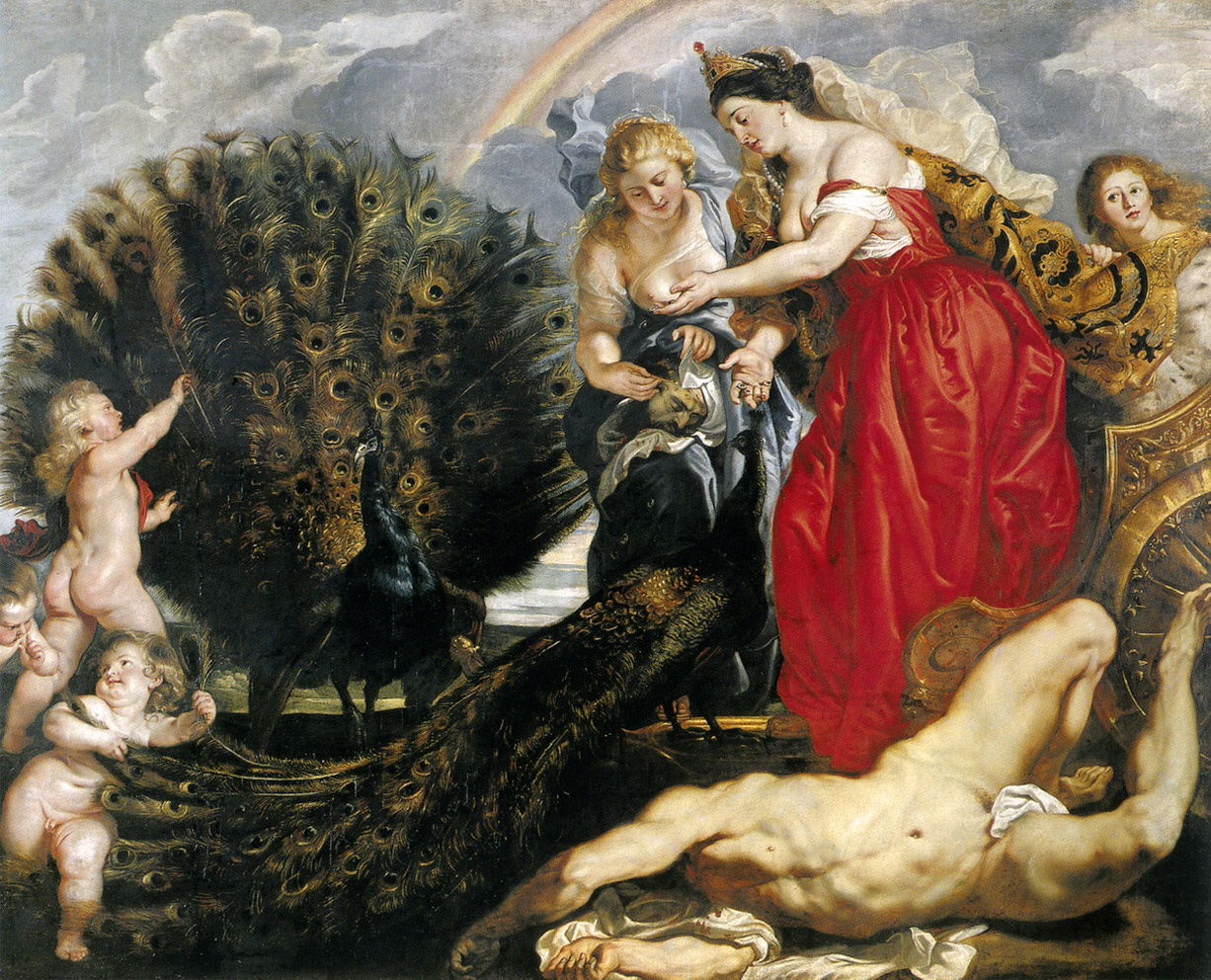
Rubens also painted Juno and Argus early in his career, in about 1611. Here he shows the conclusion of the story of Mercury’s murder of Argus within the myth of Io. Juno, wearing the red dress and coronet, is receiving eyes that have been removed from Argus’ head, and is placing them on the tail feathers of her peacocks. The headless corpse of Argus lies contorted in the foreground. Rubens has introduced a visual joke, in which Juno’s left hand appears to be cupped under the breasts of the woman behind.
Whatever the Romans really thought, the story of Janus and the start of the New Year has stuck.
 The Eclectic Light Company