
This is my second selection of paintings, artists and articles that I find most memorable among those published here in the last year.
Robert Bevan (1865–1925)

Robert Bevan (1865–1925) is one of the lesser-known painters who died a century ago. His view of Aldwych (1924) in central London shows this crescent off the Strand, to the east of Charing Cross. At the left is a motor omnibus, while drinking at the water-trough beneath the memorial is one of the remaining working horses of London, which by now were well in decline.
In memoriam Robert Bevan, British landscape painter: to 1914
In memoriam Robert Bevan, British landscape painter: 1915-1925
Rubens’ Metamorphoses

Peter Paul Rubens is almost certainly the most prolific painter of the myths told in Ovid’s Metamorphoses. As a conclusion to my retelling of those, I featured two articles assembling some of Rubens’ paintings. His The Fall of Phaeton, started in about 1604, is perhaps the best of several superb paintings of this story. Accompanying Phaëthon in the chariot of the sun are the Hours (Horae, some shown with butterfly wings), who are thrown into turmoil, and time falls out of joint as Phaëthon tumbles out of the chariot.

Rubens’ painting of The Rape of Hippodame (Lapiths and Centaurs) (1636-38) captures the violence of hand-to-hand combat between the Lapiths and Centaurs at this ill-fated wedding.
Rubens’ Metamorphoses 1
Rubens’ Metamorphoses 2
Dante’s Inferno
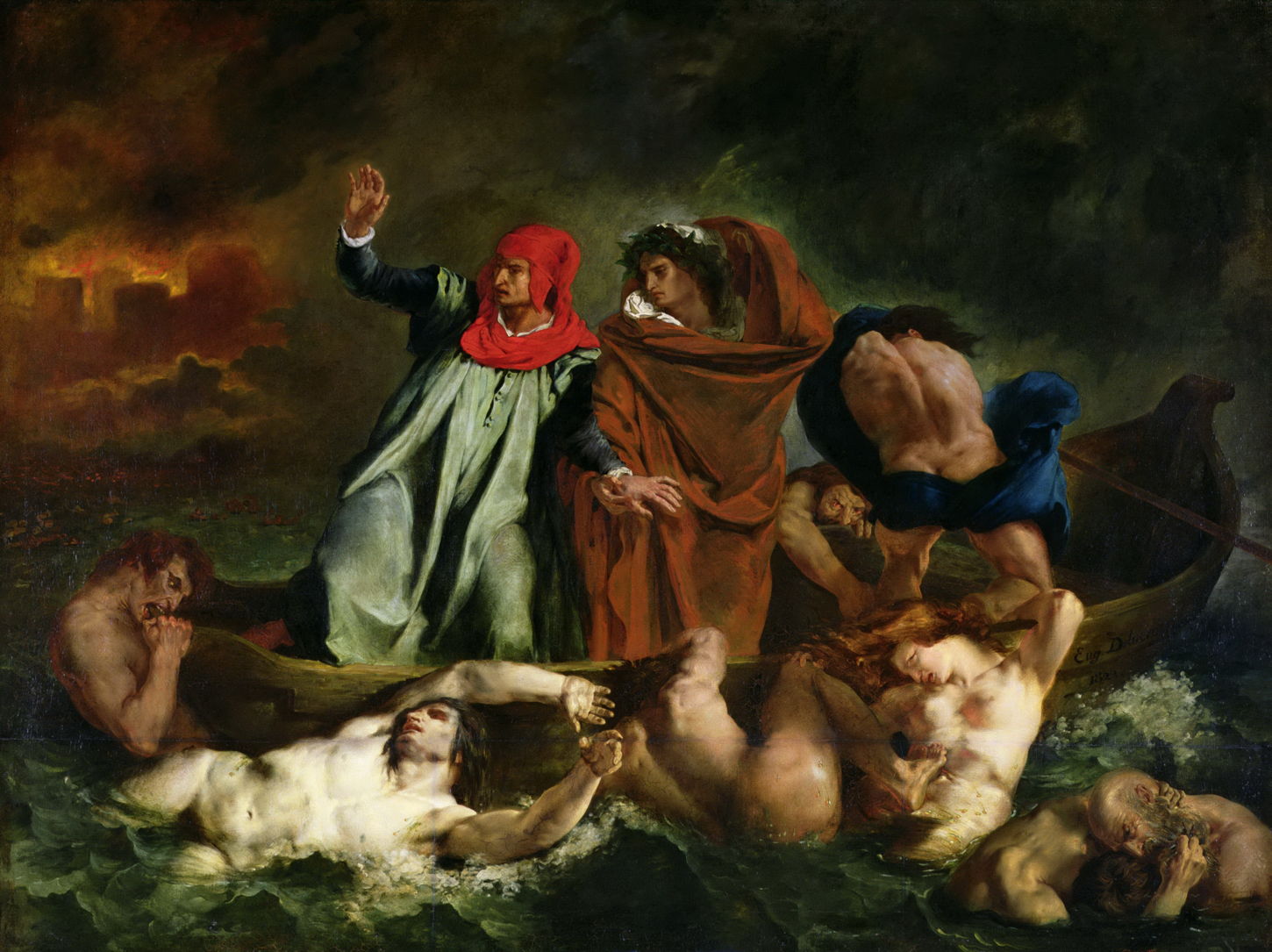
The second half of the year featured a painted account of Dante’s Inferno. Among its depictions is one of Eugène Delacroix’s finest narrative works, The Barque of Dante (1822), showing Dante and Virgil crossing a stormy river Acheron in a tiny boat. Dante, wearing his distinctive scarlet chaperon (hat), holds his hand up as he leans back onto the shoulder of Virgil his guide. This is an early experiment in colour, with water droplets on the bodies of those surrounding the boat containing at least three different colours for a unique three-dimensional effect.
Overview, Purgatory and Paradise
Windmills

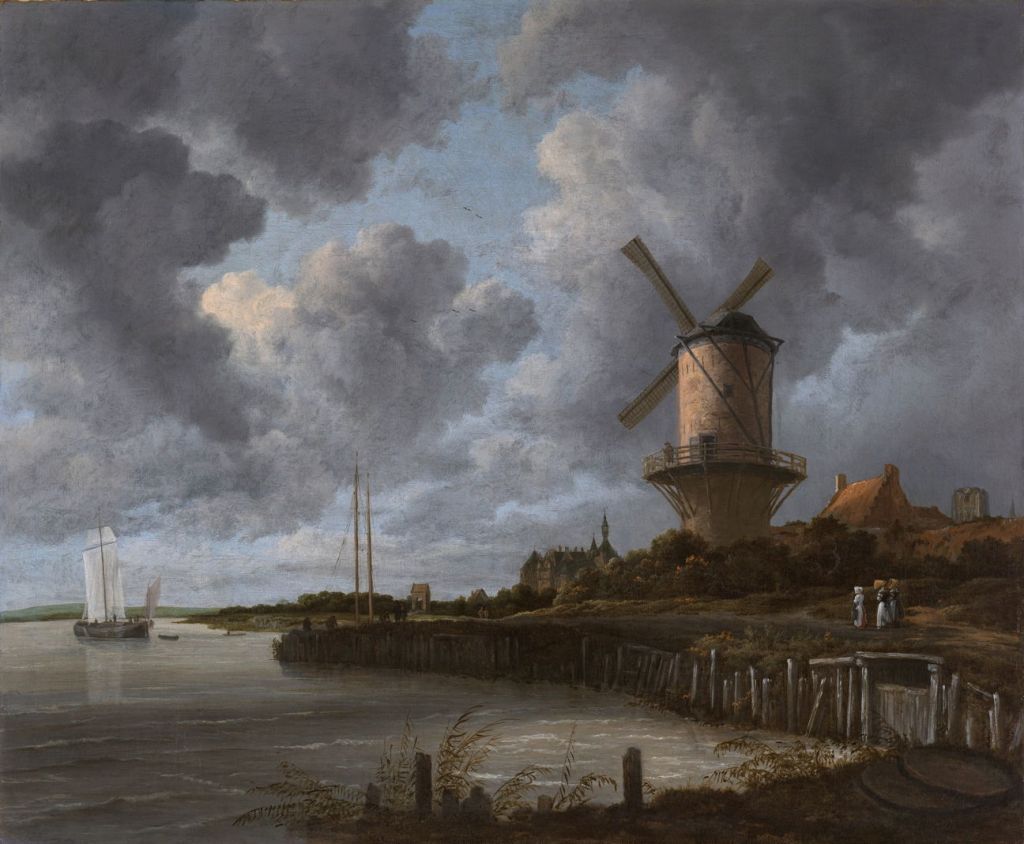
We spent a rebellious weekend looking at paintings of windmills. Masters of Dutch landscape art like Jacob van Ruisdael must have painted many hundreds of them, of which one of the best-known is this view of The Windmill at Wijk bij Duurstede from about 1670.
Paintings of windmills to 1850
Paintings of windmills after 1850
Vanitas

One of the articles in my current series on paintings of the Dutch Golden Age focussed on vanitas. David Bailly’s Self-Portrait with Vanitas Symbols (1651) is a strange web of allegory containing multiple portraits referring to the past. The figure shows him as a much younger man, holding the maulstick he used in painting. His true self-portrait at the time is in the painting held with his left hand. Next to that is a painting of his wife, who had already died, and a ghostly image of her is projected onto the wall behind the wine glass.
Gathered in front of the artist are ephemera and other Vanitas objects: the snuffed-out candle, a glass of wine, flowers, and soap bubbles, together with a string of pearls and a skull. If that message isn’t clear enough, he provides the quotation on a piece of paper: vanitas vanitum et omnia vanitas, together with his signature and date. This painting is also unusual for its innovative use of colour and monochrome passages to distinguish its features from their ground.
Walter Crane

These days, the British artist Walter Crane (1845–1915) is remembered primarily as an illustrator. In a series of three articles I showed some of his ‘fine art’ works, including this brilliant painting of Neptune’s Horses from 1892.
Walter Crane’s painted tales: 1, to 1883
Walter Crane’s painted tales: 2, 1883-97
Walter Crane’s painted tales: 3, 1898-1915
Christian Krohg (1852–1925)

Another major painter who died a century ago was the Norwegian Christian Krohg (1852–1925). His unusual painting of The Umbrella from 1902 looks down on a lone woman walking up a rough earth track, strewn with rocks, in windy weather.
Commemorating the centenary of Christian Krohg’s death
Louveciennes landscapes

I have devoted several weekends to collections of Impressionist paintings made of common locations during the early history of the movement. One unusual find among those made of Louveciennes and its environs is one of Camille Pissarro’s watercolours, a view of Louveciennes, Route de Saint-Germain from 1871.
Louveciennes landscapes: Before the war
Louveciennes landscapes: After the war
Gustave Doré

Another major illustrator of the nineteenth century was Gustave Doré, many of whose engravings are still used today. His painting Between Sky and Earth from 1862 is more of a mystery. The viewer is high above the fields outside Doré’s native Strasbourg, where several small groups are flying kites. The kite shown at the upper left has just been penetrated by a flying bird. Another unseen kite, off the top of the canvas, has a traditional tail, at the end of which is an anxious frog tied by a hindleg. However, a stork appears to have designs on seizing the opportunity to eat the frog, and is approaching from behind, its bill wide open and ready for the meal.
Gustave Doré’s paintings: Before the war
Gustave Doré’s paintings: After the war
On a cigar-box

My series on media used in painting has dug deep into its technical aspects. Among those is the use of panels made from wooden cigar boxes. In the late 1880s, several Australian artists started painting in the rural area of Heidelberg, east of Melbourne. They came together in a momentous exhibition in the history of Australian art, the 9 by 5 Impression Exhibition, in Melbourne, in 1889, named from the dimensions in inches of the standard Australian cigar-box lid of 13 by 23 cm. Tom Roberts’ Going Home from that year has dimensions of 23.4 x 13.6 cm, and linear marks in the lower section from the grain in the wood.
 The Eclectic Light Company