
Tomorrow, 29th December, we commemorate the death of the great French Neoclassical painter Jacques-Louis David, who died two centuries ago. In my first instalment I had reached the start of the French Revolution, when he played a significant role in both art and politics. He became a member of the new National Convention, where he voted in favour of executing the King, which so upset his wife that she divorced him.
Jean-Paul Marat was a leading member of the Revolutionary movement, an influential journalist through his newspaper, and a friend of David. Because of a severe skin disease, Marat spent much of the time in a bath to ease intense itching.
On the morning of 13 July 1793, Charlotte Corday, a young woman from Normandy, turned up at Marat’s house in Paris asking to see him, but his fiancée turned her away. She gained entry later that evening, and started giving Marat the names of some local counter-revolutionaries. While he was writing them down, she drew a kitchen knife with a 15 cm (6 inch) blade from her clothing, and plunged it into Marat’s chest, killing him rapidly.
Corday then admitted if not boasted of her actions, and on 17 July she was executed in public by guillotine. Marat became a martyr for the cause, after his friend David had organised one of the spectacular funerals for which he had become known.

David’s famous painting shows Marat’s body slumped over the side of his bath, the murder weapon and his quill both on the floor, the pen still in his right hand, and a handwritten note in his left hand.
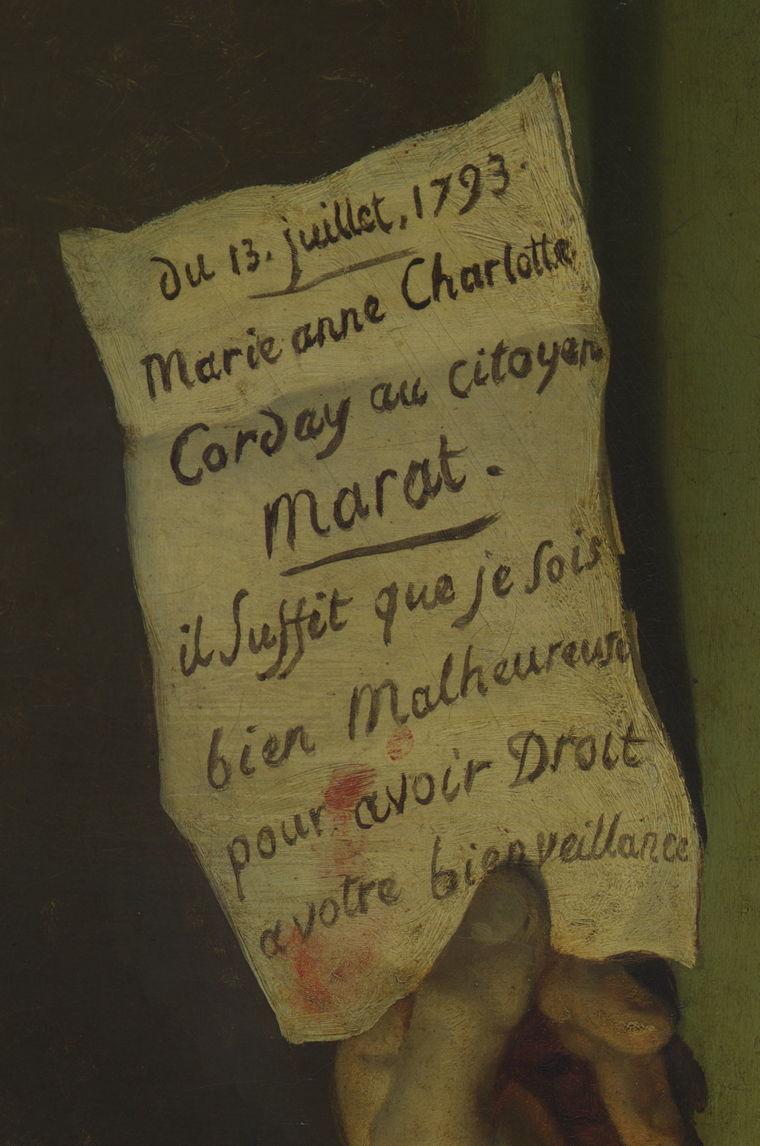
Corday’s note, here rotated from its orientation in the painting, gives the date, and addresses itself from her to Citizen Marat. It opens with the words “It suffices to say that I am very unhappy to qualify for your kindness”.
This sparse and simple painting became the quintessential image of The Terror in particular, and the Revolution as a whole, and for many it remains David’s most important work.
David pressed on with his deep involvement in the Revolution, but was soon to come to grief. In early December 1793 a fourteen year-old boy, Joseph Bara, attached himself to the revolutionary Republican forces fighting a Royalist uprising in the west of the country, to the south of the River Loire. When he was leading a pair of horses he was attacked by a group of thieves who demanded that he hand the horses over. He refused, and the brigands killed him.
This was seized on by Maximilien Robespierre, who praised the boy as a hero of the nation. Word went out that Bara had been cornered by Royalist forces, and ordered to shout “Long live the King!” When he responded by asserting his allegiance to the Republic instead, the Royalists murdered him in cold blood. This caught David’s attention, who saw the opportunity to portray an even more emotionally charged episode of revolutionary valour.

David’s unfinished painting of The Death of Young Bara from 1794 was overtaken by events: Robespierre and perhaps David had arranged for Bara’s body to be interred in the Panthéon in Paris during a grand revolutionary festival, but that never happened as Robespierre was overthrown the day before the planned ceremony, and swiftly guillotined in public. David only narrowly escaped being executed alongside him, and was arrested and imprisoned for several months in late 1794 and the middle of 1795.

David’s The Intervention of the Sabine Women (1799) is unusual among depictions of the episode of the Sabine women in showing its resolution, rather than the seizure of the women that brought the conflict about.
After the overwhelmingly male population of the nascent city of Rome had seized the wives and daughters of their neighbours the Sabines, the two groups of men proceeded to fight. David shows Roman and Sabine men joined in battle before the great walls of Rome, with the Sabine women and their children mixed in, trying to restore peace. Looming over the city is the rugged Tarpeian Rock, from which traitors and other enemies of Rome were thrown. Named in dishonour of the treacherous Tarpeia, she wasn’t its first victim: she was crushed to death by the shields of the Sabines she had let into the citadel, and is reputed to have been buried in the rock.
Highlighted in her brilliant white robes in the foreground, and separating two of the warriors, is the daughter of the Sabine king Tatius, Hersilia, whom Romulus married. The warriors are, of course, her father and her husband, and the infants strategically placed by a nurse between the men are the children of Romulus.
David started this painting when he was still in prison. He intended it to honour his former wife, who had continued to visit him during his incarceration, and to make the case for reconciliation as the resolution of conflict. It also attracted the attention of Napoleon, and when his ex-wife managed to get David released, he was able to retire from politics, return to his studio, and even remarried in 1796.
Amazingly, David and Napoleon got on well, and following the coup d’état in 1799, David was invited to paint for the First Consul, and in 1804 was appointed official court painter to the Emperor. He was commissioned to paint Napoleon’s coronation, including private sittings for the Empress Joséphine and Pope Pius VII.
When Napoleon was approaching the height of his power, David chose to paint a legend that tells of the love of the poet Sappho for Phaon the ferryman, who plied the waters between Lesbos and the Anatolian mainland. Almost certainly illiterate and hardly a good audience for Sappho’s verse, Phaon’s redeeming feature was his great physical beauty. He was given this one day when he carried Venus in his boat; the goddess was travelling in disguise as an old woman, Phaon didn’t charge her for the crossing, so she returned the favour by transforming his physical appearance. Ovid’s description of Sappho’s affair with Phaon leaves little to the imagination, even down to their lovemaking.

David’s Sappho and Phaon was necessarily not as explicit as Ovid, showing the couple fawning over one another with their recently occupied bed behind them, and an ecstatic gaze on Sappho’s face.
The single most celebrated event in Spartan history is the Battle of Thermopylae in 480 BCE, in which three hundred Spartan soldiers, with 700 Thespians and 400 Thebans, were claimed to have kept over one hundred thousand Persians at bay for three days. This is the more remarkable for the fact that the Spartans and their supporters fought to the death, following which the Persians overran Boeotia and captured Athens. It is thus an example of self-sacrifice in the face of overwhelming odds, resulting in most noble defeat.

The only major painting that I have been able to discover of this is David’s Leonidas at Thermopylae (1814). Leonidas, the Spartan King and commander of the force, is at the exact centre of the painting, the viewer fixed in his emotionless gaze. Around him are his three hundred Spartan warriors, with supporting trumpeters, a lyre hanging on the tree, and laurel crowns being handed round.
David leaves some clues to his narrative in inscriptions, which have unfortunately become barely legible. A soldier has climbed up to carve an inscription in Greek at the upper left, the word HERAKLEOS appears on a plinth to the left of Leonidas, and by his right foot is an anachronistic piece of paper bearing more Greek words. More subtle, perhaps, are the small groups driving pack animals along a narrow path at the upper right: the Persians were shown a mountain path around the narrow pass at Thermopylae, enabling them to gain an advantage over the Spartans.
This painting coincided with the defeat of Napoleon and the restoration of the Bourbon King Louis XVIII. Astonishingly, the adept David was granted amnesty, and even offered the position of court painter, which he refused. Instead he opted to exile himself in Brussels, where he continued to paint.

David’s late painting of Cupid and Psyche from 1817 has been explained as showing the conflict between the idealised love we might expect of the soul, and physical reality. He seems to have taken inspiration from a recent poem by the Greek writer Moschus, portraying Eros as something of a brat. From that, he has become an awkward teenager, grinning stupidly over his latest conquest. Psyche’s attribute of a butterfly is shown above her head.

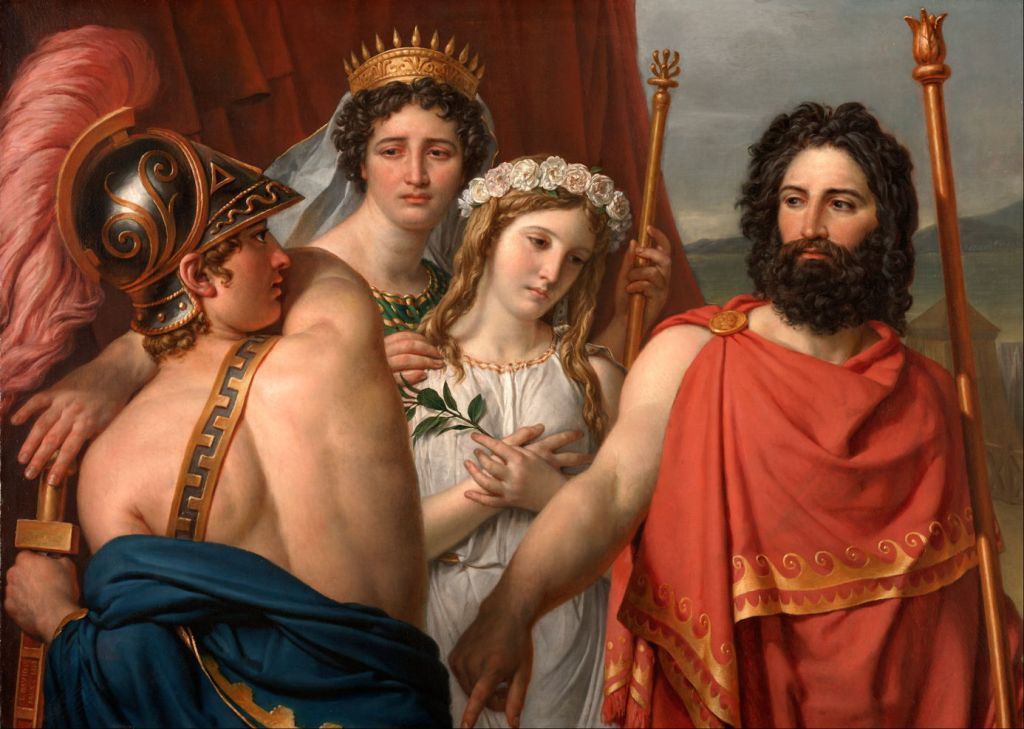
David’s unusual account of the mounting of the war against Troy is probably his last major work. In The Anger of Achilles from 1819, Iphigenia had already been promised by her father as a bride to Achilles, and the announcement of her impending sacrifice throws Achilles into the first of his many rages.
Achilles, at the left, reaches for his sword in an uncomfortable manoeuvre with his right arm. A rather masculine and tearful woman just to the right of him is Queen Clytemnestra, Iphigenia’s mother, and her right hand rests on Iphigenia’s shoulder. Iphigenia is dressed as a bride, and looks wistful, staring into the distance, her face empty of outward emotion. At the right, Agamemnon appears emotionless, but indicates firmly to Achilles for him to restrain his emotions.
One evening in 1825 when David was leaving the theatre in Brussels, he was struck by a carriage. He died as a result of his injuries on 29 December 1825. He remains one of the greatest narrative painters in the European canon, and his Neoclassical style influenced art throughout Europe.
 The Eclectic Light Company