
Merry Christmas!
To celebrate this year’s feast I have two selections of paintings. Today’s cover the Gospel account of the Nativity, Adoration of the Shepherds and of the Magi, and tomorrow’s are all about Christmas trees and their role in family celebrations. These are eclectic in their period and interpretation, and I hope capture the spirit no matter what your belief.
We start with an unusual jewel of a painting from the end of the fifteenth century.
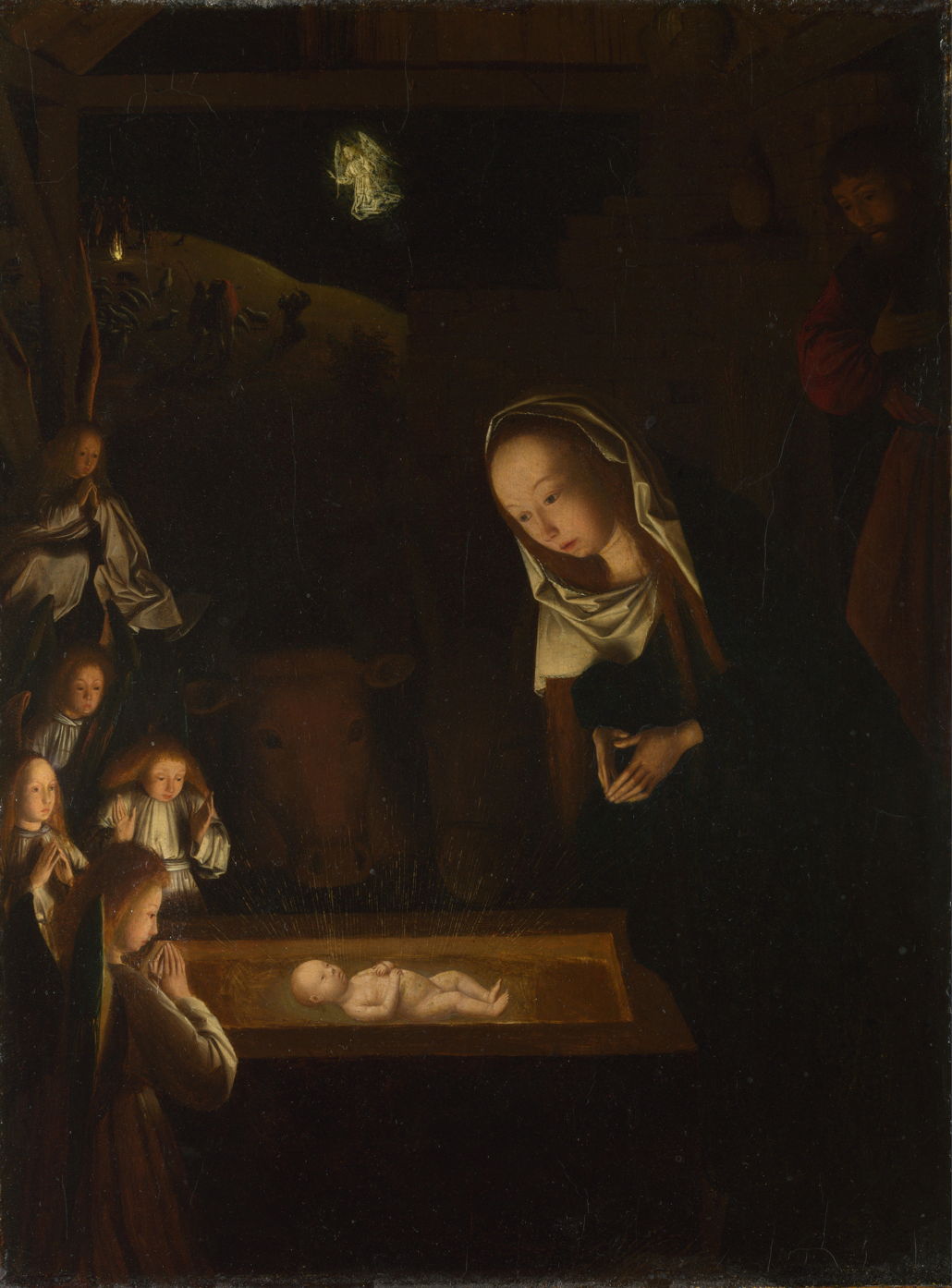
A now-forgotten literary influence on many nativity scenes was the vision of Saint Bridget (Birgitta) of Sweden, where the infant Jesus was a source of physical light. This led painters such as Geertgen tot Sint Jans to make nocturnes in which a mystical light created dramatic effects. His Nativity at Night, thought to be from about 1490, also uses chiaroscuro with narrative sense, imparting tenderness and reverence, thanks to its tonal transitions. As it became popular in nativity scenes, chiaroscuro was poised for more general use a century later.

Fritz von Uhde’s undated Christmas Night is a modern atmospheric interpretation of the Holy Family of Joseph, the infant Christ, and the Virgin Mary in their improvised accommodation in Bethlehem.

Jules Bastien-Lepage’s Annunciation to the Shepherds (1875) could have formed his manifesto, showing how he builds on tradition rather than discarding it. It strikes a compromise between the gilding and Renaissance look of the angel, the rural realism of the shepherds who have come from Millet rather than Bethlehem, and the controlled looseness and gesture in its darkened landscape. He wastes not a brushstroke in telling its simple story, in the almost averted facial expressions, arms frozen in surprise, hands that have just been tending sheep, down to the shepherds’ bare and filthy feet.

Murillo’s Adoration of the Shepherds from about 1650 features delightful additional details including the old woman carrying a basketful of eggs, chickens in front of the kneeling shepherd, and that shepherd’s worn appearance. His composition brings the heads of the key figures together, where the strongest light is cast on the baby and his mother.

Kazimierz Sichulski set this modern triptych of The Adoration of the Shepherds (1938) among the Hutsul people of the Carpathian Mountains, one of the artist’s favourite locations.
The Adoration of the Magi occupies the central panel of Hieronymus Bosch’s triptych now in the Prado in Madrid.
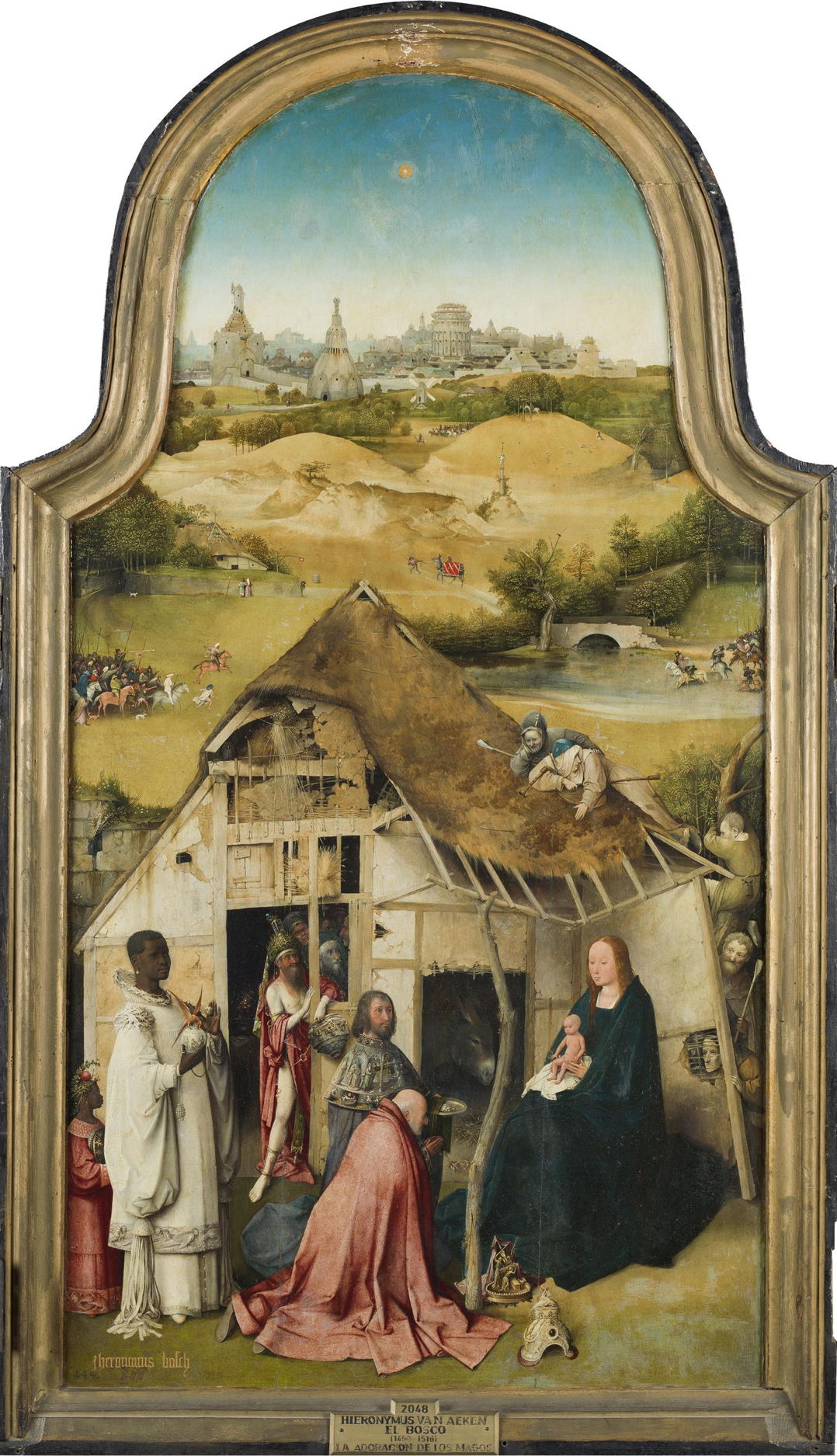

In the foreground is what appears to be a generally conventional if meticulously detailed account of the adoration of the Magi. The Virgin Mary is sat under the tumbledown eaves beside a small cattleshed or stable known in this area as hoekboerderij. The infant Christ is seated on her lap, steadied by her left hand.
The senior of the Magi, an elderly man, has removed his crown, which is to the right on the ground, and prays to the mother and child on his knees. His gift is an elaborate gold table decoration showing Abraham about to sacrifice his son, Isaac. Behind him a second has also removed his headgear and holds his gift of myrrh on a silver platter. To the left is the third, a bare-headed African king wearing immaculate white robes, and bearing his gift of frankincense inside a sphere, on top of which is a phoenix bird; he has a child attendant behind him.
More unusually, a fourth king, identified as an anti-Christ, lurks inside the shed, wearing an ornate crown, and clutching a helmet with his left hand. His appearance is bizarre because his face and neck are sunburnt, but the rest of his skin is deathly pale. He is partly undressed, and has an old wound on his right lower leg. Several other figures are seen behind.
An ass is visible through an opening in the wall of the shed, between the Virgin and the Magi, but the traditional ox that would accompany it isn’t visible.
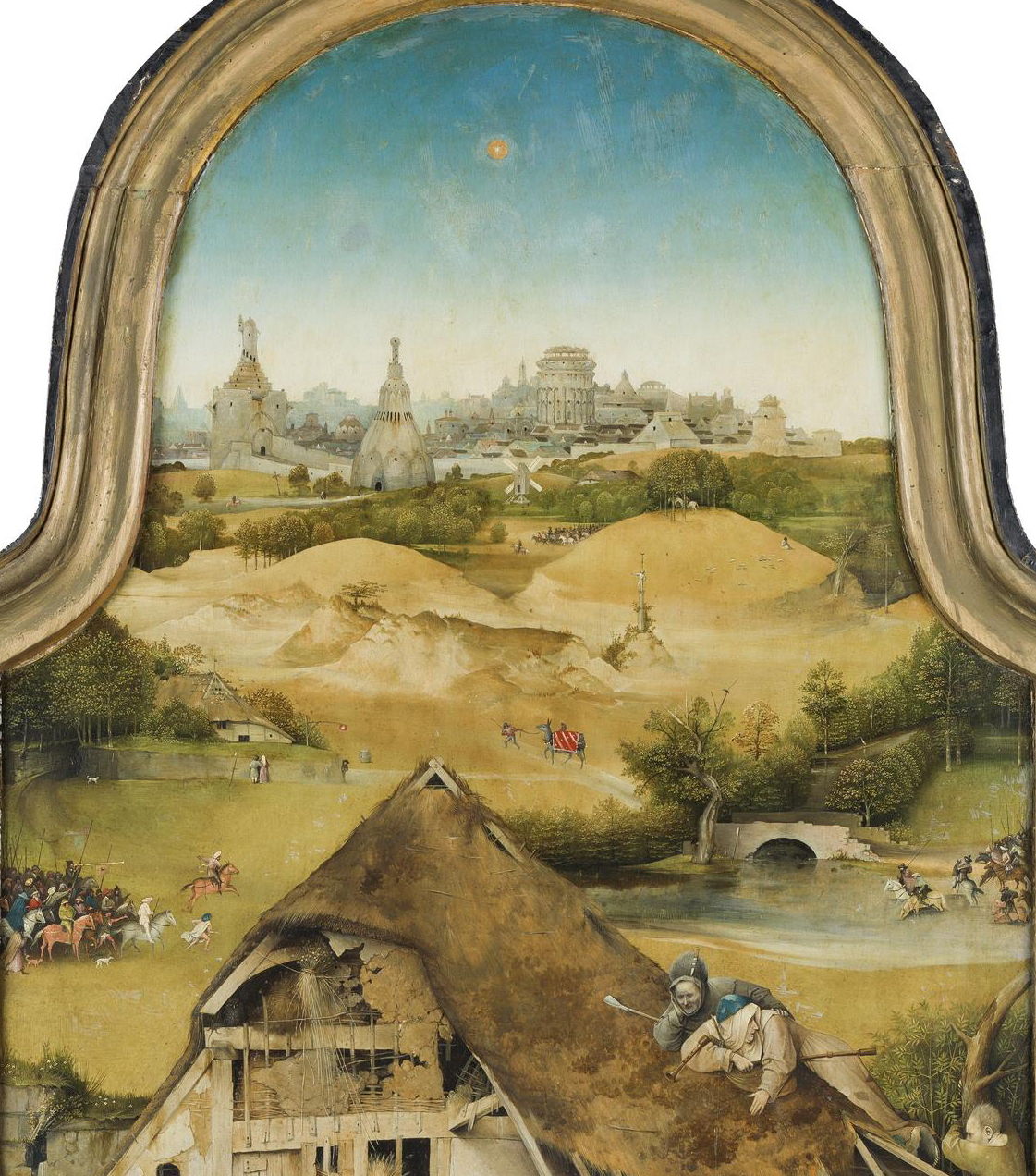
To the right and above this traditional scene are more peculiar events. A group of shepherds are engaged in climbing a tree behind and to the right of the shed. Two, a man and a woman clutching a set of bagpipes, are leaning over the thatched roof to view the scene below, and three others are below them. One of Bosch’s signature owls is just visible too: at the same level as the face of the upper person on the roof, just by the break in the wooden frame of the gable end of the shed.
The background to this panel features low, rolling hills with small woods and open grassland. In the middle distance is a windmill, behind which are unusual turreted buildings, a moat or river, and a city either based on Antwerp or ‘s-Hertogenbosch, the artist’s town. This countryside contains sporadic people, and no less than three small armies, two of which are approaching one another, from the left and right sides of this central panel; their headgear suggests that they come from outside this part of Europe. The third group can be seen back towards the foot of the windmill.
In the sky above, although it’s full daylight, the guiding star still burns brightly.

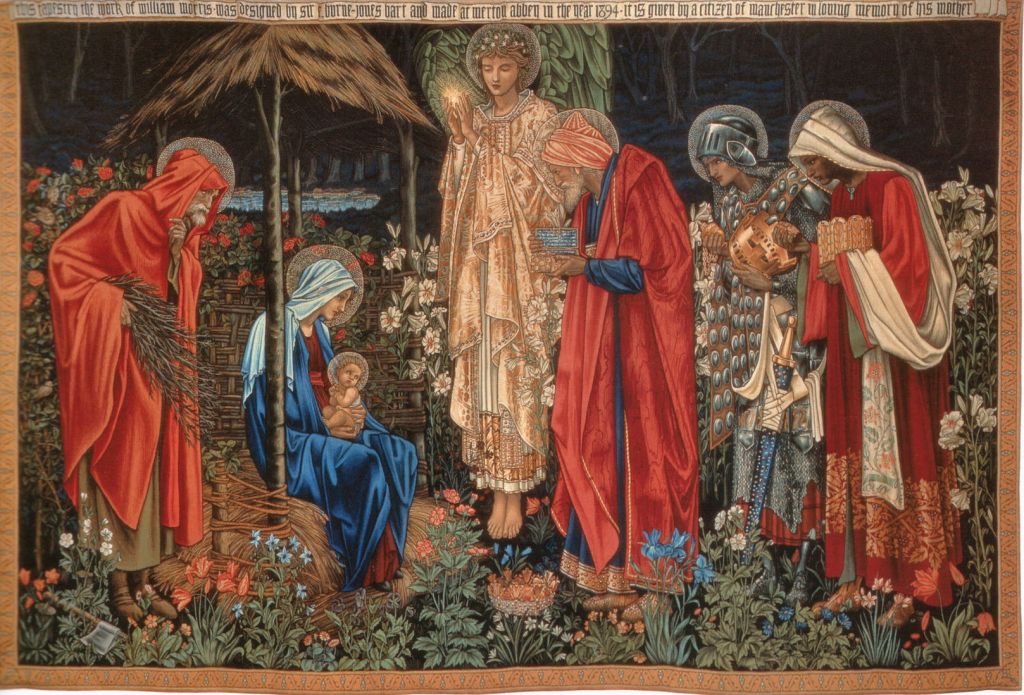
This exquisite tapestry of The Adoration of the Magi was designed in 1888 by Edward Burne-Jones, William Morris and the lesser-known John Henry Dearle. This version was woven six years later for the Corporation of Manchester, and is one of ten known examples. The composition was taken from a watercolour by Burne-Jones from 1887, photographically enlarged into cartoons, and coloured and decorated with flowers by Morris and Dearle.
We should also remember those who are unable to celebrate Christmas with their families.

In 1915, when the whole of Europe was engulfed by the Great War, Wojciech Kossak painted this Soldiers’ Christmas. The decorations on the small Christmas tree in the foreground echo the uniforms in their greyness. In the sky, a shellburst acts as a metaphor for the guiding star that led the Magi to the infant Jesus in Bethlehem, but below that celestial light these infantry soldiers must continue to fight.

The men in Jacek Malczewski’s Christmas Eve in Siberia from 1892 have been deported from their native Poland and imprisoned in the extreme cold and remoteness of Siberia. Although there’s a steaming samovar at the end of the table, they have only had soup and a wedge of bread for their seasonal feast. Following the Polish Uprising in 1863, at least 18,000 were ‘exiled’ to Siberia, many of whom never returned.
 The Eclectic Light Company