

Bosch’s greatest masterpiece, and one of the greatest paintings in the world, presents an intriguing and intricate vision. Unique in its content, it remains a conversation piece half a millennium after it was painted. Having looked at the structure and higher-level reading of this extraordinarily complex triptych, this article completes my account by delving deeper into some of its details, and trying to put this together in a better understanding of its reading and purpose.
Garden of Eden
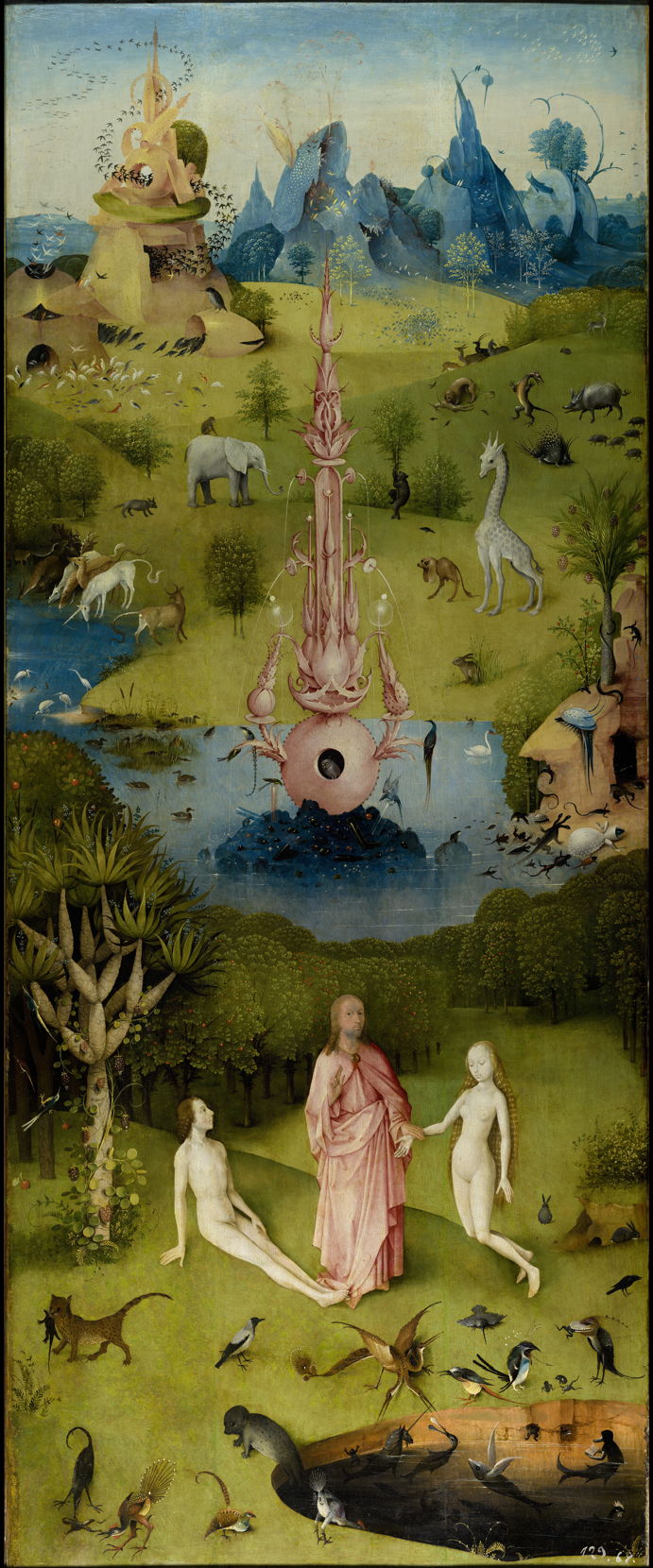
The Garden of Eden in the left panel is the most conventional part of the painting, and compares with other works showing similar scenes from Genesis, if you overlook Bosch’s idiosyncratic beasts and structures.

God, Adam, and Eve are fairly traditional in their depiction, and Bosch chooses a happy moment. At this stage, there is no danger from the serpent, and no warning of the Fall that is to come.

On the left, the prominent tree bears bunches of grapes, but others in this wood carry apples, one of which has fallen to the ground. At the right are two rabbits and a crow, two of the few recognisable rather than fanciful species; another is the cat carrying prey in its mouth in front of the tree.
The strange species seen by the small lake in the immediate foreground are portmanteaux, in that each is made up of a composite of parts from other species, with visual references made to peacocks, spoonbills, seals, ducks, unicorns, and others. One duck-fish in the lake is even reading a book, and a bird on the shore has three heads. Several other paintings by Bosch use the same technique to create strange creatures.

The other dominant object is the fountain tower in the middle of the panel, the centre where the Tree of Knowledge (of good and evil) might be expected. This fantastic structure is made up of elements derived from plants, a technique Bosch used in other and earlier paintings. Like the panels themselves, this tower has informal symmetry about its midline, which is placed along the midline of the whole panel.
The small rocky cliff at the right edge is arranged to look like the profile view of a human face, with its eye closed.
A mixture of real, legendary, and portmanteau creatures decorate this area as well. Recognisable species include the ox, deer, elephant, monkey, black bear, giraffe, porcupine, egret, duck, and rabbit, but the more fanciful includes a lizard with three heads. Coiled around the tree at the right is a black snake, the serpent that led to the Fall.

The distant spires are the domain of the birds. Swift-like birds swirl out of the rock at the left, the flock weaving its way through the upper parts of its spire, and off into the sky. Others flock on the ground by species. The more distant blue pinnacles are based on plant structure, incorporating forms from other objects too.
Overall these details make this panel a most explicit and detailed vision of Paradise before the Fall of Man, assembled from Bosch’s rich and inventive imagination.
Pleasure garden

The pleasure garden in the centre panel is all about people, their pleasures and pleasuring. In stark contrast to the left panel, which contains only three human figures, the centre panel contains many hundreds. Although other objects are also involved, one of the main themes associated with pleasure here is fruit.

With limited facilities to store or preserve soft fruit in particular, eating fruit and fruit itself was associated with sensual, even carnal, pleasure. Although Bosch’s innumerable figures are naked, almost without exception, strict convention forced him to allude to carnal pleasures indirectly, often here through the eating of fruit.

In the left foreground, men and women are seen playing with fruit, often of greatly exaggerated size, and feeding fruit to one another. One couple is touching one another inside a transparent sphere, placed on top of a fanciful fruit floating on the lake. Another couple, who have progressed further in their lovemaking, are discreetly tucked inside the part-closed shell of a blue mussel. Giant birds watch this from the left, and a huge small tortoiseshell butterfly investigates a blue thistle flower.

There are similar scenes in the right foreground, where just below the camel at the top there is a threesome taking place under a transparent dome, in which the woman to the right is clearly pregnant.

The procession of animals and riders in the middle distance still uses symbolic fruit extensively, but also alludes to riding, hunting, and other mounted sports, common pleasures among the nobility of the day. The central circular pond contains figures of women, while those riding animals appear to be exclusively men: this may allude to the hunting of partners and the division of roles in courtship.

Flying in the skies above are several strange objects, based sometimes on angels (right), sometimes on legendary or imaginary creatures, complete with more fruit and one tree.

The towers in the background form the stage for other activities, and in the single example seen in the porthole in the base of the central dark blue tower, almost show explicit sexual activity. As with other structures, Bosch bases these towers on largely vegetable forms, and gives them informal symmetry about the midline of the panel.
The centre panel thus gives a delicately non-explicit and figurative account of the many physical pleasures which the nobility would have engaged in. It matches what we know of Bosch’s likely patron, Count Henry III of Nassau-Breda, who had a vast bed onto which drunk guests would be placed, so that he could act as voyeur over what they got up to.
Garden of Hell

The ‘garden’ of Hell in the right panel is derived from the more restrained panels that Bosch had painted of Saint Anthony, such as that in his Hermit Saints triptych. This is here taken to its nightmare conclusion, in which its many figures are mutilated and tormented, in a landscape harking back to Bosch’s experience when, at the age of 13, he witnessed his home town almost burned to the ground. It moves from the mass of humanity in the centre panel to greater dominance of non-human creatures, and alarming objects.

In the foreground, a huge blue bird, wearing a cauldron on its head and swallowing a whole human, presides over the scene. That bird is sat on an elevated commode, defaecating blue bubbles containing the people it has been ingesting. Faces stare up from the foul brown waters of the cesspit underneath.
The two main groups of victims are clustered around objects associated with gaming and gambling, and those for making music. Placing the former on the road to hell isn’t surprising, but tormenting figures with a harp and other musical instruments may seem strange today. Various religious sects have viewed music as being sinful and the work of the devil, and some of its associated activities, particularly dancing, have attracted wider moral condemnation.
The instruments shown, at greatly exaggerated size, are (left) a lute, a harp, and a hurdy gurdy, a string instrument played by turning the crank shown at its top.
Another notable if not iconic feature in the foreground is the pig dressed partly as a nun, kissing a man, at the right lower corner.
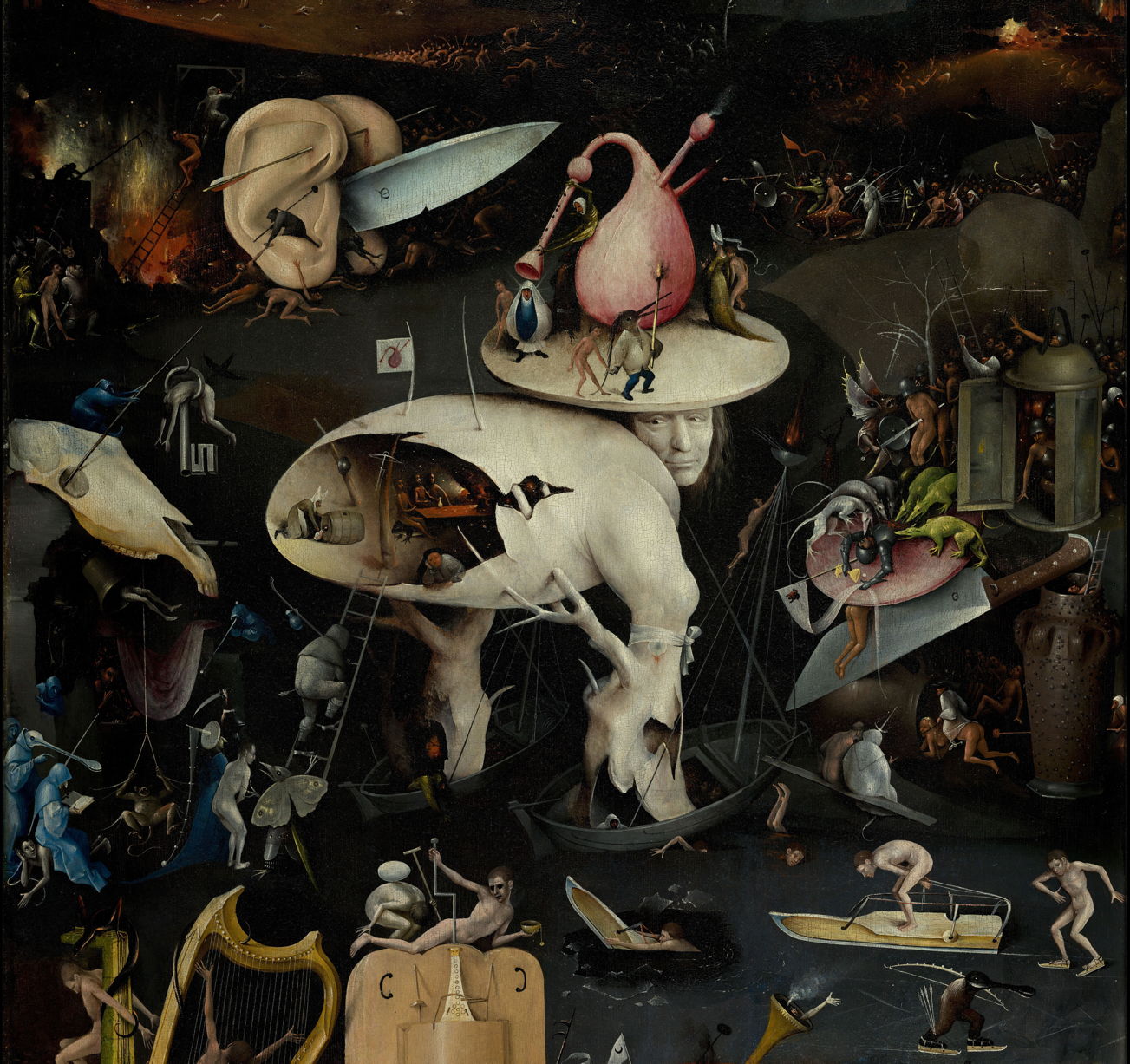
On the near-black frozen surface of the river behind, there are skaters, one of whom has fallen through the ice. Another is tied to his ice craft. Above them is the Tree-Man, a unique structure to Bosch that appears in one of his drawings, presumably a study in preparation for this triptych.

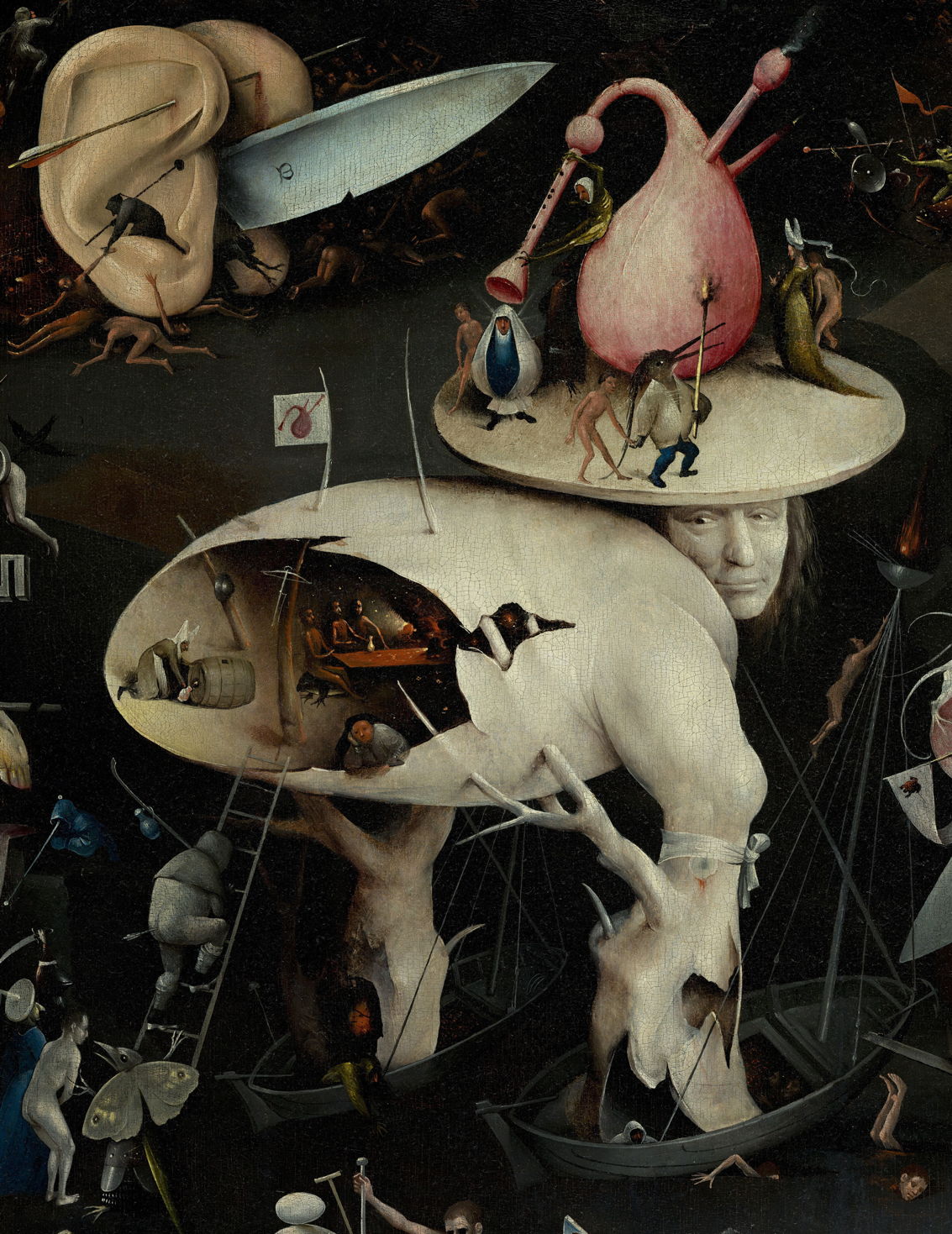
At its top, on a circular disc, is another strange portmanteau object, which looks to be a cross between bagpipes and an alchemical vessel from an alembic. Further back is a pair of severed ears between which is the blade of a knife.

The background appears apocalyptic. Large armies are on the move: cavalry cross a bridge, and other battalions of infantry fill the roads and fields. A yacht, its sail lit, heads across the water in front of a city. Tiny figures are silhouetted against the light from fires within the large buildings there, apparently engaged in its capture and destruction. Other bodies fall spreadeagle through the air as they leap from the tops of buildings. The moon, hidden behind cloud, casts rays lighting broken clouds and the thick palls of smoke rising from the ruins.
The right panel builds a vivid picture of the torment and destruction of Hell.
Owls
There are some repeated objects shown across the triptych, of which I will consider owls. Several of Bosch’s earlier paintings, even those with little or no fanciful content, have incorporated owls, implying that he used them as a form of graphical signature. This triptych follows the pattern.

There are four obvious and prominent owls shown in the triptych. The first appears in the porthole cut out from the base of the central fountain tower of the left panel.

Another giant owl appears at the left edge of the centre panel, being embraced by one of its figures.

The second owl in the centre panel is perched on top of a couple towards the right edge. It’s being tempted by the offer of fruit, but doesn’t appear interested.

The third owl in the centre panel is perched on the ‘horn’ of one of Bosch’s fanciful creatures in the procession of animals and riders.
Claims that Bosch’s owls are symbols of ignorance, false knowledge, or evil, lack support in his paintings. That one appears in the Garden of Eden, three in the garden of pleasure, and none in the garden of Hell, supports their association with more positive concepts rather than bad ones.
Synthesis
A plain grisaille painting starts the sequence off with its depiction of the creation, the perfect cover for an account in three images of the condition of mankind. We then see the first step in our history, when Adam and Eve were still secure in the Garden of Eden, surrounded by the wonders of God’s creation.
Some have suggested that the left panel, with its depiction of the emergence of animals from water, somehow hints at an evolutionary process. Viewed with a modern mind, this might appear attractive and imbue the painting with even greater meaning and magic. Half a millennium ago that would have been inconceivable: Bosch makes clear his literal belief in the Biblical account, throughout this and his other paintings. Without concepts of geological time or processes (key to the concept of evolution), such modern thinking is as alien as quantum physics.
After the Fall of Man and the expulsion from the Garden of Eden, men and women flourished and engaged in pleasures that were highly carnal and very earthly, detached from God, and outwith his commandments. These only too easily, through sins of gambling and lascivious activities associated with music, take humanity on the road to Hell, with its many torments and great suffering. Ultimately, the final panel may also refer specifically to Armageddon, the end of humanity and its world too.
Bosch takes us through this narrative with some of the richest imagery of any painting in the European canon. Its little scenes may be beautiful, puzzling, enticing, amusing, alarming, gruesome, but they are always fascinating, and the most elaborate conversation piece that you could want.
References
Falkenburg R (2011) The Land of Unlikeness: Hieronymus Bosch, The Garden of Earthly Delights, WBOOKS. ISBN 978 9 040 07767 8.
Fischer S (2013, 2016) Hieronymus Bosch, The Complete Works, Bibliotheca Universalis, Taschen. ISBN 978 3 8365 3850 3.
Matthijs Ilsink, Jos Koldeweij et al. (2016) pp 356-379 in Hieronymus Bosch, Painter and Draughtsman: Catalogue Raisonné, Yale UP and Mercatorfonds. ISBN 978 0 300 22014 8.
Schwartz G (2016) Jheronimus Bosch, The Road to Heaven and Hell, Overlook Duckworth. ISBNB 978 1 4683 1373 4.
 The Eclectic Light Company