
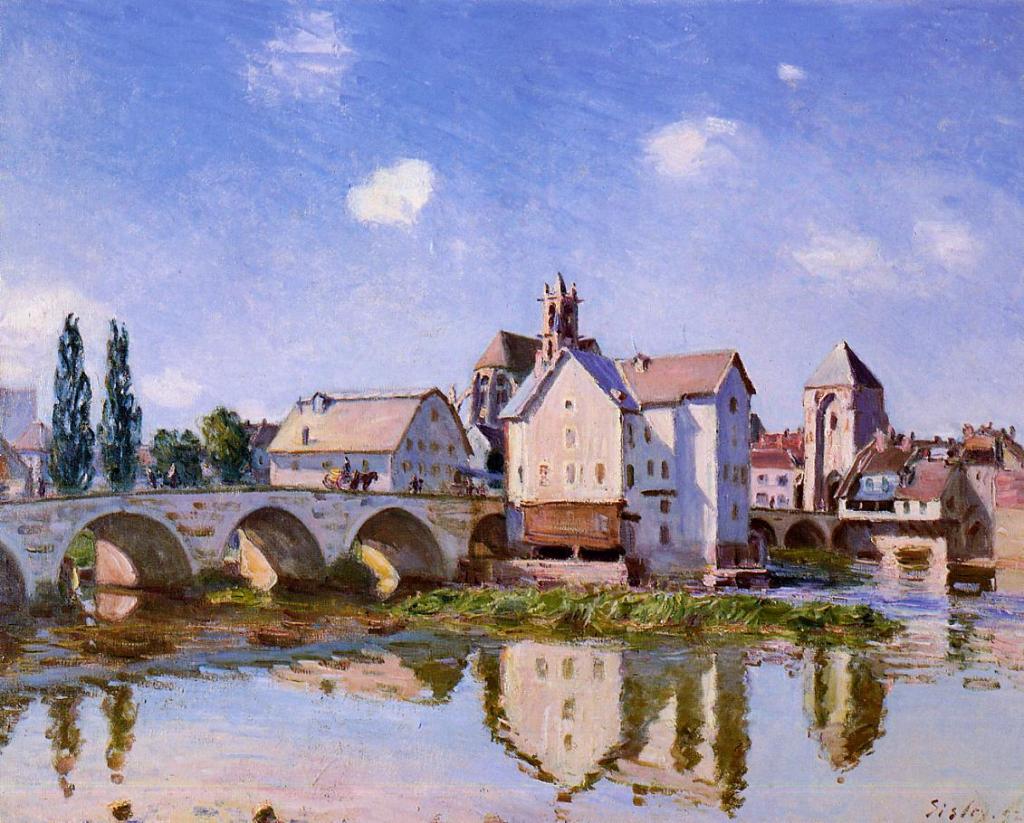
While artists from around the world had gathered in the colony at Grez-sur-Loing, little more than 12 km (7 miles) downstream, French Impressionism was flourishing at Moret-sur-Loing. Alfred Sisley and his family moved there in 1880, and this was to be the centre of his painting for most of the rest of his life. Their first house there was in Veneux-Nadon (now Veneux-Les Sablons), on the road to the village of By.
Moret had good rail connections with central Paris, although in 1881 Sisley wrote that the journey took two hours, sufficiently long for him to excuse himself from visiting the city. He lived there in quiet isolation with his family; a few visitors including Berthe Morisot and Stéphane Mallarmé made their way out to see him. But the nineteen years that he lived in or near Moret were highly productive, with a total of 550 oil paintings, several sketchbooks, and a few pastels.

Sisley experimented with his facture and style at this time. On the Hills of Moret in the Spring – Morning from 1880 looks down from one of those low hills towards the town. The brushwork in the foreground is composed of short strokes of near-white and colour, giving the hillside a distinctive texture.
By the end of 1881, the Sisley family had moved into the town of Moret. This was apparently financed in part by a loan from his dealer Durand-Ruel. About a year later, Sisley decided that the air in Moret didn’t suit him, or possibly he needed to keep on the move from his creditors, and the family moved to Les Sablons until 1886.

During Sisley’s time at Moret, he explored the banks of the rivers and canal, producing some of his best-known paintings. The Banks of the Loing towards Moret from 1883 is one his earlier riverside views, showing unusual combinations of reflections of tall trees, working craft and small industry, and distant chalk cliffs.

This view of The Loing Canal from 1884 is another fine example from near Saint-Mammès. This waterway runs parallel to the River Loing, connecting the Briare Canal to the River Seine, and is one of the series of waterways joining Paris to Lyon known as the Bourbonnais Route. These were constructed in the early eighteenth century, and still carry barges of grain from the farms in central France.
As with many of his waterside paintings, much of the canvas is occupied by the sky, which Sisley wrote that he always painted first so as to set the scene and mood for the whole painting.

Although Sisley, unlike Monet and Pissarro, painted few formal series, some of his motifs group together. The Canal du Loing, here seen in 1885, is in one of those groups. These typically have a low horizon, and reiterate his emphasis on the sky setting the mood and tone of his paintings. Below that, the water shimmers with the reflected buildings and relatively coarse brushstrokes rather than the more staccato style seen developing in Pissarro’s landscapes of this time.

Another group is exemplified by Moret – The Banks of the River Loing, probably painted in the autumn/fall of 1885, with its slightly coarser marks and strong colour contrasts. These bring the foreground closer, and push the background deep.

Sisley also recognised the visual potential of the town of Moret and its bridge, a motif that was to dominate his later work. The Bridge at Moret, Storm Effect from 1887 is an early plein air sketch capturing the approach of a storm, with the sky remaining bright for the moment, but the gathering wind already driving up small waves on the River Loing.

Sisley seems to have started another group showing the avenue of poplars at Moret-sur-Loing in 1888.

In 1892 he painted this barren winter landscape of The Canal du Loing at Moret, with its pale stand of poplars beating their rhythm across the canvas before curving into the distance.

In Moret Bridge in the Sunlight from the same year, Sisley settles on an angle of view over the town that was to prove his favourite, capturing the main spans of the bridge, the Porte de Bourgogne and the town’s Gothic church beyond.

Sisley’s most formal and conscious attempt at series painting is that of the Church at Moret-sur-Loing, a tight series with two branches consisting of fourteen paintings, completed in 1893-94, when Monet was reworking his Rouen series in the studio.

Sisley’s emphasis in this series is shown well in The Church at Moret, Evening, from 1894, and is quite different from Monet’s. As MaryAnne Stevens puts it, “Monet painted the air that lay between his eye and the façade”, while “Sisley focused on the physical mass of the structure, using different light conditions to accentuate his subject’s architectonic quality.”
Sisley remained in Moret, painting in poverty and isolation, until 1897, when he and his longstanding partner Eugénie visited South Wales and married at long last in Cardiff Town Hall. They arrived back in Moret-sur-Loing on 1 October 1897. On 8 October the following year, Eugénie Sisley died at Moret. By then, Alfred had developed his terminal illness, cancer of the throat, and was gravely ill himself. He died at Moret-sur-Loing on 29 January 1899, shortly before Asai Chū arrived in Grez-sur-Loing.
 The Eclectic Light Company