
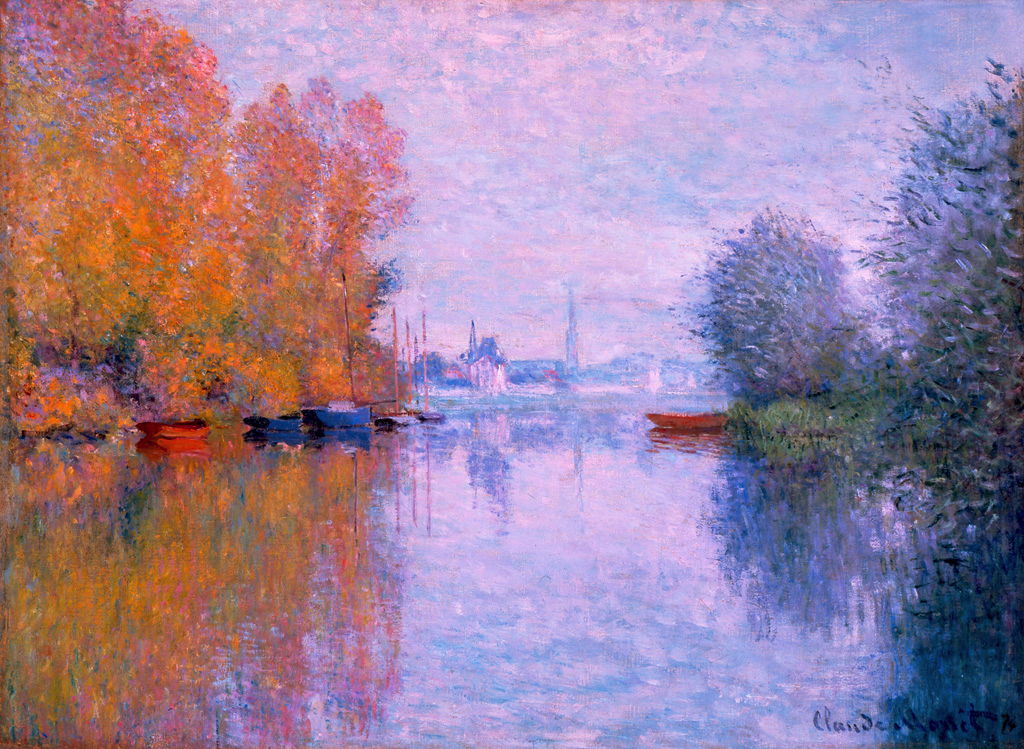
When the French Impressionists reassembled after the Franco-Prussian War and the Paris Commune, they gathered a little further up river from Louveciennes and Bougival, at the small town of Argenteuil on the north bank of the River Seine. At the time it was just on the outer edge of the north-western suburbs of the city, about 12 km (7.6 miles) from the centre, and was only fifteen minutes by train to the Gare Saint-Lazare in Paris. Claude Monet was able to commute into the metropolis, and the Sisleys moved in with the Monets in 1872. This weekend I show a small selection of the best-known paintings that were made in and around Argenteuil, and particularly at Chatou, down river.

Although Monet was barely making a living from his art at this time, he was among the few who could afford to use cadmium yellow, which has been found in his painting of The Artist’s House at Argenteuil from 1873.
This marked the start of a highly productive period for Alfred Sisley, and, in conjunction with Monet and Renoir, changed his art. The three concentrated their efforts on the recording of transient effects of light using colour, removing black from their palettes, and abandoning the traditional ‘finish’ of their paintings.

Sisley’s Footbridge at Argenteuil from 1872 is dominated by the perspective projection of the bridge itself, almost to the exclusion of the river below. His figures are gestural but look natural in their forms.
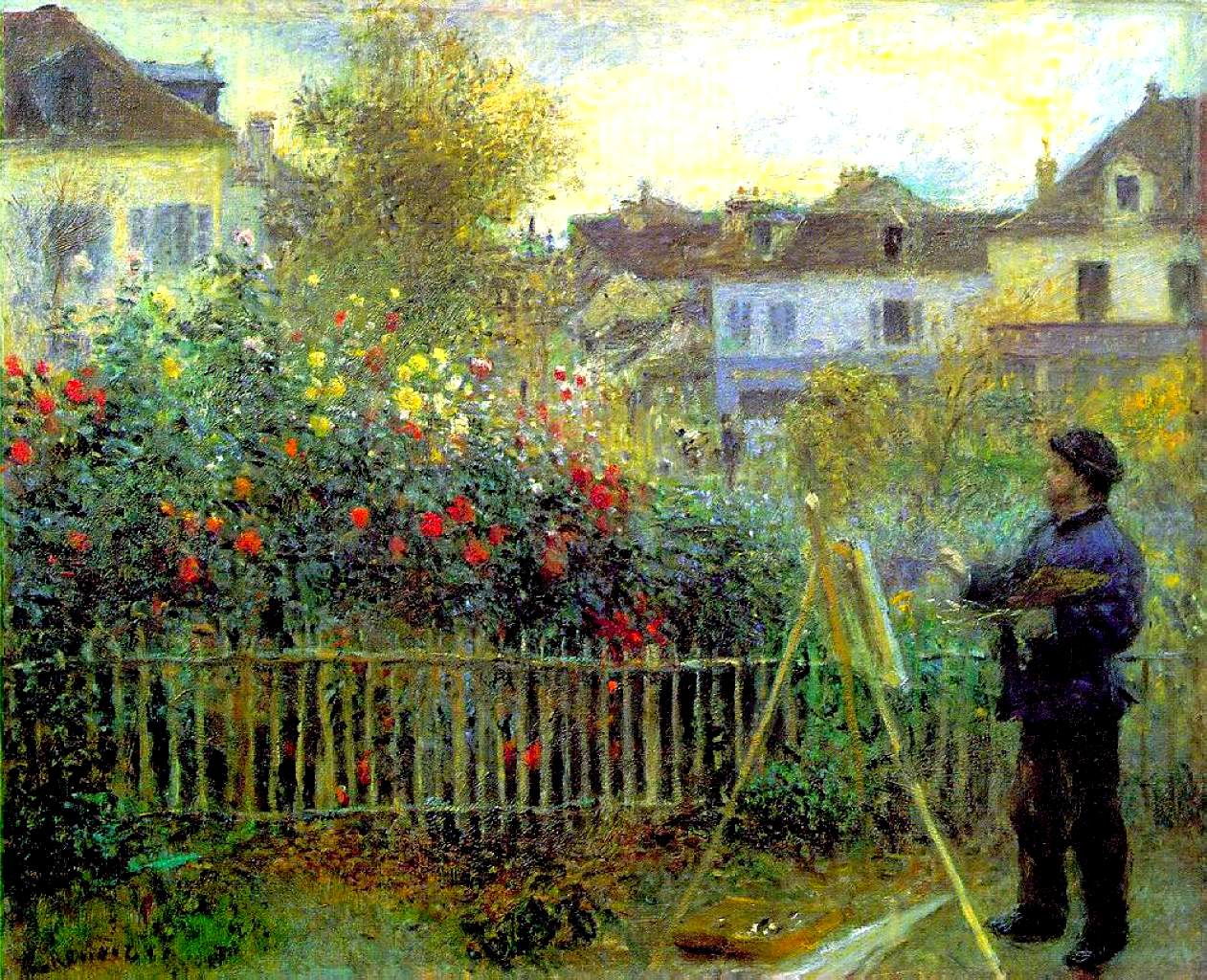
The Impressionists occasionally painted themselves at work, particularly during the earlier years of the movement. Above is Pierre-Auguste Renoir’s Monet Painting in his Garden in Argenteuil from 1873. He is using a conventional lightweight wooden easel, with a small canvas allowing him to work standing, with his oil paints in the pochade box under the easel.

Monet’s The Railway Bridge at Argenteuil (1873) is one of his several landscapes centred on the railway from the years immediately after the Franco-Prussian War. The following year, he painted the same bridge, as seen below in The Railway Bridge at Argenteuil (1874).


Monet’s commute ended at the Gare Saint-Lazare in Paris, where in 1877 he obtained permission to paint a series of works showing the station. By the third Impressionist Exhibition of April of that year, Monet had assembled seven views of the station, including one that even seemed to please the critics. Among the paintings from that campaign is his Arrival of the Normandy Train, Gare Saint-Lazare (1877).

One of the products of Renoir’s painting with Monet was this highly chromatic view of The Duck Pond (1873) at a farm near Argenteuil.

The following summer, Renoir visited Argenteuil again, to paint in the company of both Monet and Manet. The Seine at Chatou (1874) is one of his more vigorously crafted works, with a water surface similar to those being painted at the time by Sisley.

Monet’s masterwork Autumn on the Seine, Argenteuil from 1873 is a textbook example of a river landscape in autumn painted in high Impressionist style, with high chroma and loose brushstrokes.
 The Eclectic Light Company