
During the 1920s, in the last years of his career, Lovis Corinth’s paintings reached a new peak, both in their quantity and their innovative exploration of colour and texture.

Although Corinth was clearly relishing this intensity, his Large Self-portrait in Front of Walchensee (1924) shows his race against the effects of age.
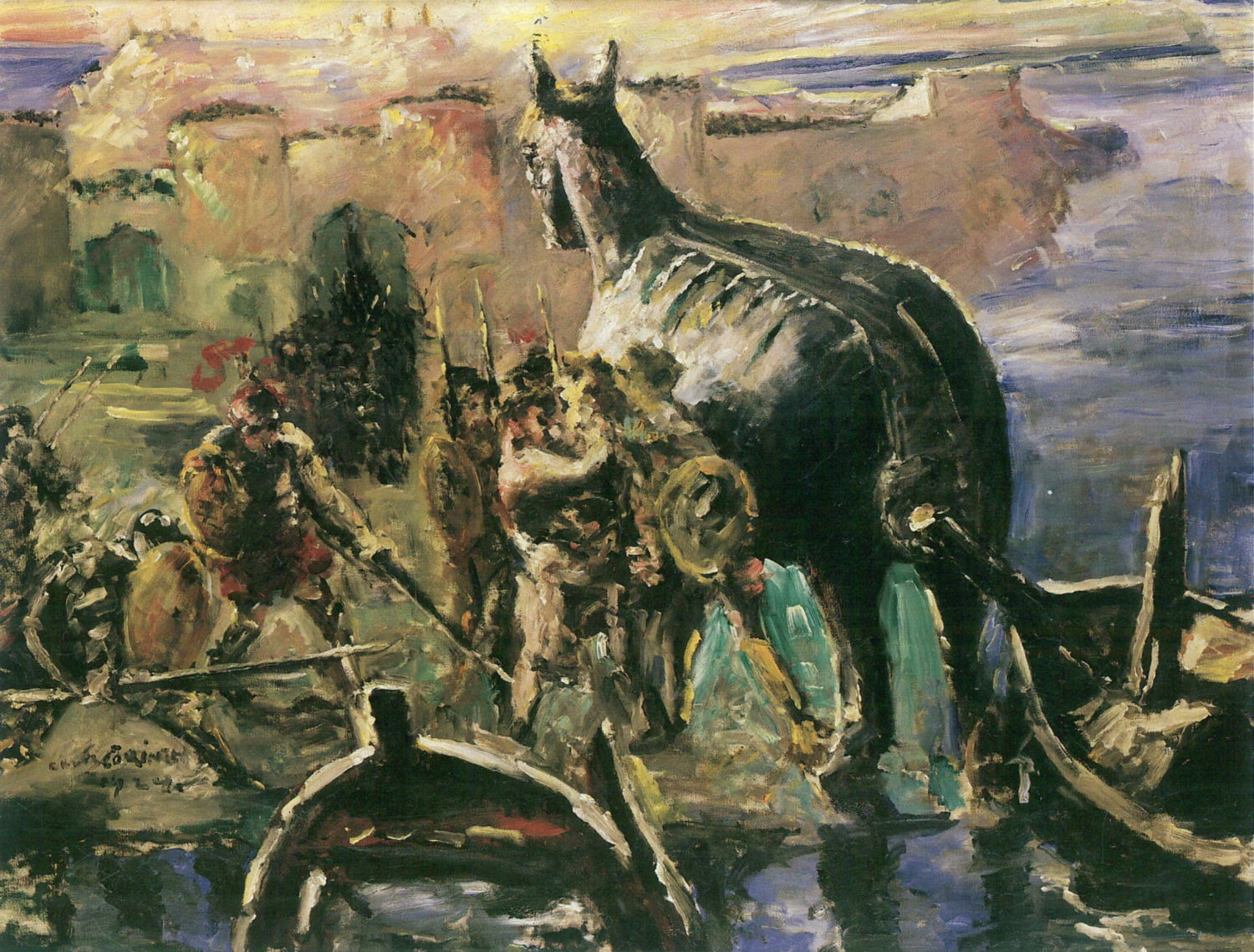
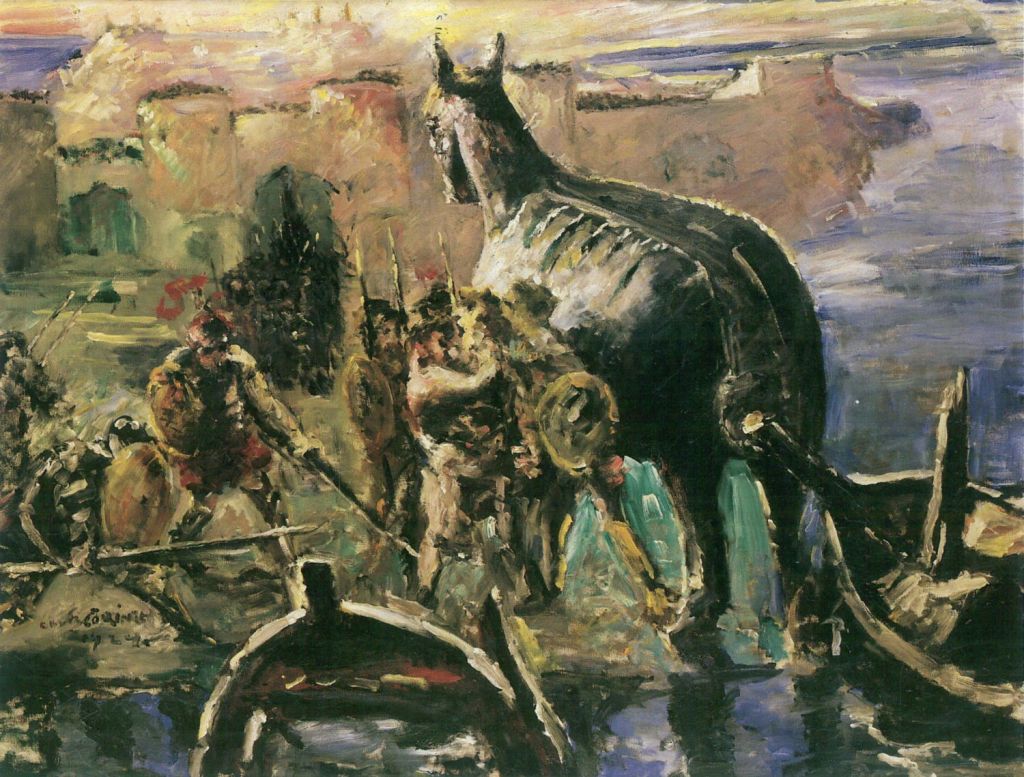
The Trojan Horse (1924) is Corinth’s last major painting from classical myth, showing the wooden horse made by the Greeks in order to gain access to the city of Troy, so they could sack and destroy it. The lofty towers and impregnable walls of the city are in the background. The select group of Greek soldiers who undertook this commando raid have already been concealed inside the horse, and those around it are probably Trojans, sent out from the city to check it out before it was taken inside.
Although there are suggestions as to an allegorical relationship between this painting and the First World War, Troy had been a hot topic in Berlin since the excavations at Hisarlık in Turkey in the late nineteenth century by Heinrich Schliemann and Wilhelm Dörpfeld.

Corinth also painted for fun: this superb depiction of a Königsberger Marzipantorte (Royal Marzipan Cake) (1924) must have been completed at great speed before his family consumed his model.

The Jochberg at Walchensee (1924) shows this 5,141 foot (1,567 metre) mountain dividing the Walchensee from the Kochelsee.

Walchensee, Vegetable Garden (1924) was painted away from his normal vantage point above the lake, to include the colours and textures of this vegetable patch.

Walchensee (1924) is a watercolour sketch reportedly painted on vellum.

Carmencita, Portrait of Charlotte Berend-Corinth in Spanish Dress (1924) probably doesn’t refer directly to the famous Spanish dancer Carmen Dauset Moreno, who had died in 1910. Charlotte Corinth, or Berend-Corinth, had continued painting in the early twentieth century, and joined the Berlin Secession in 1912. She also painted actively when at their chalet. In 1933, she emigrated to the USA, where she produced the first catalogue raisonné of her husband’s paintings. She died in 1967, so I am unable to show any of her paintings.

Corinth painted members of his family more often at this time, as he probably suspected he was reaching the end of his artistic career. In Wilhelmine in a Yellow Hat (1924) his shy daughter is starting to show some of her mother’s vivacity.

Thomas in Armour (1925) shows Corinth’s older child, then 21, wearing the suit of armour that had appeared in several of Corinth’s paintings over the years, in a visual record of his son’s transition into adult life.

Corinth painted Ecce Homo at Easter, 1925, as an act of meditation to mark the festival. It shows the moment that Pilate presents Christ to the hostile crowd, just before the Crucifixion. Christ has been scourged, bound, and crowned with thorns, and Pilate’s words are quoted from the Vulgate translation, meaning behold, the man. In keeping with his earlier contemporary interpretations of the scenes of the Passion, Pilate (left) is shown as an older man in a white coat, and the soldier (right) wears a suit of armour.
Corinth completed this in four days. This was bought for the Nationalgalerie in Berlin in 1929, but in 1937 was condemned by the Nazi party as being ‘degenerate art’. Thankfully, it escaped destruction when it was bought by the art museum in Basel in 1939.

The Beautiful Woman Imperia was one of the last paintings that Corinth completed in the late spring of 1925, and his final fleshly work. It’s based on Balzac’s anthology of tales Cent Contes Drolatiques from 1832-37. This shows the courtesan Imperia, naked in front of a priest, in surroundings suggesting contemporary decadent cabarets, or a far older ‘perfumed room’.

Corinth’s Last Self-Portrait, painted just two months before his death in 1925, is unusual in showing him with his reflection in a mirror. He is now balding rapidly, his cheeks sunken, and his eyes are bloodshot and tired. That summer he travelled to the Netherlands to view Old Masters, including Rembrandt and Frans Hals. He developed pneumonia, and died at Zandvoort on 17 July, four days before his sixty-eighth birthday.
He had painted more than a thousand works in oil, and hundreds of watercolours. He also made more than a thousand prints, an area of his work that I haven’t touched on. Ironically, it was the rise of the Nazi party from 1933 that prevented him from achieving the international recognition his work deserved.
References
Lemoine S et al. (2008) Lovis Corinth, Musée d’Orsay & RMN. ISBN 978 2 711 85400 4. (In French.)
Czymmek G et al. (2010) German Impressionist Landscape Painting, Liebermann-Corinth-Slevogt, Arnoldsche. ISBN 978 3 89790 321 0.

