
In the autumn of 1919, Lovis Corinth and his family had moved into their chalet at Urfeld, on the shore of Walchensee (Lake Walchen), to the south of Munich. From then until Corinth’s death, they divided their time between the bustle of Berlin and their garden of Eden by the lake and the mountains.

Corinth combined his new enthusiasm for painting floral arrangements with a gentle portrait of his eleven year-old daughter in Flowers and Daughter Wilhelmine (1920). The flowers shown are dominated by amaryllis, arums, and lilacs, and its composition reflects Wilhelmine’s shyness.

During the final six years of his life, Corinth must have painted more than sixty views around their chalet in Bavaria, of which I can only show a small selection. Like many others, Landscape at the Walchensee with Larch (1920) was painted from an observation point on a hill across from their chalet. This painting was bizarrely classified as being ‘degenerate art’ by the Nazis in 1937.

The local terrain produces some deceptive appearances, but many of Corinth’s late landscapes have marked tilting in their horizontals, and Walchensee by Moonlight (1920) even shows the same leftward lean in its verticals. This had been prominent in the earliest of his paintings in 1912, following his stroke. Here it probably reflects his shift of emphasis from form to areas of colour, particularly the impasto reflections of the moon on the lake’s still surface.
In 1921, Corinth was awarded an honorary doctorate and made a professor of arts by the University of Königsberg, where he had started his training.

Walchensee, Landscape with Cow (c 1921) is another view painted from his ‘pulpit’ vantage point across from the chalet.

Throughout his career, Corinth had made loose watercolour sketches, usually as preparatory studies for finished oil paintings. Now he started painting watercolour landscapes, such as his Walchensee, Evening Air (1921), capturing the colours of dusk.

Pink Clouds, Walchensee (1921) is another watercolour showing the rich colours of land and sky as the sun sets.
In 1922, his work led the German pavilion at the Venice Biennale, with a total of thirty of his paintings on display.

Red Christ (1922) is the last, most striking and original of all his many scenes of the Crucifixion. Although thoroughly modern in its approach and facture, he chose a traditional wood panel as its support, in keeping with older religious works. The red of Christ’s blood, spurting from the wound made by a spear, and oozing from his other cuts, is exaggerated by the red of the clouds and the sun’s rays.

Easter at Walchensee was painted from their chalet in 1922, as the winter snow was melting on the tops of the hills.

Corinth also painted some watercolours indoors. His Flower Vase on a Table (1922) has patches of pure, high-chroma colour for the flowers and the armchair at the right, and few suggestions of form.

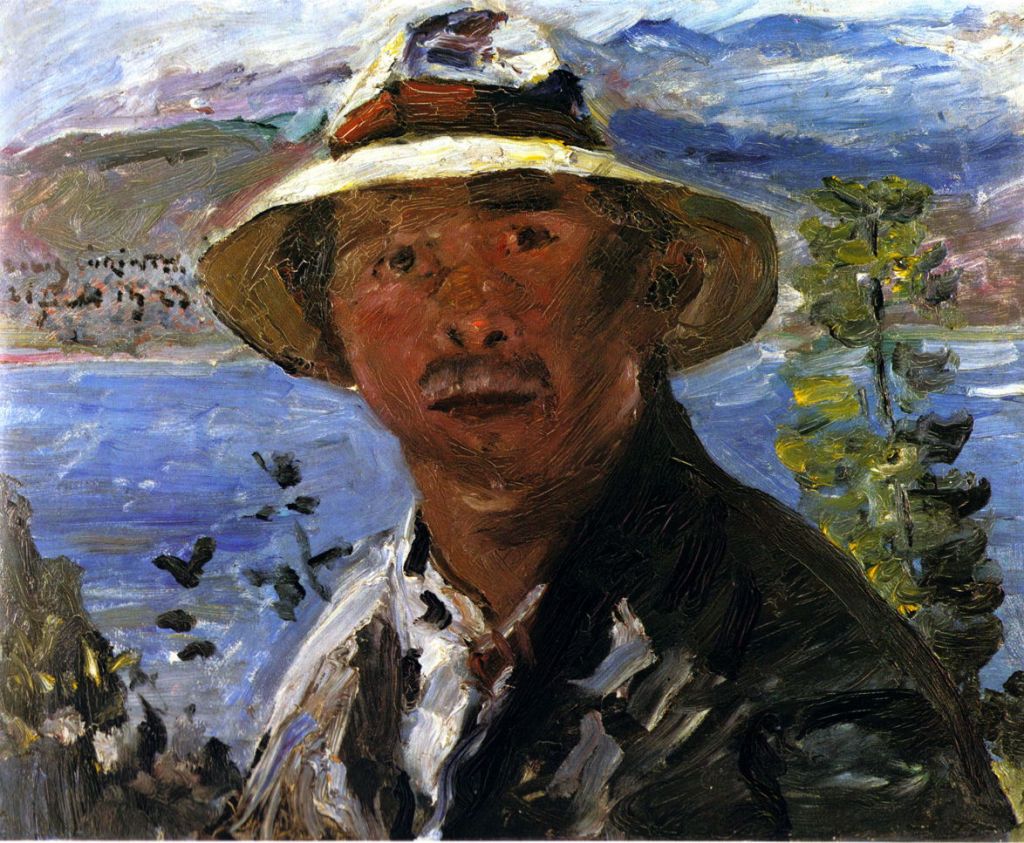
During this period of frenetic painting, Corinth appeared at first to flourish in the sunshine and fresh air. His Self-portrait in a Straw Hat from 1923 shows him looking in rude health.

Susanna and the Elders (1923) revisits the Old Testament story from the book of Daniel, which had brought him early success in 1890. The two versions he had painted then followed tradition, and show the naked Susanna being spied on by two elders, who then tried to blackmail her. Here he shows the three figures talking, as the elders put their proposition to Susanna.

Back in his ‘pulpit’ above the lake, Tree at Walchensee (1923) has the most rectilinear form of all his views of Walchensee, set by the horizontal snow-line and the trunk of the tree.

Walchensee in Winter (1923) is another evocative snowscape.

Chrysanthemums II (1923) is my favourite of his late floral works, as the texture of the paint matches the fine petals perfectly.
References
Lemoine S et al. (2008) Lovis Corinth, Musée d’Orsay & RMN. ISBN 978 2 711 85400 4. (In French.)
Czymmek G et al. (2010) German Impressionist Landscape Painting, Liebermann-Corinth-Slevogt, Arnoldsche. ISBN 978 3 89790 321 0.
 The Eclectic Light Company